 ProMapRanker
Best Retirement Investment Companies in 2026

Key takeaways
- Fidelity, Vanguard, and Schwab lead for low-cost IRAs, with $0 stock and ETF commissions and strong index funds.
- Vanguard and Schwab target-date index funds carry expense ratios near 0.08 percent, which keeps long-term costs low.
- Merrill Guided Investing suits Bank of America customers who want digital advice from $1,000.
- Edward Jones and Empower suit people who want a human adviser, at higher advisory fees that vary by balance.
Quick comparison
| Pick | Great for | Pricing starts at | Free tier | |
|---|---|---|---|---|
 Fidelity | low-cost IRAs for most savers | Free | Yes | Visit |
 Vanguard | low-cost index retirement investing | Free | Yes | Visit |
 Charles Schwab | IRAs with strong human support | Free | Yes | Visit |
 T. Rowe Price | actively managed retirement funds | See website | Yes | Visit |
 Empower | workplace plans plus personal advice | See website | Yes | Visit |
 Principal | workplace retirement plans and small business plans | See website | Yes | Visit |
 Edward Jones | in-person adviser relationships | See website | No | Visit |
 Merrill | digital advice linked to Bank of America | See website | Yes | Visit |
The best retirement investment companies
This is not financial advice. Fees and returns vary by fund, account, and market conditions, and investing carries a risk of loss. Compare fund expense ratios and advisory fees on each firm's own site before you open an account, since small annual differences add up over decades.
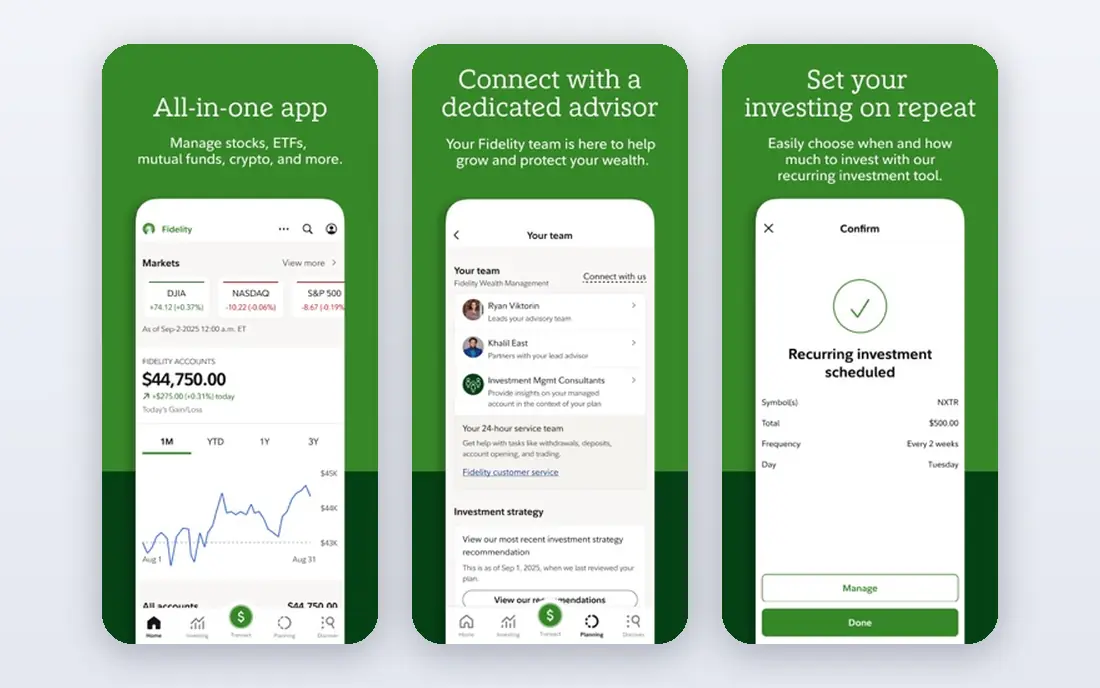
Fidelity is our pick for most retirement savers, because it combines $0 account fees, $0 stock and ETF commissions, and index funds with very low or zero expense ratios. Its Freedom Index target-date funds carry a 0.12 percent expense ratio with no minimum initial investment, which makes a single-fund retirement portfolio easy to start. Fidelity Go adds digital advice at $0 under $25,000 and 0.35 percent per year above that level.
The main drawback is choice overload. Thousands of funds, plus managed, self-directed, and advice options, can confuse a first-time saver. Start with one target-date index fund or a simple three-fund mix, and only add complexity when you have a clear reason.
- $0 account fee for standard brokerage and IRA accounts
- $0 stock and ETF commissions
- Zero-expense index funds
- Wide fund range can overwhelm beginners
- Advice fees apply on managed accounts
- Some services vary by account type
Vanguard built its name on low-cost index investing, and its retirement offering still reflects that focus. Target Retirement Funds are index fund-of-funds with an average expense ratio near 0.08 percent and a $1,000 minimum per fund, while Vanguard Digital Advisor manages portfolios for about 0.15 to 0.20 percent per year with a $100 minimum. That low-cost base is why Vanguard remains a default pick for long-term savers.
The interface is less modern than Fidelity or Schwab, and a $25 annual account service fee may apply unless waived through e-delivery. If you value low fund costs above app polish, and you plan to hold for decades, Vanguard is hard to fault.
- Target Retirement Funds with an average expense ratio near 0.08 percent
- Digital Advisor near 0.15 to 0.20 percent per year
- Strong buy-and-hold culture
- $25 annual account service fee unless waived with e-delivery
- Interface feels dated
- Some funds need a $3,000 minimum
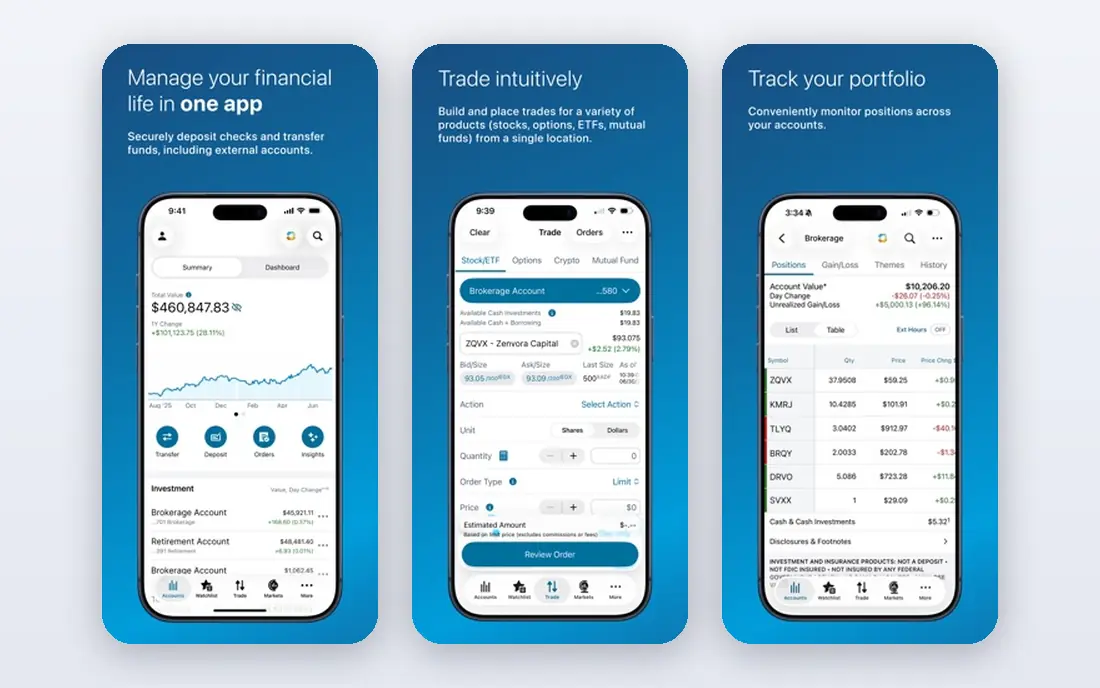
Schwab pairs low costs with the strongest in-person and phone support in this list. Standard brokerage and IRA accounts carry no annual maintenance fee and $0 stock and ETF commissions, while Schwab Target Index Funds carry a net expense ratio near 0.08 percent with no minimum initial investment. Schwab Intelligent Portfolios offers digital advice with no management fee and a $5,000 minimum, plus a Premium tier with adviser access for $30 per month.
A $50 full outbound transfer fee applies if you later move your account elsewhere, so factor that in if you switch firms often. For savers who want a branch to visit and a person to call, Schwab is the most balanced low-cost pick.
- $0 account fee and $0 stock and ETF commissions
- Target Index Funds near 0.08 percent
- Branches and phone support
- $50 fee for a full outbound account transfer
- Intelligent Portfolios needs a $5,000 minimum
- Cash allocation in robo portfolios draws debate
T. Rowe Price suits savers who prefer active management over index funds. Its Retirement Funds are actively managed target-date funds that start more aggressively than Vanguard's glide path and settle near 30 percent stocks after retirement. The 2050 fund Investor Class charges near 0.62 percent with a $1,000 minimum for IRAs, which is far above index rivals but reflects active stock and bond selection.
That fee gap matters over decades, so compare the active fund's long-term results with an index target-date fund before you pay it. If you believe active management adds value in retirement accounts, T. Rowe Price is the most established active pick here.
- Long history in retirement funds
- Retirement Funds with a clear glide path
- Adviser and brokerage accounts available
- Actively managed funds cost more than index rivals
- 2050 fund Investor Class near 0.62 percent
- Minimums of $1,000 for IRAs and $2,500 otherwise
Empower is best known as a recordkeeper for workplace 401(k) and similar plans, where many savers first meet it through an employer. Its personal advisory service adds human advisers and retirement income planning, with a fee near 0.89 percent per year and a $100,000 minimum. That human advice suits people nearing retirement who want help with withdrawals, Social Security timing, and tax-aware income.
The advisory fee is high next to digital rivals, and workplace plan fees vary by employer, so check your plan's fee disclosure. If your 401(k) is already at Empower, staying in one place for advice can be convenient, but compare the advisory fee with a digital option before you enroll.
- Large workplace retirement plan recordkeeper
- Personal advisory service with human advisers
- Planning tools for income in retirement
- Personal advisory fee near 0.89 percent per year
- $100,000 minimum for advisory service
- Fees vary by plan and balance
Principal serves many employers, especially small and mid-size businesses, with 401(k) and similar workplace plans. Its retirement offering covers target-date funds, managed accounts, and planning tools that help workers estimate income in retirement. For a business owner choosing a plan provider, Principal's small business focus and plan design support are practical strengths.
Retail savers who want a standalone IRA will find Fidelity, Vanguard, and Schwab offer broader fund choice and clearer retail pricing. Principal makes most sense when your workplace plan is already there, or when you run a business and need a plan for your team.
- Strong small business and workplace plan range
- Target-date and managed account options
- Retirement planning tools
- Pricing varies by employer plan
- Retail IRA features are thinner than Fidelity or Schwab
- Advice fees vary
Edward Jones suits savers who want a local adviser they can meet in person, rather than a website or app. Its Guided Solutions fee-based accounts start with a program fee near 1.35 percent on the first $250,000 plus a platform fee near 0.05 percent, with lower rates at higher balances, and minimums from $5,000 for fund accounts. Planning covers retirement, estate, education, and charitable goals in one relationship.
Those fees are the highest in this list for smaller accounts, and Edward Jones does not offer the same self-directed online trading setup as Fidelity, Schwab, or Merrill. If personal contact matters more than low cost, and you will use the planning service regularly, the fee may be worth it. If you rarely meet an adviser, a digital or low-cost IRA will save money.
- Local branch advisers
- Full financial planning including estate and education goals
- Guided Solutions portfolios
- Advisory fees start near 1.35 percent plus a platform fee near 0.05 percent
- Guided Solutions minimums from $5,000
- No self-directed online trading setup like rivals
Merrill, part of Bank of America, suits customers who want investing and banking in one place. Merrill Guided Investing offers digital portfolios from $1,000 for growth-focused strategies at a 0.45 percent annual program fee, while Guided Investing with Advisor costs 0.85 percent per year with a $20,000 minimum for growth strategies. Self-directed Merrill Edge accounts offer $0 online stock and ETF commissions with no minimum.
Bank integration is the real draw: linked accounts, preferred rewards tiers, and one login for banking and investing. Savers outside Bank of America may prefer Fidelity or Schwab for broader fund choice, but Merrill is a strong pick for existing bank customers who want guided retirement investing.
- Guided Investing from $1,000 for growth strategies
- 0.45 percent annual program fee
- Self-directed Merrill Edge with $0 online stock and ETF commissions
- Adviser tier costs 0.85 percent per year
- Income strategies need $50,000
- Adviser tier needs $20,000 for growth strategies
How we picked these
We compared official fee pages, fund expense ratios, account minimums, and advice offerings for firms that offer IRAs, workplace plans, or managed retirement accounts in the US in October 2026. We favored firms with clear fee disclosure, low-cost index options, and current retirement planning tools, and we noted where fees vary by balance or employer plan.
Choosing a retirement company without overpaying
Start with cost, since it is the one factor you control. Compare the expense ratio of the fund you will actually hold, not just the account fee, because a 0.08 percent index fund and a 0.62 percent active fund can differ by tens of thousands of dollars over a long career. Then compare any advisory fee separately, since advice is an extra service on top of fund costs.
Next, match the service to how much help you want. Self-directed savers do well with Fidelity, Vanguard, or Schwab and a target-date index fund. People who want digital advice at a low fee should compare Fidelity Go, Vanguard Digital Advisor, Schwab Intelligent Portfolios, and Merrill Guided Investing. People who want a human adviser should compare Empower, Edward Jones, and Merrill with Advisor, and ask for the full fee schedule in writing before signing.
Rollovers and workplace plans
If you change jobs, a rollover IRA at Fidelity, Schwab, or Vanguard usually costs nothing to open and gives wider fund choice than leaving money in an old plan. Keep the rollover direct, from plan to IRA, to avoid tax withholding problems, and check whether your old plan charges a transfer fee. For workplace plans, you cannot choose the provider, so focus on picking the lowest-cost fund inside the plan, usually an index or target-date index option.
Frequently asked questions
What is the best investment company for retirement?
Fidelity is our pick for most savers, with $0 account fees, $0 stock and ETF commissions, and low-cost index funds. Vanguard suits pure index investors, Schwab suits people who want branches and phone support, and Merrill suits Bank of America customers who want guided investing.
What is the best investment company for retirement accounts like IRAs?
Fidelity, Vanguard, and Schwab all offer strong IRAs with $0 stock and ETF commissions and low-cost target-date index funds. Compare the fund expense ratio and any advice fee, since those two numbers drive most of the long-term cost.
Are target-date funds a good retirement choice?
Target-date funds suit savers who want one fund that shifts from stocks to bonds as retirement nears. Index versions from Vanguard, Schwab, and Fidelity cost near 0.08 to 0.12 percent per year, while active versions like T. Rowe Price cost more, so check the expense ratio before you pick.
How much does retirement advice cost?
Digital advice ranges from $0 to about 0.45 percent per year, depending on the firm and balance, while human advice ranges from about 0.85 percent at Merrill with Advisor to near 0.89 percent at Empower and near 1.40 percent combined at Edward Jones for smaller accounts. Fees and returns vary, and this article is not financial advice.
Should I pick a company or a fund first?
Pick the fund strategy first, then the company that offers it at the lowest total cost. A low-cost target-date index fund at Fidelity, Vanguard, or Schwab is a sound starting point for most savers, and you can add advice later if your needs change.
Sources
- https://www.fidelity.com
- https://investor.vanguard.com
- https://www.schwab.com
- https://www.troweprice.com
- https://www.empower.com
- https://www.principal.com
- https://www.edwardjones.com
- https://www.merrilledge.com
- https://www.mymillennialguide.com/best-robo-advisors/
- https://www.finder.com/investments/best-target-date-funds
- https://www.merrilledge.com/m/pages/mobile/guided-investing-mobile.aspx
See where you really rank - block by block
ProMapRanker scans Google Maps across a grid of your service area. Simple monthly plans from $19, white-label on every plan.
Start freeKeep reading
 which software is best for pdf page removal
Which Software Is Best for PDF Page Removal in 2026
Find which software is best for pdf page removal, from free online tools to desktop editors, with page controls, privacy, safety, and pricing compared.
Read → when i work alternatives
Best When I Work Alternatives in 2026
Looking for when i work alternatives? We compare 8 scheduling apps for hourly teams, covering pricing, free plans, time clocks and the best fit for business.
Read → the best tool for keyword analysis
The Best Tool for Keyword Analysis in 2026
Find the best tool for keyword analysis with our 2026 comparison of 10 keyword analysis software tools on data depth, difficulty scores and price today.
Read →