 ProMapRanker
Best Reputation Management Software for Interior Designers in 2026

Reviews and referrals after project handover · Pricing starts at: See website
Direct answer
NiceJob is my top pick for interior designers because it is built around turning finished projects into reviews and referrals, which fits a business that runs on a small number of high-value clients. It offers a free trial, and pricing details are on its site. If you want a broader local marketing suite, Semrush Local fits; if you mainly need review requests and a review widget, GatherUp fits.
I compared these tools from vendor documentation and public sources, and I did not run hands-on tests. My focus was how each one fits the way interior design studios actually work: few clients, long projects, and a heavy reliance on word of mouth and visual portfolios.
Key takeaways
- Interior design work is referral-driven, so review software that requests feedback after project handover matters more than a tool built for high-volume retail.
- A designer's review profile usually needs Google first, then Houzz and Facebook, because clients often check Houzz before they call.
- Long project timelines mean you need scheduled review requests that can be sent weeks after the final walkthrough, not just at the moment of payment.
- Negative feedback on a large project should reach you privately first so you can respond before it becomes public.
- Software that also collects referrals and testimonials gives you more value than a tool that only chases star ratings.
Quick comparison
| Pick | Great for | Pricing starts at | Free tier | |
|---|---|---|---|---|
| NiceJob | Reviews and referrals after project handover | See website | Free trial | Visit |
 Semrush Local | Designers who want reviews plus local SEO | See website | No free plan | Visit |
 GatherUp | Straightforward review requests with private feedback | See website | Free trial | Visit |
 Whitespark | Citation cleanup with review tracking | See website | No free plan | Visit |
 Birdeye | Reviews plus client messaging in one inbox | See website | No free plan | Visit |
 Podium | Text-first communication and review requests | See website | No free plan | Visit |
 Grade.us | Agencies running reviews for designer clients | See website | Free trial | Visit |
The best reputation management software for interior designers compared
NiceJob is a reputation and referral platform aimed at local service businesses, and it maps well onto interior design because both rely on a small number of clients who can send more work your way. You add a client after the final install, and the tool handles the follow-up request for a review and, if you enable it, a referral.
For a designer, the useful part is timing. A kitchen or full-home project can run for months, so you can schedule the review request for a few days after the handover walkthrough rather than at deposit or invoice. You can point clients to Google first and add Houzz or Facebook as secondary destinations, and the private feedback option means a client who is unhappy about a delay reaches you before posting publicly.
The limits are practical. If you already have a CRM that sends follow-up emails, you may be paying for overlap. And if you only want a review widget on your site, this is more software than you need.
- Review requests tied to project completion
- referral and testimonial tools
- simple customer-facing pages
- Less useful if you never ask for referrals
- extras cost more
Semrush Local bundles listing management, review monitoring and local ranking visibility. For an interior designer who wants to know why a studio two suburbs over shows up before yours in the map pack, having reviews and local search data in one place saves switching between tools.
The review side lets you monitor incoming reviews across profiles, request new ones, and respond from a single inbox. That matters when your Google Business Profile, Houzz page and Facebook page all collect feedback and you do not want to check three tabs after every project.
Skip it if you only want review requests. The suite is broad, and a solo designer who will not use the keyword and listing tools is paying for features that sit idle.
- Review management inside a wider local toolkit
- listing management
- useful for tracking how your studio appears in local search
- Bigger learning curve
- priced for businesses that will use several features
GatherUp is a review collection and customer feedback tool. You import clients, send requests by email or SMS, and route anything below a chosen rating into a private feedback form so you can fix the problem first.
For interior design, that private routing is the strongest feature. A client who is annoyed about a delayed sofa delivery can tell you directly instead of leaving a three-star review that sits on your profile for years. You can also set up requests for different project stages, such as after the design presentation and again after installation.
It is a focused tool. If you want referral campaigns, social posting or a full local SEO suite, you will need something else alongside it.
- Simple request flows
- private feedback before public reviews
- works across multiple review sites
- Fewer marketing extras
- design feels dated to some users
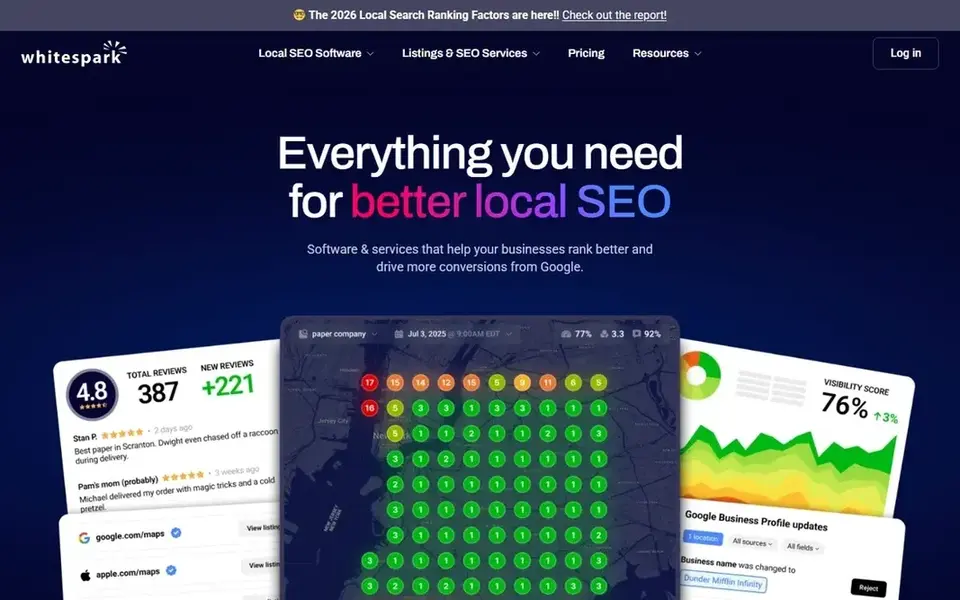
Whitespark is best known for citation building and local search tools, and it includes review monitoring and review link generation. That combination suits an interior designer whose studio name, address and phone number are inconsistent across directories, which quietly weakens local visibility.
The review link tool is handy: you generate a direct link to your Google review form and send it in your project wrap-up email without asking clients to search for you. Monitoring then shows new reviews in one place.
It is not the tool to buy if your main goal is automated review requests at scale. Think of it as the listing and citation layer that supports your reputation work.
- Strong citation and listing tools
- review monitoring
- good for fixing inconsistent studio details
- Not a dedicated review-request platform
- needs setup time
Birdeye is a reputation and customer experience platform used by local businesses with several locations or a steady flow of enquiries. It brings reviews, webchat, text messaging and listings into one dashboard.
An interior design studio with a showroom and a growing team can use it to answer enquiries from the website, send review requests after a project closes, and keep responses consistent. If you run consultations from a studio address and also work on site, having messages and reviews in one place reduces the chance a client enquiry gets missed.
The trade-off is scale. Pricing is quote-based, and a one-person studio that handles a handful of projects a year will not use most of it.
- Combines reviews, messaging and listings
- handles multiple locations
- reporting for owners
- Quote-based pricing
- more than a small studio needs
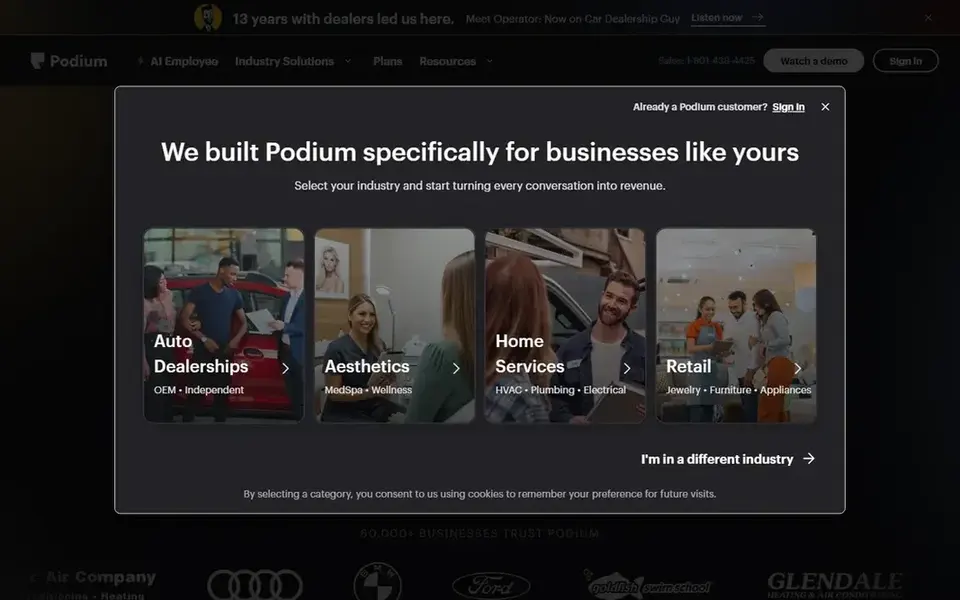
Podium is a messaging platform built around texting customers, with review invites and a review inbox included. It suits interior designers who already communicate with clients by text and want those conversations in a shared, trackable place rather than on a personal phone.
In practice, you can text a client after the final styling day with a short thank-you and a review link, and the reply lands in the same thread. For studios with a part-time assistant or a junior designer handling client updates, that shared inbox keeps everyone on the same page.
It is aimed at businesses with a reasonable volume of conversations. A designer who takes on a few large projects a year may find the cost hard to justify.
- Strong SMS messaging
- review invites by text
- payments and messaging add-ons
- Priced for higher-volume businesses
- less suited to very small studios
Grade.us is a review management platform with agency features, including white-label reporting and multi-client dashboards. It fits an SEO or marketing agency that manages reputation for several interior design studios rather than a single designer.
You build review campaigns per client, monitor reviews across Google, Facebook and industry sites, and send reports under your own brand. For a designer working with a marketing partner, it is often the agency that runs this tool on their behalf.
If you are a solo designer buying for yourself, the agency framing adds complexity you do not need. A simpler review-request tool will do the job.
- White-label options for agencies
- campaign builder
- review monitoring across sites
- Interface is plain
- smaller feature set than enterprise tools
How I chose
I started from the workflow of an interior design studio rather than from a generic feature list. Projects are long, clients are few, and the decision to hire usually follows a portfolio review and a check of reviews on Google and Houzz. So I looked for tools that can schedule a review request weeks after handover, route unhappy feedback privately, and handle more than one review site without extra manual work.
I read vendor documentation and public product pages for each tool and compared what they say they do. I did not run hands-on tests, and I have not included client results or statistics. Where a tool's pricing is not published, I have said so rather than guessing. I also left out tools whose main strength is high-volume retail review collection, because that is not how design studios operate.
What to check before you buy
- Confirm the tool can send a review request on a delay of several weeks, so it lands after the final walkthrough rather than at deposit.
- Check whether it supports Google, Houzz and Facebook, since design clients often check Houzz before they call.
- Ask whether low ratings can be routed to a private feedback form so you can resolve an issue before it goes public.
- Make sure you can send a direct Google review link in your own wrap-up email, not only through the tool's templates.
- Check how the tool handles a client who appears twice, for example a consultation that later becomes a full project.
- Confirm the contract length and cancellation terms before you commit, especially for quote-based plans.
Frequently asked questions
Do interior designers really need reputation management software?
Not strictly, but it helps. Design work comes from referrals and from clients who check your reviews before enquiring. Software makes it easier to ask every client at the right moment, keep requests consistent, and catch unhappy feedback privately before it becomes a public review.
Which review sites matter most for an interior designer?
Google is the first place most clients look, and Houzz is the one industry-specific site worth maintaining because clients use it to browse portfolios and reviews. Facebook still matters for referrals in many local markets. Start with those three and add others only if your clients use them.
When should I send the review request?
After the final walkthrough or install, once the client has lived with the result for a few days. Sending at deposit or mid-project catches people when they are stressed about timelines. A short delay also gives you a chance to fix snags before you ask for a public review.
Can I ask clients to leave a review on Google only?
You can ask for a review and point them to Google, but do not offer incentives or filter out clients you think will leave a low rating. Asking everyone and letting them choose where to post is the safer approach under Google's guidelines.
What if a client leaves a negative review about a delay?
Respond publicly, calmly and briefly, acknowledge the delay, and say what you did to resolve it. Then take the detail offline. Software that routes low ratings to private feedback helps you catch problems earlier, but it does not replace a clear response when a review is already live.
Sources
See where you really rank - block by block
ProMapRanker scans Google Maps across a grid of your service area. Simple monthly plans from $19, white-label on every plan.
Start freeBrowse all guides
← Best Reputation Management Software for Franchises in 2026Best Reputation Management Software for Pest Control in 2026 →
 best reputation management software for driving schools
Best Reputation Management Software for Driving Schools in 2026
A guide to the best reputation management software for driving schools in 2026, covering review requests, Google Business Profile replies and listings.
Read → best reputation management software for day spas
Best Reputation Management Software for Day Spas (2026)
A practical guide to the best reputation management software for day spas in 2026, compared from vendor documentation, with review requests, replies and listings.
Read → best reputation management software for computer repair shops
Best Reputation Management Software for Computer Repair Shops (2026)
A guide to the best reputation management software for computer repair shops in 2026, compared from vendor documentation and public sources.
Read → keyword difficulty local seo
How to Check Keyword Difficulty for Local SEO
How to check keyword difficulty for local search terms and pick winnable keywords for your business.
Read → geo grid scan frequency
How Often Should You Run a Geo-Grid Rank Scan?
How often to run geo-grid rank scans based on competition, budget, and campaign stage.
Read → local ranking phone call
Local Ranking Phone Call: A Complete Guide
Everything you need to know about local ranking phone call: what it is, why it matters for local SEO, and exactly how to act on it.
Read →More in Local SEO & Google Maps · All guides A to Z by date · Latest guides