 ProMapRanker
Best Reputation Management Software for Computer Repair Shops (2026)
Direct answer
Weave is my top pick for computer repair shops because it ties review requests to the phone calls and texts a repair bench already handles, so a customer who just picked up a laptop gets asked for feedback in the same thread. Pricing is quote-based, so check its pricing page. If you mainly want to fix your Google Business Profile listings, go with Whitespark; if you want review requests that follow a repair ticket to completion, look at NiceJob.
I compared these tools from vendor documentation and public sources, not from hands-on tests. I looked at how each one handles the moments a repair shop actually has: the intake call, the status update, the pickup, and the follow-up weeks later when a customer's machine is still working. I also checked how each tool handles Google Business Profile listings, since a review tool that ignores your hours and service list leaves half the job undone.
Key takeaways
- Computer repair shops live on phone calls and short counter visits, so review software that plugs into your phone system usually beats a standalone review tool.
- A repair ticket has a clear end point (the pickup), which makes it one of the easiest moments in local business to ask for a review without feeling pushy.
- Listing accuracy matters as much as reviews, because customers search "laptop repair near me" and compare your hours, address and service list across Google, Apple Maps and Bing.
- Keep every request inside Google's review policies: ask all customers, never filter by expected rating, and never offer anything in exchange for a review.
- Most tools here charge per location or per user, so price a single bench first and only add seats when you actually hire.
Quick comparison
| Pick | Great for | Pricing starts at | Free tier | |
|---|---|---|---|---|
 Weave | Phone, text and reviews in one system | See website | Not stated | Visit |
 Whitespark | Local listings and citation cleanup | See website | Not stated | Visit |
 NiceJob | Review requests after a completed repair | See website | Not stated | Visit |
 Semrush Local | Reviews plus local rank tracking | See website | No free plan | Visit |
 GatherUp | Catching feedback before it goes public | See website | Free trial | Visit |
 Broadly | Messaging and reviews for small service shops | See website | Not stated | Visit |
 Yext | Keeping many listings in sync | See website | Not stated | Visit |
The best reputation management software for computer repair shops compared

Weave is a communication platform for small service businesses, and computer repair shops fit its model well because so much of the job happens on the phone. A customer calls about a dead laptop, you book them in, you text when the part arrives, and you call when it is ready. Weave keeps those threads together and adds review requests on top, so the shop is not running a phone system and a review tool separately.
For reputation work, the useful part is the timing. You can send a review request by text after a repair is picked up, and because the customer already got status texts from the same number, the request does not look like spam. Missed calls can trigger an automatic text back, which matters for a shop where the bench technician cannot always reach the phone. That recovered conversation often turns into a repair and then a review.
The limit is that Weave is a bigger commitment than a review-only tool. Pricing is quote-based and depends on what you add, and moving your phone number over takes planning. If you only want review requests and already have a phone setup you like, a lighter tool is easier.
- Ties review requests to calls and texts
- keeps customer conversations in one inbox
- built for small service businesses
- Quote-based pricing
- setup takes planning
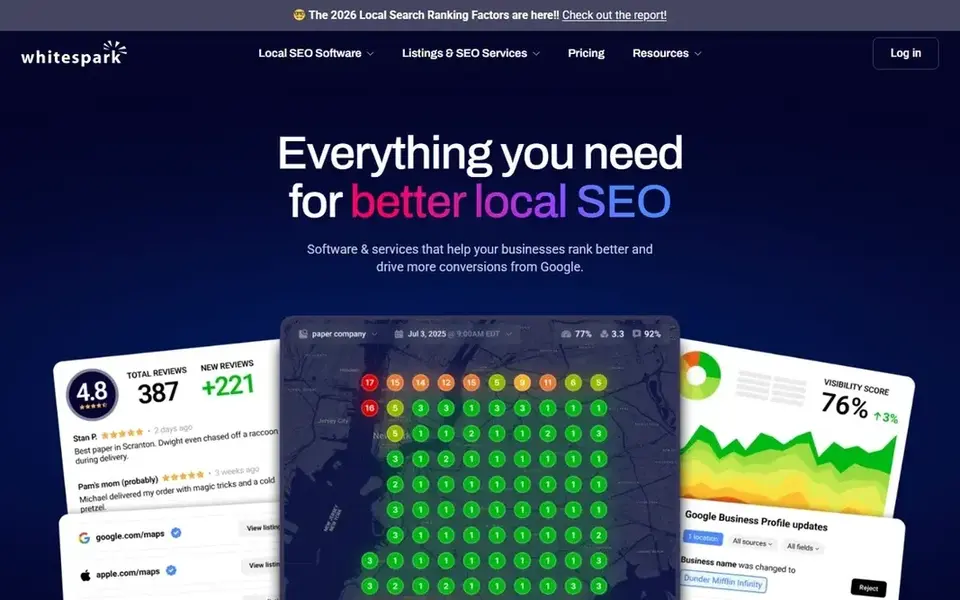
Whitespark is a local search toolset known for citation building and local ranking work. For a computer repair shop, its value is in making sure your name, address, phone number, hours and service categories match everywhere customers look: Google, Apple Maps, Bing, and the local directories people still check when they need a repair.
Reputation and listings are connected. If your Google profile says you close at 6 and a directory says 5, a customer who arrives at 5:30 leaves a one-star review about wasted time. Whitespark helps you find and fix those mismatches, and its citation tools let you build new listings on relevant local sites. It also gives you a structured way to review your Google Business Profile details.
What it does not do is run your review requests for you. There is no phone integration and no automated post-repair text. If your main problem is a thin review count rather than messy listings, pair Whitespark with a request tool or start elsewhere.
- Strong local citation tools
- clear Google Business Profile guidance
- good for fixing inconsistent listings
- Review requests are secondary
- not a full phone system
NiceJob is a review and reputation tool built around completed jobs. That maps neatly onto repair work: a ticket opens when the machine comes in, and it closes when the customer picks it up. At that point a request goes out by text or email, and NiceJob follows up if the customer does not respond.
For a repair shop, the practical benefit is that the ask happens at a natural high point. The customer has a working machine and a fresh memory of the counter conversation. NiceJob also gives you a place to catch unhappy feedback privately first, so a customer with a slow part order can tell you before writing a public review. That is a normal, allowed practice as long as you never filter who gets asked.
One limitation is discipline. If your team does not mark jobs complete, requests go out late or not at all. Shops that still run on paper tickets should fix that habit before buying.
- Simple request flow
- follows up automatically
- easy for a small counter team
- Depends on consistent job logging
- fewer phone features
Semrush Local bundles listing management and review tools with local rank tracking. For a repair shop owner who also wants to know whether the shop shows up for "phone screen repair" or "virus removal" in the local map results, that combination saves switching between tools.
The review side lets you monitor incoming reviews, reply from one place, and request new ones. Because it sits next to keyword and grid-style rank data, you can see whether a run of good reviews lines up with better map visibility. That is useful when you are deciding whether to spend the next month on reviews or on listings.
The downside is scale. Semrush is priced as a suite, there is no free plan, and a one-location repair bench will pay for features it may never open. It suits a shop that already does its own SEO or works with an agency.
- Review management alongside local rankings
- listing sync tools
- useful reporting
- Part of a larger paid suite
- more than a small shop needs at first
GatherUp is a review collection and customer feedback tool. Its main idea is a short private survey before the public ask: the customer rates the experience, and unhappy ones get routed to a private comment box while happy ones are pointed to Google. That is allowed as long as every customer is asked and nobody is steered away from leaving a public review.
For computer repair, this fits the awkward cases. A customer whose data recovery failed is not going to leave five stars, but a private message gives you a chance to explain and offer a next step. Meanwhile the customer with a clean Windows reinstall gets a simple path to Google.
GatherUp is not a phone system and does not manage listings deeply. It is a focused tool, and shops that want one login for calls, texts, listings and reviews will find it narrow.
- Private feedback step before public reviews
- simple request campaigns
- review monitoring
- Fewer phone and CRM features
- interface feels utilitarian
Broadly is a customer interaction tool for local service businesses that combines messaging, web chat and review requests. A repair shop gets a way to answer questions from its website before someone calls, then turn that conversation into a booked repair and later a review request.
The messaging angle matters for repair work because many first contacts are questions: "Do you fix water damage?" or "How long for a screen replacement?" Broadly lets you answer those in a chat window and keep the thread, which reduces phone tag at the bench. Review requests then go out by text after the job.
It is a managed product with quote-based pricing, so expect a sales conversation. Owners who like to configure everything themselves may find it less flexible than a self-serve review tool.
- Web chat and messaging alongside reviews
- built for local service businesses
- review requests by text
- Quote-based pricing
- less control for DIY owners
Yext is a listings management platform that pushes your business data to a large network of directories and maps services, and it includes review monitoring and response tools. For a computer repair shop, the appeal is consistency: one place to set your hours, services, phone number and holiday closures, then push those changes outward.
That consistency protects your reputation in a quiet way. A customer who finds the right hours on Google, Apple Maps and Bing is less likely to show up to a locked door and leave an angry review. Yext also lets you see incoming reviews alongside the listing data.
The trade-off is cost and fit. Yext is built for businesses that care about many listings and sometimes many locations, and a single repair bench may not get enough from it to justify the spend. Smaller shops usually do better with a review-first tool and a free Google Business Profile.
- Wide network of directory listings
- central control of business data
- review monitoring
- Can be costly for one location
- annual commitment style pricing
How I chose
I built this list from vendor documentation and public sources. I read each product's own pages on review requests, Google Business Profile integration, listing sync and messaging, then checked how those features map onto the way a computer repair shop actually works: a phone call, a ticket, a status update, a pickup, and a follow-up. I did not run hands-on tests, and I did not use client results or case studies to rank anything.
My filter was fit rather than feature count. A tool that sends a review request at pickup and keeps the customer conversation in one thread is more useful to a repair shop than a large suite with a dozen modules nobody opens. I also dropped anything that encouraged review gating, incentives or keyword-stuffed business names, because those practices break Google's rules and put the profile at risk. Where pricing was not public, I said so instead of guessing.
What to check before you buy
- Confirm the tool can send a review request by text, since repair customers often give a mobile number and rarely check email after pickup.
- Ask whether it connects to your point-of-sale or ticketing system, or whether your team has to mark jobs complete by hand.
- Check that review replies and monitoring cover Google Business Profile first, then Apple Maps and Facebook.
- Make sure the request flow asks every customer and never filters by expected rating, which would breach Google's review policies.
- Ask how listings are handled: whether the tool syncs hours, services and holiday closures, or only reviews.
- Get the total cost for one location and the number of users you actually need, including setup or onboarding fees.
Frequently asked questions
Do computer repair shops really need reputation software?
Not strictly, but it helps. A repair shop gets a steady flow of one-time customers who may never return, so each visit is a chance to earn a review. Software makes the ask consistent and gives you one place to reply. A shop with very low volume can start with manual requests and a well-kept Google Business Profile.
Which tool is best for a one-person repair bench?
Weave fits if your phone is your main channel and you want calls, texts and reviews together. If you want something simpler, NiceJob or GatherUp handle the request side without a phone system. Compare the monthly cost against how many reviews you expect to earn.
Can I ask customers to leave a review after a repair?
Yes, if you ask all customers, do not offer discounts or gifts in exchange, and do not screen out people you expect to leave negative feedback. Ask at pickup or by text afterward, keep the message short, and never write reviews on a customer's behalf.
How do I handle a bad review about a failed repair?
Reply publicly, stay factual, and say what you will do next. Then move the details to a private call or message. Do not argue about the diagnosis in public, and never ask the customer to remove the review in exchange for anything. A calm reply often matters more to future readers than the original complaint.
Does listing software help with reviews?
Indirectly, yes. Wrong hours, an old phone number or a missing service category sends customers to a closed door or a dead line, and that turns into a bad review. Tools like Whitespark, Semrush Local and Yext keep your details consistent, which removes one common source of complaints.
Sources
See where you really rank - block by block
ProMapRanker scans Google Maps across a grid of your service area. Simple monthly plans from $19, white-label on every plan.
Start freeBrowse all guides
← Best Reputation Management Software for Car Dealerships in 2026Best Reputation Management Software for Day Spas (2026) →
 best reputation management software for auto repair shops
Best Reputation Management Software for Auto Repair Shops (2026)
A practical guide to the best reputation management software for auto repair shops in 2026, covering review requests, replies, listings and tracking.
Read → best local seo tools for tattoo shops
Best Local SEO Tools for Tattoo Shops in 2026
A practical guide to the best local SEO tools for tattoo shops in 2026, covering Google Business Profile, reviews, citations and map rankings.
Read → best local seo tools for septic companies
Best Local SEO Tools for Septic Companies in 2026
A practical guide to the best local SEO tools for septic companies in 2026, covering listings, reviews, calls and Google Business Profile management.
Read → google business profile insights
Google Business Profile Insights Explained
A plain-English breakdown of every metric in Google Business Profile Insights and how to act on them.
Read → local seo for healthcare
Local SEO for Med Practices and Healthcare Clinics
Local SEO for healthcare clinics to attract local patients while staying compliant.
Read → local citation building services
Local Citation Building Services: A Complete Guide
Everything you need to know about local citation building services: what it is, why it matters for local SEO, and exactly how to act on it.
Read →More in Local SEO & Google Maps · All guides A to Z by date · Latest guides