 ProMapRanker
Best Local SEO Tools for Tattoo Shops in 2026

Citations and local rank tracking · Pricing starts at: See website
Direct answer
Whitespark is my first pick for tattoo shops because citation cleanup and local rank tracking are the two jobs that move a studio's map visibility, and it handles both without a heavy monthly suite. Pricing is quote-based, so check its pricing page. For review collection after each session, Grade.us fits well, and Local Viking suits artists who manage several shop locations or want steady Google Business Profile posting.
I compared these tools from vendor documentation and public sources rather than hands-on testing, so treat this as a fit guide. Tattoo shops have a specific shape: one or two studios, a steady flow of finished clients, strong visual appeal and a customer base that searches by neighbourhood. I weighted citation accuracy, review workflows, profile posting and map rank tracking for that shape.
Key takeaways
- Tattoo shops live and die on map pack visibility for searches like "tattoo shop near me", so local rank tracking matters more than broad keyword tools.
- Consistent name, address and phone data across directories is the foundation, and citation tools do that work faster than manual submissions.
- Review requests sent after a finished session convert better than generic email blasts, so pick a review tool with simple SMS and email flows.
- Google Business Profile posting and photo updates keep a studio visible between bookings, which is why profile management tools earn a place in the stack.
- No single tool covers citations, reviews and rankings well, so most shops end up with two or three small subscriptions rather than one large suite.
Quick comparison
| Pick | Great for | Pricing starts at | Free tier | |
|---|---|---|---|---|
| Whitespark | Citations and local rank tracking | See website | Not stated | Visit |
 Grade.us | Review requests after each session | See website | Free trial | Visit |
 Local Viking | Multi-location profile management | See website | Free trial | Visit |
 BrightLocal | All-in-one local reporting | See website | Free trial | Visit |
 Semrush Local | Shops already using Semrush | See website | No free plan | Visit |
 Yext | Large listing networks | See website | Not stated | Visit |
 NiceJob | Review and referral automation | See website | Free trial | Visit |
The best local SEO tools for tattoo shops compared
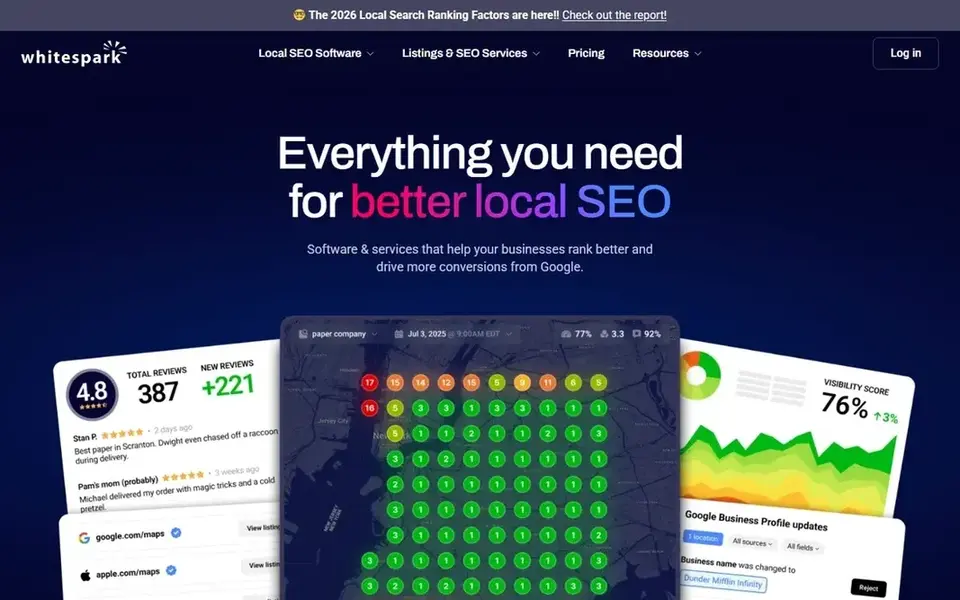
Whitespark is a local search toolset built around citations and local rankings. For a tattoo shop, the citation finder is the useful part: it shows which directories list competing studios in your city, so you can target the same ones instead of guessing. The local rank tracker follows your position for searches like "tattoo studio [neighbourhood]" across a grid of map points.
The workflow suits a shop owner who can spend an hour a week. You run a citation audit, fix mismatched addresses and phone numbers, then submit to the directories that matter locally. Rank tracking then shows whether those fixes moved your map position. It is not a review tool, so pair it with something else for post-session requests.
Skip it if you only want review collection or social posting. It is also more than a single-chair studio needs if you never plan to work on citations.
- Strong citation building and cleanup
- local rank tracker built for map results
- citation finder shows where competitors are listed
- No review request automation
- citation submissions take time to process
Grade.us is a review management platform aimed at agencies and multi-location businesses. For a tattoo shop, the practical use is a request sent by text or email a day or two after a session, when the client is still happy with fresh work and more likely to leave a review on Google.
You can set up a short request with a direct link to your Google review form, then track which clients responded. The tool also supports review monitoring, so you see new reviews in one place. Keep requests to actual clients and never offer incentives, which breaks Google's rules.
The limits are cost and complexity. A single-artist studio may find a simpler review tool cheaper, and shops that already get plenty of organic reviews may not need it at all.
- Simple review request flows
- supports multiple review sites
- agency-friendly reporting
- Pricing scales with features
- interface feels dated in places
Local Viking manages Google Business Profile listings and tracks local rankings on a map grid. A tattoo shop with two studios, or an artist running a shop plus a guest spot, gets a single dashboard for posts, photos and review replies across profiles.
The geo-grid tracker is the part I would use most. It shows where your studio ranks for "tattoo shop" searches across your city, which tells you whether you are visible in the neighbourhoods clients actually come from. Scheduled posts keep the profile active between bookings without daily effort.
The limit is scope. It does not fix citations on other directories, and a single-location shop may find its posting features enough on their own without paying for more.
- Google Business Profile posting and scheduling
- geo-grid rank tracking
- review monitoring in one dashboard
- Focused on Google rather than other directories
- best value at multiple locations
BrightLocal bundles citation building, local rank tracking, review monitoring and reporting. For a tattoo shop that wants one login instead of three, it covers the basics: audit your listings, fix the wrong ones, track map positions and watch reviews.
The reporting is the differentiator. If you ever want to show a business partner or landlord how the studio performs in local search, the reports are readable without explanation. Citation submissions are handled by the tool's team, which saves the manual directory work.
The trade-off is breadth. You pay for modules you may not use, and a shop that only needs citations will find Whitespark more focused. It is a reasonable starting point if you are unsure what you need.
- Citation building and audit in one place
- review and rank tracking included
- clean client-style reports
- Feature set is broad for a small shop
- some modules need higher tiers
Semrush Local adds listing management and review tracking to the main Semrush platform. A tattoo shop that already uses Semrush for keyword research or competitor checks gets local listing tools in the same place, which avoids another login and another invoice.
The listing sync keeps your name, address and phone consistent across directories, and review tracking shows new feedback next to your other data. For a shop owner learning SEO, having keyword data and local data side by side is genuinely useful when planning content about styles or aftercare.
The limit is the subscription. If you do not use Semrush for anything else, the local add-on is expensive for what a small studio needs, and a dedicated citation tool is cheaper.
- Listing management alongside keyword research
- review tracking
- fits an existing Semrush subscription
- Requires a Semrush plan
- overkill for shops with no other SEO work
Yext pushes your business data to a large network of directories and apps from one dashboard. For a tattoo shop with several locations or a franchise plan, that central control is the appeal: update hours or a new address once and it flows outward.
The trade-off is the model. Yext manages listings on its own network, and listings can revert when you stop paying, which matters for a shop that wants permanent citation data. Setup also takes more effort than a simple citation submission tool.
Most single-location studios should skip it. It makes sense for a growing brand with multiple shops and someone to manage the account.
- Wide publisher network
- central control of listing data
- good for multi-location brands
- Quote-based pricing
- data reverts if you leave the platform
NiceJob automates review requests and referral campaigns for small local businesses. A tattoo shop can send a request after each session, collect reviews on Google and other sites, and run a simple referral prompt for clients who bring friends.
The workflow is built for owners who do not want a dashboard. You import clients, set a request timing, and the tool handles the rest. Referral campaigns are a bonus for shops that rely on word of mouth, which most tattoo studios do.
The limit is scope. It does not manage citations or track map rankings, so it sits alongside a citation tool rather than replacing one. Shops with very few clients per week may find manual requests just as effective.
- Automated review requests
- referral and repeat-customer campaigns
- simple setup for small teams
- Not a citation tool
- automation needs a clean client list
How I chose
I built this list from vendor documentation and public sources, not from hands-on testing. I read each tool's feature pages, help docs and public descriptions, then matched them to how a tattoo shop actually operates: one or two locations, a visual portfolio, clients who search by neighbourhood and reviews that arrive after a finished piece.
I weighted four things. Citation accuracy came first because wrong address data undermines everything else. Review workflows came second, since post-session requests are the main review engine for studios. Profile posting and map rank tracking came next, then price fit for a small business. I left out tools that only make sense for large brands or that need a dedicated SEO team to run.
What to check before you buy
- Confirm the tool syncs with Google Business Profile, since that is where most tattoo shop searches end.
- Check whether citation submissions are done for you or left as a manual to-do list.
- Make sure review requests can be sent by text, because email open rates are lower for younger clients.
- Ask whether you can track rankings across a map grid rather than one city-wide position.
- Check the contract length and what happens to your listing data if you cancel.
- Confirm the tool follows Google's review policies and does not offer incentives or review gating.
Frequently asked questions
Do tattoo shops need local SEO tools at all?
Yes, if you want to show up in the map pack for searches like "tattoo shop near me". Most bookings start with a local search, and the map results are driven by your Google Business Profile, citations and reviews. Tools make those three jobs faster, but a shop can do the basics manually if it has the time.
Which tool should a single-artist studio start with?
Start with a citation tool such as Whitespark to get your name, address and phone consistent, then add a simple review request flow. A single studio rarely needs a full suite. Get the profile right, collect reviews from real clients and post new work regularly before paying for more software.
How do I get more Google reviews for my tattoo shop?
Ask clients after a finished session, when they are happiest with the work. Send a short text with a direct link to your Google review form. Never offer discounts or gifts for reviews, and never filter out unhappy clients, because both break Google's rules and can cost you the reviews you have.
Can I use these tools for multiple shop locations?
Yes. Local Viking, Yext and BrightLocal all handle multiple locations, and Semrush Local works if you already use the main platform. For two or three studios, Local Viking is the simplest fit. For a larger group, Yext or BrightLocal give more central control over listing data.
Do I need a separate tool for Instagram and Google posts?
Not necessarily. Local Viking and BrightLocal both support Google Business Profile posting, which is the part that affects local search. Instagram is a separate channel and its posts do not feed map rankings directly, though a steady portfolio there supports the same reputation work.
Sources
See where you really rank - block by block
ProMapRanker scans Google Maps across a grid of your service area. Simple monthly plans from $19, white-label on every plan.
Start freeBrowse all guides
← Best Local SEO Tools for Septic Companies in 2026Best Reputation Management Software for Auto Repair Shops (2026) →
 best local seo tools for preschools
Best Local SEO Tools for Preschools in 2026
A practical guide to the best local SEO tools for preschools in 2026, covering Google Business Profile, reviews, citations and local rank tracking.
Read → best local seo tools for podiatrists
Best Local SEO Tools for Podiatrists in 2026
A practical guide to the best local SEO tools for podiatrists in 2026, covering Google Business Profile, reviews, citations and call tracking.
Read → best local seo tools for jewelry stores
Best Local SEO Tools for Jewelry Stores in 2026
A practical guide to the best local SEO tools for jewelry stores in 2026, covering listings, reviews, maps tracking and call tracking for shops.
Read → how to get into google 3 pack
How to Get Into the Google 3-Pack (Local Pack) in Competitive Markets
Want into the coveted Google 3-pack? Learn what separates the top 3 from everyone else and how to break in.
Read → how to rank in the map pack
How to Rank in the Google Map Pack (Local 3-Pack): The Complete 2026 Guide
Learn how to rank in the map pack in 2026 with a proven, step-by-step playbook covering GBP optimization, reviews, citations, and geo-grid tracking.
Read → local seo for martial arts studios
Local SEO for Martial Arts Studios
A local SEO guide for martial arts studios: Google Business Profile setup, reviews, and youth-program-focused local search visibility.
Read →More in Local SEO & Google Maps · All guides A to Z by date · Latest guides