 ProMapRanker
Best Remote Patient Monitoring Companies in 2026

Key takeaways
- The best remote patient monitoring software for a small practice is often a managed service, while large systems may need deeper EHR and device integration.
- Device choice matters as much as software, since cellular devices suit patients without home Wi-Fi and Bluetooth devices suit patients who are comfortable with a phone app.
- Billing support, alert triage, and patient outreach separate full-service vendors from software-only tools.
- Software alone does not make a practice HIPAA compliant, since compliance also depends on policies, access controls, training, and how staff handle patient data.
Quick comparison
| Pick | Great for | Pricing starts at | Free tier | |
|---|---|---|---|---|
 HealthArc | Small and mid-size practices | See website | No | Visit |
 Optimize Health | Managed RPM services | See website | No | Visit |
 HealthSnap | Patient engagement | See website | No | Visit |
 CareSimple | Simple setup for older patients | See website | No | Visit |
 ThoroughCare | Care management plus RPM | See website | No | Visit |
 Prevounce | Turnkey RPM and billing help | See website | No | Visit |
 ChronicCareIQ | Chronic care programs | See website | No | Visit |
 Tenovi | Device infrastructure | See website | No | Visit |
 Validic | Health system data integration | See website | No | Visit |
The best remote patient monitoring companies
We compared RPM platforms on devices, workflow, billing support, EHR links, and service model. This guide covers software and services for clinicians and practice teams, not a substitute for medical advice, and practices should confirm billing rules and privacy duties with their own advisers.
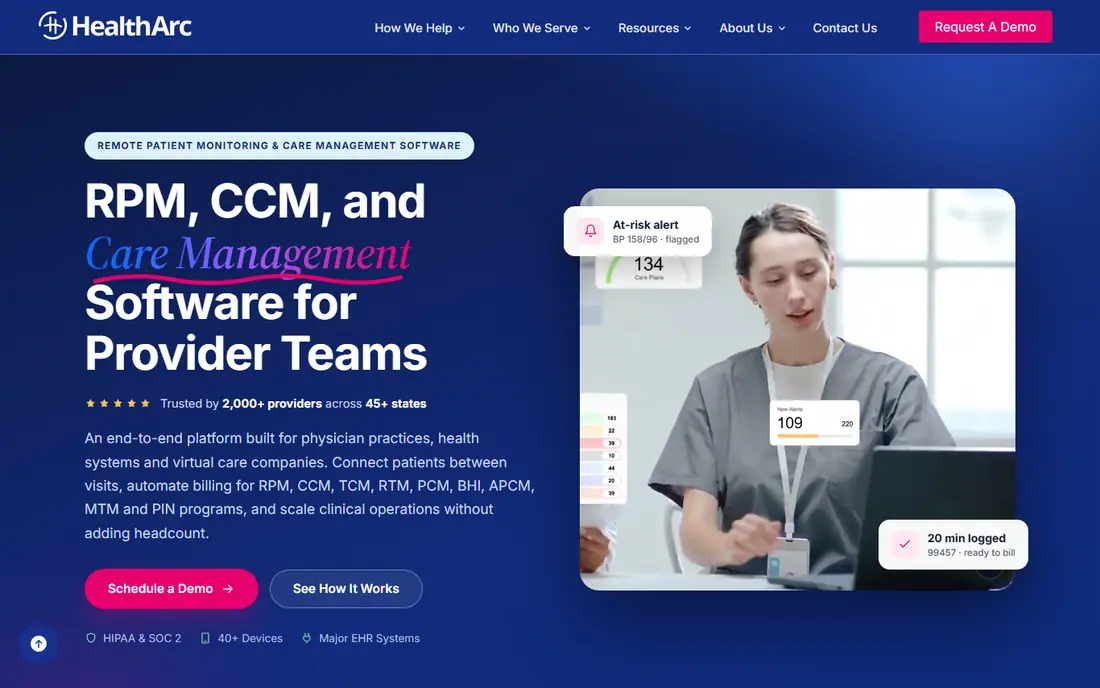
HealthArc suits practices that want RPM and chronic care management handled in one workflow. Its site describes devices, a patient app, alerts, and billing support, plus a managed option where its team handles outreach and calls. That breadth helps a small practice that lacks spare staff hours for monthly patient contact.
The catch is cost clarity. Per-patient pricing depends on service level, device type, and volume, so a demo and a written quote matter more than a headline figure. Practices should also confirm which EHR links are live for their system, not just listed as possible.
- RPM plus care management in one platform
- Device options
- Billing support described on its site
- Pricing is not a simple public list
- Practices need a demo to confirm total monthly cost
Optimize Health appeals to practices that want someone else to run the daily RPM work. Its model is described as a managed service, with patient outreach, monitoring, and billing support handled so clinic staff can focus on care. That can be a strong fit when enrollment stalls because no one has time for monthly calls.
The trade-off is control and cost. A managed service means vendor staff contact your patients, so escalation rules, message tone, and response times need clear agreement. Practices should also confirm what happens when a patient needs urgent follow-up outside vendor hours.
- Managed service model
- Patient outreach handled by vendor staff
- Automation for workflows
- Managed services can cost more than software-only tools
- Practices give up some day-to-day control
HealthSnap is a good shortlist pick for practices where patient adherence is the main problem. Its site describes a patient app, reminders, and care coordination alongside RPM and chronic care billing workflows. A clear app and simple device pairing can help patients who are willing but easily lost by complex setup.
Still, no app fixes low engagement on its own. Practices should ask about enrollment rates, reminder options, and support for patients who do not use smartphones well. A vendor demo with a real patient flow, from enrollment to first reading, reveals more than a feature list.
- Patient-friendly app experience
- RPM plus chronic care workflows
- Care coordination tools
- Engagement tools help only if patients actually use them
- Pricing requires a quote
CareSimple fits practices serving older patients or patients with limited tech comfort. Its approach centers on simple setup, shipped devices, and ordering linked to the EHR, which reduces the number of steps a patient must complete alone. That simplicity can raise the share of patients who send readings regularly.
The limit is customization. Large systems with complex workflows may need more configuration than CareSimple offers out of the box. Smaller practices, by contrast, may find that simplicity is the point, and they should confirm device types and support hours before they enroll a large panel.
- Simple device setup
- Direct shipping
- EHR-connected ordering described on its site
- Less suited to highly custom enterprise workflows
- Service scope varies by program
ThoroughCare suits practices that want one platform for several Medicare care programs, not just RPM. Its site describes RPM, chronic care, transitional care, and remote therapeutic monitoring, plus care planning, analytics, messaging, and automated billing codes. That breadth can reduce duplicate tools across programs.
Breadth also adds setup work. Practices should map their current workflows first, then ask which ThoroughCare modules replace real tasks and which add steps. A phased rollout, starting with one condition group, often works better than turning on every module at once.
- RPM plus chronic, transitional, and remote therapeutic workflows
- Broad device links
- Billing tools
- Breadth can mean a longer setup
- Practices should confirm which workflows they will actually use
Prevounce appeals to practices that want a turnkey service rather than a tool to staff themselves. Its site describes RPM, chronic care, annual wellness, and related programs, plus eligibility checks, device shipment, and billing code generation. Cellular devices also help patients without reliable home Wi-Fi.
Buyers should still confirm the staffing model in plain terms. Ask who calls patients, who reviews alerts, how escalations reach the practice, and what response time the vendor commits to. Those answers matter more than a list of program names.
- Managed services focus
- Eligibility checks
- Billing code support
- Cellular devices
- Pricing model needs a detailed quote
- Service fit depends on staffing model and escalation rules
ChronicCareIQ fits providers building structured chronic care programs around remote readings. Its platform is described as a cloud tool that helps providers connect with patients, track readings, and build care management programs. That focus suits practices that already know which conditions they want to monitor first.
The honest catch is verification. Practices should ask for current device options, EHR integration status, alert handling, and support hours, and they should test enrollment with a small patient group. A pilot of a few dozen patients gives a clearer picture than a sales call alone.
- Cloud RPM platform
- Care program building
- Patient connection tools for providers
- Smaller public profile than some rivals
- Practices should verify current EHR links and device range
Tenovi suits organizations that need device infrastructure rather than a ready-made clinical service. Its site describes cellular RPM devices, fulfillment, connectivity, and data aggregation, which can support vendors and programs that already have clinical staff. Cellular transmission also removes Wi-Fi setup for many patients.
Tenovi is not a direct replacement for a full RPM program in the same way as a managed vendor. Practices without triage staff, billing support, or outreach capacity will need those pieces from elsewhere. Confirm data flow, device types, and support terms before building a program around Tenovi alone.
- Cellular devices
- Fulfillment and connectivity
- Data aggregation for RPM programs
- More infrastructure than a full clinical program
- Practices may still need staffing and billing help
Validic fits health systems and value-based care organizations that want patient-generated data flowing into clinical systems. Its platform is described as EHR-integrated, with a broad device ecosystem for remote data. That infrastructure view helps systems that already run care teams and want cleaner data, not another standalone dashboard.
Smaller practices should be cautious. Validic may require more internal staffing and workflow work than a managed RPM vendor. Ask how data appears in your EHR, how alerts are routed, and what support covers device issues versus clinical triage.
- EHR-integrated patient data
- Broad device ecosystem
- Value-based care focus
- More infrastructure-oriented than turnkey
- Smaller practices may need added clinical staffing
How we picked these
We compared official vendor pages, RPM program descriptions, and public comparisons for device type, workflow, billing support, EHR links, and service model. We did not claim hands-on testing, and we did not invent prices, since most vendors price by patient volume and service level. We kept only vendors with a current RPM offering for US practices in October 2026.
How to choose the best RPM software for your practice
Start with staffing, not software. If your team lacks hours for monthly patient contact, a managed service will likely work better than a software-only tool, even if the monthly fee looks higher. If you have care managers ready, a platform with strong EHR links and alert tools may be enough.
Next, test the patient path. Enroll a test patient, pair a device, send a reading, and follow an alert to its resolution. Check cellular versus Bluetooth options, support for patients without smartphones, and language options. Then confirm billing workflows, including documentation, time tracking, and code support, with your billing team before a large rollout.
Finally, confirm privacy and security duties in writing. Ask about access controls, audit logs, data handling, and breach procedures, and train staff on those duties. Software alone does not make a practice HIPAA compliant, and a vendor claim about compliance does not replace your own policies and safeguards.
Frequently asked questions
What is the best remote patient monitoring company for a small practice?
A managed service such as HealthArc or Optimize Health often fits small practices, since vendor staff can handle outreach and monthly contact. Software-only tools can work if your team has care manager hours free. Compare total monthly cost, not just software fees, before you decide.
What is the best RPM software for patient engagement?
HealthSnap is often cited for a patient-friendly app and engagement tools, while CareSimple suits patients who need simple setup. Engagement still depends on enrollment support, reminders, and help for patients who struggle with devices. Test the patient flow before you commit to a large panel.
How does remote patient monitoring billing work?
RPM billing usually involves device setup, monthly data transmission, and treatment management time, with rules set by Medicare and other payers. Vendors often help with documentation and code generation, but practices remain responsible for accurate billing. Confirm current payer rules with your billing team or adviser.
Does RPM software make my practice HIPAA compliant?
No. Software alone does not make a practice HIPAA compliant. Compliance also depends on policies, staff training, access controls, risk review, and how patient data is handled day to day. Ask vendors about safeguards, but keep your own privacy program in place.
Do patients need Wi-Fi for remote patient monitoring?
Not always. Cellular devices can transmit readings without home Wi-Fi, which helps patients in areas with poor broadband or limited tech comfort. Bluetooth devices usually need a phone app and a connection. Ask each vendor which device types fit your patient panel.
What is the difference between RPM and chronic care management?
RPM tracks physiologic data from devices between visits, while chronic care management covers broader care coordination for patients with chronic conditions. Many vendors offer both in one platform, and the same patient may qualify for both programs in some cases. Confirm eligibility and documentation rules before billing both.
Sources
- https://www.healtharc.io
- https://www.optimizehealth.com
- https://www.healthsnap.com
- https://www.caresimple.com
- https://www.thoroughcare.com
- https://www.prevounce.com
- https://www.chroniccareiq.com
- https://www.tenovi.com
- https://www.validic.com
- https://www.healtharc.io/blogs/top-11-remote-patient-monitoring-companies/
See where you really rank - block by block
ProMapRanker scans Google Maps across a grid of your service area. Simple monthly plans from $19, white-label on every plan.
Start freeKeep reading
 wpforms alternatives
Best WPForms Alternatives in 2026
We compare 9 wpforms alternatives for WordPress forms, with free and paid options, current pricing notes, and honest limits for small business sites in 2026.
Read → windows task scheduler alternatives
Best Windows Task Scheduler Alternatives in 2026
Looking for Windows Task Scheduler alternatives? We compare 9 schedulers for Windows and cross-platform work, from free tools to enterprise automation.
Read → which ai video service is best
Which AI Video Service Is Best in 2026
which ai video service is best? We compare 10 legitimate AI video services on price, avatars, editing and output quality to help you pick the right tool.
Read →