 ProMapRanker
Best Pre Settlement Funding Companies in 2026


Larger personal injury cases · Pricing starts at: See website
Key takeaways
- Pre-settlement funding is usually non-recourse, which means you repay from settlement proceeds and owe nothing if you lose, but you must confirm that term in writing.
- Rates and fees vary widely and are often not published, so always ask for a written payoff table at several future dates before you sign.
- Oasis Financial, USClaims, and Peachtree suit larger or more complex cases, while High Rise and LawCash cover a broad range of personal injury cases.
- You normally need an attorney and a pending case, and your attorney must cooperate with the funder during review.
- Compare at least two offers, and talk to your attorney first, because funding costs can reduce your final settlement by a large amount over time.
Quick comparison
| Pick | Great for | Pricing starts at | Free tier | |
|---|---|---|---|---|
| Oasis Financial | Larger personal injury cases | See website | No | Visit |
 USClaims | High-value and complex cases | See website | No | Visit |
 Peachtree Financial Solutions | Structured settlements and injury cases | See website | No | Visit |
 LawCash | Long track record | See website | No | Visit |
 High Rise Financial | Fast funding decisions | See website | No | Visit |
 Tribeca Lawsuit Loans | Cases other funders decline | See website | No | Visit |
 Nova Legal Funding | Broad personal injury funding | See website | No | Visit |
 Ally Lawsuit Loans | Small to mid-size advances | See website | No | Visit |
The best pre settlement funding companies
This is not financial advice or legal advice. Rates, fees, and terms vary by company, case, and state, and you should read the full contract with your attorney before you accept any advance. Pre-settlement funding is not a traditional loan in most cases. It is an advance against a future settlement, repaid from settlement proceeds, and the cost grows the longer your case takes.
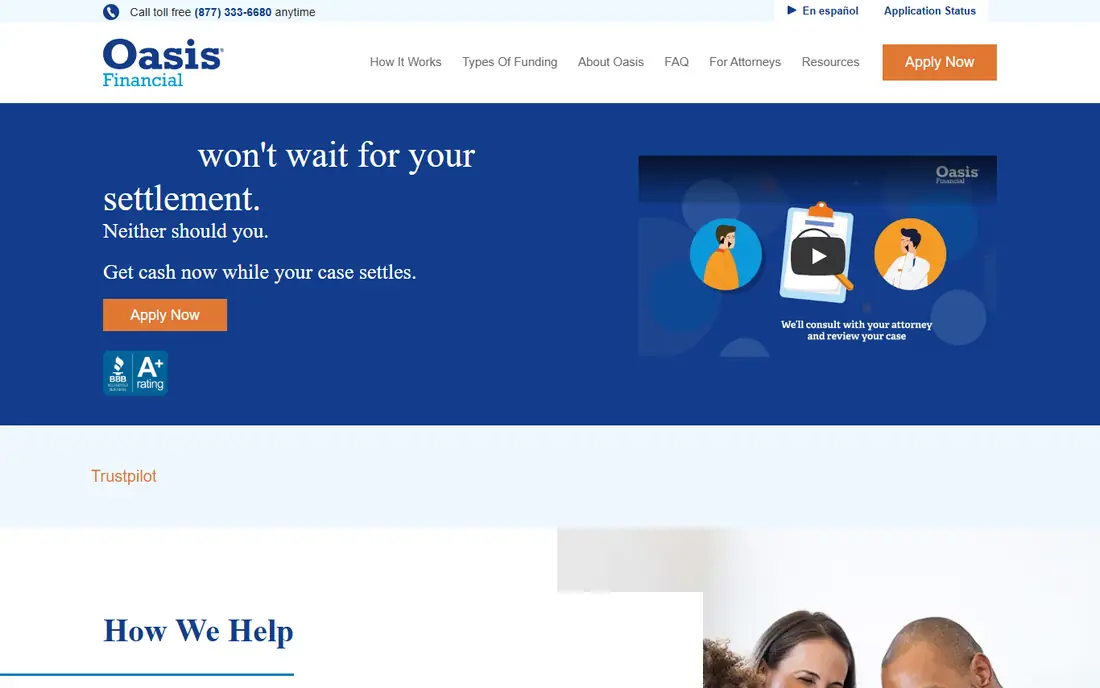
Oasis Financial is one of the best-known names in pre-settlement funding, with a history going back to 2003 and a large client base across the United States. It funds personal injury cases for plaintiffs who have an attorney, and it states that funding is non-recourse, so you do not repay if your case is lost. That structure is the key protection to confirm in your own contract.
The main drawback is pricing transparency. Oasis does not publish a full rate card, so you will only see your exact cost after review, and fees can compound over time. Ask for a payoff table showing what you would owe at 12, 24, and 36 months, and compare that table with at least one other funder before you sign.
- Long operating history
- Broad personal injury coverage
- No credit check for approval in most cases
- Rates and fees are not published in full before review
- Funding availability varies by state
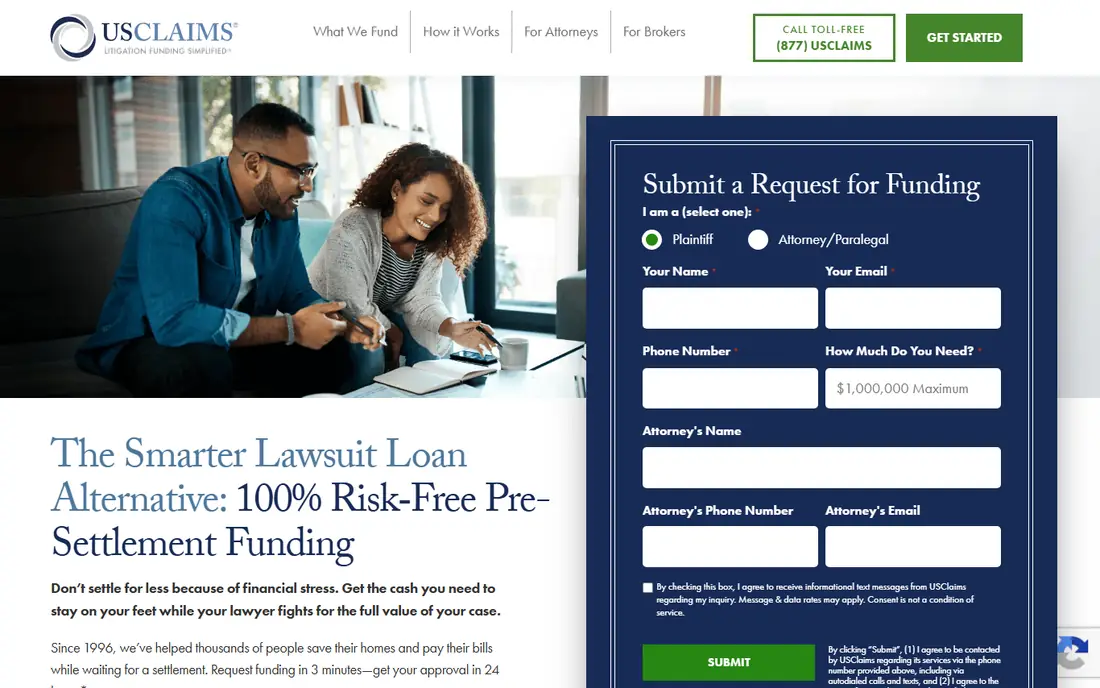
USClaims, founded in 1996, is often named for higher-value and more complex personal injury cases. Its review process works through your attorney and focuses on case merits, liability, and expected settlement value rather than your credit score. That approach suits plaintiffs whose cases are strong but slow, and who need funds to cover living costs while the case continues.
As with other funders here, the exact rate depends on your case, and you should not accept an offer based on speed alone. Ask how fees are calculated, whether they compound monthly, and what the total repayment would be if your case takes another year. A clear payoff table matters more than a fast approval when the case may run for a long time.
- Experience with larger and complex cases
- Broad case coverage
- Attorney-led review process
- Rates are case-specific and not published
- Larger cases can still carry high total costs over time
Peachtree Financial Solutions
Great for: Structured settlements and injury cases
Peachtree Financial Solutions is widely known for structured settlements, and it also funds pre-settlement personal injury cases. That dual experience can help plaintiffs who hold a structured settlement and plaintiffs waiting on a pending injury case, though the two products work differently and need separate advice. Your attorney should review which product, if any, fits your situation.
Pricing is again case-specific, and structured settlement transactions in particular need close legal review, because you are dealing with future payments, not just a short-term advance. Ask for the full cost in writing, check state rules that may apply, and do not rush a decision because a payment is due soon.
- Known for structured settlement work
- Broad personal injury coverage
- Established national company
- Pricing varies by case and is not fully published
- Structured settlement deals need careful legal review
LawCash claims the longest track record in this list, having operated since 1994, and it funds a broad range of personal injury case types across the country. Longevity is a useful signal in an industry where new firms appear and disappear, and LawCash funding is structured as non-recourse, so repayment comes from settlement proceeds.
The trade-off is speed. LawCash reviews can take longer than the fastest funders, which matters if you face an urgent bill. Rates are also case-specific, so the same advice applies. Get the payoff table, confirm the non-recourse term, and let your attorney check for any fees beyond the stated rate before you accept.
- Operating since 1994
- Broad nationwide case coverage
- Non-recourse funding model
- Decision speed can be slower than some rivals
- Rates are not published in full upfront
High Rise Financial is often picked for speed, with same-day funding possible once your attorney has provided the needed documents. It funds a broad range of personal injury cases, starting from smaller advances, and it presents its funding as non-recourse. For plaintiffs facing rent, medical bills, or car costs while a case drags on, that speed can be the deciding factor.
Speed should not replace comparison. A fast offer with a high monthly rate can cost more over a long case than a slower offer with a lower rate. Ask for the payoff table at several dates, confirm whether fees compound, and check the total cost against your expected settlement before you take the money.
- Known for same-day or fast funding in many cases
- Broad personal injury coverage
- Clear non-recourse model
- Fast funding does not mean low cost
- Rates vary by case and need a written payoff check
Tribeca Lawsuit Loans is known for considering cases that other funders decline, which can help plaintiffs whose cases are newer, smaller, or harder to assess. It funds a range of case types and uses a non-recourse model, so repayment depends on a successful settlement or award.
The caution here is cost. Cases that carry more risk for a funder often carry higher rates for the plaintiff, so a Tribeca offer needs the same careful review as any other. Ask for the full payoff schedule, check for caps on total repayment if the funder offers one, and talk to your attorney about whether waiting, borrowing elsewhere, or taking a smaller advance would leave you better off.
- Known for approving cases other funders turn down
- Broad case types
- Non-recourse structure
- Higher-risk cases may carry higher costs
- Terms must be checked closely with your attorney
Nova Legal Funding covers a broad set of personal injury cases and works through your attorney during review, which is the standard model for this industry. Its advances are structured as non-recourse, so you repay from settlement proceeds rather than from your own pocket if the case fails. That model suits plaintiffs who need help with living costs during a pending case.
As with the other funders, the key step is to see the cost in writing over time. Ask for a payoff table, confirm the fee calculation method, and check whether your state has rules that affect funding terms. A smaller advance that covers only urgent bills is often safer than a large advance that eats into your final settlement.
- Broad personal injury case coverage
- Attorney-coordinated review
- Non-recourse advances
- Rates and fees are case-specific
- Availability and terms vary by state
Ally Lawsuit Loans suits plaintiffs who need a smaller advance rather than a large sum. It funds personal injury cases through an attorney-led review, and its advances are non-recourse, so a lost case does not leave you owing repayment from your own funds. That structure helps when the need is a specific bill, not a long period of support.
Even a small advance needs a payoff check, because fees compound over time and a case that runs for two years can turn a modest advance into a much larger repayment. Take only what you need for urgent costs, ask for the payoff table, and compare Ally with at least one other funder before you sign.
- Covers smaller advances
- Broad personal injury cases
- Non-recourse funding model
- Rates vary by case
- Smaller advances still carry costs that grow over time
How we picked these
We compared funder websites, case coverage, funding models, and independent roundups, and we kept only companies that are still active in October 2026, fund pre-settlement personal injury cases, and use a non-recourse model. We did not rank on published rates, because most funders do not publish full rates, and any list that claimed exact rates for all of them would be guessing. Instead, we weighed track record, case range, funding speed, state availability, and clarity about the non-recourse term.
What to check before you accept an advance
Start with your attorney, not with a funder website. Your attorney knows your case value, timeline, and risks, and can tell you whether an advance is wise at all. In many cases, the best move is to wait, negotiate a payment plan for a bill, or take a much smaller advance than the funder offers.
Next, demand the payoff table in writing. Ask what you would owe if your case settles in 6, 12, 24, and 36 months, whether fees compound monthly, and whether there is a cap on total repayment. If a funder will not give you that table, or pressures you to sign quickly, walk away and try another company.
Finally, compare at least two offers side by side, and read the contract for upfront fees, case type limits, and state exclusions. A legitimate funder should not charge an application fee just to review your case, and should allow your attorney to review the agreement before you sign. The cheapest offer on paper is not always the cheapest over the life of your case, so judge offers by total repayment, not by approval speed alone.
Frequently asked questions
What is pre-settlement funding?
Pre-settlement funding is an advance against a future settlement in a pending legal case, usually a personal injury case. In most cases it is non-recourse, which means you repay from settlement proceeds and owe nothing if you lose, but you must confirm that term in your contract.
Do I need an attorney to get pre-settlement funding?
Yes, in almost all cases. Funders require a pending case and a cooperating attorney, because they review case merits and settlement prospects through your attorney. If you do not have an attorney, a funder will usually decline your application.
How much does pre-settlement funding cost?
Costs vary widely by company, case, and state, and most funders do not publish full rates. Ask for a written payoff table at 12, 24, and 36 months, check whether fees compound, and compare at least two offers before you sign, because total cost grows the longer your case takes.
How fast can I get pre-settlement funding?
Some funders offer same-day or next-day funding once your attorney provides the needed documents, while others take 48 hours or longer. Speed depends on how quickly your attorney responds and how complete your case file is, so ask your attorney to send documents promptly.
What happens if I lose my case?
With a true non-recourse advance, you owe nothing if you lose, settle for nothing, or have your case dismissed. Confirm that term in writing, because a contract that is not non-recourse works differently and could leave you owing money even after a loss.
Is pre-settlement funding available in every state?
No. Availability varies by state, and some funders do not operate in certain states or limit certain case types, such as workers compensation, by state. Check availability for your state early, and ask your attorney whether your state has specific rules that affect funding.
Sources
- https://www.oasisfinancial.com
- https://www.usclaims.com
- https://www.peachtreefinancial.com
- https://www.lawcash.com
- https://www.highrisefinancial.com
- https://www.tribecalawsuitloans.com
- https://www.novalegalfunding.com
- https://www.allylawsuitloans.com
- https://www.oasisfinancialfunding.com/blog-best-pre-settlement-funding.html
- https://www.topconsumerreviews.com/best-lawsuit-funding-companies/detailed-reviews.php
See where you really rank - block by block
ProMapRanker scans Google Maps across a grid of your service area. Simple monthly plans from $19, white-label on every plan.
Start freeKeep reading
 which software is best for pdf page removal
Which Software Is Best for PDF Page Removal in 2026
Find which software is best for pdf page removal, from free online tools to desktop editors, with page controls, privacy, safety, and pricing compared.
Read → when i work alternatives
Best When I Work Alternatives in 2026
Looking for when i work alternatives? We compare 8 scheduling apps for hourly teams, covering pricing, free plans, time clocks and the best fit for business.
Read → the best tool for keyword analysis
The Best Tool for Keyword Analysis in 2026
Find the best tool for keyword analysis with our 2026 comparison of 10 keyword analysis software tools on data depth, difficulty scores and price today.
Read →