 ProMapRanker
Best Platforms to Sell Art Online in 2026

Key takeaways
- Etsy suits most artists starting out, thanks to a huge buyer audience and low listing cost.
- Saatchi Art, Artfinder and Singulart suit fine-art originals and collectors, but commissions are high.
- Fine Art America, Redbubble and Society6 suit print-on-demand, where the platform handles printing and shipping.
- Shopify suits artists who want their own branded store and audience, but you must bring your own traffic.
- Always compare the total fee on a sale, including listing, transaction, processing and commission, not just the headline rate.
Quick comparison
| Pick | Great for | Pricing starts at | Free tier | |
|---|---|---|---|---|
 Etsy | Starting a shop with a large audience | Free | Yes | Visit |
 Saatchi Art | Fine-art originals for collectors | Free | Yes | Visit |
 Artfinder | Independent artists and originals | Free | Yes | Visit |
 Singulart | Established contemporary artists | See website | No | Visit |
 Fine Art America | Print-on-demand prints and decor | Free | Yes | Visit |
 Redbubble | Print-on-demand merch and designs | Free | Yes | Visit |
 Society6 | Design-led print-on-demand | Free | Yes | Visit |
 Shopify | Your own branded art store | $29 per month | No | Visit |
 ArtPal | Free gallery plus print-on-demand | Free | Yes | Visit |
The best platforms to sell art online
Selling art online can mean original paintings, prints, photography or digital downloads, and the best platform depends on which of those you sell. We compared platforms with live artist offers in October 2026, using official seller pages and published fee comparisons, and we kept only platforms where artists can actually list and sell work today.

Etsy is the easiest place for most artists to start selling online. Buyers already search Etsy for handmade art, prints and digital downloads, so a new shop can get views without building an audience from scratch. Listing costs $0.20 per listing, with a 6.5 percent transaction fee plus payment processing, so the entry cost is low even if the total fee on a sale is higher than the listing fee alone.
Competition is the main drawback. Many shops sell similar prints and digital art, so good photos, clear titles and strong search terms matter. Etsy also charges for optional advertising and its Plus plan, which can add cost. For an artist testing demand or building a first online shop, Etsy is still the best starting platform.
- Very large buyer audience
- Low listing fee
- Supports originals, prints and digital downloads
- Fees add up across listing, transaction and processing
- Competition is intense
Saatchi Art is a curated marketplace for original art and prints, aimed at collectors rather than general shoppers. Artists can list original paintings, sculpture and photography, and Saatchi Art helps with marketing and shipping coordination. For an emerging artist without gallery representation, that collector audience and global reach are valuable.
The cost is high: Saatchi Art takes a 40 percent commission on original artwork, so the artist keeps 60 percent. That means pricing must allow for the commission, and buyers pay more than they would direct from the artist. If you sell original fine art and want collector exposure, Saatchi Art is a strong choice, but it is not the best platform for keeping the largest share of each sale.
- Collector audience
- Global reach
- Shipping coordination for originals
- 40 percent commission on originals
- Hard to build a loyal buyer base on the platform
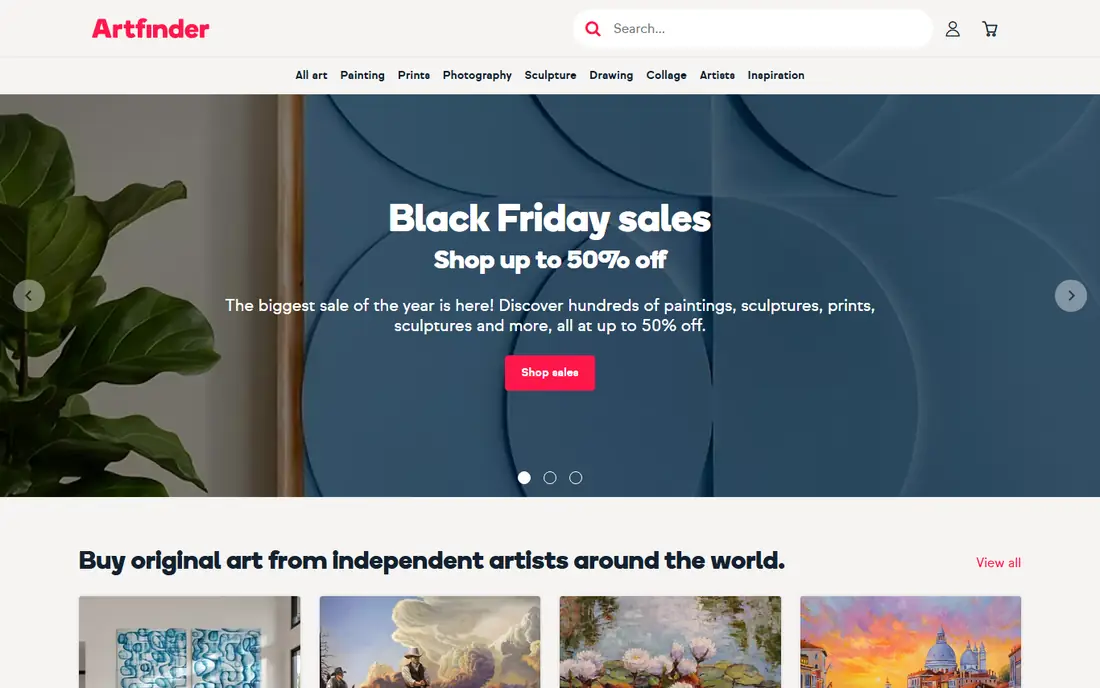
Artfinder is a curated marketplace for independent artists selling original art and prints, with a strong buyer base in the UK and Europe as well as the US. It offers a free starter plan and paid plans with lower commission rates, plus an optional managed shipping service. For an independent artist who wants a gallery-style marketplace without running a full shop, Artfinder is a practical option.
Commission is the main cost, at 40 to 50 percent depending on plan, and paid plans add a monthly fee on top. Check the current plan terms before you list, since the best plan depends on how often you sell. For original art with a managed marketplace feel, Artfinder is a credible alternative to Saatchi Art.
- Independent artist focus
- Global buyer audience
- Managed shipping option
- Commission of 40 to 50 percent depending on plan
- Paid plans add a monthly cost
Singulart is a curated online gallery for contemporary art, aimed at established artists with a proven record. It offers personal support, help with pricing and marketing, and access to collectors looking for contemporary work. For an artist who already has exhibition experience and a body of work, that curation and support can justify the higher commission.
Singulart is selective, so not every applicant is accepted, and commission can reach about 50 percent, with subscription plans on some tiers. That makes it a poor fit for a beginner testing the market. For an established contemporary artist who wants gallery-style representation online, Singulart is a strong platform.
- Curated contemporary gallery
- Personal support and pricing help
- Strong marketing for artists
- Selective entry
- Commission up to about 50 percent
- Subscription plans on some tiers
Fine Art America, also known as Pixels, is a print-on-demand platform for art prints, photography and home decor. Artists upload work, set a markup above the base product price, and the platform handles printing, framing and shipping. A free account is available, with a premium account at $30 per year for extra features. That model suits photographers and digital artists who want prints without holding stock.
The marketplace is crowded, and earnings per sale depend on your markup, so you must market your own shop to stand out. Fine Art America does not bring the same buyer intent as a curated gallery. For hands-off print sales with no stock risk, it is one of the best options available.
- Free account option
- You set your markup above base price
- Platform handles printing and shipping
- Very crowded marketplace
- You must drive much of your own marketing
Redbubble lets artists sell designs on a wide range of print-on-demand products, from art prints and stickers to clothing and home goods. Artists set a markup above the base price, and Redbubble production partners handle printing and shipping. That breadth suits illustrators and graphic artists whose work fits merch as well as wall art.
Earnings vary by product, markup and account tier, and standard accounts may face additional fees that reduce the artist share. Redbubble is also a crowded marketplace, so design quality and tagging matter. For an illustrator who wants many product types without stock or fulfilment work, Redbubble is a strong, free-to-join option.
- Free to join
- Many print-on-demand products
- Handles production and shipping
- Artist margin depends on markup and account tier
- Extra fees can reduce earnings
Society6 is a print-on-demand marketplace focused on design-led art, prints and home decor. Artists upload work, and Society6 handles production, shipping and customer service. The platform suits artists with a strong visual style that fits home decor and lifestyle products, and its curated feel can help design-led work stand out.
The main limit is earnings. Artists typically earn about 10 percent on many items, which is lower than setting your own markup on Fine Art America or Redbubble. Society6 is therefore best as a hands-off extra channel, rather than a main income source. For design-led artists who want a simple storefront, it is worth joining.
- Design-forward marketplace
- Prints and home decor
- Handles production and shipping
- Royalty of about 10 percent on many items
- Limited control over pricing
Shopify is not a marketplace, but a platform for building your own branded online store. Artists can sell originals, prints and digital downloads, control pricing and keep their customer list, and pay no platform sales commission beyond payment processing. That control is valuable for an artist building a long-term brand, rather than renting space on a marketplace.
The trade-off is traffic. Shopify does not bring buyers to your store, so you must drive visits through social media, email, search or advertising. There is also a monthly fee and setup work, including themes, payments and shipping settings. For an artist ready to build a brand and audience, Shopify is the best own-store platform.
- Full control over branding, pricing and customer list
- No platform sales commission
- Many apps and themes
- You must bring your own traffic
- Monthly fee plus payment processing
- More setup work
ArtPal offers a free gallery and print-on-demand service, with no listing fees and no commission on products you sell yourself. Artists can list originals and prints, and use ArtPal print-on-demand for reproductions without holding stock. That free, simple setup suits beginners and artists who want a low-cost online gallery.
ArtPal has a smaller buyer audience than Etsy or Saatchi Art, and less marketing support, so you will need to drive your own traffic. Print-on-demand sales do involve a production share. For a free starting gallery with no upfront cost, ArtPal is a useful option, especially alongside a larger marketplace.
- Free to join
- Keep 100 percent on your own products
- Built-in print-on-demand
- Smaller buyer audience
- Less marketing support than larger marketplaces
How we picked these
We compared platforms with live artist selling offers in October 2026, using official seller pages and published fee comparisons. We included open marketplaces, curated galleries, print-on-demand platforms and an own-store platform, so the list covers originals, prints and digital art. We favoured platforms with clear fee terms and a real buyer audience, and we left pricing as website based where fees vary by plan or product. We did not claim hands-on testing.
What to check before you choose a platform to sell art online
Start with your work type. Original fine art suits a curated gallery, prints and photography suit print-on-demand, and digital downloads suit Etsy or your own store. A platform that is perfect for prints may be a poor fit for originals, and vice versa. Check what you can sell, how shipping works, and who handles returns and customer service.
Compare total fees on a typical sale, including listing fees, transaction fees, payment processing, commission and any subscription. A 40 percent commission on a $1,000 original is $400, which changes your pricing far more than a $0.20 listing fee. Check payout timing, minimum payout thresholds and tax reporting. Finally, think about audience ownership: a marketplace brings buyers today, but your own store and email list protect your sales if a marketplace changes its fees or rules.
Frequently asked questions
What is the best platform to sell art online?
The best platform to sell art online depends on your work. Etsy suits most artists starting out, Saatchi Art and Artfinder suit fine-art originals, and Fine Art America and Redbubble suit print-on-demand. The best platform to sell art online for you is the one that matches your work type, your fee tolerance and your audience goals.
How much does it cost to sell art online?
Costs vary widely. Etsy charges $0.20 per listing plus a 6.5 percent transaction fee and payment processing, curated galleries charge 40 to 50 percent commission, and print-on-demand platforms take a base price plus your markup or a royalty. Shopify charges $29 per month plus payment processing, with no platform sales commission.
Should I sell originals or prints online?
Many artists sell both. Originals earn more per sale but sell less often, while prints earn less per sale but can sell repeatedly without new work. Print-on-demand removes stock risk, while originals need careful packing and shipping. Start with the format that matches your current work and audience, then add the other format later.
Do I need my own website to sell art?
No, but it helps long term. A marketplace gives you buyers today, while your own website and email list give you control over pricing, branding and customer relationships. Many artists use both: a marketplace for discovery, and their own store for repeat buyers and higher-margin sales.
How do I price art for an online platform?
Work out your costs, including materials, time, platform fees, payment processing and shipping, then set a price that leaves a sustainable margin after those costs. For a high-commission gallery, the list price must be higher than a direct sale price to net the same amount. Check comparable work on the same platform, but do not underprice to win a sale that loses money after fees.
Sources
- https://www.foundmyself.com/blog/where-to-sell-artwork-online/
- https://wahooart.com/en/articles/compare-where-to-sell-your-art-online-in-2026-every-commission-fee-and-payout-schedule-verified-en/
- https://financialbinder.com/where-to-sell-artwork-online/
- https://www.ecommerceceo.com/best-places-to-sell-art-online/
- https://www.etsy.com
- https://www.saatchiart.com
- https://www.artfinder.com
- https://www.singulart.com
- https://www.fineartamerica.com
- https://www.redbubble.com
- https://www.society6.com
- https://www.shopify.com
- https://www.artpal.com
See where you really rank - block by block
ProMapRanker scans Google Maps across a grid of your service area. Simple monthly plans from $19, white-label on every plan.
Start freeKeep reading
 wpforms alternatives
Best WPForms Alternatives in 2026
We compare 9 wpforms alternatives for WordPress forms, with free and paid options, current pricing notes, and honest limits for small business sites in 2026.
Read → windows task scheduler alternatives
Best Windows Task Scheduler Alternatives in 2026
Looking for Windows Task Scheduler alternatives? We compare 9 schedulers for Windows and cross-platform work, from free tools to enterprise automation.
Read → which ai video service is best
Which AI Video Service Is Best in 2026
which ai video service is best? We compare 10 legitimate AI video services on price, avatars, editing and output quality to help you pick the right tool.
Read →