 ProMapRanker
Best Open Source MLOps Platforms in 2026

Key takeaways
- Most teams need more than one open source MLOps tool, since tracking, pipelines, serving, and monitoring are separate jobs.
- MLflow is the safest starting point for experiment tracking, while Kubeflow suits teams already running Kubernetes.
- Open source saves license fees but adds setup and maintenance work, so budget engineering time, not just servers.
- Pick tools with active communities and clear docs, since you will rely on community support instead of a vendor help desk.
Quick comparison
| Pick | Great for | Pricing starts at | Free tier | |
|---|---|---|---|---|
 MLflow | Experiment tracking and registry | Free | Yes | Visit |
 Kubeflow | Kubernetes-native pipelines | Free | Yes | Visit |
 Metaflow | Python-native workflows | Free | Yes | Visit |
 DVC | Data and model versioning | Free | Yes | Visit |
 ZenML | Portable pipelines | Free | Yes | Visit |
 Feast | Feature store | Free | Yes | Visit |
 BentoML | Model serving | Free | Yes | Visit |
 Seldon Core | Advanced model serving | Free | Yes | Visit |
The best open source MLOps platforms
Open source MLOps platforms cover different stages of the model life cycle, from tracking experiments to serving models in production. The tools below are all free to use under open source licenses, though you still pay for the compute and storage you run them on.
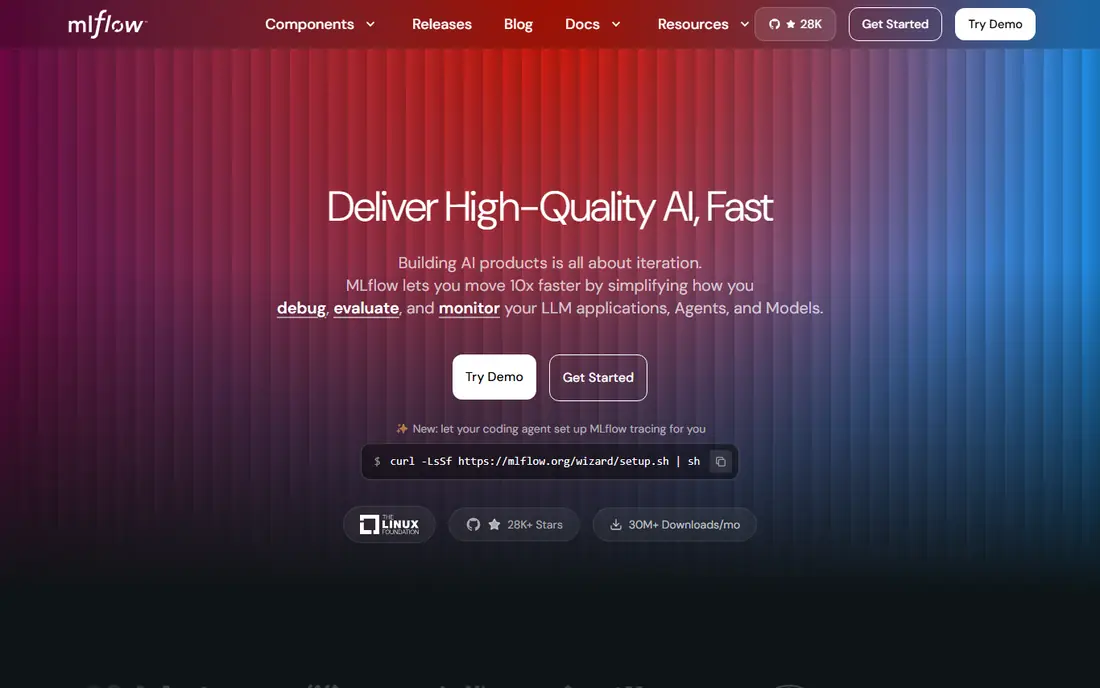
MLflow is the most common starting point for open source MLOps, and for good reason. Its tracking component logs parameters, metrics, and artifacts for each run, and its model registry gives teams a shared place to version and promote models. It integrates with scikit-learn, TensorFlow, PyTorch, and other major frameworks, so most Python teams can adopt it without changing their training code much.
MLflow is not a full pipeline orchestrator or a production serving platform on its own. Teams often pair it with a pipeline tool and a serving tool from this list. If you only pick one open source tool this year, MLflow is the one that improves daily work fastest.
- Widely adopted tracking standard
- Model registry included
- Works with major Python frameworks
- Serving and pipeline features are lighter than specialist tools
- Scaling needs care
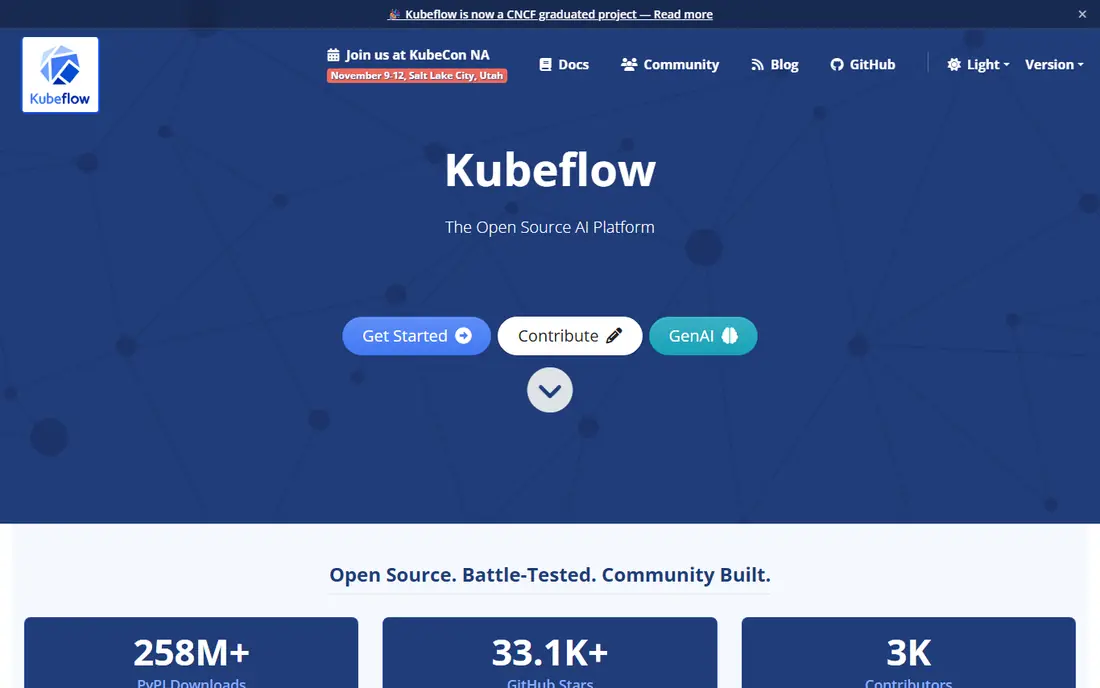
Kubeflow brings machine learning workflows to Kubernetes, with pipelines, distributed training, tuning, and serving components in one project. For an organization already running Kubernetes in production, that fit is powerful: models run on the same platform as other services, with the same scaling and access controls. Multi-team platform groups get the most value from it.
The cost is complexity. Installing, upgrading, and operating Kubeflow takes real platform engineering skill, and small teams can spend more time on the platform than on models. Kubeflow suits mid-size to large teams with Kubernetes expertise and several model teams to serve.
- Full pipeline, training, and serving components
- Scales on Kubernetes
- Strong for multi-team platforms
- Complex to install and run
- Overkill for small teams
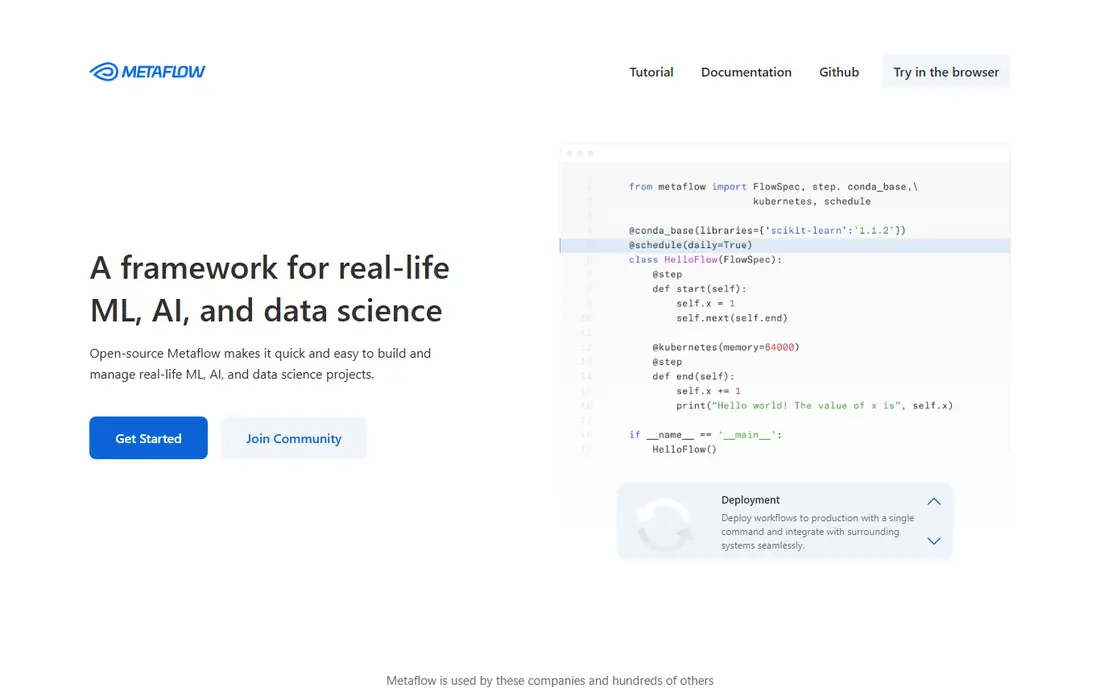
Metaflow, originally built at Netflix, lets data scientists write workflows in plain Python and run them locally or in the cloud with little change. Its focus on a smooth development loop is its main strength: you can build and debug a flow on your laptop, then scale the same code for production runs. Versioning of code, data, and results is built into the design.
Metaflow covers less of the full platform surface than Kubeflow, so larger platform teams may still add separate serving and monitoring tools. It suits data-science-led teams and smaller groups that want production workflows without operating a heavy platform.
- Simple Python workflow design
- Good local development loop
- Scales from laptop to cloud
- Smaller ecosystem than Kubeflow
- Enterprise features need extra work
DVC adds version control for datasets and models, the large files Git handles poorly. Teams can version a dataset beside the code that trained on it, reproduce an old run, and share data through cloud storage without stuffing large files into Git. That link between code, data, and model is the core of reproducibility in machine learning.
DVC is not an experiment tracker, so pair it with MLflow or a similar tool for metrics and run comparison. Its lightweight design makes it easy to adopt one project at a time. DVC suits any team that has ever lost track of which data produced which model.
- Git-style versioning for data and models
- Works with existing Git workflows
- Lightweight to adopt
- Does not track experiments by itself
- Needs storage setup
ZenML provides a pipeline framework that stays portable across orchestrators, clouds, and tooling choices. You define steps once, then swap the underlying orchestrator or artifact store without rewriting the pipeline. That portability helps teams that want to avoid lock-in or that run across more than one cloud.
The abstraction layer takes time to learn, and teams that already standardize on one orchestrator may not need it. ZenML suits teams building a platform they expect to change over time, or teams moving off a managed service without a full rewrite.
- Portable across orchestrators and clouds
- Modular stack design
- Good pipeline abstraction
- Abstraction adds learning time
- Paid tiers exist for managed features
Feast is an open source feature store that keeps training and serving on the same feature definitions. That consistency matters because a model trained on one version of a feature and served with another can fail quietly in production. Feast helps teams define, share, and reuse features across models instead of rebuilding them per project.
A feature store adds data engineering work, so a team with one simple model may not need it yet. Feast suits teams with several production models, online serving needs, or repeated feature logic across projects.
- Consistent features for training and serving
- Reduces training-serving skew
- Good for multi-model teams
- Needs setup and data engineering
- Overkill for a single simple model
BentoML turns a trained model into a production API with minimal packaging work. It supports major frameworks, handles model artifacts and dependencies, and gives teams a clear path from a notebook model to a running service. For teams that ship models as APIs, that speed is the main draw.
Very advanced serving needs, such as complex canary setups or multi-model routing, may need a Kubernetes serving tool alongside it. BentoML suits teams that want a quick, clean route from model to API without building serving infrastructure from scratch.
- Fast model-to-API packaging
- Supports many frameworks
- Simple deployment path
- Advanced serving patterns need extra tooling
- Managed cloud is paid
Seldon Core is a Kubernetes-native serving platform for machine learning models, with support for A/B testing, canary deployments, and model explainability. Platform teams that already run Kubernetes can use it to serve many models with consistent controls, scaling, and monitoring hooks. Its deployment patterns suit production systems where a bad model version must be rolled back fast.
The requirement is Kubernetes expertise and a cluster to run it on. Smaller teams without that platform will find BentoML simpler. Seldon Core suits platform teams serving models at scale with strict release practices.
- Kubernetes-native serving
- A/B testing and canary releases
- Explainability support
- Kubernetes required
- Setup is heavier than BentoML
How we picked these
We compared open source tools named across 2026 MLOps guides, then checked each project's own site and docs for its life cycle stage, license, and current status. We favored tools with active maintenance, clear docs, and a distinct job in the stack, and we excluded managed-only platforms that are not open source. We did not claim hands-on testing.
How to build an open source MLOps stack
Start with the pain you feel today, not with a full platform diagram. If experiments are hard to compare, start with MLflow. If data versions are a mess, start with DVC. If pipelines break when they move to production, start with Metaflow or ZenML. One solved problem builds trust for the next tool.
Map the stack by stage: tracking, data versioning, pipelines, feature store, serving, and monitoring. You do not need a tool for every stage on day one. Many teams run well with tracking, versioning, and one serving tool, then add a feature store or advanced monitoring when production models multiply.
Costs and maintenance to budget
Open source tools are free to download, but they are not free to run. Budget for compute, storage, upgrades, security patches, and the engineer time to keep the platform healthy. If your team cannot staff that work, a managed service may cost less in total, even with license fees.
Avoiding common mistakes
Do not pick a tool because it covers every stage on paper. A broad tool used badly is worse than a narrow tool used well. Also, keep model, data, and code versions linked from the start. Rebuilding that link after months of untracked runs is painful and sometimes impossible.
Frequently asked questions
What is MLOps?
MLOps is the practice of managing machine learning models through their full life cycle: data, training, testing, deployment, and monitoring. It borrows ideas from DevOps, such as version control and automated pipelines, and applies them to models and data.
Are open source MLOps tools really free?
The software is free under open source licenses, but you pay for compute, storage, and the engineering time to run and maintain it. Some projects also sell managed or enterprise editions with extra features.
Which open source MLOps tool should I start with?
Most teams start with MLflow for experiment tracking, since it improves daily work quickly and pairs well with other tools. Add DVC if data versioning is a problem, and a pipeline tool when manual training runs become hard to repeat.
Do I need Kubernetes for open source MLOps?
No. Tools such as MLflow, Metaflow, DVC, and BentoML run without Kubernetes. Kubeflow and Seldon Core do need Kubernetes, so pick them only if your team already runs it or plans to.
How do open source tools compare with managed platforms?
Open source tools give you control, portability, and no license fees, but you own setup and maintenance. Managed platforms reduce that burden and add support, at the cost of fees and less control over the stack.
Can I mix open source and managed tools?
Yes, and most teams do. A common mix is open source tracking and versioning with a managed serving or monitoring service, or the reverse. Keep version links between tools so runs stay reproducible.
Sources
See where you really rank - block by block
ProMapRanker scans Google Maps across a grid of your service area. Simple monthly plans from $19, white-label on every plan.
Start freeKeep reading
 best resource management software
Best Resource Management Software in 2026
We compared the best resource management software for scheduling, capacity and utilization, with current pricing and free trials, to help teams choose well.
Read → best reporting tools
Best Reporting Tools in 2026
Compare the best reporting tools for dashboards, scheduled reports, and business insights, from Power BI and Tableau to Looker Studio for every team size.
Read → best remote support software
Best Remote Support Software in 2026
Looking for the best remote support software? We compare 9 tools on price, security, session controls, and fit for helpdesks, MSPs, and small teams in 2026.
Read →