 ProMapRanker
Best Local SEO Tools for Furniture Stores in 2026

All-in-one local SEO for single showrooms · Pricing starts at: See website
Direct answer
BrightLocal is my top pick for furniture stores because it handles the three jobs a showroom actually needs: Google Business Profile audits, local rank tracking by map grid, and citation cleanup in one dashboard. It has no free plan stated, so check its pricing page. For review generation on big-ticket purchases, look at Grade.us, and for multi-location listing control across a chain of stores, Yext is the other option worth comparing.
I put this list together from vendor documentation and public sources, not from hands-on tests. I run a small SEO agency and work mostly with local businesses, so I looked at what each tool does for the way a furniture store actually gets found: map pack visibility, reviews after delivery, and listings that match the showroom address.
Key takeaways
- Furniture shoppers research online for weeks before visiting a showroom, so map pack visibility and review volume matter more than a single landing page.
- A Google Business Profile audit should come first, because duplicate listings and wrong categories are common for stores that sell both sofas and mattresses.
- Local rank tracking by grid shows whether you appear for "furniture store near me" across the whole delivery area, not just at your pin.
- Review tools that support long request delays fit furniture better, since customers often review after delivery rather than at the till.
- Citation cleanup matters most for stores that have moved premises or changed names, which is common in this trade.
Quick comparison
| Pick | Great for | Pricing starts at | Free tier | |
|---|---|---|---|---|
| BrightLocal | All-in-one local SEO for single showrooms | See website | Not stated | Visit |
 Yext | Multi-location furniture chains | See website | Not stated | Visit |
 Grade.us | Review requests after furniture delivery | See website | Free trial | Visit |
 Whitespark | Citation building and local rank tracking | See website | Not stated | Visit |
 Local Falcon | Map grid visibility checks | See website | Not stated | Visit |
 Semrush | Keyword and competitor research | See website | Not stated | Visit |
 CallRail | Tracking calls from local ads | See website | Free trial | Visit |
The best local SEO tools for furniture stores compared
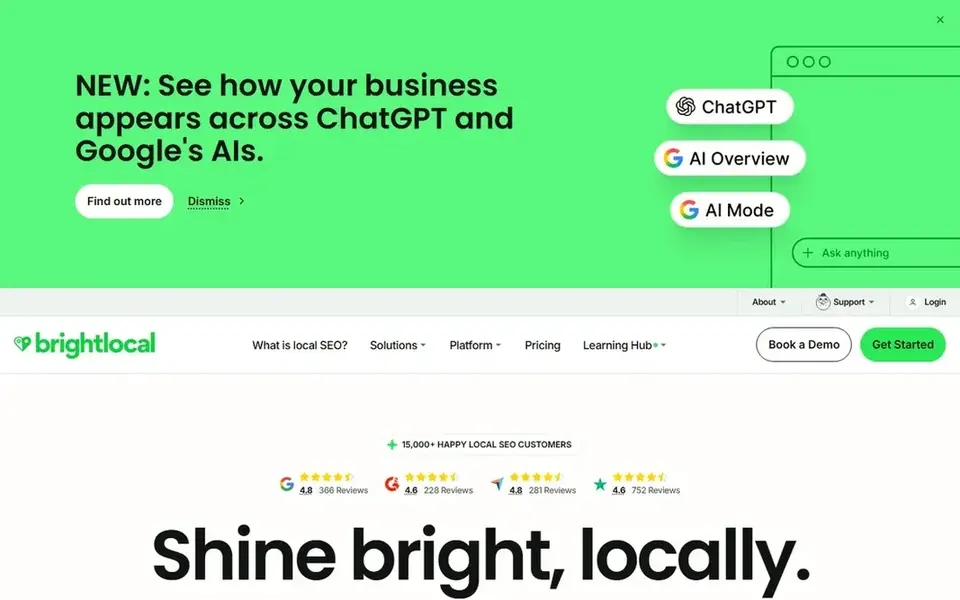
BrightLocal is the tool I would start a furniture store on. It combines a Google Business Profile audit, local rank tracking, citation management and review monitoring in one dashboard. For a single showroom selling sofas, beds and dining sets, that covers the whole local job without stitching three subscriptions together.
The workflow fits furniture well. You run the GBP audit first to catch duplicate listings left over from an old address or a previous store name, then fix categories so the profile reads as a furniture store rather than a general retailer. Grid rank tracking then shows where you appear for searches like "furniture store near me" across your delivery radius, which matters because customers often search from a neighbouring town.
The limits are mostly about scale. If you run a chain with dozens of branches and need centralised control over every profile, BrightLocal is workable but not the tightest fit. A single-store owner or a small local agency will get more from it than a national chain.
- GBP audit catches duplicate and wrong-category listings
- grid-based rank tracking
- citation building and cleanup in the same account
- Grid tracking depth depends on the plan
- not built for very large multi-location chains
Yext is built for businesses that need one source of truth for store data across many directories. A furniture chain with branches in several towns, each with different opening hours and delivery zones, is the kind of customer it suits.
For furniture specifically, the value is consistency. If one branch lists a different phone number on a directory than the one on its Google Business Profile, customers call the wrong store and the listing looks unreliable. Yext pushes the same name, address, phone and hours everywhere from one record, which keeps the map pack clean across the chain.
The trade-off is cost and complexity. Pricing is quote-based and scales with the number of locations, so a single independent showroom will usually find it heavier than needed. It is a chain tool, not a starter tool.
- Central control over listings across many directories
- strong for chains with many branches
- structured data handling
- Quote-based pricing that grows with locations
- can be more than a single store needs
Grade.us is a review management tool, and reviews are where furniture stores win or lose the map pack. A sofa is a considered purchase, and shoppers read reviews carefully before driving to a showroom.
The feature that matters here is timing. Furniture customers usually review after delivery, not at the point of sale, so a review request that fires days or weeks later fits the buying cycle better than an immediate ask. Grade.us supports scheduled campaigns, so you can set the request to go out after the delivery window and keep the message plain and honest.
It is not a full local SEO suite. There is no citation cleanup or grid rank tracking, so it works best alongside a tool like BrightLocal. Skip it if you want one dashboard for everything.
- Automated review request campaigns
- supports delayed sends
- simple review monitoring
- Plainer interface than some rivals
- fewer local SEO extras beyond reviews
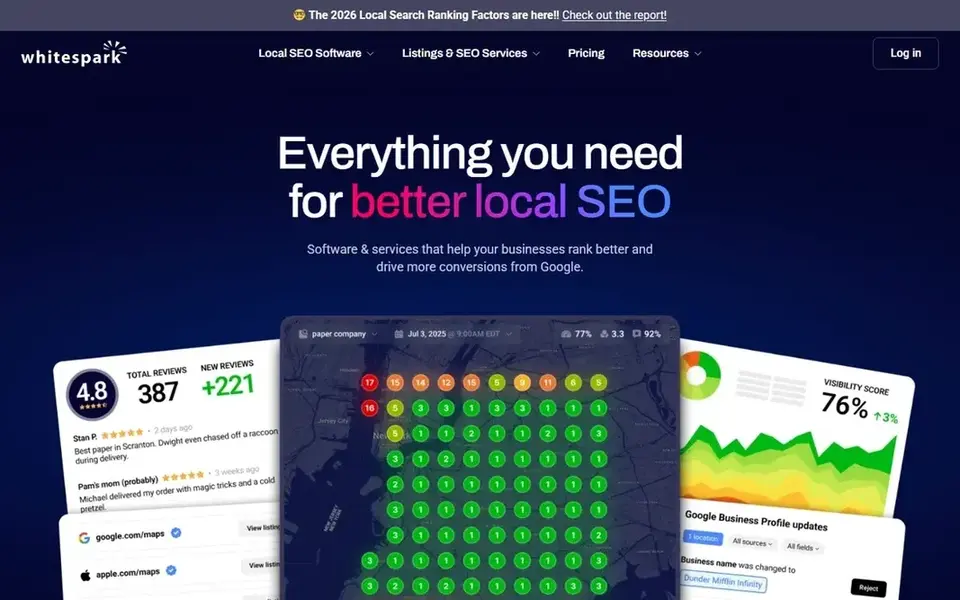
Whitespark is well known in local SEO for citation work and local rank tracking. For a furniture store that has moved, rebranded or inherited old directory listings, its citation finder and building service are useful for cleaning up the mess.
The rank tracker shows how you place for local searches in specific areas, which helps when your showroom sits on a retail park outside the town centre and you want to know whether you appear for searches from the surrounding neighbourhoods. It is a solid complement to a GBP-focused tool.
The main drawback is that Whitespark's features are spread across separate products rather than one dashboard. Budget for that if you want citations and rank tracking together, and expect to manage a couple of logins.
- Strong citation research and building
- local rank tracking
- reputable in the local SEO field
- Features split across separate products
- less of an all-in-one dashboard
Local Falcon specialises in map grid rank tracking. It plots your Google Maps position across a grid of points around your store, so you can see the shape of your visibility rather than a single number.
For furniture stores this is genuinely useful. A showroom on the edge of town may rank well at its own pin but disappear a few miles out, right where much of its customer base lives. Seeing that pattern tells you whether to focus on reviews, categories or local content for the surrounding towns.
It does one job well and stops there. There is no citation management, review requesting or GBP audit, so treat it as a visibility check rather than a complete toolkit.
- Clear map grid visualisation
- shows visibility across a delivery area
- simple to read
- Narrow focus on rank grids
- not a full SEO suite
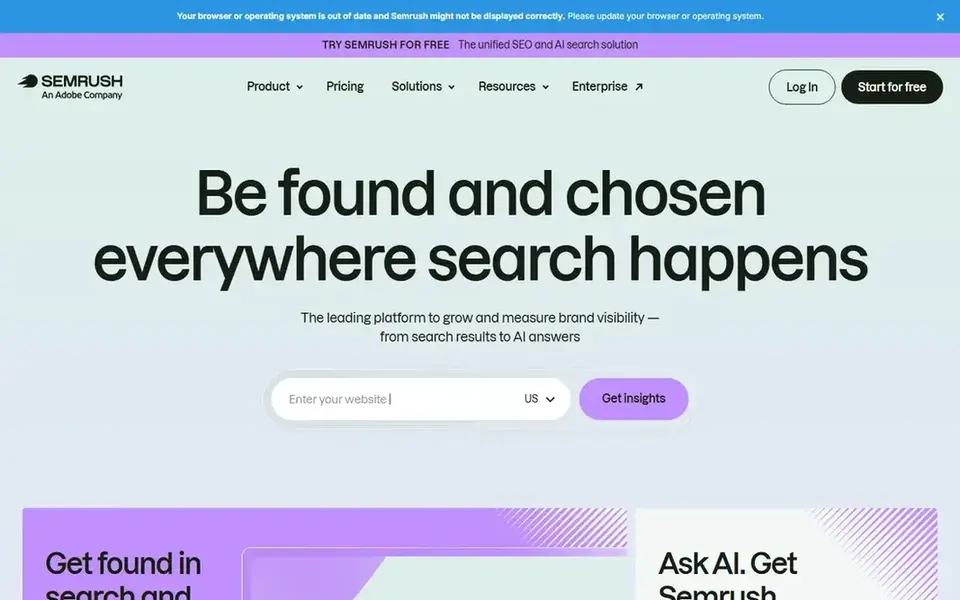
Semrush is a broad SEO platform, and its local features sit inside a much larger toolkit. For a furniture store, the useful part is research: which terms shoppers use for sofas, beds and dining sets in your area, and which competitors rank for them.
That research feeds the rest of your local work. If you learn that people search for "oak dining table [town]" rather than "furniture shop", you can shape your Google Business Profile services, posts and landing pages around those terms. Semrush also offers local listing management, though it is one module among many.
One limitation: scope. A small independent store may find the full suite more than it needs, and the local features are not as deep as a dedicated local tool. It suits stores that also want organic keyword and content research.
- Deep keyword research
- competitor tracking
- local listing management add-on
- Broad suite with local features as one part
- can be more than a small store needs
CallRail tracks phone calls and shows which campaign, ad or listing produced them. For furniture stores, phone calls still matter: people ring to ask about delivery times, stock and finance options before visiting.
If you run local ads or track calls from your Google Business Profile, CallRail shows which channels bring in calls and which do not. That helps you decide where to spend effort, whether that is map pack visibility or paid local ads.
It is not an SEO tool in the broader sense. There is no rank tracking or citation work, so it sits alongside the others. Skip it if your store gets most enquiries through the showroom door and web forms.
- Call tracking with source attribution
- works with Google Ads and local campaigns
- simple reporting
- Call tracking only, not a full SEO suite
- needs numbers set up per campaign
How I chose
I picked these tools by reading vendor documentation and public sources, then matching each one to how a furniture store gets found locally. I did not run hands-on tests, and I have not included client results or statistics. The question I asked of each tool was simple: does it help a showroom appear in the map pack, earn honest reviews, or keep its listings accurate?
I also weighed limits. A single-store owner does not need a chain-scale listing platform, and a chain does not want to manage five separate subscriptions. Where a tool only does one job, I said so. Where pricing is quote-based, I noted it. The order reflects fit for the typical furniture store, not a ranking of overall quality.
What to check before you buy
- Confirm the tool audits Google Business Profile categories, because furniture stores often get lumped into general retail and lose relevant searches.
- Check whether rank tracking works by map grid, so you can see visibility across your delivery area rather than only at the store pin.
- Ask whether review requests can be delayed, since furniture customers usually review after delivery.
- Confirm citation tools can find and fix old listings from a previous address or store name.
- Check how many locations the plan covers if you run more than one showroom.
- Read the vendor's own documentation on Google guideline compliance, and avoid any tool that suggests review gating or keyword-stuffed business names.
Frequently asked questions
Do furniture stores need local SEO tools at all?
Yes, if you want to appear in the Google Maps results when people search for furniture near them. Most furniture purchases start with a local search, and the map pack is where those searches land. Tools help you keep your profile accurate, track where you rank across your delivery area, and collect reviews honestly.
Which tool is best for a single showroom?
BrightLocal is the most complete starting point for one store, because it covers profile audits, rank tracking and citations together. If reviews are your weak spot, add Grade.us for scheduled review requests after delivery. Local Falcon is a cheaper way to check map visibility if that is your only concern.
How do I get more Google reviews for a furniture store?
Ask every customer, and time the request after delivery rather than at the till. Use a review tool that supports delayed campaigns so the ask arrives when the purchase feels complete. Never offer incentives for positive reviews or filter out unhappy customers, as both break Google's guidelines.
Can these tools fix duplicate Google Business Profiles?
Some can flag duplicates during a profile audit, but the fix itself happens in your Google Business Profile account. BrightLocal and Yext both help you spot inconsistencies across listings. Resolving a duplicate usually means claiming or removing the extra profile directly with Google.
Do I need a call tracking tool as well?
Only if phone calls are a big part of your enquiries and you want to know which channel produced them. CallRail handles that well. Many furniture stores get enough from a profile audit, rank tracking and review requests, and can add call tracking later.
Sources
See where you really rank - block by block
ProMapRanker scans Google Maps across a grid of your service area. Simple monthly plans from $19, white-label on every plan.
Start freeBrowse all guides
← Best Local SEO Tools for Carpet Cleaning Companies in 2026Best Local SEO Tools for Martial Arts Schools in 2026 →
 best local seo tools for bike shops
Best Local SEO Tools for Bike Shops in 2026
A bike shop owner's guide to the best local SEO tools for 2026, compared from vendor docs and public sources, with fit notes for service and retail.
Read → best local rank tracking tools for storage facilities
Best Local Rank Tracking Tools for Storage Facilities in 2026
A practical guide to the best local rank tracking tools for storage facilities in 2026, covering grid scans, Google Business Profile checks and reporting.
Read → best local rank tracking tools for real estate agents
Best Local Rank Tracking Tools for Real Estate Agents in 2026
A practical guide to local rank tracking tools for real estate agents, compared from vendor docs and public sources, with pricing and fit notes.
Read → local seo for dentists
Local SEO for Dentists: How to Fill Your Chairs From Google Maps
A local SEO playbook for dentists: GBP optimization, reviews, and geo-grid tracking to win the map pack.
Read → local seo for bakeries
Local SEO for Bakeries
A local SEO guide for bakeries: Google Business Profile setup, reviews, and custom-order and walk-in local SEO for bakeries.
Read → local seo for auto detailing shops
Local SEO for Auto Detailing Shops
A local SEO guide for auto detailing shops: Google Business Profile setup, reviews, and before/after photo GBP posts for detailers.
Read →More in Local SEO & Google Maps · All guides A to Z by date · Latest guides