 ProMapRanker
Best Local SEO Tools for Bike Shops in 2026

All-round local SEO for one shop · Pricing starts at: See website
Direct answer
BrightLocal is my top pick for bike shops because it handles the three jobs a shop actually needs: Google Business Profile checks, local rank tracking for "bike repair near me" style searches, and citation cleanup in one dashboard. It has no free plan stated, so check its pricing page before you commit. If you mainly want review requests after a tune-up, look at NiceJob, and if you want to see where you rank on a map grid across your city, Local Falcon is the other one to compare.
I put this list together from vendor documentation and public sources rather than hands-on testing. I looked at what each tool actually does for a shop with a service counter, a repair queue and a retail floor, and where each one stops being useful. Prices change, so I have not quoted any.
Key takeaways
- A bike shop's local visibility depends on service keywords ("bike tune-up", "flat repair") as much as product keywords, so pick a tool that tracks both.
- Your Google Business Profile categories and services list matter more than most on-page tweaks for a shop with a physical address.
- Review tools that trigger a request after a repair ticket closes fit bike shop workflows better than generic email campaigns.
- Citation tools are worth it mainly to fix inconsistent name, address and phone data across directories, not to spray listings everywhere.
- No tool fixes a thin profile: hours, photos of the workshop, and accurate service menus come first.
Quick comparison
| Pick | Great for | Pricing starts at | Free tier | |
|---|---|---|---|---|
| BrightLocal | All-round local SEO for one shop | See website | No free plan | Visit |
 Local Falcon | Map grid rank tracking across a city | See website | Not stated | Visit |
 Whitespark | Citation building with manual control | See website | Not stated | Visit |
 NiceJob | Review requests after a repair | See website | Not stated | Visit |
 Yext | Controlling listings at scale | See website | Not stated | Visit |
 Semrush | Keyword and competitor research | See website | Free plan | Visit |
 CallRail | Tracking calls from Maps and ads | See website | Free trial | Visit |
The best local SEO tools for bike shops compared
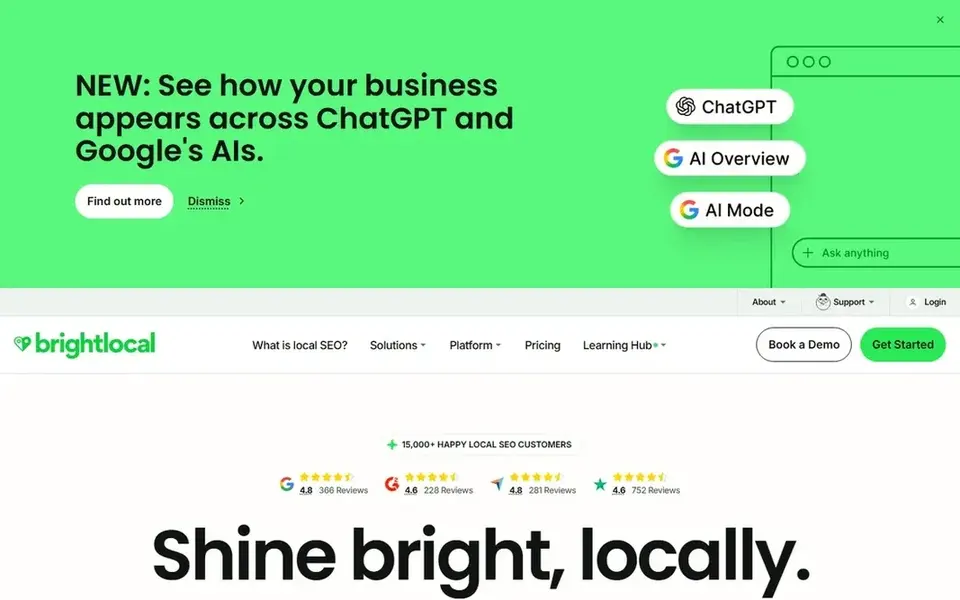
BrightLocal is a local SEO platform built around the Google Business Profile, local rankings and citations. For a single bike shop it covers the basics in one place: you add your business, connect the profile, and get a view of how you show up for searches like "bike shop near me" or "bicycle repair [town]". It suits an owner or a small agency managing one to a handful of locations.
The workflow that matters for a bike shop is the citation audit. Shops often have old addresses from a previous location, or a phone number that changed when the workshop line was split from the retail line. BrightLocal finds those mismatches across directories and gives you a list to fix. The rank tracking lets you watch service keywords separately from product keywords, which is useful because "kids bike" and "brake adjustment" behave very differently in local results.
The limits are practical: it is a reporting and audit tool, not a magic switch. If your profile has wrong hours or no photos, BrightLocal will show the problem but you still have to fix it. Skip it if you only want review requests and nothing else.
- Local rank tracking by keyword and location
- citation audit and cleanup
- review monitoring and Google Business Profile checks
- No free plan stated
- some features overlap if you already pay for a rank tracker
Local Falcon scans Google Maps results on a grid of points around your shop and shows where you appear at each point. For a bike shop on one side of town, this answers a question a single rank number cannot: are you visible to riders in the next suburb, or only to people standing outside your door?
That matters for service searches. Someone with a broken derailleur three miles away may see a different set of shops than someone two streets over. Running a scan before and after you update your profile categories, add services, or collect a batch of reviews gives you a rough read on whether those changes moved anything at the edges of your area. It is also handy when you are choosing between two units or considering a second location.
The limit is that a grid scan is a snapshot. It does not fix listings, manage reviews or tell you why you rank where you do. If you want one dashboard for everything, pair it with a broader tool rather than relying on it alone.
- Grid-based map scans show where you rank by area
- good for spotting weak neighbourhoods
- simple visual reports
- A scan is a point-in-time snapshot
- not a full citation or review tool
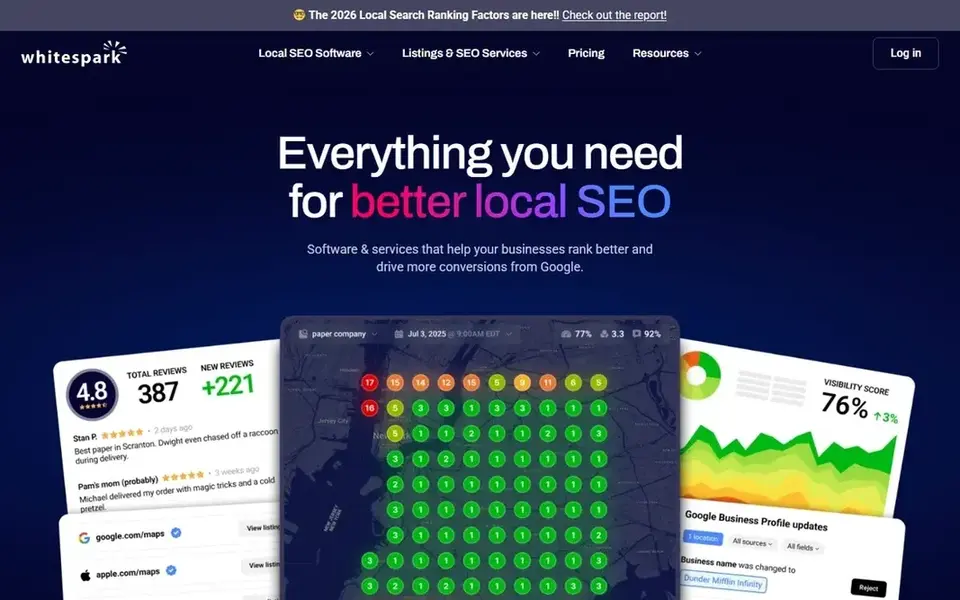
Whitespark is known for citation research and building, plus a local rank tracker. For a bike shop, the useful part is finding the directories that actually matter in your area, including local cycling clubs, race listings and community pages, rather than blasting your details to hundreds of irrelevant sites.
The citation finder shows where your name, address and phone number already appear and flags inconsistencies. That is worth doing once when you open or move, and again if you change your phone number or add a second workshop. The rank tracker covers local pack positions so you can watch service terms over time.
It is more manual than an all-in-one suite, and the citation building service is a paid add-on in most cases. Skip it if you want a single login that also handles reviews and social posting.
- Citation finder and building service
- local rank tracker
- strong directory research
- More hands-on than automated suites
- not aimed at retail inventory
NiceJob is a review and reputation tool built around getting customers to leave feedback after a job. For a bike shop, that maps neatly onto the repair ticket: when a tune-up or wheel build is collected, the customer gets a request to leave a review.
The reason this matters for local SEO is that review volume and recency feed into how your profile looks to riders comparing shops. A steady trickle of reviews mentioning specific services, like "full service" or "e-bike diagnostics", reads better than a burst of generic five-star notes. NiceJob handles the request and the follow-up without your mechanics having to remember.
The limit is scope: it does not manage citations, track map rankings or fix your Google Business Profile categories. It also depends on your customer records being accurate. If you already have a POS or booking system with review requests built in, check that before adding another subscription.
- Review requests tied to a customer record
- simple for counter staff
- helps build a steady review flow
- Review-focused rather than full SEO
- needs clean customer data to work
Yext manages business listing data from one place and pushes updates across a network of directories, maps and apps. A single bike shop rarely needs this. A small chain, a shop with a workshop plus a satellite service point, or a franchise group does.
The value is consistency at scale. If you change winter opening hours or add a second location, you update once and the change propagates. For a shop that also runs mobile repair vans or seasonal pop-ups, that control saves a lot of manual editing.
For one shop with one address, the cost is hard to justify against a citation audit tool that fixes the same problems once. Look at it when listing management becomes a recurring job rather than a one-off cleanup.
- Central control of listing data
- wide network of directories and maps
- useful if you add locations
- Priced for larger operations
- overkill for a single shop
Semrush is a broad SEO platform with keyword research, competitor analysis and a set of local tools including listing management and review monitoring. For a bike shop, its main use is research: finding the terms riders actually search, such as "gravel bike fitting" or "tubeless setup", and seeing which local competitors show up for them.
That research feeds your Google Business Profile services list and your site pages. If you are deciding whether to write about e-bike servicing or kids' bike sizing, the keyword data gives you a starting point. The local listing tools then help keep your details consistent.
The limit is focus. Most of the platform is aimed at content and search marketing beyond local, and the local pieces are not as deep as dedicated tools. A shop that only wants map visibility can spend less elsewhere.
- Broad keyword data
- competitor tracking
- local listing and profile tools included
- Local features are one part of a large suite
- more than a shop needs for local alone
CallRail tracks phone calls and shows which source produced them, including calls from your Google Business Profile, your website and paid ads. For a bike shop, the phone is still how a lot of service enquiries arrive: "can you look at this today", "do you have this in stock", "how much for a full service".
Knowing whether those calls come from Maps, your site or an ad tells you where to put effort. If most calls come from the profile, keep the profile sharp. If they come from a service page, that page is earning its keep. CallRail also records calls, which helps when counter staff are busy.
The limit is that it is call tracking and nothing else. It will not fix citations, request reviews or track rankings. It also means managing a tracking number, which you should set up carefully so your main number stays consistent across listings.
- Call tracking with source attribution
- records which channel drove the call
- works with Google Business Profile calls
- No listings, reviews or rank tracking
- adds a tracking number to manage
How I chose
I compared these tools from vendor documentation, public feature pages and what each one is designed to do, not from hands-on testing. I did not run trials or set up accounts for this guide. My filter was simple: does the tool do something a bike shop actually needs, and does it do it without requiring a marketing team to operate it?
I weighted three jobs heavily. First, Google Business Profile accuracy, because a shop lives or dies on hours, services and photos being right. Second, local rank tracking that separates service terms from product terms. Third, review flow tied to a repair or sale, since that is how bike shops naturally collect feedback. I left out tools that only make sense for large multi-location brands or that duplicate something already covered.
I also noted limits honestly. Several of these tools overlap, and buying two that do the same job is a common waste. Where a tool is narrow, I said so, because a shop owner's time is better spent on the workshop floor than on a dashboard they do not need.
What to check before you buy
- Confirm the tool can track service keywords separately from product keywords, since "bike repair" and "kids helmet" behave differently in local results.
- Check whether it connects directly to your Google Business Profile or only reports on it from outside.
- Ask how review requests are triggered: manual, after a ticket closes, or by import from your POS.
- Confirm citation tools cover the directories that matter in your country and region, not just US-heavy lists.
- Check whether call tracking requires changing your main number, and how that affects listing consistency.
- Look at the export and reporting options so you can hand a simple summary to a partner or manager.
Frequently asked questions
Do bike shops really need local SEO tools?
Most shops benefit from at least a citation audit and profile monitoring. Riders search by service and by location, so showing up correctly in Maps for "bike repair near me" matters. A full suite is optional; a review tool plus a citation cleanup may be enough to start.
Which tool is best for a single bike shop on a budget?
Start with a citation audit and profile check, then add review requests. BrightLocal covers the first part well. If budget is tight, do the profile work manually first, since accurate hours, services and photos cost nothing and fix the most common visibility problems.
How do I track rankings for service terms like tune-ups?
Use a local rank tracker that lets you set keywords by location. Local Falcon's grid scans and BrightLocal's rank tracking both handle this. Keep service terms in a separate group from product terms so you can see which side of the business is driving visibility.
Should I use a call tracking tool in a bike shop?
It helps if you cannot tell whether calls come from Maps, your site or ads. CallRail shows the source. If your phone volume is low or staff already ask every caller how they found you, a tracking tool may be more overhead than value.
Can these tools fix a suspended Google Business Profile?
No. They can flag profile problems and keep data consistent, but reinstatement is handled through Google's own process. Fix the underlying issue, such as address or category problems, and follow Google's guidelines rather than trying to work around them.
Sources
See where you really rank - block by block
ProMapRanker scans Google Maps across a grid of your service area. Simple monthly plans from $19, white-label on every plan.
Start freeBrowse all guides
← Best Local Rank Tracking Tools for Storage Facilities in 2026Best Local SEO Tools for Carpet Cleaning Companies in 2026 →
 best local rank tracking tools for real estate agents
Best Local Rank Tracking Tools for Real Estate Agents in 2026
A practical guide to local rank tracking tools for real estate agents, compared from vendor docs and public sources, with pricing and fit notes.
Read → best local rank tracking tools for orthodontists
Best Local Rank Tracking Tools for Orthodontists in 2026
A practical guide to the best local rank tracking tools for orthodontists, compared from vendor documentation and public sources for 2026.
Read → best local rank tracking tools for furniture stores
Best Local Rank Tracking Tools for Furniture Stores in 2026
A first-person guide to the best local rank tracking tools for furniture stores in 2026, compared from vendor documentation and public sources.
Read → promorepublic alternatives
Best PromoRepublic Alternatives in 2026
Compare 9 PromoRepublic alternatives for scheduling, content ideas, reviews, and local marketing in 2026, from Buffer to Sprout Social and Planable today.
Read → local seo for car dealerships
Local SEO for Car Dealerships
A local SEO guide for car dealerships: Google Business Profile setup, reviews, and inventory-driven local SEO for auto dealers.
Read → local seo for tree service
Local SEO for Tree Service Companies
How tree service companies can rank higher for emergency and seasonal local searches.
Read →More in Local SEO & Google Maps · All guides A to Z by date · Latest guides