 ProMapRanker
Best Local Rank Tracking Tools for HVAC Companies in 2026

All-in-one local tracking and reporting · Pricing starts at: See website
Direct answer
Semrush is my first pick for most HVAC companies because its local pack tracking, map grid views and reporting cover the way heating and cooling searches work by suburb and service area. It has no free plan stated, so check its pricing page. BrightLocal suits agencies that report to several HVAC clients, and Local Falcon is the better fit when you mainly want to see how a map grid looks around each service address.
I compared these tools from vendor documentation and public sources, not from hands-on tests. I looked at how each one handles map grids, multi-location tracking, Google Business Profile data and reporting, then matched that to how HVAC companies actually get found: by town, by service type and by urgency.
Key takeaways
- HVAC searches happen by town and neighbourhood, so you need grid-based rank tracking rather than one city-level number.
- Emergency keywords like "AC repair near me" and planned keywords like "furnace installation" should be tracked as separate groups.
- Google Business Profile performance data and rank tracking answer different questions, so use both.
- Reporting matters if you sell maintenance plans or service agreements and need to show visibility by area.
- Check that the tool supports the number of locations and grid points you actually need before you commit.
Quick comparison
| Pick | Great for | Pricing starts at | Free tier | |
|---|---|---|---|---|
| Semrush | All-in-one local tracking and reporting | See website | Not stated | Visit |
 BrightLocal | Agencies managing several HVAC clients | See website | Free trial | Visit |
 Local Falcon | Map grid visibility around each service area | See website | Free trial | Visit |
 Whitespark | Local rank tracking with citation work | See website | Free trial | Visit |
 SE Ranking | Smaller HVAC businesses and lean agencies | See website | Free trial | Visit |
 Ahrefs | Keyword and competitor research with tracking | See website | Not stated | Visit |
 Moz Pro | Simple local rank reports for owners | See website | Free trial | Visit |
The best local rank tracking tools for HVAC companies compared
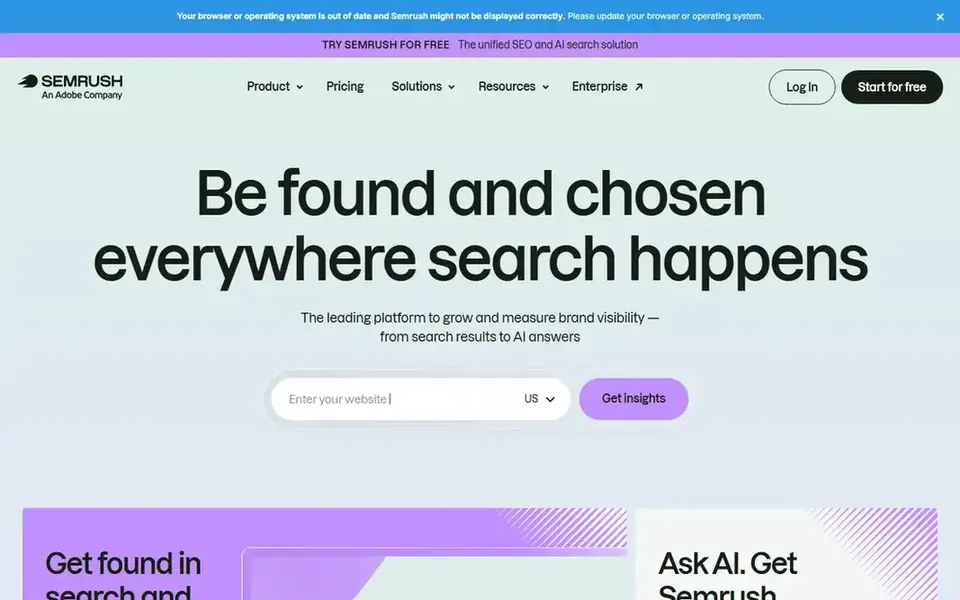
Semrush is a full SEO platform with a local tracking layer. For an HVAC company it fits when you want keyword research, competitor checks and rank tracking in one login. You can set up a project for the main service area, add the towns you cover and track terms like "AC repair", "heat pump installation" and "emergency furnace repair" separately.
The local pack and map grid views show where you appear around a point, which matters when your vans cover several suburbs. Position Tracking lets you group keywords by service line so you can see whether cooling searches or heating searches are moving. Reports can be shared with a business owner who wants a monthly summary without opening the tool.
The limits are practical: the interface is large, and a one-van HVAC company may pay for features it never opens. Skip it if you only want a simple map grid and nothing else.
- Local pack and map grid tracking
- Position Tracking by location
- Reporting for clients and owners
- Broad feature set takes time to learn
- Local limits depend on plan
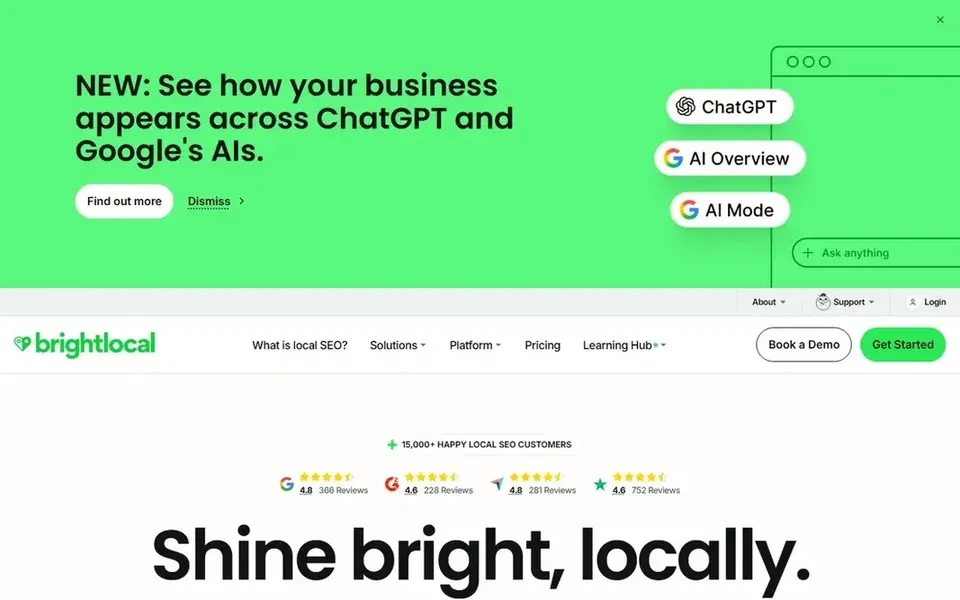
BrightLocal is built around local marketing, and that shows in how it handles multi-location work. If you run an agency with five HVAC clients across different cities, you can keep each one in its own campaign and track rankings by town rather than by a single national term.
For HVAC work the useful part is grouping: separate "heating" and "cooling" keyword sets, then comparing them month to month. Because the same account also covers citations and review monitoring, you can show a client that rankings, listings and reviews are moving together, which is closer to how a homeowner actually finds and chooses a contractor.
Its map grid tracking is not as deep as the dedicated grid tools. If you mainly want heat maps around each service address, pair it with a specialist rather than relying on it alone.
- Rank tracking built for local businesses
- Citation and review tools in one place
- Client-friendly reports
Local Falcon focuses on one job: scanning a grid of points around a location and showing where you rank at each point. For HVAC companies this is the closest match to reality, because a homeowner in one suburb may see you in the map pack while someone two towns over does not.
You set a scan around the shop address or a service centroid, choose the grid size and keyword, then repeat the scan on a schedule. Over a few months the history shows whether your visibility is spreading toward the towns you want. That is more useful than a single "rank 4" number when your actual service radius is wide.
It is a specialist tool, not a full SEO suite. Skip it if you need keyword research, content planning or citation management in the same place.
- Grid-based map rank tracking
- Scan history to see movement over time
- Works well for multi-town service areas
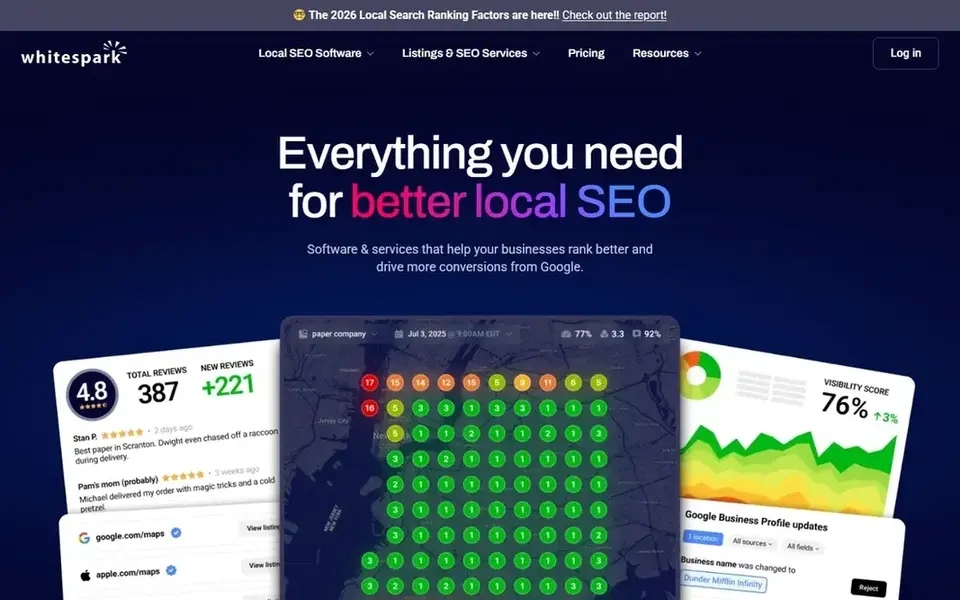
Whitespark is a local search toolkit, and its rank tracker is designed for the same audience as its citation tools. For an HVAC company that is useful because local visibility usually depends on both rankings and consistent listings across directories, and you can work on both without switching vendors.
The rank tracker lets you follow keywords by location and see local pack positions, and the grid view gives a sense of spread around a point. If you also use the citation finder to clean up name, address and phone details, the two reports tell a coherent story for a client or for your own business.
It is less of a general SEO platform than Semrush or Ahrefs. If you want backlink analysis and content tools in the same subscription, this is not the pick.
- Local rank tracker with grid views
- Citation finder and builder in the same account
- Built for local search work
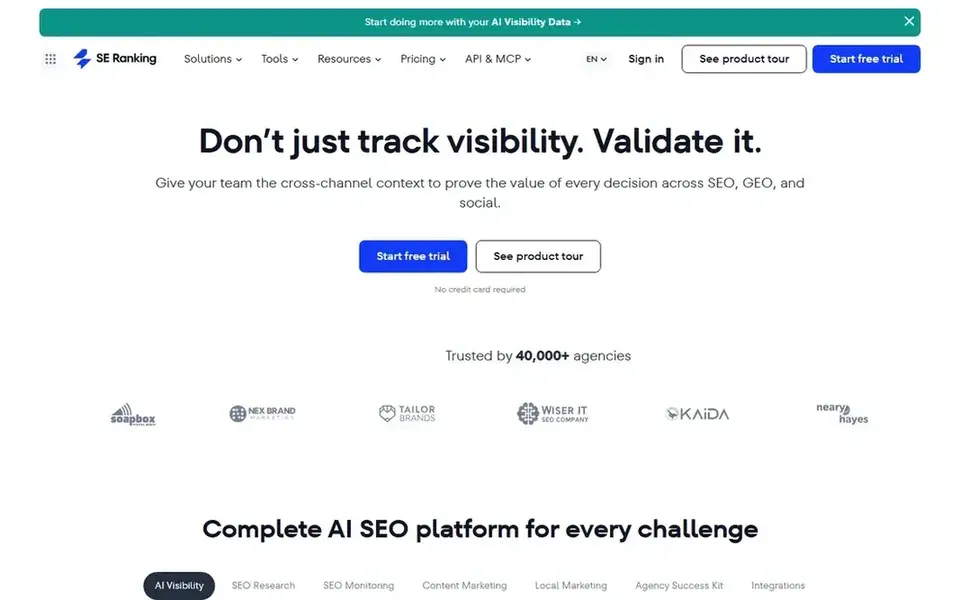
SE Ranking sits in the middle ground: more than a single-purpose grid scanner, less sprawling than the largest platforms. For an HVAC owner who wants to track a handful of service keywords across a few towns, the setup is manageable without a long learning curve.
You can create separate keyword groups for installation, repair and maintenance terms, then check positions by location. The reporting side is friendly to small businesses, which helps if you send a monthly update to a manager who does not work in SEO. Local marketing features cover some of the profile and listing basics as well.
Grid depth and local feature coverage depend on the plan you choose, so check the details before you buy. Very large multi-location operations may outgrow it.
- Rank tracking with location settings
- Local marketing features alongside SEO tools
- Reports that are easy to hand to a client

Ahrefs is known for keyword and backlink research, and that is where it earns its place on this list. For an HVAC company planning pages for each town or service, its keyword data helps you see what people search and which competitors rank for those terms.
Rank tracking by location is available, so you can follow your main terms over time. What it does not do as well as the specialists is show a map grid around a service address. Treat it as the research layer and pair it with a grid tool if map visibility is the question you care about most.
It is a large subscription for a small contractor. Skip it if you only need to know where you appear in the map pack each week.
- Strong keyword and competitor data
- Rank tracking by location
- Useful for planning service-area pages
- Local pack tracking is not the main focus
- Local grid views are limited
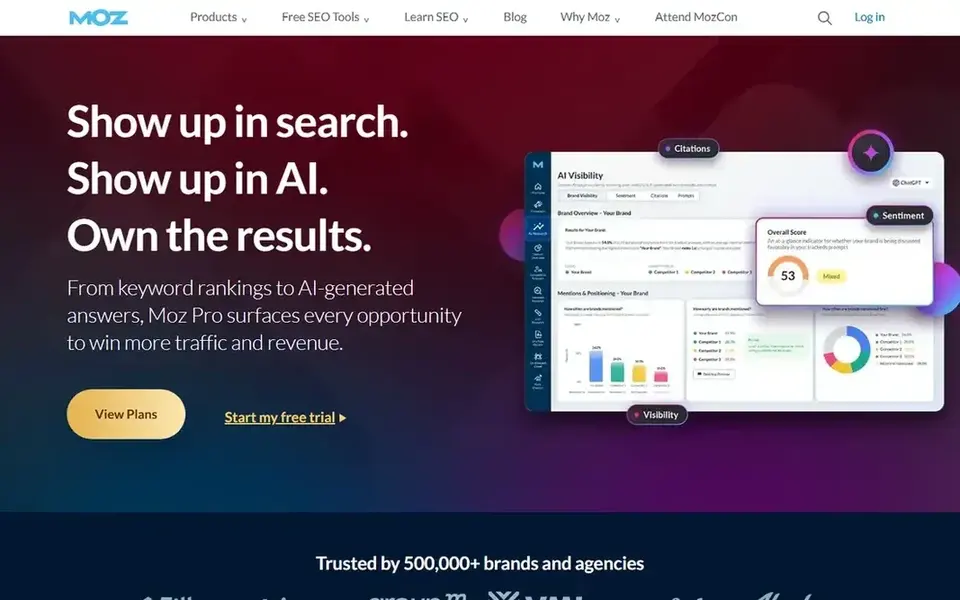
Moz Pro is a long-standing SEO platform with a local component. For an HVAC business owner who wants a clear weekly view of where the company ranks for core service terms, the dashboards are readable and the setup is not complicated.
You can track keywords by location and use the local features to keep listing details in order. The reports are simple enough to share with a partner or office manager who wants a summary rather than a data dump. It works best as a general tracking tool with local support.
Its map grid views are limited compared with Local Falcon or Semrush, so do not expect detailed heat maps around every service address. Larger agencies with many clients may find the local workflow thinner than they need.
- Straightforward rank tracking
- Local listing and citation features
- Reports that are easy to read
How I chose
I built this list from vendor documentation and public sources. That means reading each product's own pages on local rank tracking, map grids, location settings and reporting, and checking what each one says it covers. I did not run hands-on tests, so I am not claiming measured accuracy or speed for any tool.
The filter was fit for HVAC work. A tool had to support location-based tracking, because heating and cooling searches are local by nature. It had to handle more than one keyword group, so repair, installation and maintenance terms could be separated. Reporting counted, because many HVAC companies work with an agency or need to show progress to a manager. I also noted limits: some tools are specialists, some are broad platforms, and a small contractor should not pay for a suite it will not use.
What to check before you buy
- Confirm the tool tracks the map pack and local finder, not just organic results.
- Check how many locations and grid points you can scan, since a wide service area needs more than one point.
- Make sure you can group keywords by service line, such as AC repair, furnace repair and heat pump installation.
- Ask whether Google Business Profile data can be pulled in or compared alongside rankings.
- Look at the report format and decide whether it is readable for a business owner or client.
- Check that the tool follows Google's guidelines and does not promise review gating or keyword-stuffed business names.
Frequently asked questions
Do HVAC companies need a separate local rank tracker?
Yes, if map visibility matters to you. General rank trackers often report a single position for a city, while HVAC customers search by town and see different map results. A local tracker with grid views shows where you appear around each service area, which is closer to what a homeowner sees when they search for AC repair or furnace service.
What keywords should an HVAC company track?
Track three groups: urgent repair terms like "AC repair near me" and "emergency furnace repair", planned installation terms like "heat pump installation", and maintenance terms like "furnace tune-up". Add the town names you serve to each group. Separating them shows whether your visibility problem is in emergency searches, planned work or recurring service.
Can I track rankings for several towns with one tool?
Most tools on this list let you add multiple locations or scan points, but the limits depend on the plan. Check how many locations and grid scans are included before you buy. If you cover a wide area, a grid tool like Local Falcon or the local features in Semrush will show spread better than a single city-level position.
Is Google Business Profile performance enough on its own?
No. Profile performance shows how people found and interacted with your listing, but it does not show where you rank against competitors at each point on the map. Use it alongside a rank tracker. The two together tell you whether more people are seeing the listing and whether you are moving up in the map pack.
How often should I check local rankings?
Weekly is enough for most HVAC companies, and monthly is fine for reporting. Rankings move slowly in local search, and checking daily mostly adds noise. Set a schedule, keep the same grid size and keyword list, and compare over months. That makes it easier to connect changes to work you did on the profile, listings or service pages.
Sources
See where you really rank - block by block
ProMapRanker scans Google Maps across a grid of your service area. Simple monthly plans from $19, white-label on every plan.
Start freeBrowse all guides
← Best Local Rank Tracking Tools for Hotels in 2026Best Local Rank Tracking Tools for Law Firms in 2026 →
 best local rank tracking tools for contractors
Best Local Rank Tracking Tools for Contractors in 2026
A contractor's guide to the best local rank tracking tools for 2026, compared on grid tracking, Google Business Profile data, reviews and reporting.
Read → best local rank tracking tools for agencies
Best Local Rank Tracking Tools for Agencies in 2026
A practical guide to the best local rank tracking tools for agencies in 2026, covering grid tracking, GBP insights, reporting and multi-client workflows.
Read → best local rank tracking tools for accountants
Best Local Rank Tracking Tools for Accountants in 2026
A practical guide to the best local rank tracking tools for accountants, compared from vendor docs and public sources, with pricing and free plan notes.
Read → how to delete a review on google maps
How To Delete A Review On Google Maps?
Everything you need to know about how to delete a review on google maps: what it is, why it matters for local SEO, and exactly how to act on it.
Read → local seo benchmarking
Local SEO Benchmarking: How to Set and Beat Your Baselines
Set local SEO benchmarks with geo-grid baselines and learn how to measure progress against competitors.
Read → google business profile audit
Google Business Profile Audit: A Free 30-Point Checklist
Run a free Google Business Profile audit with this 30-point checklist to find quick wins.
Read →More in Local SEO & Google Maps · All guides A to Z by date · Latest guides