 ProMapRanker
Best Local Rank Tracking Tools for Hotels in 2026
Direct answer
My top pick for hotels is Semrush, because its local pack tracking, map grid views and competitor monitoring fit multi-location properties well. It has no free plan stated, so check its pricing page before you commit. If you want a dedicated local grid tool, try Local Falcon; if you need review and listing management alongside rankings, BrightLocal is the other name I would shortlist.
I compared these tools from vendor documentation and public sources, not from hands-on tests. I looked at what each one says it tracks, how it handles map results and multi-location accounts, and where the limits are for a hotel. Use this as a shortlist to check against your own property setup.
Key takeaways
- Hotels need rank tracking that reads the map pack, not just blue-link results, because most booking searches start with a map.
- Grid-based tools show how visibility changes street by street, which matters when your property sits near competitors or a landmark.
- Multi-location tracking lets a hotel group compare its city-centre, airport and resort properties in one dashboard.
- Review signals and Google Business Profile health affect local rankings, so tools that combine both save you a second subscription.
- Check that the tool supports the countries and languages your guests search in before you buy.
Quick comparison
| Pick | Great for | Pricing starts at | Free tier | |
|---|---|---|---|---|
 Semrush | All-round local and organic tracking | See website | Not stated | Visit |
 Local Falcon | Map grid visibility scans | See website | Not stated | Visit |
 BrightLocal | Reviews, citations and rank checks together | See website | Free trial | Visit |
 Whitespark | Citation building and local rank tracking | See website | Not stated | Visit |
 SE Ranking | Agencies managing several hotel clients | See website | Free trial | Visit |
 Ahrefs | Keyword and competitor research | See website | Not stated | Visit |
 Google Business Profile | The source of your own listing data | See website | Free plan | Visit |
The best local rank tracking tools for hotels compared
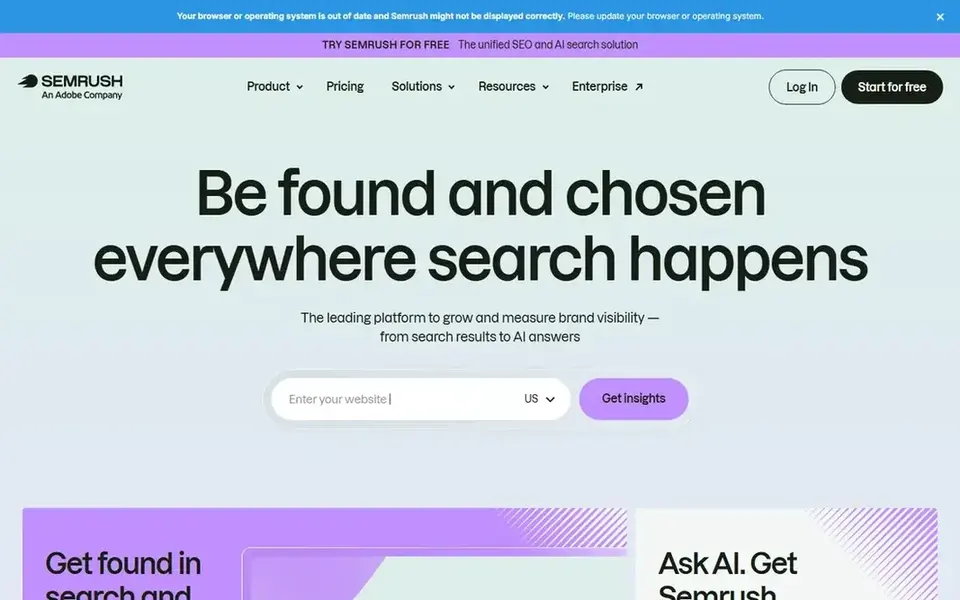
Semrush is a broad SEO platform that also covers local search. For a hotel it is useful when you want one dashboard for your website pages, your Google Business Profile visibility and the keywords guests use, such as "boutique hotel near the station" or "pet-friendly hotel [city]". It suits marketing teams at hotel groups and agencies that already run organic campaigns.
The position tracking feature lets you set up projects per property and watch how each one ranks for branded and non-branded searches. You can compare your hotel against nearby competitors and see whether a new competitor listing has pushed you down in the map pack. For a hotel with seasonal demand, that history helps you spot changes before the booking window opens.
The limit is depth on map grids. If you mainly want to see how visibility changes across a city, a dedicated grid tool does that more directly. Skip Semrush if you only need a simple rank check and nothing else.
- Local pack and map tracking alongside organic rankings
- competitor and keyword research in one place
- position tracking for many locations
- Local grid views are less detailed than dedicated map tools
- plans can be heavy for a single small hotel
Local Falcon is built around map grid scans. It places a grid over an area and checks where a business appears in local results at each point. For a hotel this is a clear way to see whether you show up for guests searching from the airport, the motorway junction or the old town.
A city-centre hotel often ranks well right at its address but drops off a few streets away. A grid scan makes that visible, so you can decide whether to work on reviews, categories or nearby landmark mentions. Resort hotels can use it to check visibility from the main access roads and transport hubs.
The tool is focused on grids rather than full rank tracking for your website. If you need organic keyword tracking and content tools too, you will need a second product. Skip it if you only want a single daily rank number.
- Grid scans show visibility across a map area
- good for spotting weak spots around a property
- useful competitor comparison on the same grid
- Narrower than a full SEO suite
- grid scans are a snapshot, so you need to repeat them
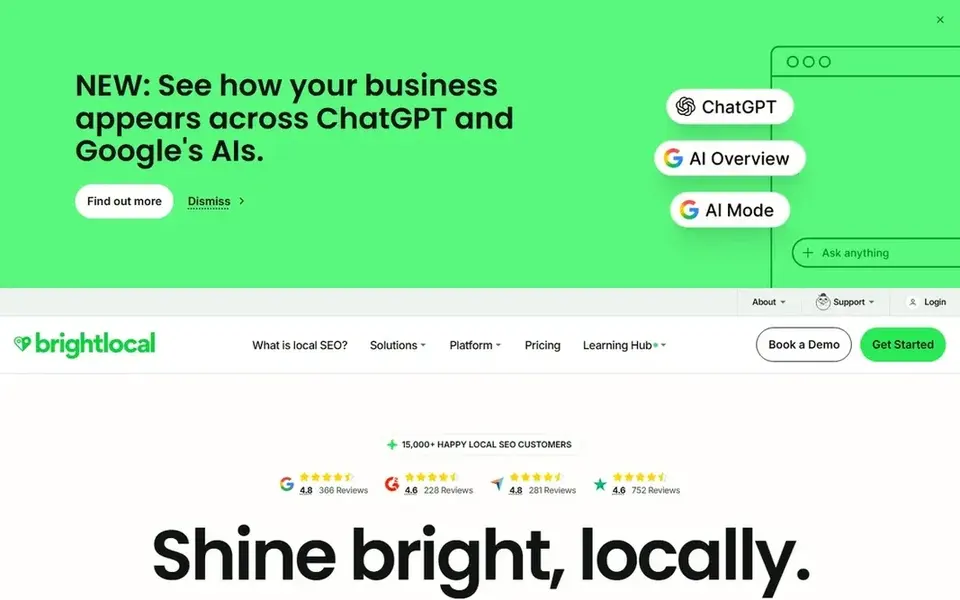
BrightLocal is a local marketing platform with rank tracking, review monitoring, citation checks and reporting. For a hotel, the appeal is having guest reviews and map rankings in the same place, since review signals and listing accuracy both affect how you appear in local results.
You can track rankings for each property, monitor new reviews across Google and other platforms, and check that your name, address and phone number match across directories. For a group with several hotels, the reporting helps you show owners how each property is doing without building spreadsheets by hand.
The trade-off is breadth. A single small hotel may not need every module, and the interface takes some learning. If you want one simple rank checker, look elsewhere.
- Combines local rank tracking with review and citation tools
- multi-location reporting for hotel groups
- clear reports you can share with owners
- Many features can feel busy for one property
- some tools are aimed more at agencies than in-house teams
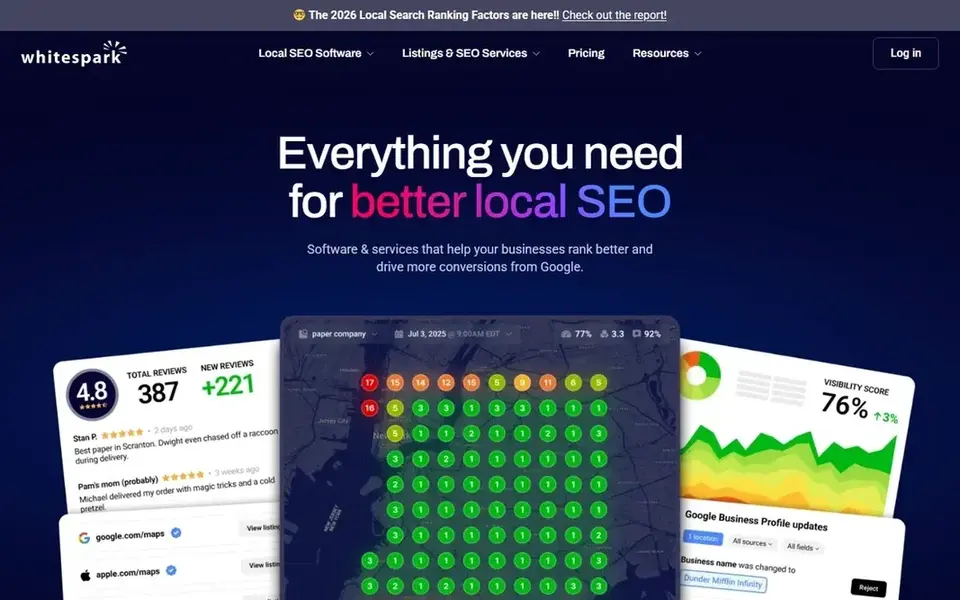
Whitespark is known for local search tools, including citation building and a local rank tracker. For hotels, accurate listings matter because guests find you through OTAs, directories and maps, and inconsistent addresses or phone numbers confuse both guests and search engines.
The local rank tracker shows how a property performs in local results, and the citation tools help you fix and build listings across directories. An agency running local SEO for several hotels can use it to keep listing data consistent and to check rankings after changes.
It is a professional tool, so a single hotel owner may find it more than needed. Skip it if you already have listing management covered and only want rank data.
- Strong citation and listing tools alongside local rank tracking
- grid-based local search rank views
- good fit for agencies serving hotels
- Less of an all-in-one SEO suite
- pricing is aimed at professionals
SE Ranking is an SEO platform with rank tracking, competitor analysis and reporting. It fits agencies and marketing teams that manage several hotel websites and want one place to check rankings across properties and markets.
For hotels, you can set up projects per property, track keywords in the languages guests use, and check local results alongside standard organic rankings. The reporting features help when you need to send a monthly summary to a hotel owner or general manager who does not log into the tool.
The main limit is that local-specific depth varies by plan, so check what is included before you buy. A single property with a small budget may find it more than necessary.
- Rank tracking with local and map results
- white-label reports for client hotels
- competitor tracking in the same project
- Some local features depend on the plan
- setup takes time for many locations

Ahrefs is a research and analysis platform. For a hotel it is most useful before and alongside rank tracking: finding the search terms guests use, checking which competitor hotel or OTA pages rank for them, and seeing which pages earn links.
It can track rankings for your site, but it is not built around the map pack the way local tools are. Use it to plan content and understand the competitive landscape, then use a local tool for map visibility.
Skip it if your only goal is to see where your hotel appears on the map. It is a research tool first.
- Deep keyword and backlink data
- useful for destination and competitor research
- strong reporting on organic visibility
- Local pack tracking is not the core focus
- less suited to street-level map visibility
Google Business Profile is the free listing tool every hotel should use. It is where your property details, photos, categories, amenities and reviews live, and it is the source Google uses for much of what appears in the map pack.
Its performance insights show how people find your listing and what they do next, such as requesting directions or calling. That is not the same as rank tracking, but it tells you whether your listing is doing its job. Pair it with a rank tracking tool to see where you appear relative to competitors.
It does not show competitive rankings or keyword positions, so it cannot replace a tracker. Use it as the foundation, not the whole system.
- Free and official
- shows how your listing appears and performs
- insights on calls, direction requests and messages
- No competitive rank tracking
- limited keyword-level reporting
How I chose
I compared these tools from vendor documentation and public sources rather than hands-on tests. I read what each vendor says about local rank tracking, map results, multi-location support and reporting, and I checked how those features fit the way hotels are found: through map searches, review signals and listing accuracy.
The shortlist favours tools that handle more than one property, because hotels are often part of a group or managed by an agency. I also weighed limits, such as whether a tool is a full SEO suite or a focused local product, so you can match it to your team size and budget. Where a feature depends on the plan, I say so.
What to check before you buy
- Confirm the tool tracks the map pack and local results, not just standard organic rankings.
- Check multi-location support if you manage more than one property, including how projects and reports are organised.
- Make sure it covers the countries and languages your guests search in.
- Look for review monitoring if guest reviews are part of your local strategy, since review signals affect local visibility.
- Ask whether grid or radius views are included, because street-level visibility matters for city hotels.
- Check reporting and export options so you can share results with owners or managers who do not use the tool.
Frequently asked questions
What is local rank tracking for a hotel?
It is the process of checking where your hotel appears in local search results, including the map pack, for searches guests use. It usually covers branded searches, such as your hotel name, and non-branded ones, such as "hotel near the train station". Tools track these positions over time and across locations.
Do hotels need a grid-based rank tracker?
Not always, but it helps. A grid scan shows how visibility changes across an area, which is useful when your hotel sits near competitors, a landmark or a transport hub. A simple rank checker gives one position, while a grid shows the pattern around your property.
Can I track rankings for multiple hotel properties?
Yes, most tools on this list support multiple projects or locations. Check how the tool organises them and whether reports can be split by property. For groups, look for a dashboard that compares properties without manual work.
Does Google Business Profile show my rankings?
No. It shows performance insights for your own listing, such as calls and direction requests, but not competitive rankings or keyword positions. Use it as the base for your listing and pair it with a rank tracking tool for position data.
How often should I check local rankings?
Weekly checks are usually enough for most hotels, with a closer look around seasonal booking periods or after listing changes. Grid scans can be run less often, such as monthly, unless you are actively testing changes.
Sources
See where you really rank - block by block
ProMapRanker scans Google Maps across a grid of your service area. Simple monthly plans from $19, white-label on every plan.
Start freeBrowse all guides
← Best Local Rank Tracking Tools for Contractors in 2026Best Local Rank Tracking Tools for HVAC Companies in 2026 →
 best local rank tracking tools for agencies
Best Local Rank Tracking Tools for Agencies in 2026
A practical guide to the best local rank tracking tools for agencies in 2026, covering grid tracking, GBP insights, reporting and multi-client workflows.
Read → best local rank tracking tools for accountants
Best Local Rank Tracking Tools for Accountants in 2026
A practical guide to the best local rank tracking tools for accountants, compared from vendor docs and public sources, with pricing and free plan notes.
Read → best local landing page builders
Best Local Landing Page Builders in 2026
A practical guide to the best local landing page builders for 2026, compared on vendor docs and public sources for local SEO and Google Business Profile work.
Read → local seo for accountants and cpas
Local SEO for Accountants and CPAs
A local SEO guide for accountants and cpas: Google Business Profile setup, reviews, and seasonal tax-time local search visibility.
Read → promapranker vs whitespark
ProMapRanker vs Whitespark: Which Local Rank Tracker Wins
A side-by-side comparison of ProMapRanker and Whitespark for geo-grid local rank tracking: features, pricing, and accuracy.
Read → map rank tracker
Map Rank Tracker: Visualize Your Maps Rankings as a Heatmap
A map rank tracker turns your rankings into a visual heatmap. See how to read and act on the colors.
Read →More in Local SEO & Google Maps · All guides A to Z by date · Latest guides