 ProMapRanker
Best Investing and High Return Platform in 2026

Key takeaways
- No platform can promise high returns, and any platform that does should be treated with caution.
- Fidelity, Charles Schwab, and Vanguard lead for low-cost, long-term investing, with zero-commission stock and ETF trades.
- Robinhood, Webull, and SoFi suit mobile-first investors, while Betterment and Wealthfront suit hands-off investors.
- Fees, fund costs, and your own risk tolerance matter more than a platform brand when results differ over years.
Quick comparison
| Pick | Great for | Pricing starts at | Free tier | |
|---|---|---|---|---|
 Fidelity | Overall low-cost investing | Free | Yes | Visit |
 Charles Schwab | Research and active traders | Free | Yes | Visit |
 Vanguard | Long-term index investors | Free | Yes | Visit |
 Robinhood | Mobile-first beginners | Free | Yes | Visit |
 Webull | Active traders and charting | Free | Yes | Visit |
 SoFi Invest | New investors and simple start | Free | Yes | Visit |
 Betterment | Hands-off automated investing | 0.25% per year | No | Visit |
 Wealthfront | Automated investing and tax tools | 0.25% per year | No | Visit |
 E*TRADE | Education and intermediate traders | Free | Yes | Visit |
The best investing platforms
This is not financial advice. Returns vary, past performance does not guarantee future results, and investing carries risk of loss, including loss of your original investment. The platforms below do not create returns by themselves: returns come from the investments you choose, the fees you pay, and how long you stay invested. We compared them on commissions, fund costs, account types, research, and ease of use.
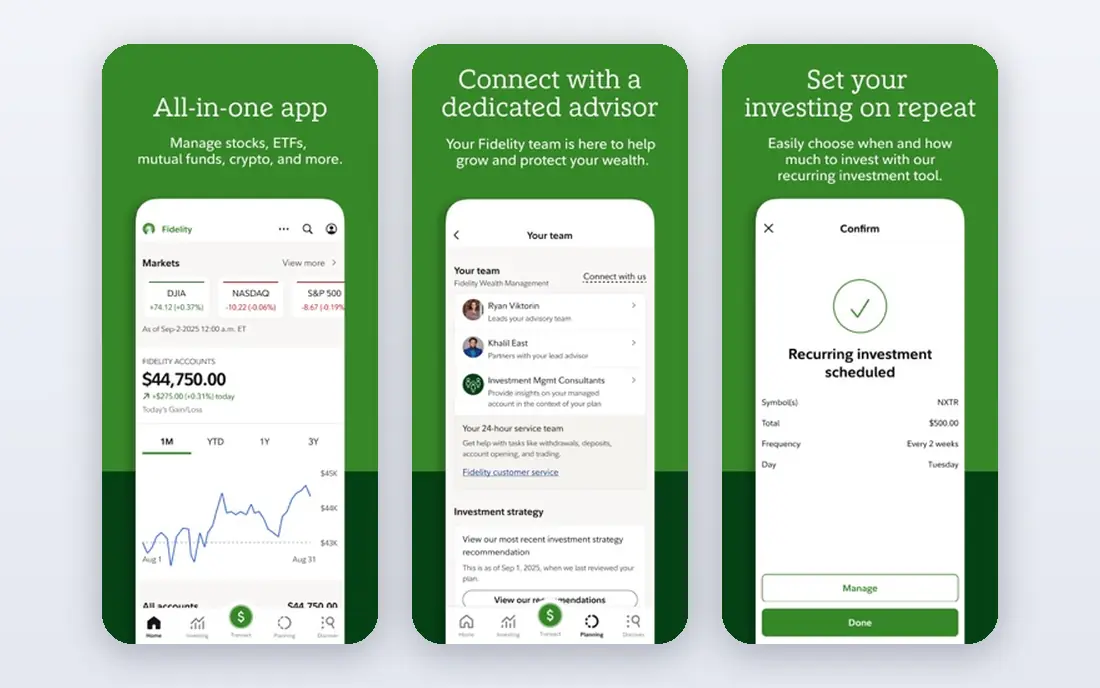
Fidelity is our pick for most investors. Stock and ETF trades carry no commission, fractional shares start from small amounts, and its own zero expense ratio index funds keep ongoing fund costs very low. Retirement accounts, taxable accounts, and cash management sit in one place, which makes it easy to build a long-term plan without juggling several providers.
The breadth is also the catch. Fidelity offers so many tools, accounts, and research reports that a new investor can feel lost on the first visit. Start with a single diversified fund or a simple portfolio, use the education library for the basics, and add advanced tools only when you need them.
- Zero-commission stock and ETF trades
- Zero expense ratio index funds
- Broad research and retirement accounts
- The full platform can feel large for a first-time investor
- Some advanced tools take time to learn
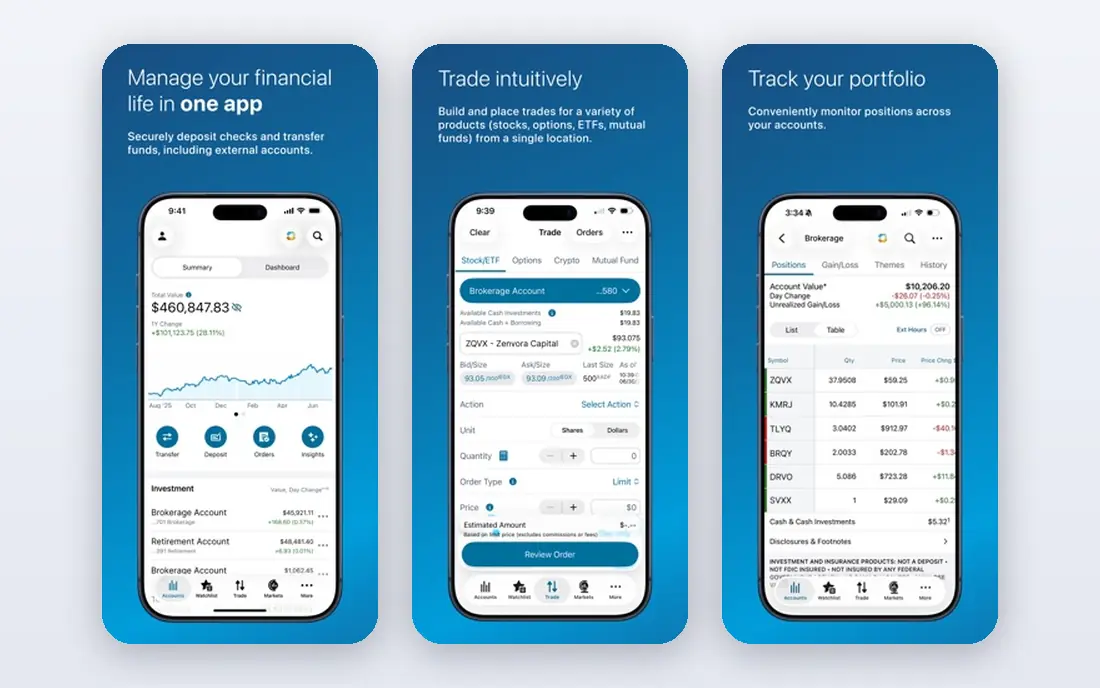
Charles Schwab suits investors who want strong research and a serious trading platform alongside retirement accounts. Stock and ETF trades are commission-free, fractional shares are available, and thinkorswim, inherited from TD Ameritrade, gives active traders charting and paper trading. The education library is also strong for investors who want to learn before they trade more often.
One detail to watch is uninvested cash. Schwab default cash sweep yields have often been lower than money market fund yields, so cash sitting idle may earn less than at some rivals unless you move it. Check where your uninvested cash sits, and do not leave large sums idle without a reason.
- Zero-commission stock and ETF trades
- Thinkorswim trading platform
- Strong education library
- Default cash sweep yields can be low unless you choose a money market fund
- Interface differs across platforms
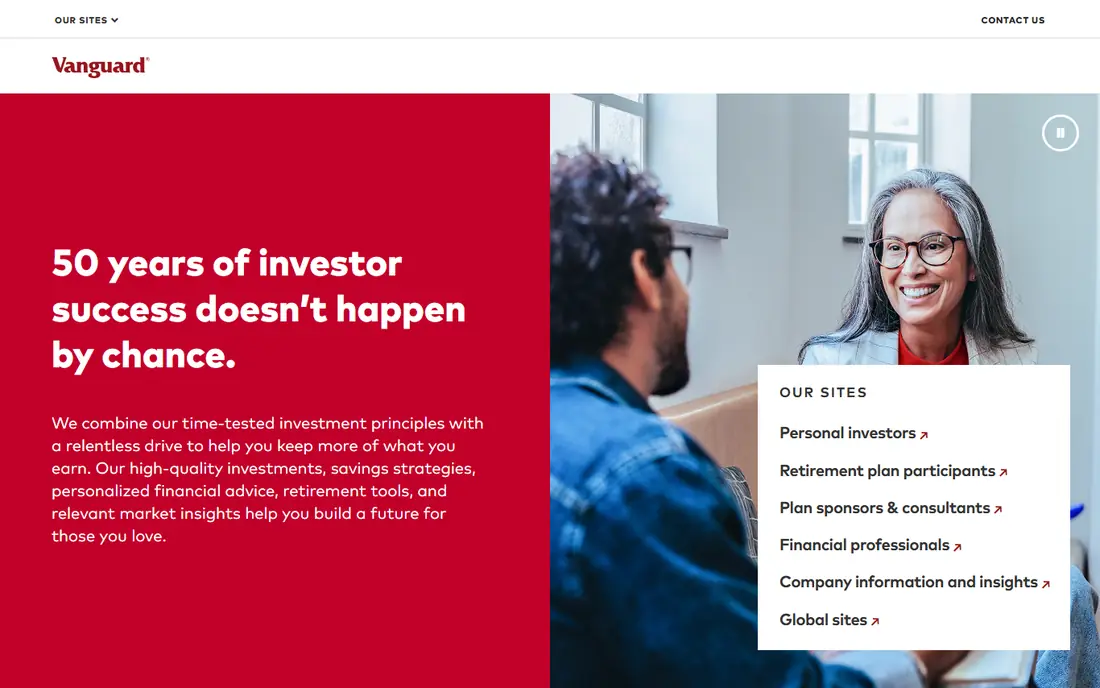
Vanguard is the classic choice for buy-and-hold investors. Its index funds and ETFs carry very low average expense ratios, and the company structure, owned by its funds, keeps the focus on low costs rather than upselling. For a retirement saver who wants a diversified portfolio and plans to hold for decades, Vanguard is hard to fault on cost.
The experience is less polished than Fidelity or Schwab. The app and website feel dated, and options traders pay more per contract than at several rivals. If you trade rarely and value low fund costs above app design, that trade is easy to accept, but active traders should look elsewhere.
- Very low-cost index funds and ETFs
- Strong retirement focus
- Simple long-term portfolios
- Mobile app and website feel dated next to rivals
- Options cost more per contract than some brokers
Robinhood is the easiest platform on this list to start on. The mobile app is clean, stock and ETF trades are commission-free, fractional shares let you start small, and an IRA contribution match is available with the paid Gold plan. For a new investor who wants to buy a first ETF from a phone, Robinhood removes most friction.
The simplicity has limits. Research, retirement planning tools, and customer support depth are thinner than at Fidelity or Schwab, and Gold costs a monthly fee. Treat Robinhood as a starting point, not a full financial plan, and be careful with borrowed-money or speculative trades, which can lose money fast.
- Simple mobile app
- Zero-commission stock, ETF, and options trades
- Fractional shares and IRA match on Gold
- Research is thinner than full brokers
- Gold subscription adds a monthly cost for extra features
Webull appeals to traders who live in charts. It offers commission-free stock and ETF trades, detailed technical analysis tools, and extended hours trading, all in a mobile-first design. For an investor who follows price patterns and trades more often than a buy-and-hold saver, Webull gives more charting power than most beginner apps.
The gaps matter for long-term savers. Webull does not offer mutual funds, and its education and retirement planning tools are thinner than those at Schwab or Fidelity. Frequent trading also raises costs through spreads and taxes, and it does not guarantee better returns, so keep position sizes modest.
- Zero-commission stock and ETF trades
- Strong charting and technical tools
- Extended hours trading
- No mutual funds
- Research and education are thinner than full-service brokers
SoFi Invest suits new investors who want investing next to banking in one app. There are no account minimums, you can choose self-directed trading or automated investing, and the interface keeps the basics clear. For someone already using SoFi for banking or loans, adding investing in the same app is convenient.
The range is narrower than a full broker. Research tools are limited, and the investment menu does not match Fidelity or Schwab for depth. That is fine for a simple diversified portfolio, but investors who want bonds, a wide fund range, or advanced trading tools should compare a larger broker first.
- No account minimums
- Simple active and automated investing
- Banking and lending in one app
- Research is limited
- Investment choice is narrower than large brokers
Betterment is for investors who want a portfolio managed for them. You answer questions about goals and risk tolerance, Betterment builds a diversified portfolio, and it rebalances automatically as markets move. The annual advisory fee is clear, and goal-based planning helps retirement, home, and general savings goals stay separate.
The trade is control. You do not pick individual stocks, and the advisory fee, while modest, adds up over decades compared with a do-it-yourself index portfolio. If you enjoy choosing investments, Betterment will feel restrictive, but if you want investing handled with little input, it is a strong choice.
- Automated diversified portfolios
- Goal-based planning
- Automatic rebalancing
- Annual advisory fee applies
- Less control over individual holdings
Wealthfront pairs automated investing with tax tools that can help taxable accounts. Its portfolios rebalance automatically, tax-loss harvesting can offset gains in taxable accounts, and planning tools cover retirement and college goals. A self-directed option also exists for investors who want some manual control alongside automation.
As with Betterment, the advisory fee is the cost of convenience, and some features carry minimums. Tax-loss harvesting helps only in taxable accounts, not in retirement accounts, so the benefit depends on where you invest. Check the fee and the account type before you assume the tax features will pay for themselves.
- Automated portfolios with tax-loss harvesting
- Cash account and planning tools
- Self-directed option available
- Annual advisory fee applies
- Account minimum applies to some features
E*TRADE, part of Morgan Stanley, suits intermediate investors who want education alongside trading. Stock and ETF trades are commission-free, webinars and courses cover many topics, and paper trading lets you practice without risking real money. The platform range, from mobile app to professional desktop tools, grows with the investor.
Options trades still carry a per-contract fee, and the Morgan Stanley connection means some services overlap with other Morgan Stanley offers. That is a minor point for most investors, but it is worth knowing when you compare account types. For a learner who wants to trade with guidance, E*TRADE remains a solid middle ground.
- Zero-commission stock and ETF trades
- Strong education and webinars
- Paper trading for practice
- Now part of Morgan Stanley, so some tools overlap with other offers
- Options fees apply per contract
How we picked these
We compared official fee schedules, fund expense ratios, account types, and platform features from the vendors themselves, plus public broker comparisons. We favored platforms that are open to US retail investors, publish clear fees, and offer diversified investments rather than speculative products alone. We did not rank platforms by past returns, since past returns do not predict future results, and we excluded any platform promising guaranteed high returns.
How to choose an investing platform
Match the platform to how you invest
A buy-and-hold saver needs low fund costs and a simple portfolio, which points to Vanguard, Fidelity, or Schwab. A hands-off investor needs automation, which points to Betterment or Wealthfront. A frequent trader needs charting and low trading friction, which points to Webull or Schwab thinkorswim. Pick the platform that fits your actual habit, not the one with the most features.
Watch fees, not just commissions
Zero commission does not mean zero cost. Fund expense ratios, advisory fees, options fees, and cash sweep yields all affect long-term results, and small annual differences compound over decades. Compare the total cost for your portfolio size and trading pattern, and keep cash invested or in a suitable cash option rather than sitting idle.
Manage risk from the start
Higher potential return normally comes with higher risk, and concentrated bets, borrowed money, and speculative assets can lose value fast. Diversify across asset types, keep an emergency fund outside your investments, and only invest money you can leave invested for years. If a return sounds guaranteed, step back and check the risks before you commit any money.
Frequently asked questions
Can any platform guarantee high returns?
No. Returns depend on markets, the investments you choose, fees, and timing, and no honest platform can guarantee a high return. Be cautious of any service promising guaranteed profits, since that promise is a common sign of fraud or extreme risk.
Is it better to pick stocks or index funds?
Index funds give broad diversification at low cost, which suits most long-term investors. Picking individual stocks can beat the market, but it can also lag it badly, and it takes research and discipline. Many investors combine a core index portfolio with a small amount for individual ideas they follow closely.
How much money do I need to start investing?
Most platforms on this list have no account minimum for a taxable or retirement account, and fractional shares let you start with small amounts. Start with an amount you can afford to leave invested, build the habit with regular contributions, and increase the amount as your income allows.
What is the difference between a broker and a robo-advisor?
A broker gives you the tools to choose and trade investments yourself, while a robo-advisor builds and manages a diversified portfolio for you for an annual fee. Brokers suit investors who want control, and robo-advisors suit investors who want automation and are happy to pay for it.
Are my investments safe if a platform fails?
US brokers normally hold customer securities separately from company assets, and SIPC protection covers missing securities up to set limits if a firm fails. SIPC does not protect against market losses, so your investments can still fall in value even when the platform itself is sound.
Sources
See where you really rank - block by block
ProMapRanker scans Google Maps across a grid of your service area. Simple monthly plans from $19, white-label on every plan.
Start freeKeep reading
 free alternatives to grok imagine
Free Alternatives to Grok Imagine in 2026
We compared the best free alternatives to grok imagine for image generation, from fast daily credits to design tools, so you can create without paying.
Read → best tools for instagram content creation
Best Tools for Instagram Content Creation in 2026
Compare the best tools for Instagram content creation, from Canva and CapCut to Later and Buffer, on design, video, planning, scheduling, and price in 2026.
Read → best tool to split pdf files
Best Tool to Split PDF Files in 2026
We compared the best tool to split pdf files on split modes, file limits, privacy and price, so you can split a PDF cleanly and keep every page in one go.
Read →