 ProMapRanker
Best Holding Company Names in 2026

Key takeaways
- Good holding names are broad, formal and durable, so they still fit if you add businesses later.
- Generators give ideas fast, while curated naming services add human screening and trademark checks.
- A free domain result does not prove a name is legally available, so check trademarks and state registers separately.
- Shortlist several names before filing, because your first choice may already be taken.
Quick comparison
| Pick | Great for | Pricing starts at | Free tier | |
|---|---|---|---|---|
 Namelix | Free AI name ideas with domain checks | Free | Yes | Visit |
 Atom | Vetted names and naming contests | See website | No | Visit |
 BrandBucket | Curated premium brand names | See website | No | Visit |
 Novanym | Curated names with domain included | See website | No | Visit |
 NameSnack | Keyword-based name ideas | See website | Yes | Visit |
 Shopify Business Name Generator | Free name ideas tied to store setup | Free | Yes | Visit |
 Looka | Names with visual brand identity | Free | Yes | Visit |
 Panabee | Creative domain and name problem-solving | Free | Yes | Visit |
The best holding company name tools
This article does not list invented holding company names, because a name that fits one business can clash with a trademark, a domain or a state register for another. Instead, it compares naming tools and services that help you generate, screen and choose a holding company name that fits your own structure.
A holding company name is usually formal, broad and durable, since it may cover several businesses over time. Use these tools for ideas, then check trademark, domain and state registration availability before you file anything. Keep the shortlist broad at first, because a formal name that sounds right on day one may fail a check later, and a backup list saves a rushed second choice.
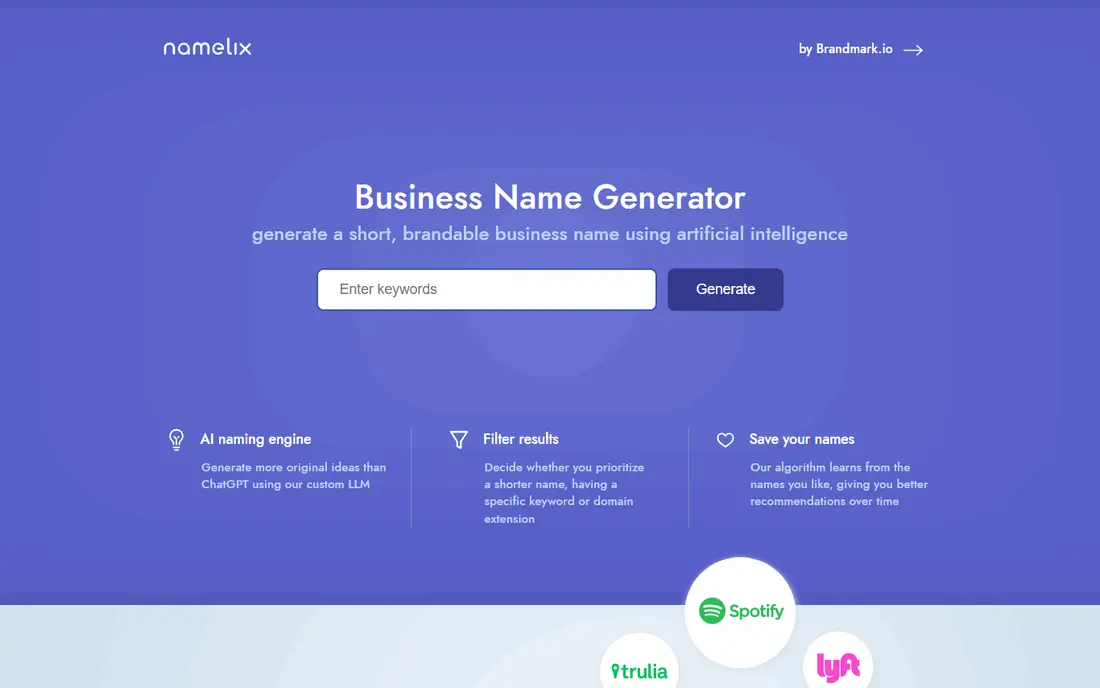
Namelix suits founders who want many short, brandable name ideas fast, without paying before they see directions they like. Its generator lets you set name style, length and keywords, and it shows domain signals alongside each idea.
It does not clear trademarks, so every shortlisted name still needs trademark and state register checks before filing. Before you file, run trademark, domain and state business-register checks on every shortlisted name, and keep notes on which checks you ran.
- Free generation
- Short brandable name styles
- Domain signals and logo concepts
- No trademark clearance
- Ideas need separate legal checks
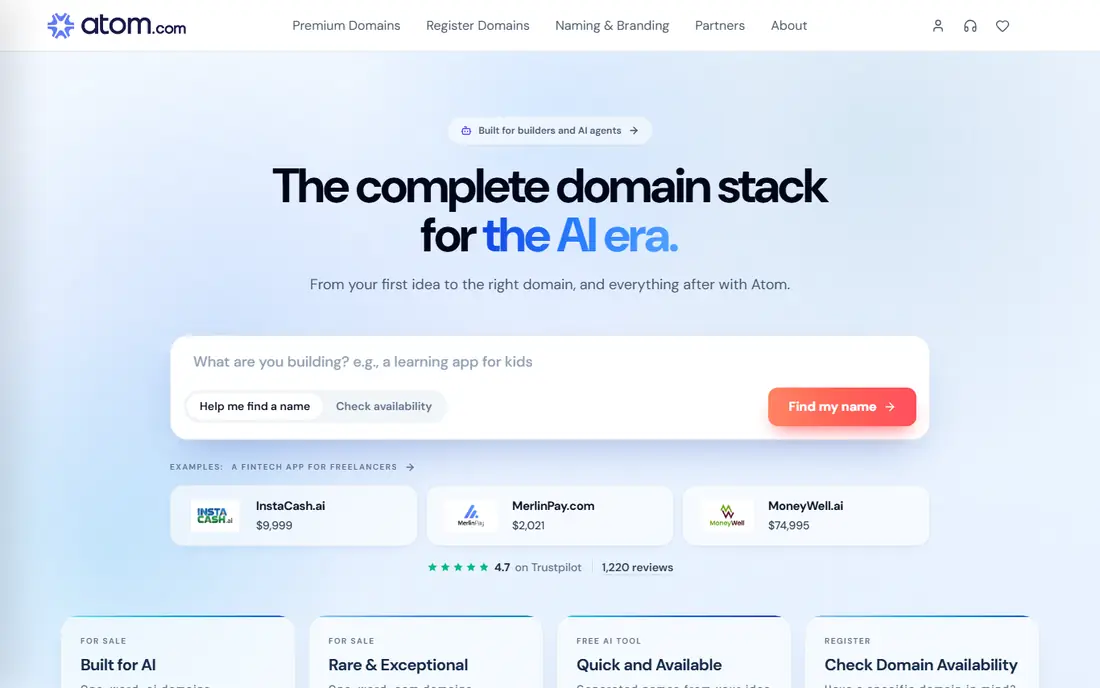
Atom, formerly Squadhelp, suits founders who want vetted names or a contest where many people propose and refine ideas. Its marketplace and contest model add human judgement to AI generation, which can help when the stakes are higher.
Premium names and contest fees cost more than free tools, so set a budget before you start a contest. Before you file, run trademark, domain and state business-register checks on every shortlisted name, and keep notes on which checks you ran.
- Curated premium names
- Naming contests with human input
- Trademark and domain screening options
- Premium names and contests cost more than free generators
BrandBucket suits buyers who want a ready, curated brand name with a matching domain, rather than generating ideas from scratch. Its marketplace pairs names with domains and logo options, which speeds up branding once a name is chosen.
Premium prices can be high, and many names are styled for consumer brands, so filter for formal, broad holding-company tones. Before you file, run trademark, domain and state business-register checks on every shortlisted name, and keep notes on which checks you ran.
- Curated name marketplace
- Names paired with domain and logo options
- Premium pricing
- Holding names may need a broader, formal tone
Novanym suits buyers who want a short, curated name with a domain included, without running a contest. Its catalogue focuses on brandable names that are ready to buy, which suits founders who want a quick, clean choice.
The catalogue is smaller than larger marketplaces, so it works best as one shortlist source among several. Before you file, run trademark, domain and state business-register checks on every shortlisted name, and keep notes on which checks you ran.
- Curated names
- Domain included with a purchase
- Logo options
- Premium pricing
- Smaller catalogue than larger marketplaces
NameSnack suits founders who want quick keyword-based ideas and domain signals in a simple interface. Enter a few holding-related or neutral keywords, and it returns combinations to shortlist and screen further.
Its screening depth is limited, so treat results as raw ideas and run trademark and state checks separately. Before you file, run trademark, domain and state business-register checks on every shortlisted name, and keep notes on which checks you ran.
- Free idea generation from keywords
- Domain availability signals
- Simple interface
- Limited screening depth
- Ideas need separate legal checks
Shopify Business Name Generator suits founders who want free, fast ideas and who may also set up an online store. It checks domain signals as it generates names, which helps avoid shortlisting names with no usable domain.
Its tone leans toward store and consumer brands, so holding-company founders should filter for broad, formal options. Before you file, run trademark, domain and state business-register checks on every shortlisted name, and keep notes on which checks you ran.
- Free to use
- Domain availability signals
- Useful if you also need a store
- E-commerce focus
- Limited formal holding-name styling
Looka suits founders who want to see a name with a logo and brand preview before choosing, which helps judge tone. Its search is free, and it shows social handle signals alongside name ideas, which is useful for a professional presence.
Full brand kits cost extra, and Looka does not clear trademarks, so screen shortlisted names separately. Before you file, run trademark, domain and state business-register checks on every shortlisted name, and keep notes on which checks you ran.
- Free to search
- Name ideas with logo and brand previews
- Social handle signals
- Full brand kits are paid
- No legal clearance
Panabee suits founders whose first-choice names are taken and who need creative alternatives fast. It checks domain and app-name availability and suggests related spellings and combinations when an idea is unavailable.
It is a brainstorming tool, not a legal or curation service, so run full trademark and state checks on any name you keep. Before you file, run trademark, domain and state business-register checks on every shortlisted name, and keep notes on which checks you ran.
- Free to use
- Domain and app-name checks
- Creative suggestions when a name is taken
- Simpler interface
- No trademark clearance or curation
How we picked these
We compared official naming tool pages on generation style, domain checks, trademark screening and pricing. We did not invent company names, and we used See website where pricing depends on a contest, premium name or package chosen.
How to choose a holding company name with these tools
Start broad, then narrow. A holding company may own businesses in different fields, so avoid a name tied to one product or place unless that is deliberate. Generate broad directions first, such as abstract, geographic or founder-based themes, then test each one against your long-term plans.
Screen before you fall in love. Check domain availability, social handles, trademark databases and your state business register for each shortlist name. A name that passes one check can still fail another, so run all of them before spending on branding or filings.
Say it, spell it and file it. A holding name will appear on contracts, bank forms and tax filings, so it should be easy to spell, pronounce and type. Test it in an email address, a letterhead line and a phone conversation, and avoid spellings that need constant correction.
Keep a backup shortlist. Your first choice may be taken, too close to an existing firm, or blocked by a trademark in your field. Keep three to five screened backups, so a failed check does not force a rushed second choice.
Frequently asked questions
What makes a good holding company name?
A good holding name is broad, formal and durable, so it still fits if the group adds businesses in new fields. It should be easy to spell and pronounce, and it should pass trademark, domain and state register checks. Avoid names tied to a single product unless that scope is fixed.
Can I use a name generator for a holding company?
Yes, generators are useful for ideas and directions, especially for abstract or compound names. They do not replace legal checks, so treat generated names as a shortlist to screen, not as cleared names. Curated services can add human review and preliminary trademark screening.
Do I need a domain for a holding company name?
A matching domain helps for email, banking and professional correspondence, even if the holding company has no public website. Check domain availability early, and consider common extensions if the exact match is taken. A domain result alone does not prove legal availability.
How do I check if a holding company name is taken?
Check your state business register, the US trademark database and domain availability, in that order for most US firms. State rules differ, so confirm the exact filing office and name rules for your state. A lawyer can help when a name is close to an existing mark.
Should a holding company name mention holdings?
It can, but it does not have to, and many holding companies use neutral names that do not describe their subsidiaries. A neutral name gives more room to add businesses later. Choose based on your filing, banking and branding needs, not on a naming trend.
Sources
See where you really rank - block by block
ProMapRanker scans Google Maps across a grid of your service area. Simple monthly plans from $19, white-label on every plan.
Start freeKeep reading
 wpforms alternatives
Best WPForms Alternatives in 2026
We compare 9 wpforms alternatives for WordPress forms, with free and paid options, current pricing notes, and honest limits for small business sites in 2026.
Read → windows task scheduler alternatives
Best Windows Task Scheduler Alternatives in 2026
Looking for Windows Task Scheduler alternatives? We compare 9 schedulers for Windows and cross-platform work, from free tools to enterprise automation.
Read → which ai video service is best
Which AI Video Service Is Best in 2026
which ai video service is best? We compare 10 legitimate AI video services on price, avatars, editing and output quality to help you pick the right tool.
Read →