 ProMapRanker
Best Healthcare Software Development Companies in 2026

Key takeaways
- Healthcare development is a compliance project first and a coding project second, so HIPAA handling, audit trails, and data access controls must come before design polish.
- Arkenea, ScienceSoft, and OSP Labs stand out for healthcare-only or healthcare-heavy work, while larger general firms suit enterprise scale.
- Most firms price by project or by hour, so we list See website where no public rate is reliable, and we note typical rate ranges only where sources agree.
- EHR and FHIR experience is the fastest filter: ask for a live integration example in your exact EHR before you shortlist a firm.
- This is not medical advice, and software choices do not replace clinical, legal, or compliance review for your organization.
Quick comparison
| Pick | Great for | Pricing starts at | Free tier | |
|---|---|---|---|---|
 Arkenea | Healthcare-only custom builds | See website | No | Visit |
 ScienceSoft | Enterprise clinical systems | See website | No | Visit |
 OSP Labs | HIPAA and FDA-aware builds | See website | No | Visit |
 Appinventiv | Patient-facing health apps | See website | No | Visit |
 HTD Health | Digital health product teams | See website | No | Visit |
 Folio3 Digital Health | Epic-linked apps and health SaaS | See website | No | Visit |
 Boston Technology Corporation | EHR, telehealth, and revenue tools | See website | No | Visit |
 Orangesoft | Healthcare product design and apps | See website | No | Visit |
The best healthcare software development companies
We compared firms that publish healthcare case work, describe HIPAA-aware development, and show real EHR, telehealth, or patient app projects. Prices are mostly by quote in this market, so we focus on fit, proof, and process rather than a fake price table.
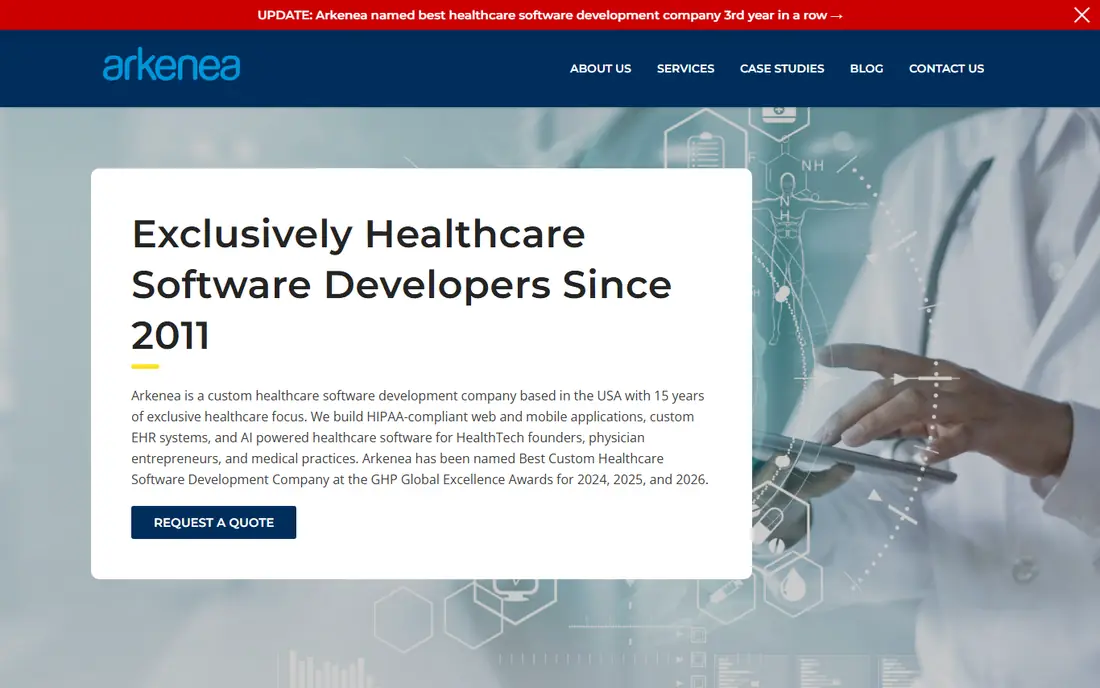
Arkenea is a healthcare software development company with an exclusive focus on healthcare, which is a useful filter in a market full of general firms that add health work on the side. Its published work covers provider groups, health technology startups, and enterprise health organizations, with projects that include EHR links, patient engagement platforms, and AI-assisted tools. The firm describes thorough scoping before a fixed price, which matters when clinical workflows are still unclear at the start.
The limit is scale and price clarity. Arkenea prices by project, so you will need a discovery conversation before you get a firm number. It also will not suit a buyer that needs hundreds of developers on one program. For a focused product or a single clinical workflow, that healthcare-only depth is often worth more than a larger bench.
- Exclusive healthcare focus
- HIPAA-aware design from scoping
- Experience across provider and startup work
- Pricing is by project
- Smaller team than global consultancies
ScienceSoft is a long-running software firm with a large healthcare practice, and it appears in many 2026 shortlists for clinical systems and hospital software. Its strengths are compliance-aware engineering, HL7 and FHIR integration, and data-heavy systems where audit trails matter. That profile suits health systems and mid-size organizations that need a system to pass internal review, not just to launch quickly.
The trade-off is pace. ScienceSoft projects tend to include more planning and documentation up front, which can feel slow for a startup that wants a minimum viable product in weeks. Cost is also by quote, and enterprise-grade process usually carries an enterprise-grade price. If your main risk is integration and audit, that process is a feature, not a delay.
- Long history in healthcare IT
- Strong HL7 and FHIR work
- Audit-ready delivery process
- Heavier planning cycles
- Pricing is by project
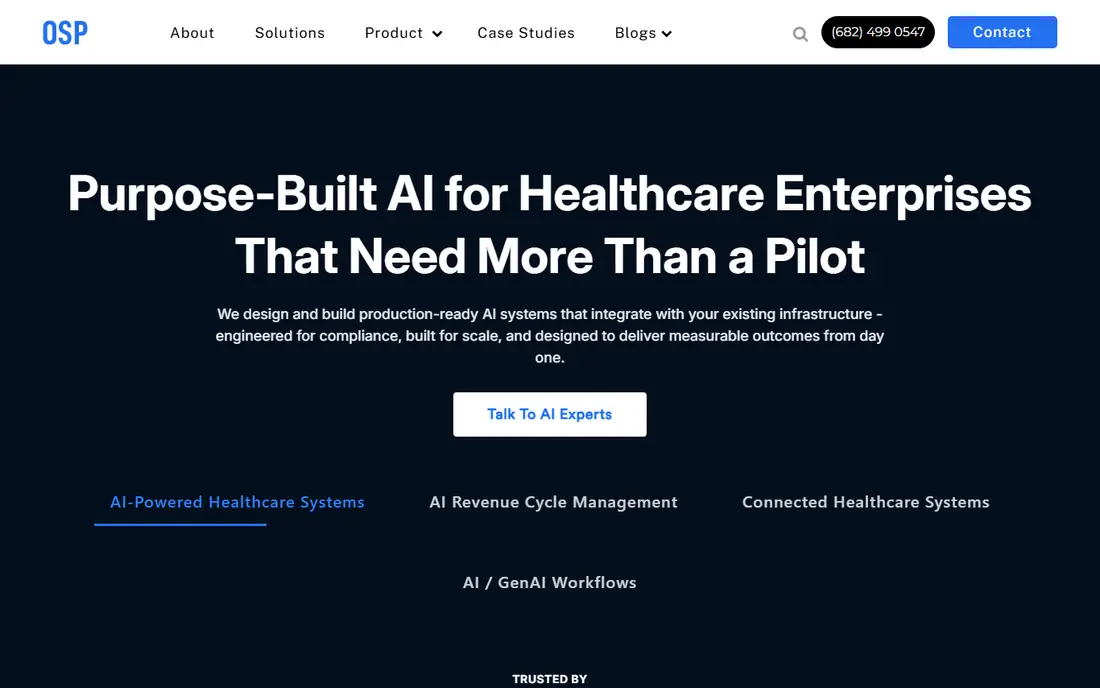
OSP Labs is a healthcare software firm based in the United States with work across EHR integration, automation, and patient-facing apps. Its published focus includes HIPAA-aware development and FDA-related compliance considerations, which matter for teams building tools that touch regulated data or devices. That makes it a natural shortlist choice for providers that need custom builds rather than a generic app team.
The catch is that OSP Labs, like most firms here, does not publish a simple rate card. You will need to share your scope, data flows, and integration targets to get a realistic estimate. It also works best when the client can name the clinical problem clearly, because compliance work grows quickly when scope keeps shifting.
- Healthcare compliance depth
- EHR integration work
- Patient app experience
- Pricing is by project
- Best fit needs a clear scope
Appinventiv is a large app development firm with a substantial healthcare portfolio, including EHR-related systems, telemedicine apps, and AI-assisted health tools. Its size helps when a project needs design, mobile, backend, and quality testing under one roof, and its health startup work shows it can move from idea to a patient-facing product. For funded startups and mid-size health organizations, that breadth is useful.
The limit is cost and fit for very small budgets. A large firm usually prices above a small studio, and its process may feel heavy for a simple prototype. Appinventiv also covers many industries, so you should ask for the specific healthcare team, not just the company brand, and check recent health projects in your exact area.
- Strong mobile and patient app portfolio
- Large delivery team
- Health startup experience
- Higher cost than small studios
- Less suited to tiny fixed budgets
HTD Health is a digital health development firm with published work on telehealth, FHIR-based systems, and product design for health teams. Its pitch is product thinking plus engineering, which suits organizations that need more than code: user research, product scope, and a build plan that survives clinical review. The firm also notes certifications and quality processes that help with regulated work.
The drawback is the same as for most specialist firms: no public price, and a minimum engagement that may be too large for a solo founder with a small prototype budget. HTD Health fits best when you have funding, a clear product direction, and a need for both design and backend depth. Ask for a phased plan so you can test the team on a small slice before funding the full build.
- Focus on digital health products
- Telehealth and FHIR work
- Design and engineering together
- Pricing is by project
- Minimum project size may exclude tiny builds
Folio3 Digital Health focuses on healthcare software and apps, with published work on Epic-linked products and ready-to-deploy health SaaS tools. That Epic angle matters, because many hospitals run Epic and will not accept a vendor that has never worked inside that system. Folio3 also offers product-style builds for startups that want a faster start than a fully custom project.
The limit is access. Epic integration depends on the client hospital, its IT team, and its approval process, so timelines can slip for reasons outside the vendor's control. Pricing is also by project, and SaaS options may carry ongoing fees on top of build cost. If Epic is central to your plan, ask Folio3 for a named Epic project and the role it played in that integration.
- Epic integration experience
- Ready-to-deploy health SaaS options
- US-based delivery
- Pricing is by project
- Epic work needs client access and approvals
Boston Technology Corporation
Great for: EHR, telehealth, and revenue tools
Boston Technology Corporation is a healthcare technology firm with work across EHR integration, telemedicine, and revenue cycle platforms. That mix suits provider organizations that need clinical tools and billing tools to work together, rather than two separate vendors. Its enterprise experience also helps when a project must pass security review, procurement, and clinical governance.
The trade-off is fit for small teams. Boston Technology Corporation tends to suit mid-size and larger organizations, and its process may be more than a startup needs for a first prototype. Pricing is by project, so you should arrive with a clear scope and a realistic budget range. For a health system or a funded health company, it is a solid enterprise shortlist name.
- EHR integration and telehealth depth
- Revenue cycle experience
- Enterprise delivery
- Pricing is by project
- Process suits larger clients
Orangesoft is a development firm with a strong healthcare focus, covering patient apps, clinical tools, and product design, with published knowledge of HL7, FHIR, and DICOM standards. That standards knowledge matters when a product must exchange data with labs, imaging systems, or other clinical tools. Its design strength also helps for patient-facing products, where a confusing screen can lead to missed care steps.
The catch is cost structure. A design-led process often means more discovery and design time before coding starts, which can raise the early bill even if it saves rework later. Pricing is by project, so a clear scope and a phased budget help. Orangesoft suits health startups that want a polished product and a team that already speaks clinical data standards.
- Healthcare-only team focus
- HL7, FHIR, and DICOM knowledge
- AI and device-adjacent work
- Pricing is by project
- Design-led process may cost more up front
How we picked these
We compared firms with published healthcare case work, stated HIPAA-aware practices, and evidence of EHR, FHIR, telehealth, or patient app delivery. We favored firms that name their healthcare focus and standards, rather than firms that list healthcare as one of many industries with no detail. Where pricing was not published on the vendor site, we wrote See website, because agency rates vary by scope, team, and location.
How to choose a healthcare development partner
Start with compliance and integration, not with a demo. Ask for a business associate agreement, a description of how patient data is stored and accessed, and a named integration in your EHR or data standard. Then ask who will actually work on your project, how often you will see working software, and what happens after launch, since health products need updates, security patches, and support.
Get a phased quote. A discovery phase, a first release, and a support phase are easier to compare than one large fixed price. Check references from a similar organization, and ask those references about delays, security review, and post-launch fixes. This is not medical advice, and any clinical workflow should also pass review by your clinical and legal teams before it goes live.
Frequently asked questions
What is the best healthcare app development company for a startup?
A startup often does best with a healthcare-focused firm such as Arkenea, HTD Health, or Orangesoft, because those teams already handle HIPAA-aware design and clinical workflows. A large general firm can also work, but you should confirm that the assigned team has recent health projects. Start with a small, phased build so you can test fit before funding a full product.
What do top healthcare software companies usually charge?
Most firms price by project or by hour, and public rate ranges vary widely by location and scope. Small studios may quote lower hourly rates, while enterprise firms quote higher rates with more process and documentation. Always ask for a written scope, a phased estimate, and what is excluded, such as EHR access fees or ongoing support.
How do I check HIPAA compliance for a development firm?
Ask for a business associate agreement, a written description of data handling, access controls, encryption, audit logs, and breach response. Also ask how the firm tests security and how it handles patient data in staging and test systems. A firm that treats these questions as routine is a better sign than a firm that treats them as an extra.
What is the difference between a healthcare app company and a general software firm?
A healthcare firm brings clinical workflow knowledge, EHR and FHIR experience, and compliance-aware process from the start. A general firm may write good code but need extra time to learn clinical data rules, which can lead to rework. If your product touches patient data, that healthcare experience is usually worth paying for.
Should I choose a US-based healthcare software company?
A US-based team can help with time zones, HIPAA familiarity, and hospital procurement, but location alone does not prove quality. Some offshore teams also deliver strong healthcare work, especially when they have US health clients and clear compliance process. Judge the team, references, and security process, not just the office address.
Sources
See where you really rank - block by block
ProMapRanker scans Google Maps across a grid of your service area. Simple monthly plans from $19, white-label on every plan.
Start freeKeep reading
 top rated pdf scanner software
Best PDF Scanner Software in 2026
Looking for top rated pdf scanner software? We compare 8 scanner apps on scan quality, OCR, price, watermarks and privacy to find your best fit for daily use.
Read → expensify alternatives
Best Expensify Alternatives in 2026
Looking for expensify alternatives? We compare 8 top expense tools on price, cards, receipts and approvals to help your team pick the right one in 2026.
Read → best tools for drawing diagrams
Best Tools for Drawing Diagrams in 2026
Compare the best tools for drawing diagrams, from Lucidchart and Miro to free diagrams.net. See pricing, templates, and collaboration features for teams.
Read →