 ProMapRanker
Best GEO Tools for Ecommerce in 2026

Key takeaways
- GEO tools measure whether AI engines name a store when shoppers ask buying questions, not only whether pages rank in search.
- Otterly AI at $29 per month is the cheapest paid start, while Profound, Scrunch AI, and AthenaHQ suit larger catalogs.
- Writesonic and Frase combine tracking with content fixes, which helps stores that need to rewrite product pages, not only monitor them.
- Entry tier limits matter: check how many prompts and engines are included before comparing headline prices.
Quick comparison
| Pick | Great for | Pricing starts at | Free tier | |
|---|---|---|---|---|
 Profound | Enterprise GEO analytics | See website | Free trial | Visit |
 Peec AI | Focused GEO analytics | $95 per month | Free trial | Visit |
 Otterly AI | Budget GEO tracking | $29 per month | Free trial | Visit |
 Scrunch AI | Conversation and bot diagnostics | $250 per month | Free trial (7 days) | Visit |
 AthenaHQ | Tracking plus content fixes | $295 per month | Yes | Visit |
 Goodie | Attribution focused enterprise teams | $399 per month | No | Visit |
 Writesonic | Content plus GEO tracking | $79 per month | Free trial | Visit |
 SE Ranking | Suite users adding GEO | $99 per month | Free trial (14 days) | Visit |
 Frase | Content optimization for GEO | $49 per month | Free trial (7 days) | Visit |
The best geo tools for ecommerce
Generative engine optimization, or GEO, is the work of making a store visible inside AI generated answers. These tools track that visibility and, in some cases, help fix the pages behind it.
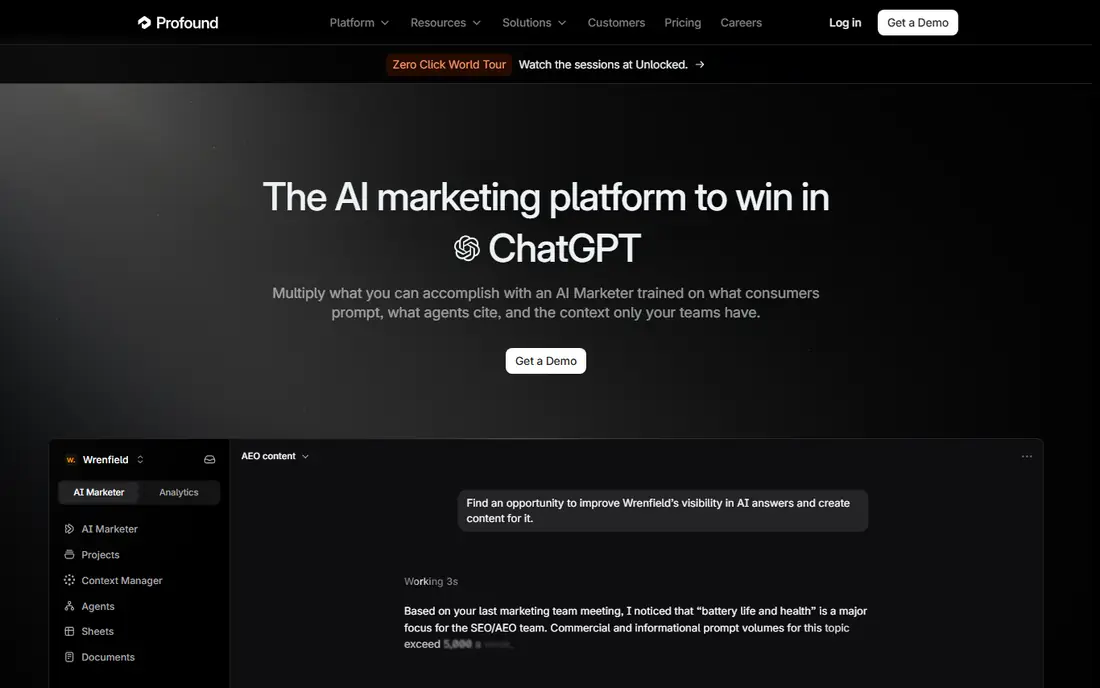
Profound is one of the best known GEO platforms, and it shows how AI engines answer questions about a brand, a category, and a product. A store can track prompts such as the best espresso machine for a small apartment, see which retailers are cited, and compare its own share of citations with competitors. The platform also connects visibility to traffic and conversion data, which helps a larger team argue for content work in business terms.
The catch is access. Profound withdrew its old low cost Starter plan in September 2026, and current entry is a free trial plus custom and agency plans. That makes it a poor fit for a small store with a tight budget. For a large retailer or an agency with several clients, the depth of the reporting and the breadth of engine coverage justify the conversation with sales.
- Wide engine coverage on higher plans
- Citation level detail
- Integrations with analytics tools
- No simple low cost self-serve plan in 2026
- Reporting suits analyst led teams
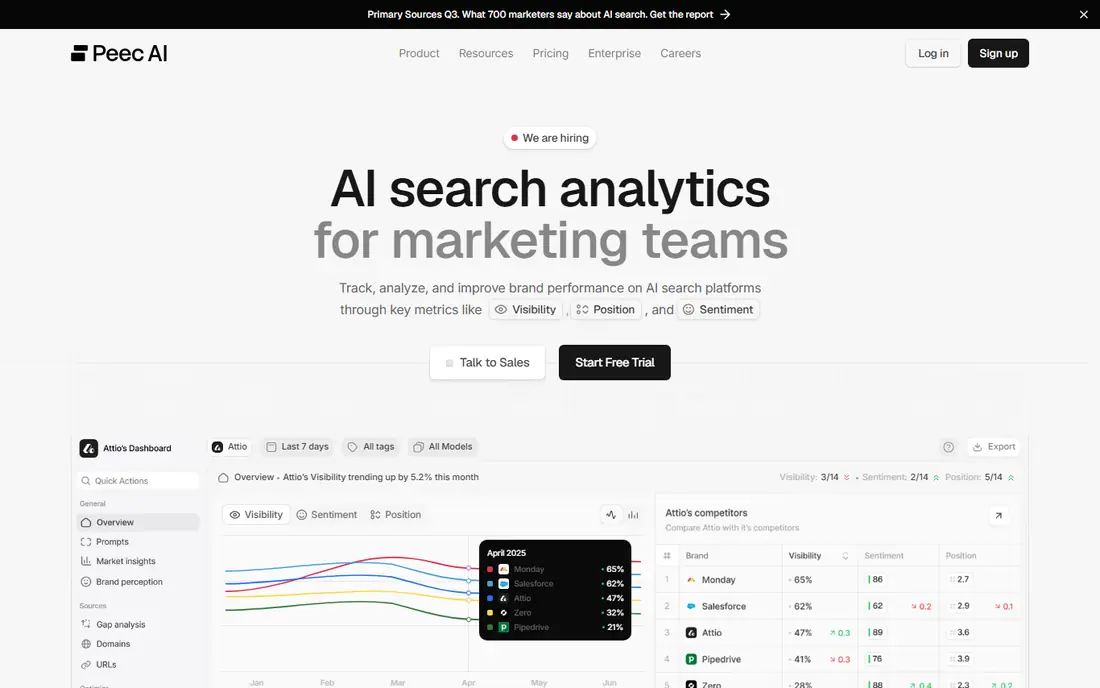
Peec AI keeps GEO tracking simple and readable. It separates direct citations, where an AI answer links or names a source, from general brand mentions, which is a useful distinction for a store. A mention without a citation may raise awareness, but a citation is what sends a shopper toward a product page. Peec AI also tracks sentiment and competitor share of voice, so a team can see whether its brand is gaining ground in a category.
At $95 per month for Starter, Peec AI sits between the budget trackers and the enterprise platforms. It does not rewrite pages or simulate shopper personas. It tells a team, clearly and daily, where it stands. For a mid-size store that already has someone to act on the findings, that focus is a strength, not a gap.
- Clear distinction between citations and mentions
- Share of voice tracking
- Clean dashboards
- Smaller engine list than enterprise platforms
- Public pricing can be hard to view
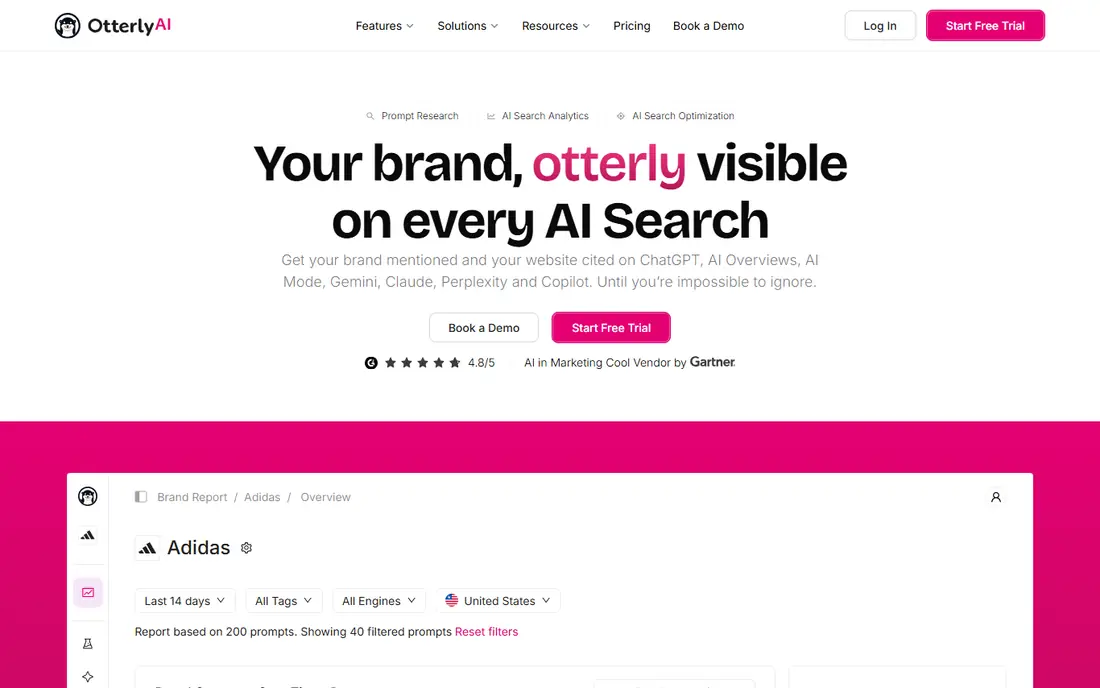
Otterly AI converts keywords into prompts and tracks brand mentions across AI engines, with sentiment analysis on top. For a small ecommerce team, the appeal is simple: $29 per month for Lite, daily data, and a setup that does not need a consultant. A store can start with its top twenty product categories, learn which ones AI answers cite, and build from there.
The limits are real but fair at this price. Some engines are paid add-ons, and the platform does not offer the deep crawler diagnostics of Scrunch AI or the persona work of larger tools. Otterly AI is best seen as a first GEO tool. If the data shows that AI answers drive real traffic, a team can upgrade later with evidence in hand.
- Lowest paid price in this list
- Fast setup
- Daily runs across major engines
- Extra engines cost more as add-ons
- Fewer diagnostic tools than enterprise options
Scrunch AI treats an AI answer as part of a conversation, not a single response. Shoppers ask follow-up questions about price, sizing, warranty, and shipping, and Scrunch AI maps how a brand holds up across that journey. It also monitors bot traffic, so a store can check whether AI crawlers can actually reach its catalog pages, and it flags hallucinations where an answer states something false about a product.
Pricing starts at $250 per month billed annually, or $300 month to month, with a 7-day trial. That is enterprise money, and small stores should not stretch for it. For a large retailer, the combination of journey tracking and crawler diagnostics can surface problems that a simple citation count would miss, such as whole sections of a catalog that AI systems cannot read.
- Multi-turn journey tracking
- AI crawler and bot monitoring
- Hallucination detection
- High price for small stores
- More setup than a basic tracker
AthenaHQ combines GEO monitoring with content work. It tracks visibility across many AI models, analyzes citations, detects hallucinations, and then offers optimization recommendations, including agent drafted fixes. For an ecommerce team, that closes the loop: the same tool that shows a missing citation can suggest what to add to the product page that should have been cited.
AthenaHQ offers a free plan with credits, and Starter costs $295 per month. The credit model means teams should watch usage as they add prompts and checks. Stores that want a tracker plus a work list will get more from AthenaHQ than from a monitoring only tool. Stores that only want a weekly citation count may find the extra features unnecessary.
- Free plan with credits
- Many models on paid plans
- Optimization recommendations and agents
- Credit based billing needs careful management
- Starter price is high for small teams
Goodie focuses on a question that larger stores care about: can AI visibility be linked to revenue, not only to mentions. Its Explorer plan starts at $399 per month, with up to eleven models on Enterprise plans, plus MCP access for teams that want to pull data into their own systems. For a retailer that already attributes sales across channels, that framing makes GEO easier to defend in a budget meeting.
The price is the main barrier. A small or mid-size store will get similar citation tracking for far less from Peec AI or Otterly AI. Goodie earns its place here for enterprise teams where attribution modeling is a hard requirement, and where the cost of the tool is small next to the revenue at stake in AI driven product discovery.
- Revenue attribution features
- Wide model coverage on higher plans
- MCP access
- Highest entry price in this list
- Built for enterprise budgets
Writesonic pairs GEO tracking with a content suite, and its Action Center turns citation gaps into content recommendations. A store can see which buying questions it misses, then draft or update the relevant product or guide page without switching tools. That matters for ecommerce, where the fix is often a better product description, a fuller FAQ, or a new comparison guide.
Writesonic starts at $79 per month billed annually. All ten engines are available on Enterprise plans, while lower plans cover fewer. Teams that already create content at volume will like the combined workflow. Teams that only want monitoring should compare the price with Peec AI, since Writesonic charges for a content platform as well as a tracker.
- AI visibility tracking with content creation in one platform
- Action Center turns gaps into fixes
- Broad engine coverage on higher plans
- Content features may distract teams that only want tracking
- Entry price billed annually
SE Ranking, through its SE Visible GEO features, adds AI search tracking to a suite that already covers rank tracking, audits, and keyword research. It collects answers in a real browser, tracks five engines on its plans, and supports multi-project reporting for agencies. For a store already paying for SE Ranking, adding GEO keeps all search data in one place.
The Basic plan starts at $99 per month, with Core at higher prices, and extra AI tracking can cost more as an add-on. SE Ranking does not match the dedicated GEO platforms on engine breadth or persona work. It wins on value for teams that want GEO as one part of a broader SEO subscription, rather than as a standalone purchase.
- GEO tracking inside a full SEO suite
- Real browser collected answers
- Multi-project reporting
- AI tracking beyond plan limits is an add-on
- Less GEO specific depth than dedicated platforms
Frase helps stores write the pages that AI engines prefer to cite. It mines the questions people ask around a topic, builds a brief from top performing pages, and scores content for both search and AI visibility. For ecommerce, the practical use is category and guide content: a page that answers sizing, compatibility, care, and warranty questions in plain text is far more quotable than a page that hides those facts in images or filters.
Frase starts at $49 per month, with a 7-day trial. It is not the deepest tracker here, and teams that need wide engine coverage should pair it with a dedicated monitor. As a content tool for a store that publishes guides and category pages, it is one of the cheapest ways to make pages more citable.
- Question mining and briefs for AI friendly content
- Affordable
- SEO and GEO scores in one workflow
- Not a dedicated enterprise tracker
- Backlink data is limited
How we picked these
We compared official feature and pricing pages plus public reviews, and we weighted ecommerce fit: buying question prompts, product page fixes, citation detail, and cost per store or domain. We excluded tools that only generate text without tracking, and tools with no clear GEO product. Prices were checked from vendor and review sources in October 2026 and change often, so confirm the current plan before buying.
How to run GEO for a store
Start with a prompt list built from real buying questions, not from keyword volume alone. Include comparisons, budgets, use cases, and problem solving prompts for each main category. Add competitor names, since a GEO report is most useful when it shows the gap between your citations and theirs. Then fix the pages that should be cited: clear specs, prices, stock status, delivery and returns terms, and short FAQs in plain text.
Keep structured data accurate and current, and test pages the way an AI system reads them: text first, images second. A fact that only appears in a product image will not be quoted. Review GEO data monthly, and judge success by changes in cited pages and in traffic from AI referrals, not by a single visibility score. A score that rises while sales stay flat is a sign that the wrong prompts are being tracked.
Frequently asked questions
What is the best geo platform for ecommerce?
It depends on size and budget. Otterly AI suits small stores, Peec AI suits mid-size teams, and Profound, Scrunch AI, or Goodie suit large retailers. Stores that need content fixes as well should look at AthenaHQ, Writesonic, or Frase.
Are GEO and AEO the same thing?
They describe the same work from different angles. AEO stresses answers, while GEO stresses generative engines. Most vendors now use the terms for the same set of tracking and optimization features, so compare the features, not the label.
How many prompts should a store track?
Start with the top categories and the main buying questions for each, often 20 to 50 prompts for a small store. Track more only when the team can act on the results. Hundreds of prompts with no one to fix the pages behind them add cost without value.
Can a GEO tool guarantee citations in ChatGPT or Perplexity?
No. Tools can show where a store is cited, which pages are used, and which questions it misses. Citations shift as models change, so use the data to improve pages and measure progress over months, not days.
Does GEO replace normal SEO for ecommerce?
No, it extends it. Rankings, technical health, and backlinks still matter, and many AI answers draw on pages that also rank well. A store should keep its SEO work and add GEO tracking on top, ideally in the same suite where that is possible.
Sources
See where you really rank - block by block
ProMapRanker scans Google Maps across a grid of your service area. Simple monthly plans from $19, white-label on every plan.
Start freeKeep reading
 wpforms alternatives
Best WPForms Alternatives in 2026
We compare 9 wpforms alternatives for WordPress forms, with free and paid options, current pricing notes, and honest limits for small business sites in 2026.
Read → windows task scheduler alternatives
Best Windows Task Scheduler Alternatives in 2026
Looking for Windows Task Scheduler alternatives? We compare 9 schedulers for Windows and cross-platform work, from free tools to enterprise automation.
Read → which ai video service is best
Which AI Video Service Is Best in 2026
which ai video service is best? We compare 10 legitimate AI video services on price, avatars, editing and output quality to help you pick the right tool.
Read →