 ProMapRanker
Best Gaming PC Company in 2026

Key takeaways
- Alienware, ASUS ROG, and MSI lead for premium prebuilt gaming desktops with current graphics cards and strong cooling designs.
- CyberPowerPC and iBUYPOWER offer the best value for mainstream 1440p gaming, with wide configurator choice.
- Lenovo Legion suits buyers who want a quiet, well priced tower from a large mainstream brand.
- NZXT and Origin PC suit buyers who want a clean custom build with careful cable work and component choice.
- HP OMEN suits buyers who want tool-less access and a familiar large brand warranty.
Quick comparison
| Pick | Great for | Pricing starts at | Free tier | |
|---|---|---|---|---|
 Alienware | Premium prebuilt gaming desktops | See website | No | Visit |
 ASUS ROG | High performance gaming towers | See website | No | Visit |
 MSI | Balanced prebuilt gaming desktops | See website | No | Visit |
 CyberPowerPC | Value mainstream gaming PCs | See website | No | Visit |
 iBUYPOWER | Configurable gaming PCs | See website | No | Visit |
 Lenovo Legion | Quiet mainstream gaming towers | See website | No | Visit |
 HP OMEN | Tool-less mainstream gaming PCs | See website | No | Visit |
 NZXT BLD | Clean custom builds | See website | No | Visit |
 Origin PC | High end custom builds | See website | No | Visit |
The best gaming pc company
This guide compares companies, not single models, since each brand sells many configurations. We focused on current 2026 lineups with modern graphics cards, DDR5 memory, and solid state storage, plus build quality, cooling, upgrade access, and warranty support. Prices vary by configuration, so check the current configurator before buying.
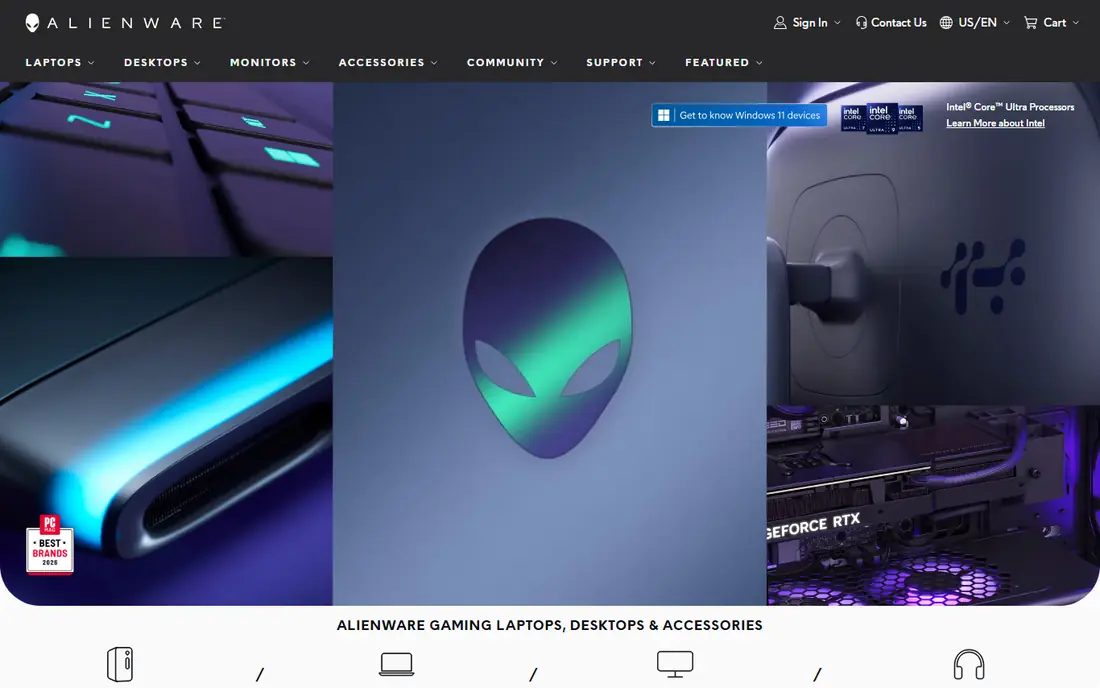
Alienware, Dell gaming brand, remains the most recognisable premium prebuilt name, with Aurora towers that pair current Intel and AMD processors with modern graphics cards. Its Area-51 and Aurora lines target high refresh 1440p and 4K gaming, with liquid cooling options and a design that stands out in a home office. Dell support and warranty options also appeal to buyers who want one company to call.
The trade-off is price and, on some models, proprietary layouts that make later upgrades harder than in a standard tower. Buyers who plan to swap parts often should check the specific model chassis and motherboard layout first. For a premium, ready to play desktop, Alienware still sets a high bar.
- Distinctive design and cooling
- Current high end graphics options
- Dell warranty and support network
- Premium pricing
- Some models use proprietary parts that limit upgrades
ASUS ROG covers gaming desktops from compact systems to large towers, backed by ASUS strength in motherboards, graphics cards, and cooling. ROG towers often pair current processors with high end graphics, generous DDR5 memory, and fast storage, which suits gamers who also stream or edit video. Build quality and thermal design are consistent strengths across the range.
Pricing at the high end is steep, and the many ROG sub-lines can make comparison harder than it should be. Buyers should compare the exact model number, graphics card, and cooling type rather than the ROG name alone. For performance-first buyers, ROG remains a top tier choice.
- Strong component engineering
- Wide tower range
- Good cooling and motherboard quality
- Premium models are costly
- Naming across ROG lines can confuse buyers
MSI offers a broad prebuilt range, from affordable Codex towers to higher end Aegis systems, with current graphics cards and DDR5 memory across most 2026 models. Its mid-range towers often include 32GB of memory and larger solid state drives than rivals at a similar price, which helps with multitasking and a growing game library. Many MSI towers also use standard parts that make future upgrades simpler.
The styling is more restrained than Alienware or ROG, which some buyers will see as a plus and others as a drawback. Warranty terms should be checked by model and retailer, since coverage can vary. For balanced value and performance, MSI is a strong mainstream pick.
- Balanced configurations
- Good storage and memory at mid-range prices
- Standard parts on many models
- Design is less distinctive than Alienware
- Support quality varies by region
CyberPowerPC is a frequent value leader, with Gamer Xtreme and Gamer Master lines that pair current graphics cards with DDR5 platforms at prices below many premium brands. Its online configurator lets buyers choose processor, graphics, memory, storage, and cooling, which helps match a build to a budget without paying for extras. Retail deals, including warehouse club listings, can make it even better value.
Because configurations vary so widely, buyers should read the exact parts list and avoid the cheapest power supply or cooling option if they plan to upgrade later. Support feedback is mixed, so keep the order details and warranty terms safe. For value-first buyers, CyberPowerPC is hard to ignore.
- Strong value at mainstream prices
- Wide configurator choice
- Frequent retail deals
- Build quality can vary by configuration
- Support experiences vary
iBUYPOWER, a long running custom builder, lets buyers configure desktops by case, processor, graphics, memory, storage, and cooling, with ready to ship RDY systems for faster delivery. Its Y40 and Element lines cover mainstream to high end gaming, and many builds use industry standard parts that support later upgrades. That mix of custom and ready options suits both patient builders and buyers who want a PC this week.
Custom builds can take longer to ship, and the cheapest base configuration may need a memory or storage upgrade for modern games. Checking the full parts list before ordering avoids most disappointments. For buyers who want control without building themselves, iBUYPOWER is a solid choice.
- Flexible configurator
- Standard parts on many builds
- Strong AMD and Intel options
- Lead times vary for custom builds
- Base models need careful parts choices
Lenovo Legion towers, including the Tower 5i line, pair current processors and graphics cards with DDR5 memory in a restrained case that fits a home office better than a glass showpiece. Review coverage in 2026 notes quiet operation and solid mainstream performance, which suits gamers who play in shared rooms or record audio. Lenovo warranty and support reach also help first-time buyers.
Upgrade room varies by model, and some Legion towers use compact layouts that limit larger graphics cards or extra cooling. Buyers who plan major upgrades should check chassis size and power supply headroom first. For a quiet, dependable mainstream tower, Legion is a strong pick.
- Quiet operation on many towers
- Good value
- Large support network
- Some models have limited upgrade room
- Design is understated
HP OMEN towers, including the 45L line, are built for gamers who want to upgrade without tools, with easy access to memory, storage, and graphics cards on many models. Current OMEN desktops pair modern processors with current graphics cards and offer liquid cooling options for higher tiers. HP support and warranty options give mainstream buyers confidence.
High end OMEN models carry premium prices, and preinstalled software should be reviewed after first setup. For buyers who value easy maintenance and a large brand behind the purchase, OMEN offers a practical balance of performance and serviceability.
- Tool-less component access on many models
- Strong cooling on 45L towers
- HP support network
- Premium pricing on high end models
- Software extras need cleanup after setup
NZXT BLD builds custom gaming PCs in NZXT cases, with a configurator that estimates performance for popular games at chosen settings. That guidance helps buyers avoid overpaying for power they will not use, or underbuying for the games they play most. Cable management and airflow are consistent strengths, since NZXT controls both case and build.
Prices run higher than CyberPowerPC or iBUYPOWER at similar specs, and budget buyers may find fewer entry options. For buyers who want a tidy, well built custom PC with clear performance expectations, NZXT BLD is worth the premium.
- Clean cable management
- Configurator with performance guidance
- Quality cases and cooling
- Fewer budget options
- Custom builds cost more than mass market rivals
Origin PC focuses on high end custom desktops, with detailed configurators covering processors, graphics, cooling, storage, and case finishes. Build quality and testing are central to its pitch, and lifetime support options appeal to buyers who want help long after delivery. It suits enthusiasts, creators, and gamers who want a top tier system built to order.
Costs are well above mainstream brands, and custom orders take time. Buyers on a tight budget should look at CyberPowerPC, MSI, or Lenovo instead. For a no compromise custom build, Origin PC remains one of the most respected names in the field.
- High end customisation
- Careful build quality
- Lifetime support options
- High prices
- Longer lead times for custom orders
How we picked these
We compared current 2026 lineups, published specifications, configurator choice, cooling and upgrade design, and warranty support from official brand pages and retailer listings. We kept companies with active United States desktop sales, modern graphics and DDR5 platforms, and a clear support path. We excluded brands with discontinued desktop lines or unclear United States availability.
How to choose your gaming PC
Start with your monitor and games
A 1080p high refresh monitor needs less graphics power than a 1440p or 4K display, and competitive games need less than demanding single player titles. Match graphics card and processor to your monitor first, then spend remaining budget on memory and storage.
Aim for 32GB of memory and 1TB of storage
Modern games, streaming, and background apps fill 16GB quickly, and 1TB of storage fills fast with large titles. A 32GB DDR5 and 1TB solid state drive setup is a sensible floor for most buyers in 2026, with 2TB worth considering for large libraries.
Check upgrade access before you buy
Look at case size, power supply wattage, motherboard layout, and whether parts are standard or proprietary. A tower that is easy to upgrade can last years longer than a sealed or proprietary design with similar launch specs.
Frequently asked questions
What is the best PC company for gaming?
Alienware, ASUS ROG, and MSI lead for premium and balanced prebuilts, while CyberPowerPC and iBUYPOWER lead for value. Lenovo Legion suits quiet mainstream use, and NZXT BLD and Origin PC suit custom builds. The best company depends on budget, upgrade plans, and support needs.
Is it better to buy a prebuilt or custom gaming PC?
A prebuilt is faster, comes with a single warranty, and needs no assembly. A custom build from NZXT BLD, Origin PC, or iBUYPOWER gives more control over parts and cooling. Both routes work well in 2026, so choose based on time, budget, and upgrade plans.
How much should I spend on a gaming PC in 2026?
Mainstream 1440p gaming desktops often sit in the mid-range, while high end 4K systems cost considerably more. Spend first on graphics card and processor for your monitor, then on memory and storage, and avoid paying for lighting or case extras before core performance is covered.
Do gaming PCs need liquid cooling?
Not always. Good air cooling suits many mainstream builds, while liquid cooling helps high end processors and compact cases stay quiet under load. Check reviews for the exact model, since cooling quality varies more by design than by cooling type alone.
Can I upgrade a prebuilt gaming PC later?
Many towers from MSI, iBUYPOWER, HP OMEN, and NZXT use standard parts and allow memory, storage, and graphics upgrades. Some premium models use proprietary layouts, so confirm case size, power supply, and motherboard access for the exact model before buying.
Sources
See where you really rank - block by block
ProMapRanker scans Google Maps across a grid of your service area. Simple monthly plans from $19, white-label on every plan.
Start freeKeep reading
 wpforms alternatives
Best WPForms Alternatives in 2026
We compare 9 wpforms alternatives for WordPress forms, with free and paid options, current pricing notes, and honest limits for small business sites in 2026.
Read → windows task scheduler alternatives
Best Windows Task Scheduler Alternatives in 2026
Looking for Windows Task Scheduler alternatives? We compare 9 schedulers for Windows and cross-platform work, from free tools to enterprise automation.
Read → which ai video service is best
Which AI Video Service Is Best in 2026
which ai video service is best? We compare 10 legitimate AI video services on price, avatars, editing and output quality to help you pick the right tool.
Read →