 ProMapRanker
Best Fraud Detection Software in 2026

Key takeaways
- SEON is the most transparent pick for mid-size teams, with published pricing and control over fraud rules.
- Signifyd and Riskified suit merchants who want a chargeback guarantee and are willing to pay for risk transfer.
- Stripe Radar is the easiest start for stores already on Stripe, while Fingerprint suits developers who need device signals.
- No tool blocks all fraud, so pair scoring with manual review for high-value or unusual orders.
Quick comparison
| Pick | Great for | Pricing starts at | Free tier | |
|---|---|---|---|---|
 SEON | Transparent rule control | $699 per month | No | Visit |
 Sift | Marketplaces and platforms | See website | No | Visit |
 Riskified | Chargeback guarantee at scale | See website | No | Visit |
 Forter | Enterprise retail protection | See website | No | Visit |
 Signifyd | Guaranteed order decisions | See website | No | Visit |
 Stripe Radar | Stores already on Stripe | $10 per month | Yes | Visit |
 Fingerprint | Device identification | $99 per month | Yes | Visit |
 NoFraud | Small store guarantees | See website | Yes | Visit |
The best fraud detection software
Fraud detection tools score orders, accounts and logins, then approve, review or block them based on risk. Some vendors also guarantee approved orders against chargebacks, which changes the pricing model and the risk you carry.
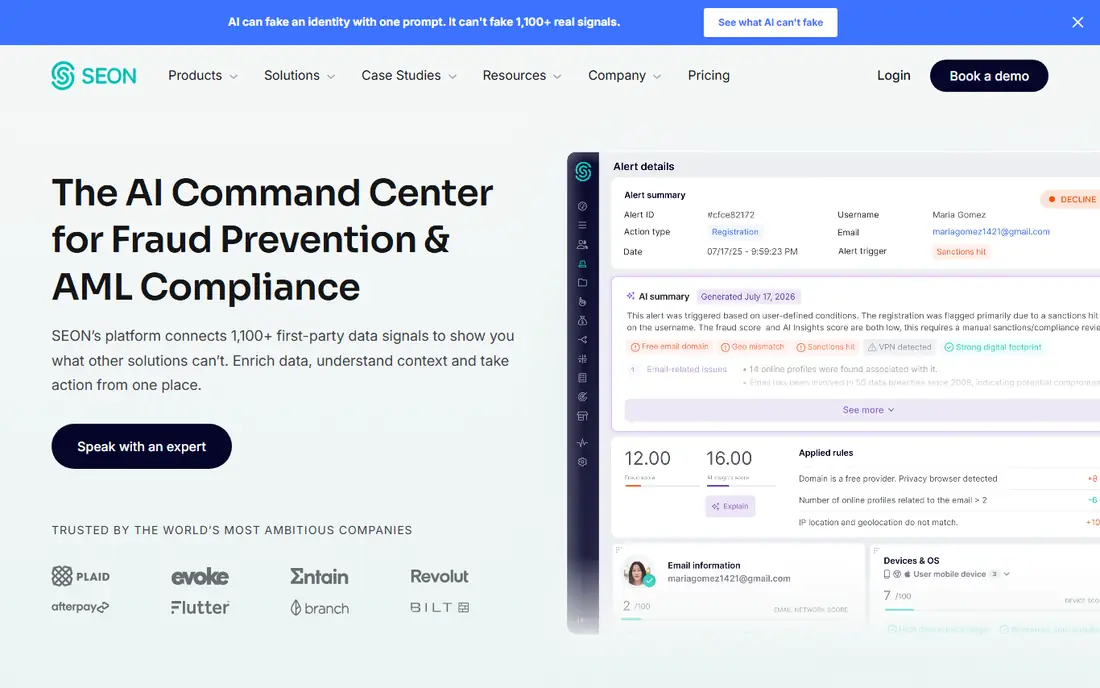
SEON scores risk from email, phone, IP, device and browser signals before a transaction completes, which helps teams catch account abuse and payment fraud early. Users can build custom rules, review cases and adjust scoring as fraud patterns change, rather than accepting a black-box decision. That control appeals to fintech, gaming and ecommerce teams that want to own their fraud logic.
The Starter plan costs $699 per month for a set number of fraud checks, with Premium pricing on request. A free trial is available on request, though its length is not stated on the pricing page. SEON suits mid-market teams that need transparency and rule control, while very small stores may find the starting price high.
- Published Starter pricing
- Email, phone, IP and device signals
- Custom rules
- Starter plan starts at $699 per month
- AML features sit on higher tiers
Sift covers payment fraud, account takeover, fake accounts and content abuse in one platform, which suits marketplaces and digital platforms facing several fraud types at once. Its network signals learn from events across customers, while workflows route risky cases to review teams. That breadth helps platforms where fraud shifts from payments to accounts and back again.
Pricing is custom and volume-based, so budgeting needs a sales conversation and a clear event estimate. Smaller stores may find the process heavier than a plug-in tool. For scaling platforms with review teams and multiple fraud surfaces, Sift offers depth that single-purpose tools cannot match.
- Broad fraud coverage
- Network signals
- Case management and workflows
- Custom pricing
- Implementation needs planning for larger platforms
Riskified focuses on ecommerce order decisions, approving or declining orders automatically and guaranteeing approved orders against fraud chargebacks. That guarantee shifts financial risk from the merchant to Riskified, which appeals to retailers that lose margin to chargebacks and manual review delays. Global coverage helps merchants selling across countries and payment methods.
Pricing is custom, typically based on a share of approved order value with minimums, so it suits larger merchants better than small stores. The guarantee also carries terms and exclusions that need reading before signing. For high-volume retailers, the combination of automation and risk transfer can justify the cost.
- Chargeback guarantee on approved orders
- Automated decisions
- Global coverage
- Custom pricing based on approved volume
- Minimums may suit larger merchants
Forter builds decisions around identity, linking devices, accounts and behavior to spot abuse across a retailer's full journey. It covers payment fraud, account takeover, policy abuse and loyalty fraud, which matters for large retailers where fraud moves beyond checkout. That identity view helps approve good customers faster while blocking repeat abusers.
Pricing is enterprise and custom, so Forter is not a small-store tool. Implementation also needs integration work and a clear data plan. Large retailers with high order volume, loyalty programs and account abuse problems will get the most value, while smaller merchants should start with a more transparently priced option.
- Identity-based decisions
- Account and loyalty protection
- Large retailer focus
- Enterprise pricing
- Less suited to small stores
Signifyd, like Riskified, guarantees approved ecommerce orders against fraud chargebacks, which lets merchants ship with more confidence. Automated decisions reduce manual review queues, while integrations with major ecommerce platforms speed up setup. That model suits mid-size and larger stores where chargeback costs and review delays hurt margins.
Pricing is custom and tied to order volume, so small stores should compare it with NoFraud or Stripe Radar first. Guarantee coverage has terms, including order types and evidence rules, that affect real payouts. Read those terms, test decision accuracy on your own orders, and confirm how disputes are handled before committing.
- Chargeback guarantee
- Automated order decisions
- Ecommerce integrations
- Custom pricing
- Guarantee terms need careful review
Stripe Radar is the natural first step for businesses already processing payments through Stripe. Radar Lite screening comes with standard Stripe pricing, while Radar for Fraud Teams adds custom rules, lists and richer review tools from $10 per month for the standard tier, with per-transaction pricing on higher options. Setup is minimal because payment data already flows through Stripe.
Radar works best inside the Stripe ecosystem, so businesses with many payment providers or non-payment fraud surfaces will need another layer. For a Stripe store, though, it offers fast protection without a separate vendor contract. Start here, measure blocked fraud and false declines, and add a specialist tool only when Radar leaves clear gaps.
- Built into Stripe payments
- Radar Lite included on standard pricing
- Easy start
- Best value stays inside Stripe
- Advanced fraud teams need extra tools for non-Stripe flows
Fingerprint identifies devices visiting a site or app, even when cookies are cleared or browsers change, which helps spot linked accounts, bots and repeat abusers. Developers can add its API to signup, login and checkout flows, then use the device ID in their own rules or another fraud platform. A free tier covers limited monthly API calls for testing.
Fingerprint is a signal, not a full fraud decision engine, so teams still need rules or a scoring platform to act on its data. The paid plan starts at $99 per month for a set number of API calls. It suits product and engineering teams building fraud defenses into their own stack, rather than merchants who want an out-of-the-box guarantee.
- Accurate device identification
- Developer-friendly API
- Free tier for testing
- Device signals alone do not decide fraud
- Needs rules or another platform for decisions
NoFraud targets small and mid-size ecommerce stores that want guarantee-style protection without enterprise pricing. A free starter plan covers smaller stores, while paid plans add higher volume and guarantee coverage. Setup focuses on ecommerce platforms, so a store can start screening orders quickly without a long integration project.
Custom pricing above starter limits means larger stores need a quote, and guarantee terms should be checked for order types and evidence rules. NoFraud suits stores that outgrow basic platform fraud tools but are not ready for enterprise contracts. Compare its guarantee cost with the chargeback losses it would need to prevent.
- Free starter plan for smaller stores
- Chargeback guarantee options
- Fast ecommerce setup
- Custom pricing above starter limits
- Guarantee terms vary by plan
How we picked these
We compared official feature pages, pricing pages and product coverage for fraud tools that serve ecommerce, fintech and platform businesses in 2026. We favored tools with clear scoring, guarantee or device-signal models, current availability, and published or quotable pricing. We left out tools that only offer credit checks, only handle chargeback disputes after the fact, or lack a usable fraud scoring product.
Choosing fraud protection by risk and volume
Start with your fraud loss, not a feature list. A store losing a few orders a month needs a different tool from a marketplace facing account takeover at scale. Measure chargebacks, false declines and manual review hours for a month, then pick a tool whose pricing and model match that loss.
Guarantee or scoring, not both by accident
Guarantee tools charge for risk transfer and suit merchants who want predictable fraud costs. Scoring tools charge for signals and rules, and suit teams that want control and already handle review. Some vendors blend both, so read the contract to see which risk you still carry after approval.
Test on real orders before a long contract
Run a trial or pilot on live traffic, and track approval rates, chargebacks and review workload, not just blocked fraud. A tool that blocks good customers costs more than it saves, even when fraud falls. Set a review step for high-value orders during the pilot, and keep that step for unusual orders after launch.
Frequently asked questions
What is the best fraud detection software?
SEON is the most transparent pick for mid-size teams, while Signifyd and Riskified suit merchants who want a chargeback guarantee. Stripe Radar is best for Stripe stores, and Sift suits marketplaces. The best tool follows your volume, fraud type and whether you want a guarantee or scoring control.
What are the best fraud detection companies for ecommerce?
Signifyd, Riskified, NoFraud and Stripe Radar are strong ecommerce picks, with the first three offering guarantee options and Radar offering built-in Stripe screening. SEON and Forter also serve ecommerce, with SEON focused on rule control and Forter on enterprise identity. Compare guarantee terms and approval rates, not just monthly price.
What is the best fraud prevention company for small stores?
NoFraud and Stripe Radar are the most accessible small-store options, thanks to a free starter plan and built-in Stripe screening. Fingerprint also offers a free tier for developers building their own checks. Start with the tool that fits your platform, and move to a guarantee vendor when chargeback volume justifies it.
How does fraud detection software work?
Fraud tools score orders, logins or accounts using signals such as device, email, IP, velocity and past behavior, then approve, review or block the action. Rules and machine learning models adjust scores as patterns change, while case tools let analysts review risky events. No system is perfect, so high-value or unusual cases still benefit from human review.
Does fraud detection software stop all chargebacks?
No, fraud tools reduce chargebacks but cannot stop every type, including friendly fraud where a real customer disputes a valid charge. Guarantee vendors cover fraud chargebacks on approved orders under their terms, but exclusions apply. Pair scoring with clear product descriptions, delivery proof and dispute handling for the best result.
Sources
See where you really rank - block by block
ProMapRanker scans Google Maps across a grid of your service area. Simple monthly plans from $19, white-label on every plan.
Start freeKeep reading
 best resource management software
Best Resource Management Software in 2026
We compared the best resource management software for scheduling, capacity and utilization, with current pricing and free trials, to help teams choose well.
Read → best reporting tools
Best Reporting Tools in 2026
Compare the best reporting tools for dashboards, scheduled reports, and business insights, from Power BI and Tableau to Looker Studio for every team size.
Read → best remote support software
Best Remote Support Software in 2026
Looking for the best remote support software? We compare 9 tools on price, security, session controls, and fit for helpdesks, MSPs, and small teams in 2026.
Read →