 ProMapRanker
Best Fintech Expense Management Companies in 2026

Key takeaways
- Ramp and Brex lead on free card-led plans, which suit startups that want controls without a per-user fee at entry level.
- Navan stands out when travel booking and expenses should sit in one workflow.
- Expensify and Zoho Expense fit teams that want to keep existing cards or keep costs low.
- SAP Concur, Airbase, and Emburse suit larger firms with complex policies, audits, and multi-entity needs.
- Pricing models differ sharply, so compare the total cost for your actual user count, not only the headline rate.
Quick comparison
| Pick | Great for | Pricing starts at | Free tier | |
|---|---|---|---|---|
 Ramp | Card-led spend control | Free | Yes | Visit |
 Brex | Startups and global teams | Free | Yes | Visit |
 Navan | Travel plus expense in one place | $15 per user per month | Yes | Visit |
 Expensify | Keeping existing corporate cards | $5 per member per month | Yes | Visit |
 Zoho Expense | Low-cost expense automation | See website | Yes | Visit |
 BILL Spend and Expense | Budget-controlled cards | Free | Yes | Visit |
 SAP Concur | Large enterprise compliance | See website | No | Visit |
 Airbase | Procure-to-pay control | See website | No | Visit |
 Emburse | Audited enterprise workflows | See website | No | Visit |
The best fintech expense management companies
We compared card programs, receipt capture, approvals, accounting links, and published pricing. The list covers free entry plans, mid-market tools, and enterprise suites.
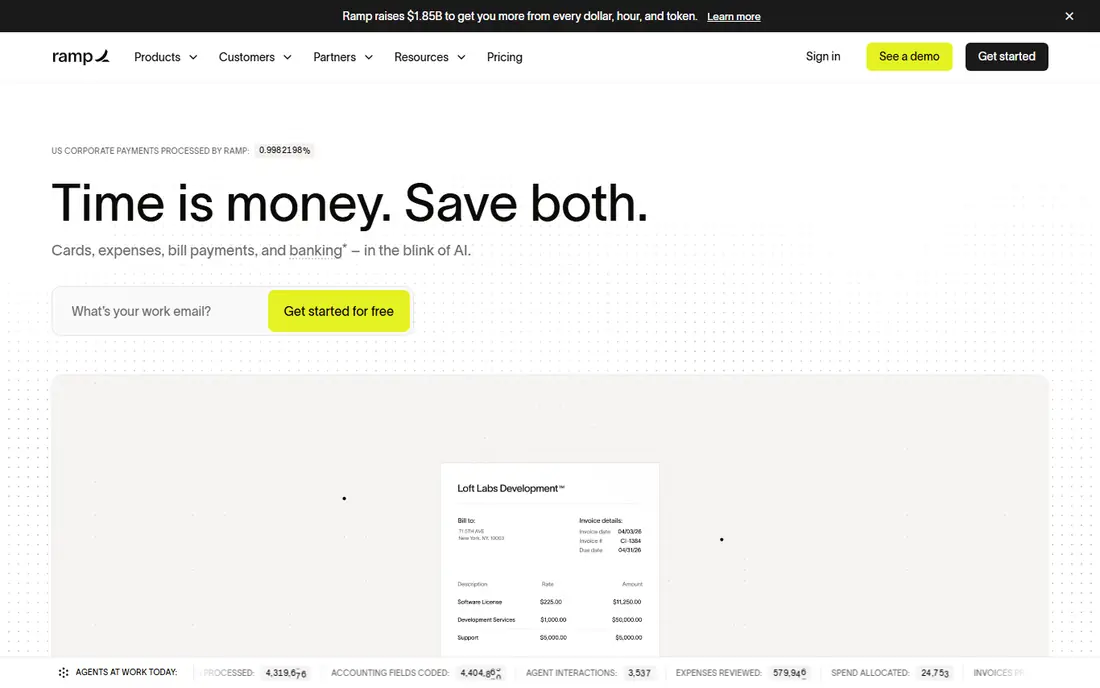
Ramp pairs corporate cards with expense management, bill pay, and approvals in one platform. Finance teams can set limits by employee, vendor, or category, and receipts can be matched to card transactions as spending happens. That card-first design cuts down on month-end chasing, because much of the expense record is created at the point of payment. For startups and growth firms, the free tier is a strong draw, since it covers core card and expense work without an upfront per-user charge.
The catch is that the free tier is not the full product. The Plus plan, listed at $15 per user per month plus a platform fee in recent pricing pages, adds deeper automation and controls. Teams that need procurement, advanced approvals, or wider integrations should price that tier for their full headcount. Ramp fits best when a company is happy to move card spending onto Ramp cards and wants finance to see spending in real time.
- Free entry tier with corporate cards
- Real-time spend controls
- Accounting integrations
- Plus plan adds a per-user fee
- Some advanced features sit behind paid tiers
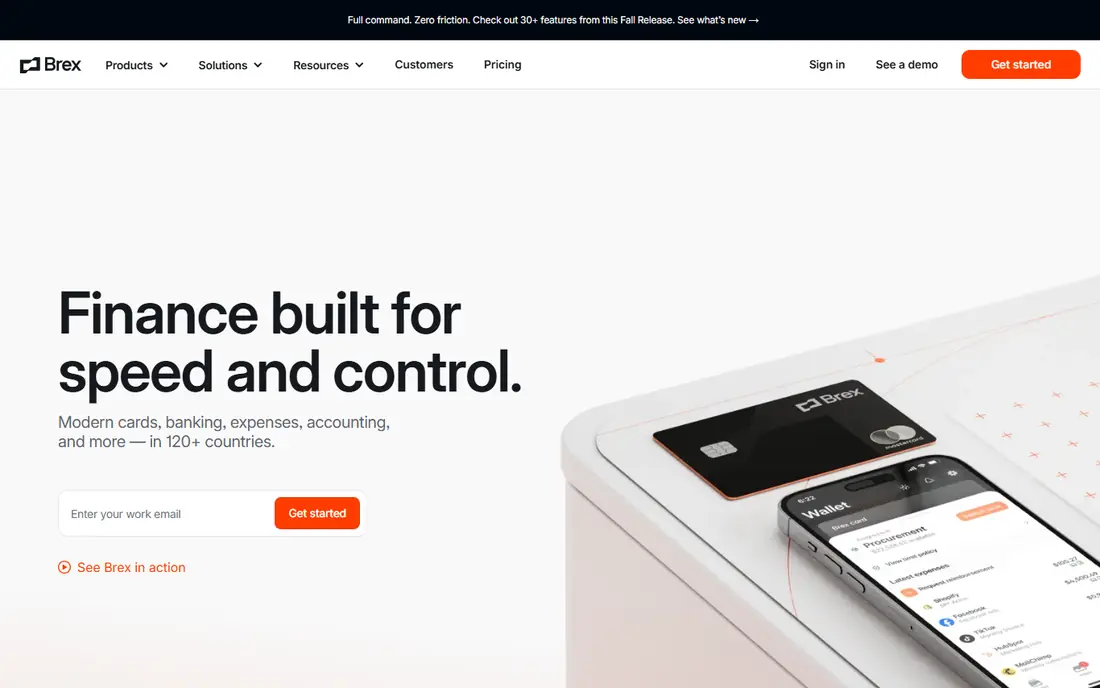
Brex combines corporate cards, banking, and expense management for startups and mid-market firms. Its Essentials tier is free, while Premium is listed at $12 per user per month in recent pricing pages. The platform supports spend controls, receipt capture, and accounting links, and it has built strength with global teams that need cards in more than one country. For a young company that wants a modern card program without paying per user from day one, Brex is a natural shortlist entry.
The trade-off is qualification and tier limits. Credit limits and some features depend on the company's cash balance and profile, so not every applicant gets the same terms. Premium features can also add up across a larger team. Brex fits best when a company wants cards, banking, and expenses tied together, and when its finance team is comfortable managing limits through the Brex platform rather than a traditional bank.
- Free Essentials tier
- Global card issuance
- Banking and spend tools in one place
- Premium plan adds cost
- Some firms may not qualify for the highest limits
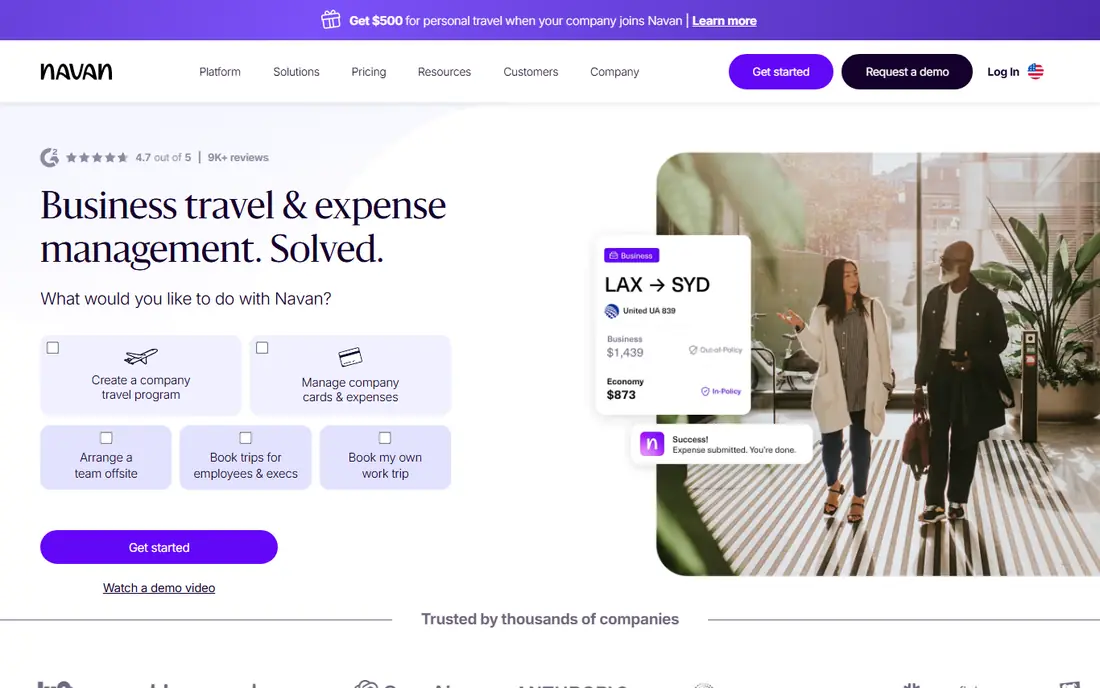
Navan, formerly TripActions, links travel booking with expense capture, so a booked trip can feed expense records without manual re-entry. Recent pricing pages list its expense plan at $15 per user per month, with the first five expensing users free for smaller companies in some cases. Travel booking itself can be free, which helps firms that book often but expense less often. Policy controls let finance set travel and spend rules in one place, rather than in two separate tools.
The catch is fit. If a team rarely travels, Navan's travel strength adds little value, and a card-led tool may cost less. Its expense plan also costs more than the free tiers from Ramp or Brex. Navan fits best when travel is a large share of spending, when managers want one view of trips and costs, and when policy compliance matters more than the lowest possible entry price.
- Travel booking linked to expenses
- First users free on some plans
- Strong policy controls
- Expense plan costs more than card-only rivals
- Travel focus may be excess for office-only teams
Expensify is a long-running expense tool built around receipt capture, expense reports, and reimbursements. Unlike Ramp and Brex, it does not require a company to switch card programs, which matters for firms with bank cards they want to keep. Its Collect plan has been listed at $5 per member per month, with higher Control plans adding approvals, integrations, and single sign-on. Mobile receipt scanning remains a core strength, and the tool supports mileage, per diem, and multi-currency work in many plans.
The honest weakness is tiering. Multi-level approvals and deeper accounting integrations sit on higher plans, so the entry price can understate the cost for a firm with complex needs. Per-member pricing also means costs grow as more staff submit expenses. Expensify fits best for teams that want a familiar expense workflow, want to keep their current cards, and value simple receipt capture over a full card replacement.
- Works with existing cards
- Receipt scanning
- Reimbursement and bill pay options
- Advanced controls sit on higher plans
- Per-member pricing can rise with headcount
Zoho Expense offers receipt scanning, approvals, mileage tracking, and reimbursements at a price point well below most rivals. It has a free plan for small teams, and paid plans have been listed from a few dollars per user per month depending on billing and region. The strongest fit is inside the Zoho ecosystem, where expenses can sync with Zoho Books and other Zoho apps without extra middleware. For a small business that already uses Zoho, that link alone can justify the choice.
The limit is scope. Zoho Expense is an expense tool first, not a corporate card program with the same depth of real-time card controls as Ramp or Brex. Larger firms with multi-entity needs may find its controls lighter than enterprise suites. It fits best for budget-conscious teams, small firms, and Zoho users who want clean expense automation without paying for a full spend platform.
- Free plan for small teams
- Low paid entry price
- Tight links to Zoho Books
- Fewer card-led controls than Ramp or Brex
- Advanced features need higher tiers
BILL Spend and Expense, formerly Divvy, gives teams corporate cards with budget controls, so spending stops when a budget runs out rather than being caught after the fact. The spend plan can be free when used with BILL corporate cards, which makes it attractive for small teams that want control without a subscription. It also connects to BILL bill pay and accounting tools, so card spend and vendor payments can sit in one finance workflow. For firms already using BILL for payables, that link is practical.
The catch is that the free plan is card-led, so firms that want to keep other cards should look elsewhere. BILL also sells wider accounts payable and receivable products with separate pricing, so the total cost depends on which BILL products a firm adopts. BILL Spend and Expense fits best for small and mid-size teams that want budget-enforced cards, clear approval flows, and a direct link to bill pay.
- Free spend plan with BILL cards
- Budget limits that decline spending
- Bill pay links
- Free plan ties to BILL cards
- Full BILL platform pricing is separate and higher
SAP Concur is the enterprise standard for travel, expense, and invoice management in many large firms. It handles complex policies, multi-country tax and compliance rules, and approvals across large organizations. Its link to SAP enterprise software is a major draw for firms already running SAP, since expense data can flow into finance systems with less manual work. For a multinational with strict audit needs, Concur offers depth that smaller tools cannot match.
The trade-off is weight. Pricing is quote-based, implementation can take time, and the product can feel heavy for a team of twenty. Small firms rarely need its full compliance engine, and they may pay for scope they never use. SAP Concur fits best for large enterprises, regulated firms, and SAP users who need audited, policy-driven travel and expense work at scale.
- Deep travel and expense policy controls
- Strong SAP links
- Global compliance support
- Quote-based pricing
- Implementation can be heavy for small teams
Airbase combines procurement, corporate cards, bill pay, and expense management in one platform. Requests for purchases can be approved before spending happens, which gives finance control earlier than a receipt-based tool. Cards, reimbursements, and vendor payments then flow through the same approval and accounting structure. For mid-market firms that have outgrown simple expense reports, that procure-to-pay view is a real step up.
The catch is scope and price. Airbase pricing is quote-based, and the platform can be more than a small team needs. Implementation also takes more planning than a simple card tool, because procurement workflows must match how the company actually buys. Airbase fits best for mid-market firms with growing procurement needs, multiple approvers, and a finance team ready to manage pre-spend controls.
- Procurement plus cards plus bill pay
- Approval workflows
- Accounting integrations
- Quote-based pricing
- More product than a small team needs
Emburse offers travel and expense tools built for audit, policy enforcement, and multi-tier approvals. Its products cover receipt capture, expense reports, card feeds, and travel booking, with controls suited to firms that must show clear audit trails. Companies in regulated or multi-entity settings often choose Emburse for that discipline, and its tools can handle complex approval chains that simpler apps cannot. The range spans several product lines, which lets firms pick a closer fit for their size.
The weakness is clarity. Emburse has grown through several products, so comparing options and pricing can take more work than with a single-plan tool. Pricing is quote-based, with no free plan for most enterprise use. Emburse fits best for mid-market and enterprise firms that value audit trails, policy control, and structured approvals over the lowest entry price.
- Audit-ready expense workflows
- Multi-tier approvals
- Travel and expense depth
- Quote-based pricing
- Product range can be confusing across brands
How we picked these
We compared official pricing pages, product documentation, and public feature descriptions for card-led platforms, expense-only tools, and enterprise suites. We favored tools with a live product in 2026, clear receipt and approval workflows, and accounting links that small and mid-size finance teams can actually use. We left out tools that only handle personal budgeting, tools with no published US presence, and tools we could not verify through an official site. Prices shown are entry prices from vendor pages and recent pricing summaries; quote-based tools are marked as See website.
What to check before you choose
Card-led or expense-only
Card-led tools control spending at payment time, while expense-only tools record spending after it happens. Card-led tools suit firms ready to switch cards. Expense-only tools suit firms that want to keep existing bank cards.
Total cost at your headcount
A free tier for five users can become costly at fifty users. Price each shortlist option for your full submitting headcount, including approvers, and check whether platform fees sit on top of per-user fees.
Accounting and policy fit
Check native links to your accounting system, approval depth, and mileage or per diem support. A tool that exports cleanly to your ledger will save more time than a cheaper tool that needs manual cleanup each month.
Travel needs
If travel is a large share of spend, a combined travel and expense tool can cut duplicate entry. If travel is rare, a simpler expense tool is usually enough, and you should not pay for travel features you will not use.
Frequently asked questions
What are the best fintech companies for expense management?
Ramp and Brex lead for card-led control with free entry tiers, Navan leads for travel plus expense, and Expensify leads for teams keeping existing cards. The best pick depends on whether you want new cards, travel booking, or simple expense reports.
What is the best fintech expense management company for a small business?
For a small business, Zoho Expense, BILL Spend and Expense, Ramp, and Brex are strong starting points because they offer free or low-cost entry plans. Compare the total cost at your team size, and check whether you need cards, bill pay, or only expense reports.
Do expense management tools replace corporate cards?
Some do, and some do not. Ramp, Brex, and BILL issue their own cards, while Expensify and Zoho Expense work with cards you already have. Choose a card-led tool if you want controls at payment time, and an expense-only tool if you want to keep your current card program.
How much does expense management software cost?
Entry prices range from free tiers to about $15 per user per month for mid-tier plans, while enterprise tools use quote-based pricing. The real cost depends on user count, platform fees, and whether you add procurement, travel, or bill pay.
Is Navan better than Ramp for expense management?
Navan is stronger when travel booking matters, because trips and expenses share one workflow. Ramp is stronger for card-led spend control and real-time limits. A travel-heavy firm may favor Navan, while a card-heavy firm may favor Ramp.
Can expense tools connect to accounting software?
Most tools on this list connect to common accounting systems such as QuickBooks, Xero, NetSuite, or Sage, though depth varies by plan. Check the specific integration for your system before you commit, and test how expense categories map to your chart of accounts.
Sources
See where you really rank - block by block
ProMapRanker scans Google Maps across a grid of your service area. Simple monthly plans from $19, white-label on every plan.
Start freeKeep reading
 wpforms alternatives
Best WPForms Alternatives in 2026
We compare 9 wpforms alternatives for WordPress forms, with free and paid options, current pricing notes, and honest limits for small business sites in 2026.
Read → windows task scheduler alternatives
Best Windows Task Scheduler Alternatives in 2026
Looking for Windows Task Scheduler alternatives? We compare 9 schedulers for Windows and cross-platform work, from free tools to enterprise automation.
Read → which ai video service is best
Which AI Video Service Is Best in 2026
which ai video service is best? We compare 10 legitimate AI video services on price, avatars, editing and output quality to help you pick the right tool.
Read →