 ProMapRanker
Best Factoring Companies for Trucking in 2026


Spot market carriers wanting fuel savings · Pricing starts at: See website
Key takeaways
- Same-day funding is common, but the advance rate, fee and reserve terms still vary a lot from one company to the next.
- Non-recourse factoring costs more in most cases, yet it can protect a small carrier when a broker fails to pay.
- Fuel cards and broker credit checks often matter as much as the headline rate, because fuel is a daily cost.
- Short or flexible contracts suit owner-operators, while larger fleets may trade flexibility for a lower volume rate.
Quick comparison
| Pick | Great for | Pricing starts at | Free tier | |
|---|---|---|---|---|
| RTS Financial | Spot market carriers wanting fuel savings | See website | No | Visit |
 Triumph Business Capital | Larger fleets using broker payment tools | See website | No | Visit |
 OTR Solutions | Owner-operators wanting an app-first service | See website | No | Visit |
 Apex Capital | Carriers wanting funding any hour of the day | See website | No | Visit |
 TBS Factoring Service | Carriers already using Love's truck stops | See website | No | Visit |
 TAFS | Carriers wanting back-office help plus factoring | See website | No | Visit |
 eCapital | Mid-size fleets wanting a high advance | See website | No | Visit |
 Bobtail | Carriers wanting simple, flat pricing | See website | No | Visit |
The best factoring companies for trucking
We compared trucking factoring companies on advance rates, funding speed, contract flexibility, fuel programs and broker credit tools. Rates and terms vary, so read the contract before you sign, and confirm every fee, reserve and termination rule in writing.
RTS Financial suits carriers who take loads from brokers they have not worked with before. Its broker credit checks help a driver judge payment risk before accepting a load, which matters when a single unpaid invoice can wipe out a week of profit. The company also pairs factoring with a fuel card program, so fuel savings sit next to faster payment in one relationship.
The catch is that pricing is not published as a flat rate, so two carriers can pay different fees for similar loads. Ask for the full fee schedule, including any monthly minimums, wire fees and reserve release timing. Carriers with steady volume tend to get better terms, so it pays to share honest volume figures during the quote.
- Same-day funding on approved invoices
- Broker credit check tools
- Fuel card program
- Pricing is quoted, not published
- Fees depend on volume and risk
Triumph Business Capital
Great for: Larger fleets using broker payment tools

Triumph Business Capital fits fleets that want a factor with banking scale behind it. Because its payment platform is used across the freight market, invoice checks and broker payments can move faster than a manual process. That speed helps dispatchers plan fuel and payroll without waiting weeks for broker payment terms to run out.
Smaller carriers should read the contract term closely, since Triumph has often used multi-year style agreements rather than month-to-month terms. If your fleet size or freight mix may change soon, ask what happens at renewal and what it costs to leave early. The service makes most sense when volume is stable and the fleet plans to stay put.
- Banking parent company
- Payment tools used by many brokers
- Same-day funding options
- Contracts can run longer than flexible rivals
- Pricing is quoted
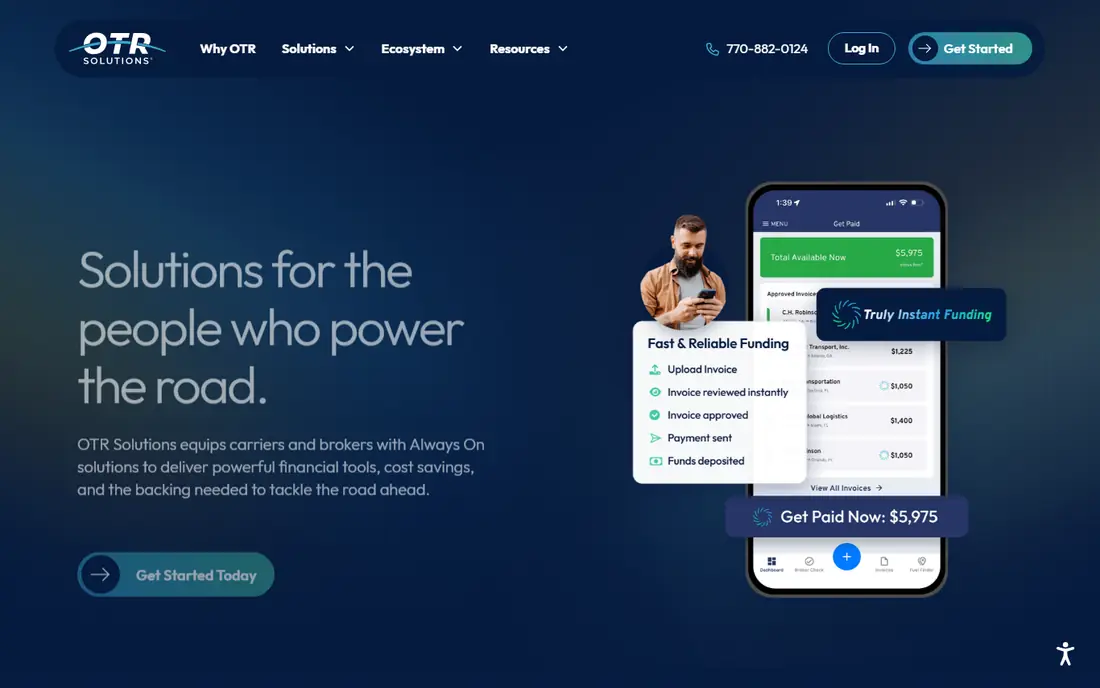
OTR Solutions, formerly OTR Capital, is built for carriers who want to run factoring from a phone. Drivers can photograph bills of lading, submit invoices and watch funding status without sitting at a desk. Its non-recourse option also absorbs broker non-payment risk within approved credit limits, which is a real safety net for a one-truck operation.
The trade-off is price, since non-recourse cover and app convenience are not free. Rates shift with volume, so a carrier running few loads a month may pay more per invoice than a busier fleet. Check whether your regular brokers fall inside the approved credit limits, because cover only helps on loads the factor approves in advance.
- Mobile app for submitting invoices
- Genuine non-recourse options
- Fast funding alerts
- Rates vary by volume tier
- Some features suit app users more than phone users
Apex Capital stands out for carriers who deliver late at night or over weekends and do not want to wait until Monday for money. Its funding service runs through nights, weekends and holidays, which helps cash flow when a load finishes on a Sunday. The company also offers a fuel card, so drivers can pair faster payment with fuel discounts at major stops.
Apex has often used longer contract terms, so flexibility is weaker than at some rivals. Before signing, confirm the term length, the notice period and any early termination fee. For a carrier with steady freight and a regular schedule, the always-on funding may be worth that commitment.
- Funding available around the clock
- Fuel card discounts
- Recourse and non-recourse options
- Contract terms can run for a year
- Pricing is quoted, not published
TBS Factoring Service fits carriers who already fuel and stop at Love's locations. The link to that network can make fuel, maintenance and factoring feel like one system rather than three separate vendors. TBS also offers back-office and compliance support, which helps small carriers who lack an office team to chase paperwork.
The downside is flexibility, since TBS has often used longer-term agreements. A carrier who values the freedom to switch factors quickly may find the term restrictive. Ask about the full fee picture too, including any account or transaction fees, and weigh it against the fuel network savings.
- Ties to the Love's fuel and service network
- Factoring plus compliance help
- Long industry history
- Terms can be long
- Pricing is quoted and varies by carrier
TAFS pairs factoring with back-office services such as billing and collections support, which suits carriers who would rather drive than chase invoices. Its fuel program is often cited as a strong point, and that matters because fuel is usually the largest weekly cost after the truck payment. Same-day funding on approved invoices helps keep that fuel account topped up.
As with most factors, the headline pitch is only part of the cost. Confirm the factoring fee, any reserve percentage, and how long the reserve is held after the broker pays. Also ask whether back-office services are included or billed separately, since that changes the true monthly cost.
- Fuel program reported as strong
- Back-office services
- Same-day funding options
- Pricing is quoted
- Contract terms need close reading
eCapital suits mid-size fleets that need most of the invoice value up front rather than a smaller advance with a larger reserve. A higher advance leaves less cash locked away while waiting for the broker to pay, which helps fleets covering payroll and fuel across several trucks. The company also factors freight beyond small owner-operator work, so growing fleets may not outgrow it quickly.
The caution is contract length and pricing opacity, both common in this market. eCapital quotes by risk and volume, so the rate you get depends on your brokers and your history. Get the advance rate, fee, reserve and contract term in one written quote, and compare it line by line with a shorter-term rival before committing.
- Advances up to a high share of invoice value
- Serves fleets beyond trucking
- Fast funding
- Contract terms can be multi-year
- Pricing is quoted and varies by risk
Bobtail appeals to carriers who hate fine print. Its flat-rate model and lack of a long contract make costs easier to predict than tiered or volume-based pricing. Advances can reach the full invoice value, so there is no reserve held back in the usual way, which simplifies weekly cash planning for a small fleet.
What you give up is the extras that full-service factors bundle in, most notably a fuel card program. If fuel discounts matter more to you than pricing simplicity, a rival with a fuel network may save more overall. Bobtail is the pick for carriers who prize a clean price and the freedom to leave.
- Flat-rate pricing with no long contract
- Advances up to the full invoice value
- Simple app workflow
- No fuel card program
- Fewer back-office extras than full-service factors
How we picked these
We compared official company pages, pricing disclosures, funding and contract descriptions, and independent 2026 roundups of freight factoring. We favored companies with a clear trucking focus, published or widely reported funding features, and a track record serving owner-operators and fleets. We did not run hands-on trials, and we left out any company whose current factoring service could not be confirmed. Where a vendor quotes rather than publishes rates, we say so instead of guessing a figure.
What to check before you sign a factoring agreement
Start with the fee, not the advance. A high advance with a high fee can cost more than a lower advance with a cheap fee, so work out the cost on a typical invoice for your own loads. Then check the reserve: how much is held back, when it is released, and what happens if a broker pays late or disputes a load.
Next, settle recourse against non-recourse. Recourse factoring is usually cheaper, but you repay the factor if the broker does not pay. Non-recourse shifts that risk within approved limits, but it costs more and only covers approved brokers. Finally, read the term, the minimum volume rule and the exit fee. A cheap rate inside a long contract with a steep exit fee is not cheap if your business changes.
Frequently asked questions
What is the best factoring company for trucking?
There is no single winner, because the best fit depends on fleet size, freight type and how much flexibility you need. Owner-operators often favor simple, flexible pricing, while larger fleets may get better rates from a bank-backed factor. Compare at least three written quotes on the same invoice value before choosing.
What is the best factoring company for trucking for a new carrier?
New carriers should look for a factor that accepts newer authorities and offers broker credit checks, since broker risk is highest early on. Ask whether there is a minimum volume rule and what happens in a slow month. A short contract matters more than a small rate difference when you are still learning your lanes.
How does trucking factoring work?
You sell an unpaid freight invoice to the factor, which advances most of its value, often the same day, and keeps a fee. When the broker pays, the factor releases any reserve minus its fee. The factor usually handles collection from the broker, which saves the carrier chasing payment.
Is non-recourse factoring worth the extra cost?
It can be, if you haul for brokers with uncertain payment histories or if one unpaid invoice would strain your cash. Non-recourse cover only applies within approved credit limits, so check that your regular brokers qualify. If your brokers pay reliably, recourse factoring is usually cheaper.
Do factoring companies offer fuel cards?
Many do, and fuel discounts can add up to real savings across a month of driving. Compare the discount, the accepted locations and any card fees against a standalone fuel card. A strong fuel program can outweigh a slightly higher factoring fee, but only if you fuel inside that network.
Sources
See where you really rank - block by block
ProMapRanker scans Google Maps across a grid of your service area. Simple monthly plans from $19, white-label on every plan.
Start freeKeep reading
 best resource management software
Best Resource Management Software in 2026
We compared the best resource management software for scheduling, capacity and utilization, with current pricing and free trials, to help teams choose well.
Read → best reporting tools
Best Reporting Tools in 2026
Compare the best reporting tools for dashboards, scheduled reports, and business insights, from Power BI and Tableau to Looker Studio for every team size.
Read → best remote support software
Best Remote Support Software in 2026
Looking for the best remote support software? We compare 9 tools on price, security, session controls, and fit for helpdesks, MSPs, and small teams in 2026.
Read →