 ProMapRanker
Best ERP for Professional Services in 2026


Growing mid-size services firms · Pricing starts at: See website
Key takeaways
- NetSuite and Sage Intacct suit mid-size firms that need finance, project accounting, and multi-entity support in one cloud system.
- Acumatica suits firms with many users, since its pricing is based on resources used rather than a fee for every named user.
- Deltek Vantagepoint is the strongest fit for architecture, engineering, and consulting firms with project-heavy work.
- Microsoft Dynamics 365 Business Central suits firms already using Microsoft 365, Teams, and Outlook.
- Odoo is the most flexible low cost starting point, but larger firms should budget for implementation help.
Quick comparison
| Pick | Great for | Pricing starts at | Free tier | |
|---|---|---|---|---|
| Oracle NetSuite | Growing mid-size services firms | See website | No | Visit |
 Sage Intacct | Finance-led services firms | See website | No | Visit |
 Acumatica | Firms with many users | See website | No | Visit |
 Microsoft Dynamics 365 Business Central | Microsoft 365 firms | $70 per user per month | Free trial | Visit |
 Odoo | Small firms starting modular | See website | Yes | Visit |
 Workday | Large people-centric firms | See website | No | Visit |
 Deltek Vantagepoint | Project-based AEC and consulting firms | See website | No | Visit |
 Certinia | Salesforce-based services firms | See website | No | Visit |
 SAP Business One | Small firms needing SAP depth | See website | No | Visit |
The best ERP for professional services
Professional services firms need more than a general ledger. They need project accounting, time and expense tracking, resource planning, billing, and revenue recognition that follows how work is actually delivered. The systems below cover that mix at different firm sizes.
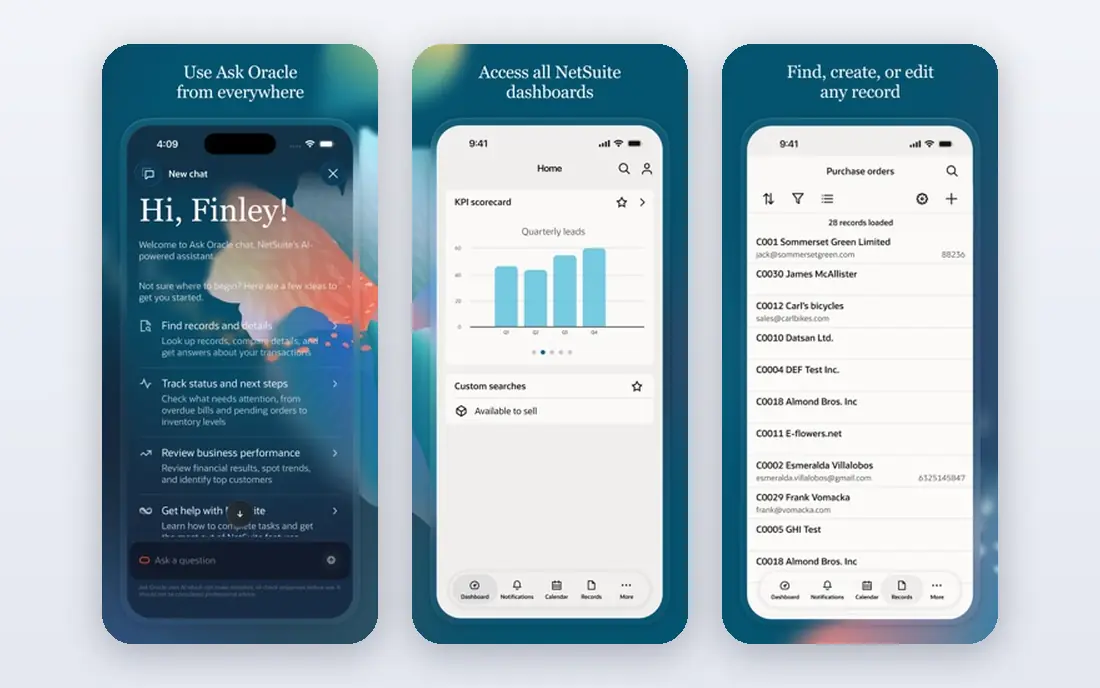
NetSuite brings finance, project management, resource planning, and billing into one cloud system, with SuiteProjects covering much of what a services firm needs day to day. Multi-subsidiary support helps firms that operate across entities or countries, and the partner network means most regions have implementation help. For a firm outgrowing separate accounting and project tools, that breadth is the main draw.
The trade-off is cost and setup time. Pricing is quote based and rises with users and modules, and a careful implementation plan matters more than the software choice alone. Firms should get a scoped quote that includes project accounting and revenue recognition, not just the core ledger.
- Broad finance and project suite
- Multi-entity support
- Large partner network
- Quote-based pricing
- Implementation can be lengthy
Sage Intacct starts from finance, which suits firms where the finance team drives the ERP decision. Its controls, dimensions for reporting, and multi-entity handling make month end and consolidation cleaner than in a general accounting tool. Project accounting and billing cover many services workflows, especially for firms that bill by time, retainer, or milestone.
Resource scheduling is thinner than in project-first systems, so firms with complex staffing needs may add a separate tool. Pricing is modular and quote based, so buyers should price the project and billing modules they actually need rather than comparing base prices alone.
- Strong financial controls
- Multi-entity and multi-currency support
- Good revenue recognition
- Project and resource tools are less deep than Deltek
- Modules add cost
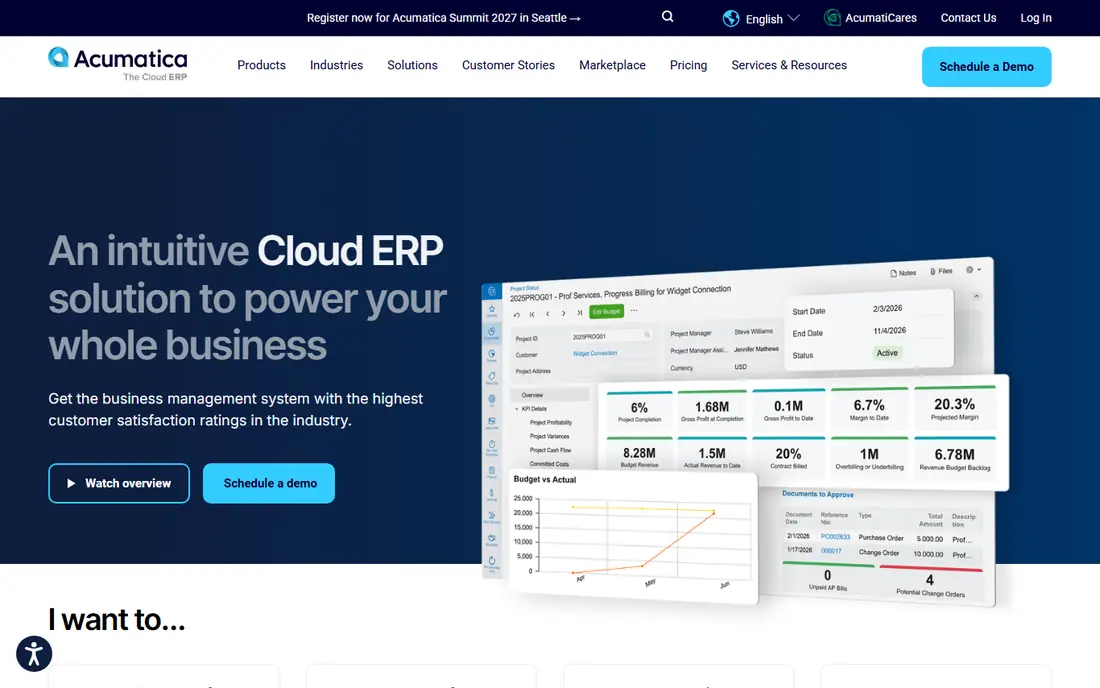
Acumatica charges by resources used rather than by named user, which can save money for firms where many staff log time or view projects but do not need full ERP seats. Its Professional Services Edition covers project accounting, time and expense, CRM, and financials in one package, and deployment can be cloud or hosted. That mix suits mid-size firms that expect headcount growth.
Buyers work through partners, so the quality of the partner matters as much as the product. Firms should ask for a resource estimate tied to transaction volume, not just headcount, and confirm which project features are included in their edition.
- Resource-based pricing without per-user fees
- Strong project accounting
- Flexible deployment
- Partner-led sales
- Some advanced resource tools are adequate rather than leading
Business Central fits firms already living in Microsoft 365. Staff can work from Outlook, Teams, and Excel views they already know, and the Essentials plan starts at a published per-user price that makes budgeting simpler than quote-only rivals. Project jobs, time, and billing are available, with Premium adding service and manufacturing depth.
It is not as project-specialised as Deltek out of the box, and many firms still need a partner to set up jobs, billing rules, and reporting. For Microsoft-centred firms that want a steady, well supported ERP, it is a practical and transparent choice.
- Familiar Microsoft interface
- Strong Outlook and Teams links
- Published per-user pricing
- Project depth varies by setup
- Partner implementation often needed
Odoo lets a small firm start with invoicing, projects, timesheets, and CRM, then add apps as needs grow. The Community edition is free to self-host, while the hosted Enterprise edition adds support and fuller features. That modular path suits firms that want to avoid paying for a large ERP before they need it.
The risk is uneven depth. Some apps are polished and some are basic, and a firm that needs strict revenue recognition or complex project controls should test those workflows first. With a good implementer, Odoo can grow a long way, but it rewards firms that keep their processes simple.
- Modular apps
- Open source Community edition
- Low starting cost
- Enterprise pricing is per user
- Quality varies by app and implementation
Workday suits large consulting, IT services, and professional firms where people, projects, and finance must share one model. Its financial management and professional services automation cover planning, staffing, billing, and revenue, while human capital tools link workforce plans to project demand. For firms above a few hundred staff, that joined-up view is hard to match.
Smaller firms will find it costly and heavy, and implementation takes serious planning and change management. It belongs on the shortlist for large firms that can fund a full programme, not for a small firm looking for a quick accounting upgrade.
- Strong finance plus human capital link
- Excellent multi-entity support
- Strong resource planning
- Enterprise pricing
- Implementation is a major project
Deltek Vantagepoint is built around projects first, which is why architecture, engineering, and consulting firms rate it so highly. It handles project planning, resource scheduling, time and expense, billing, and CRM in a way that follows the project lifecycle, rather than treating projects as an add-on to finance. Firms with government or compliance work also benefit from Deltek depth in that area.
Pricing is quote based and implementation needs care, especially for firms moving from older Deltek products. For a project-heavy firm, though, the fit is often closer than a general ERP, and that fit can save time every week once live.
- Project-first design
- Strong resource planning
- Billing and CRM built for project firms
- Quote-based pricing
- Less generalist than NetSuite for non-project work
Certinia, formerly FinancialForce, runs natively on Salesforce, which makes it the natural pick for firms already using Salesforce for sales and service. Project accounting, resource management, billing, and revenue recognition sit on the same platform as CRM data, so pipeline, delivery, and finance share one record. That reduces duplicate entry and reporting gaps.
The catch is platform commitment. Firms not already on Salesforce face two purchases, not one, and pricing is quote based. For Salesforce firms, however, Certinia often fits better than bolting a separate ERP onto the CRM.
- Native Salesforce platform fit
- Strong project accounting
- Good billing and revenue tools
- Requires Salesforce commitment
- Quote-based pricing
SAP Business One gives smaller firms access to SAP finance, sales, purchasing, and inventory in one system, with project tools available through configuration and partner add-ons. Firms that plan to grow into larger SAP systems, or that work with SAP-centric clients, may value that path. Deployment can be on-premise or hosted through partners.
It is less services-specific out of the box than Deltek or Certinia, so professional services buyers should confirm project accounting, time capture, and billing workflows in a demo. With the right partner, it is a solid small firm ERP, but it is not a plug-and-play services suite.
- Broad finance and operations coverage
- SAP partner network
- On-premise or hosted options
- Partner-led pricing
- Services project tools need careful configuration
How we picked these
We compared official product pages, pricing models, and services-specific features such as project accounting, time and expense, billing, and revenue recognition. We kept systems that are actively sold in October 2026 and that truly serve professional services firms, not just general accounting tools. We excluded tools that lacked project depth or a clear ERP scope.
How to choose for your firm
Start with billing and revenue, not the ledger
Most firms feel ERP pain in billing, utilisation, and revenue recognition first. Map your billing models, such as time and materials, fixed fee, retainer, and milestone, and test each one in a demo before you compare prices.
Count total cost, not licence cost alone
Implementation, training, integrations, and partner time often exceed the first year licence fee. Ask each vendor for a scoped implementation estimate, a timeline, and what happens to pricing as users or transaction volume grow.
Pilot with one practice group
Roll out to one team first, with real projects, real timesheets, and real invoices. That pilot reveals reporting gaps and training needs while the cost of fixing them is still low.
Frequently asked questions
What is the best ERP for professional services?
NetSuite and Sage Intacct are strong general picks for mid-size firms, Deltek Vantagepoint leads for project-heavy AEC and consulting firms, and Acumatica suits firms with many users. The best choice depends on firm size, billing model, and existing platforms such as Microsoft or Salesforce.
What is the best ERP for service companies?
Service companies that bill by project should prioritise project accounting, resource planning, and billing over inventory features. Deltek, Certinia, and NetSuite SuiteProjects cover that mix, while Business Central and Odoo suit smaller firms with simpler projects.
How much does ERP for professional services cost?
Costs vary widely by users, modules, and implementation scope. Published per-user prices exist for Business Central, while most others are quote based. Always ask for licence plus implementation plus annual support in one total before comparing vendors.
Do small professional services firms need ERP?
Not always. A firm with simple billing and few projects may do well with accounting software plus a project tool. ERP makes sense when project, finance, and resource data live in separate tools and reporting becomes slow or unreliable.
How long does ERP implementation take?
Small firms may go live in a few months with a focused scope, while mid-size and large firms often need six to eighteen months. Data cleanup, billing rules, and training usually take longer than software setup alone.
Sources
- https://www.netsuite.com
- https://www.sage.com/en-us/intacct/
- https://www.acumatica.com
- https://www.microsoft.com/en-us/dynamics-365/products/business-central
- https://www.odoo.com
- https://www.workday.com
- https://www.deltek.com/en/products/vantagepoint
- https://www.certinia.com
- https://www.sap.com/products/erp/business-one.html
See where you really rank - block by block
ProMapRanker scans Google Maps across a grid of your service area. Simple monthly plans from $19, white-label on every plan.
Start freeKeep reading
 wpforms alternatives
Best WPForms Alternatives in 2026
We compare 9 wpforms alternatives for WordPress forms, with free and paid options, current pricing notes, and honest limits for small business sites in 2026.
Read → windows task scheduler alternatives
Best Windows Task Scheduler Alternatives in 2026
Looking for Windows Task Scheduler alternatives? We compare 9 schedulers for Windows and cross-platform work, from free tools to enterprise automation.
Read → which ai video service is best
Which AI Video Service Is Best in 2026
which ai video service is best? We compare 10 legitimate AI video services on price, avatars, editing and output quality to help you pick the right tool.
Read →