 ProMapRanker
Best E-Commerce Companies in 2026

Key takeaways
- Amazon leads on reach and logistics, while Shopify leads for brands that want their own store.
- Marketplaces give sellers instant traffic, but store platforms give sellers more control over the brand.
- eBay and Etsy suit second-hand, vintage and handmade goods better than general retailers.
- Fees, fulfilment and returns policies change the real cost, so compare them before you list a product.
- This guide is based on publicly reported factors such as model, reach and services, not a verified ranking.
Quick comparison
| Pick | Great for | Pricing starts at | Free tier | |
|---|---|---|---|---|
 Amazon | Largest marketplace reach | Free | No | Visit |
 Shopify | Brands building their own store | See website | Free trial | Visit |
 Walmart | Omnichannel selling in the US | See website | No | Visit |
 eBay | Second-hand and collectibles | Free | No | Visit |
 Etsy | Handmade and vintage goods | See website | No | Visit |
 Alibaba | Sourcing and wholesale trade | Free | No | Visit |
 Target | Premium US marketplace selling | See website | No | Visit |
 Mercado Libre | Latin America selling | See website | No | Visit |
 Wayfair | Home and furniture selling | See website | No | Visit |
The best e-commerce companies
The phrase best e-commerce company can mean two different things. For a shopper, it means a wide range, fair prices and reliable delivery and returns. For a seller, it means traffic, fees, fulfilment help and control over the brand. This guide covers both angles, and it groups marketplaces and store platforms together because many sellers use both at once.
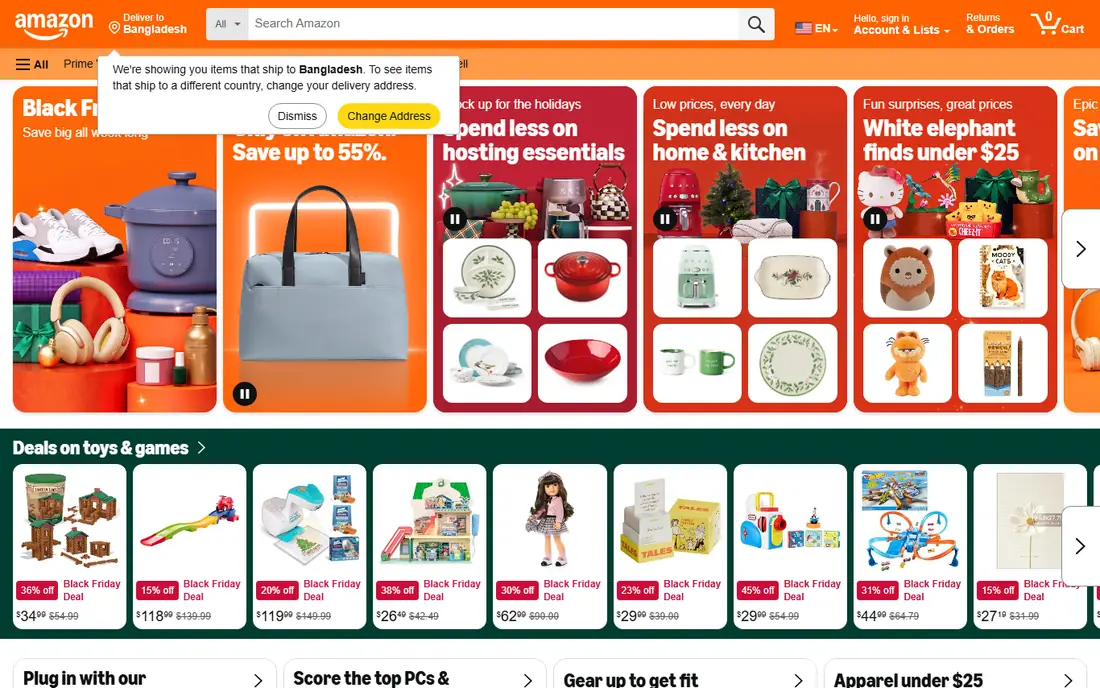
Amazon is the largest general marketplace for most US shoppers, and that traffic is the main reason sellers list there first. Shoppers find a huge range, fast delivery options through Prime and fulfilment services, and a returns process they already know. For a new brand, that familiarity can turn a first listing into early sales far faster than a standalone store.
The trade-off is control and cost. Selling fees vary by category, competition on popular products is intense, and your listing sits next to rivals selling similar goods. Amazon suits sellers who want volume and who can protect margin after fees, advertising and fulfilment costs. It is less suited to a brand that wants a fully custom storefront as its main home.
- Huge shopper traffic
- Fulfilment and Prime delivery options
- Wide product range
- Selling fees and competition are high
- Brand control is limited on a marketplace listing

Shopify is not a marketplace, it is a platform that powers a brand's own online store. That distinction matters, because a Shopify store gives you control over design, pricing, email lists and customer data in a way a marketplace listing does not. The app ecosystem adds payments, shipping, subscriptions and marketing tools, and the platform scales from a first product to a large catalogue.
The catch is traffic. Shopify does not send shoppers to your store, so you need search, social, email or paid ads to bring visitors in. Many successful sellers therefore use Shopify for brand control and Amazon or another marketplace for discovery. If you want a store that feels like your brand, Shopify is the most common starting point.
- Full control over store design and brand
- Large app ecosystem
- Payments and shipping tools
- No built-in marketplace traffic
- Sellers must drive their own visitors
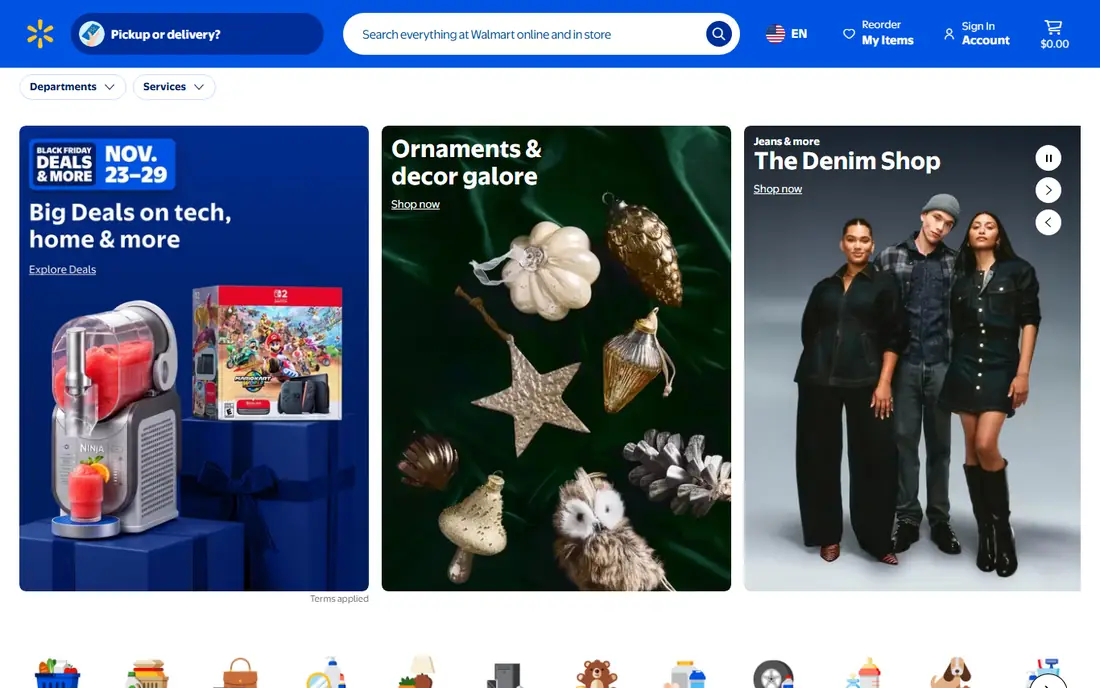
Walmart combines a huge US store network with a growing online marketplace, which gives sellers an omnichannel route that pure online marketplaces cannot match. Shoppers can buy online for pickup or delivery, and sellers can reach customers who already trust the Walmart name for everyday goods. That reach is strongest in the US, where the store network supports fast fulfilment.
Marketplace approval is not automatic, and sellers should expect category checks and performance standards. Fees vary by category, so model the cost for your exact products before you list. For established brands selling mass-market goods in the US, Walmart is a useful second marketplace alongside Amazon.
- Large US shopper base
- Stores support pickup and delivery
- Growing marketplace
- Marketplace approval can be strict
- Fees vary by category
eBay remains the natural home for second-hand goods, rare items and collectibles, where an auction can find the right buyer for a product that has no standard price. Sellers can list at a fixed price or run an auction, and the global buyer pool helps niche products find demand. For resellers and collectors, that community is hard to replace.
Fees apply to sales, and sellers need to manage descriptions, photos and returns carefully, because condition disputes are more common with used goods. eBay is less suited to a brand selling new, mass-market products at scale, where Amazon or Walmart may offer more volume. For unique, vintage or pre-loved stock, eBay is still a first choice.
- Strong for used, rare and collectible goods
- Auction and fixed-price selling
- Global buyer pool
- Fees apply on sales
- Competition and returns handling need care
Etsy serves shoppers who are actively looking for handmade, personalised and vintage goods, which gives small makers a ready audience. Listing setup is simple, search is built around craft and style, and the community around the marketplace helps new shops get found. For a maker selling a small range, that fit matters more than raw traffic.
Fees include listing, transaction and payment charges, so a low-priced item can lose a large share to fees if you do not price carefully. Store customisation is also limited compared with Shopify. Etsy suits makers who want a marketplace audience for craft goods, while a Shopify store can serve as the brand home for repeat customers.
- Shoppers looking for handmade and vintage goods
- Simple listing setup
- Craft-focused community
- Transaction and payment fees add up
- Marketplace rules limit store customisation
Alibaba is best understood as a sourcing and wholesale platform, not a consumer store like Amazon. Businesses use it to find manufacturers and suppliers, compare quotes, and buy in bulk for resale or production. That business-to-business focus, plus coverage across China and other markets, makes it a key part of many supply chains.
Buyers need to check suppliers carefully, confirm samples, and understand minimum orders, shipping and import costs before placing a large order. Alibaba is not the right choice for a shopper buying one item for home delivery. For a business building a product range, it is a central sourcing tool, and it should be used alongside quality checks and clear supplier terms.
- Huge supplier and wholesale range
- Business-to-business trade tools
- Global sourcing
- Minimum orders and quality checks need care
- Not a consumer shopping site in the same way
Target Plus, the marketplace arm of Target, gives selected sellers access to a trusted US retail brand and to shoppers who use Target for everyday and home goods. Store pickup and delivery options support the online offer, and the curated approach means shoppers see a more focused range than on a fully open marketplace. For brands that fit Target's style, that curation is a benefit.
The marketplace is selective, so not every seller will be accepted, and the seller pool is smaller than Amazon's. Fees and terms vary, so check the current seller terms before you plan around Target. For US brands that want a premium retail channel alongside their own store, Target is worth an application when it fits.
- Trusted US retail brand
- Store pickup and delivery options
- Curated marketplace
- Marketplace is invitation-led and selective
- Smaller seller pool than Amazon
Mercado Libre is the leading marketplace in much of Latin America, with payments and logistics services built around the region's shoppers. For a seller targeting Brazil, Mexico, Argentina or neighbouring markets, it offers reach that a US or European marketplace cannot match. Mobile shopping is central, and local payment methods matter as much as price.
Rules, fees and logistics vary by country, and cross-border selling adds tax, shipping and returns complexity. Sellers should start with one country, learn its payment and delivery norms, and expand only when the first market works. For Latin America, Mercado Libre is the marketplace to understand first.
- Leading marketplace across Latin America
- Payments and logistics services
- Mobile-first shoppers
- Rules and fees vary by country
- US sellers face cross-border complexity
Wayfair is a specialist marketplace for home goods and furniture, where shoppers arrive with a room or a project in mind. That focus helps sellers of furniture, decor and home improvement goods reach buyers who are already comparing styles, sizes and delivery options. Bulky delivery and assembly services are part of the offer for many products.
The narrow category is also the limit. Wayfair will not help a seller of electronics or apparel, and furniture returns, damage and delivery scheduling need careful handling. For home brands, though, a specialist audience often converts better than a general marketplace where the same product competes with unrelated goods.
- Focused home and furniture audience
- Large catalogue
- Delivery for bulky goods
- Category is narrow
- Furniture returns and damage handling need care
How we picked these
We compared public information on business model, geographic reach, shopper and seller services, and marketplace or platform type in October 2026. We kept companies that operate at scale today and that fit the topic for shoppers, sellers or both. We did not assign invented scores or sales figures, and we used See website where fees or seller terms vary by category or country.
How to choose an e-commerce company
Start by stating whether you are shopping or selling, because the best choice changes completely. A shopper should weigh range, price, delivery speed and returns. A seller should weigh traffic, fees, fulfilment help and brand control. Many sellers use two channels at once, and that is often the right answer.
Marketplace or your own store
A marketplace gives you traffic on day one, but it also gives you rules, fees and neighbours selling similar goods. Your own store gives you control and customer data, but you must earn every visit. A common pattern is to test a product on a marketplace, learn what sells, and then build a Shopify store for repeat buyers and higher-margin sales.
Fees, fulfilment and returns
Read the fee schedule for your exact category, including referral fees, payment fees and advertising costs. Check who handles storage, packing and delivery, and who pays when a return arrives damaged. A low headline fee can become expensive once fulfilment and returns are added, especially for bulky or low-priced goods.
Trust, protection and support
Check buyer protection, seller protection, dispute handling and customer support before you rely on a platform for a large order or a full product range. Read recent seller terms, not just marketing pages, and keep records of listings, messages and shipments. A platform that resolves disputes fairly is worth more than a small fee saving.
Frequently asked questions
What is the best e-commerce company?
The best e-commerce company depends on your goal. Amazon offers the largest general marketplace reach, Shopify is best for brands that want their own store, eBay suits second-hand and collectible goods, and Etsy suits handmade and vintage goods. This guide is based on publicly reported factors, not a verified ranking, so match the company to your goal.
What is the best e-commerce company for a new seller?
A new seller often starts on a marketplace such as Amazon, eBay or Etsy for instant traffic, then builds a Shopify store for brand control. The right marketplace depends on the product: handmade goods fit Etsy, used goods fit eBay, and mass-market goods fit Amazon or Walmart. Test one channel well before adding a second.
Is Shopify an e-commerce company or a platform?
Shopify is a platform that lets brands build and run their own online stores, rather than a marketplace where shoppers browse many sellers in one place. That is why Shopify appears in this guide alongside marketplaces: sellers use it to sell online, but they must drive their own traffic. Its app ecosystem and payment tools are part of the platform offer.
Which e-commerce company is best for handmade goods?
Etsy is the strongest fit for handmade, personalised and vintage goods, because its shoppers arrive looking for those products. Shopify can serve as a brand store for repeat customers, and a marketplace listing on Etsy can bring in first-time buyers. Price carefully, because listing, transaction and payment fees apply.
How do e-commerce fees work?
Fees vary by company and category, and they usually include a referral or transaction fee plus a payment processing fee. Some marketplaces add listing fees or advertising costs, while store platforms charge a subscription plus payment fees. Always model fees for your exact products and prices, and check the current seller terms on the vendor site.
Should I sell on more than one e-commerce company?
Yes, when you can manage stock and customer service across channels. Many sellers use a marketplace for discovery and their own store for repeat sales, which spreads risk if one channel changes its rules or fees. Keep stock levels in sync, use the same product information, and do not expand faster than your fulfilment can handle.
Sources
See where you really rank - block by block
ProMapRanker scans Google Maps across a grid of your service area. Simple monthly plans from $19, white-label on every plan.
Start freeKeep reading
 wpforms alternatives
Best WPForms Alternatives in 2026
We compare 9 wpforms alternatives for WordPress forms, with free and paid options, current pricing notes, and honest limits for small business sites in 2026.
Read → windows task scheduler alternatives
Best Windows Task Scheduler Alternatives in 2026
Looking for Windows Task Scheduler alternatives? We compare 9 schedulers for Windows and cross-platform work, from free tools to enterprise automation.
Read → which ai video service is best
Which AI Video Service Is Best in 2026
which ai video service is best? We compare 10 legitimate AI video services on price, avatars, editing and output quality to help you pick the right tool.
Read →