 ProMapRanker
Best Data Management Software in 2026


Enterprise data management · Pricing starts at: See website
Key takeaways
- Informatica and Collibra lead for large enterprises, but both need sales quotes and dedicated governance staff.
- Atlan and Alation suit modern data teams that want a catalog people actually use, with governance built in.
- Talend and Fivetran focus on moving data well, while Purview fits organisations already deep in Microsoft Azure.
- Snowflake is a warehouse platform, not a governance suite, so pair it with a catalog for full data management.
- Most enterprise tools are quote-only, so judge them on a written quote at your data volume, not a headline price.
Quick comparison
| Pick | Great for | Pricing starts at | Free tier | |
|---|---|---|---|---|
| Informatica IDMC | Enterprise data management | See website | Free trial | Visit |
 Collibra | Enterprise governance | See website | Free trial | Visit |
 Atlan | Modern data catalog | See website | Free trial | Visit |
 Alation | Analytics governance | See website | Free trial | Visit |
 Qlik Talend | Integration and quality | See website | Free trial | Visit |
 Fivetran | Managed data ingestion | See website | Free trial | Visit |
 Microsoft Purview | Azure governance | See website | Free trial | Visit |
 Snowflake | Cloud data warehouse | See website | Free trial | Visit |
The best data management software
Data management covers integration, quality, catalogs, governance, and master data. The best data management platforms below cover different parts of that job, so we note what each one does best rather than pretending one tool does everything equally well.
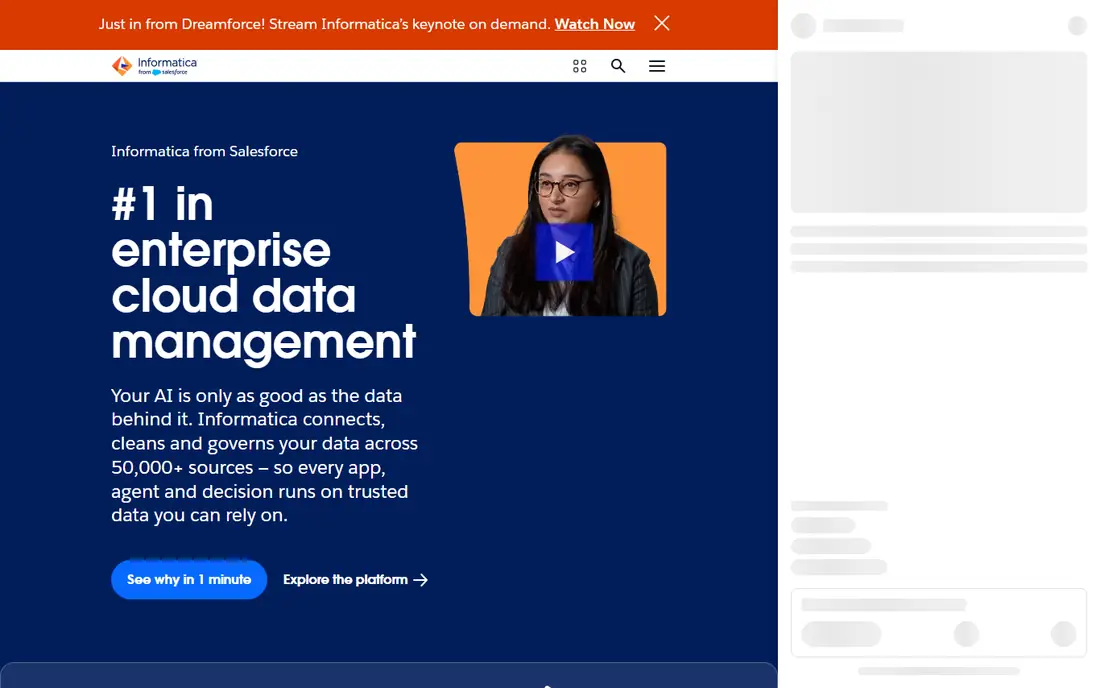
Informatica Intelligent Data Management Cloud is the broadest enterprise option in this list. It covers integration, data quality, master data management, and governance in one cloud platform, with lineage that shows how data moves between systems. Large organisations with many source systems benefit most, since the connector range and transformation options handle messy, multi-domain data.
That breadth comes with cost and complexity. Pricing uses Informatica Pricing Units and requires a sales quote, so small teams cannot judge it from a price page. Implementation also needs planning and skilled staff. For enterprises already invested in Informatica, it is a natural standard. For smaller teams, it is usually more platform than they need.
- Broad integration, quality, and master data features
- Wide connector range
- Strong lineage views
- Quote-only pricing
- Complex setup
- Needs skilled administrators
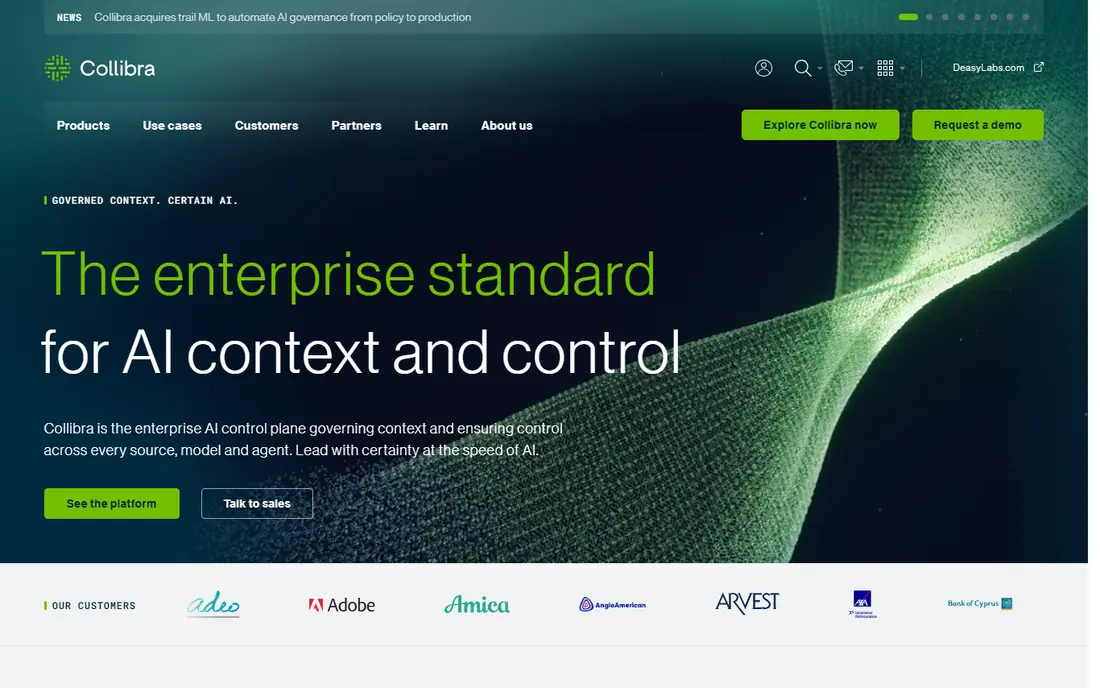
Collibra is built for organisations that need formal control over data. Stewardship workflows, policies, and audit trails sit at the centre, with a catalog that documents ownership and definitions. Regulated industries value that structure, since it supports compliance reporting and clear accountability for sensitive data. Lineage and quality views help teams trace issues to their source.
Collibra assumes you have people to run governance, not just software to install. Without stewards and agreed policies, much of its value stays unused. Pricing is quote-only and typically reaches six figures at enterprise scale. If your organisation needs that level of control, Collibra is a safe, well-proven choice.
- Formal governance workflows
- Stewardship and policy tools
- Audit-ready reporting
- Quote-only pricing
- Long implementation for large programmes
- Needs a governance function
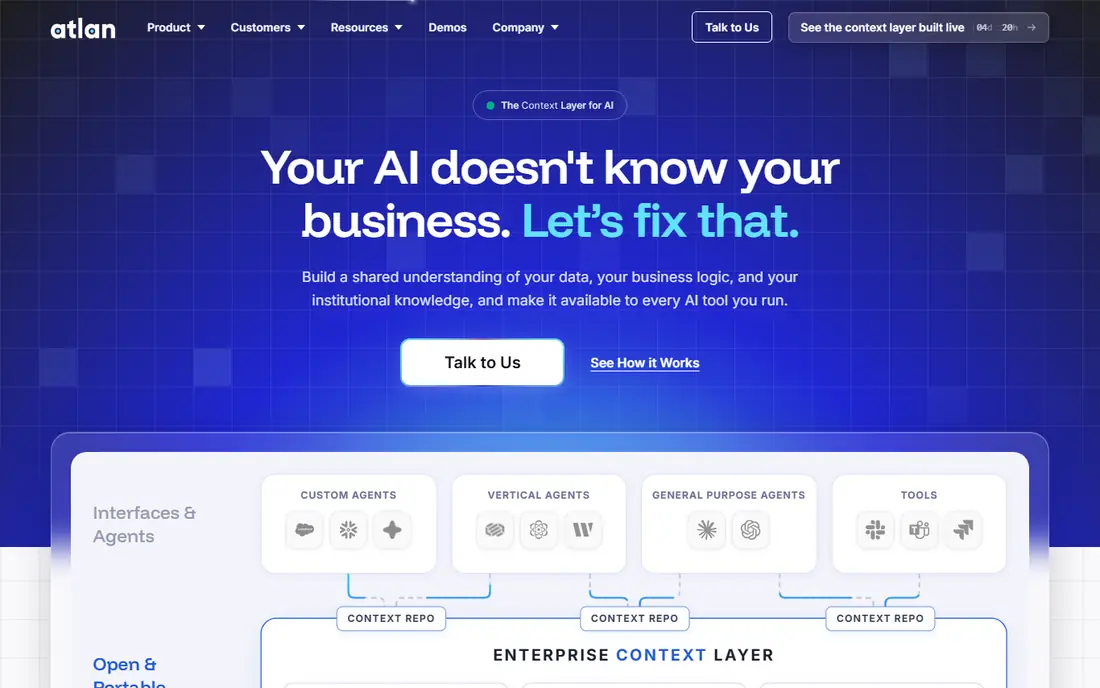
Atlan appeals to data teams that want a catalog people enjoy opening. Discovery, documentation, and lineage are presented in a modern interface, with collaboration features that let analysts ask questions and share context. It integrates with common warehouses and BI tools, so definitions stay close to where analysis happens. Many mid-size to large teams adopt it as their main catalog.
Atlan does not replace integration or master data tools. You will still need pipelines to move data and rules to resolve golden records. Pricing is custom for most deployments, so request a quote at your user and asset count. For teams on a modern cloud stack, Atlan is often the easiest catalog to get adopted.
- Modern, collaborative catalog
- Automated lineage
- Popular with cloud data teams
- Quote-only pricing for full plans
- Not a pipeline or master data tool on its own
Alation focuses on helping analysts find trusted data and use it correctly. Its catalog uses machine learning to suggest definitions, owners, and related assets, which speeds up onboarding for new analysts. Governance features cover policies and AI data use, a growing concern as teams connect AI tools to production data. Search is a particular strength here.
Implementation time varies with data complexity, and larger rollouts can take months. Pricing is quote-only, with enterprise deployments commonly running into six figures a year. Alation suits large firms standardising analytics, rather than small teams that need a quick catalog win.
- Strong catalog and search
- Machine learning suggestions
- AI governance features
- Quote-only pricing
- Implementation can take months
- Best for larger analytics teams
Qlik Talend, formerly Talend, remains a workhorse for integration and data quality. Pipelines move data between systems, clean and standardise it, and support change data capture for fresher data. Teams already using Qlik products get a natural fit, and the tool handles complex transformations that simpler connectors cannot. It is a strong choice for engineering-led data teams.
Talend is not a casual business-user tool. Building and maintaining pipelines needs technical skill, and cloud pricing requires a quote. Smaller teams may prefer managed ingestion tools with less setup. For organisations with real integration complexity, Talend still earns its place.
- Mature integration and data quality tools
- Change data capture
- Broad connectors
- Quote-only cloud pricing
- Interface feels dated in places
- Needs technical users
Fivetran takes a different approach from Talend. It offers managed connectors that pull data from SaaS apps and databases into a warehouse with little upkeep. Schema changes are handled automatically in many cases, which saves engineering time. Teams that want ingestion to just work, without building pipelines by hand, like that model.
Costs are usage-based, tied to monthly active rows or similar measures, so bills grow as data volume grows. Complex transformations still belong in a tool like dbt after ingestion. If your main problem is getting data into the warehouse reliably, Fivetran is one of the simplest answers.
- Large SaaS connector library
- Low maintenance ingestion
- Automatic schema handling
- Usage-based cost can rise at scale
- Less suited to complex transformations
Microsoft Purview suits organisations already committed to Azure and Microsoft 365. It provides a data catalog, lineage, and governance controls that sit close to Azure data services and compliance tools. That closeness matters for security and access reviews, since data and controls live in the same ecosystem. Pricing is usage-based through Azure, rather than a flat licence.
Outside Azure, Purview loses much of its advantage. The catalog experience is functional rather than delightful, and specialist tools often win on discovery alone. For Microsoft-centred organisations, though, Purview is a practical and cost-sensible governance layer.
- Deep Azure and Microsoft 365 integration
- Catalog and compliance tools
- Usage-based pricing
- Weaker fit outside Azure
- Catalog experience less polished than specialist rivals
Snowflake is the warehouse at the centre of many modern data stacks. It stores and queries large datasets, scales compute separately from storage, and supports secure data sharing between organisations. Partners and tools around Snowflake cover ingestion, transformation, and BI, which makes it a flexible foundation. Performance on analytic workloads is a clear strength.
Snowflake alone does not solve governance, quality, or master data. Teams still need a catalog, policies, and pipeline tools around it. Credit-based pricing also needs monitoring, since heavy queries raise costs. Treat Snowflake as the storage and compute layer, and pair it with a catalog such as Atlan or Purview for full data management.
- Scalable cloud analytics
- Data sharing features
- Broad ecosystem of partners
- Usage-based credits need cost control
- Not a governance or catalog suite on its own
How we picked these
We compared vendor product pages, pricing models, and independent data management comparisons, and we checked which parts of data management each tool actually covers. We kept only live, supported products with a clear enterprise or mid-market user base in 2026. Where pricing is quote-only, we said so plainly instead of repeating third-party estimates as vendor prices.
Choosing the right data management software
Start by naming the problem. Integration, governance, catalog, and master data are different jobs, and buying the wrong category wastes a year.
Name the core job first
If data cannot get into the warehouse reliably, start with ingestion tools such as Fivetran or Talend. If analysts cannot find trusted data, start with a catalog such as Atlan or Alation. If regulators or auditors need control, start with governance tools such as Collibra or Purview. One purchase rarely fixes all three at once.
Count users, assets, and volume before pricing
Enterprise quotes depend on users, data assets, and volume, so gather those numbers before a sales call. Ask what is included in the base price and what counts as an add-on, such as lineage, quality rules, or AI governance. A written quote at your real scale is the only fair way to compare quote-only tools.
Plan for adoption, not just installation
A catalog that analysts ignore helps no one. Check search quality, documentation workflows, and integrations with your BI tools during a trial. Assign owners for key datasets early, and start with a small set of high-value domains rather than trying to catalogue everything at once.
Frequently asked questions
What is the best data management platform for small teams?
Small teams should start narrow, often with Fivetran for ingestion and a lighter catalog, rather than buying a full enterprise suite. Atlan and Purview can also work at smaller scale if the stack already fits them. Avoid Informatica and Collibra until governance needs and staffing justify enterprise pricing and effort.
What is the best data management software for enterprises?
Informatica IDMC and Collibra lead for enterprises, with Informatica covering integration and master data more broadly and Collibra leading on formal governance workflows. The right pick depends on your main gap. Many large firms use both kinds of tool, with one for pipelines and another for governance.
How much does data management software cost?
Costs range from usage-based warehouse and ingestion bills to six-figure annual enterprise contracts for governance and catalog suites. Most enterprise tools in this list are quote-only, so actual cost depends on users, assets, and volume. Always get a written quote and ask about implementation and support costs on top of licences.
What is the difference between a data catalog and data governance software?
A catalog is the inventory of data, showing what exists, where it lives, and what it means. Governance software adds controls, including policies, stewardship, access rules, and compliance reporting. Most platforms here do both to some degree, but Collibra leads on workflows while Atlan and Alation lead on discovery.
Do we need data management software for AI projects?
Yes, if AI tools touch production data. Untracked data sources, unclear ownership, and poor quality data lead directly to unreliable AI output and compliance risk. A catalog, lineage, and quality checks help teams prove which data an AI system used and whether that data was approved for the purpose.
Sources
See where you really rank - block by block
ProMapRanker scans Google Maps across a grid of your service area. Simple monthly plans from $19, white-label on every plan.
Start freeKeep reading
 best virtual meeting platform
Best Virtual Meeting Platforms in 2026
Searching for the best virtual meeting platform? We compare 9 video meeting tools on price, free plans, capacity, and features for teams of all sizes.
Read → best social media reporting tools
Best Social Media Reporting Tools in 2026
Compare the best social media reporting tools in 2026, with pricing and free plans, and the right pick for creators, agencies, and large marketing teams.
Read → best social media platforms for business
Best Social Media Platforms for Business in 2026
We compared the best social media platforms for business, from Facebook and Instagram to LinkedIn and TikTok, with ad strengths and who each platform suits.
Read →