 ProMapRanker
Best Data Catalog Platforms in 2026

Key takeaways
- Alation is the best discovery-first catalog for analytics teams that need analysts to actually use the catalog every day.
- Collibra is the best governance-first platform for regulated enterprises that need policy, workflows and audit trails.
- Atlan is the best modern choice for cloud-native data teams that want collaboration built into the catalog.
- OpenMetadata and DataHub are the best open-source routes for engineering-led teams that can run their own infrastructure.
- Secoda and Select Star are the fastest routes to value for mid-sized teams that do not need a full governance suite.
Quick comparison
| Pick | Great for | Pricing starts at | Free tier | |
|---|---|---|---|---|
 Alation | Discovery-first enterprise catalog | See website | No | Visit |
 Collibra | Governance-led enterprises | See website | No | Visit |
 Atlan | Cloud-native collaboration | See website | No | Visit |
 data.world | Knowledge graph catalog | See website | No | Visit |
 OpenMetadata | Open-source control | Free | Yes | Visit |
 DataHub | Open-source metadata platform | Free | Yes | Visit |
 Microsoft Purview | Microsoft and Azure estates | See website | No | Visit |
 Secoda | Fast mid-market setup | $800 per month | Yes | Visit |
 Select Star | Automated lineage and discovery | See website | No | Visit |
The best data catalog platforms
A data catalog helps people find, understand and trust data across warehouses, lakes, BI tools and applications. The best data catalog software does more than list tables. It shows lineage, ownership, quality signals, business definitions and usage, so an analyst can judge whether a dataset is safe to use. We compared these platforms on discovery, lineage, governance, integrations and total cost.

Alation is our pick for organizations whose main problem is adoption. Analysts and engineers can search data like they search the web, see how colleagues have used a dataset, and follow lineage back to its source. That behavioral layer, showing which tables are actually trusted and used, is what separates Alation from a simple metadata list.
The cost and effort are real. Alation is an enterprise platform with unpublished pricing, and a full deployment can take several months with professional services. Data quality is also lighter than in Collibra, so teams that need native quality rules may need a partner tool. If your goal is to get a large analytics team using one trusted catalog, Alation is the strongest discovery-first choice.
- Strong search and behavioral signals that surface trusted datasets
- Analyst-friendly interface
- Broad connector range for warehouses and BI tools
- Enterprise pricing is not published and runs high
- Implementation can take months
- Data quality features rely partly on partner tools
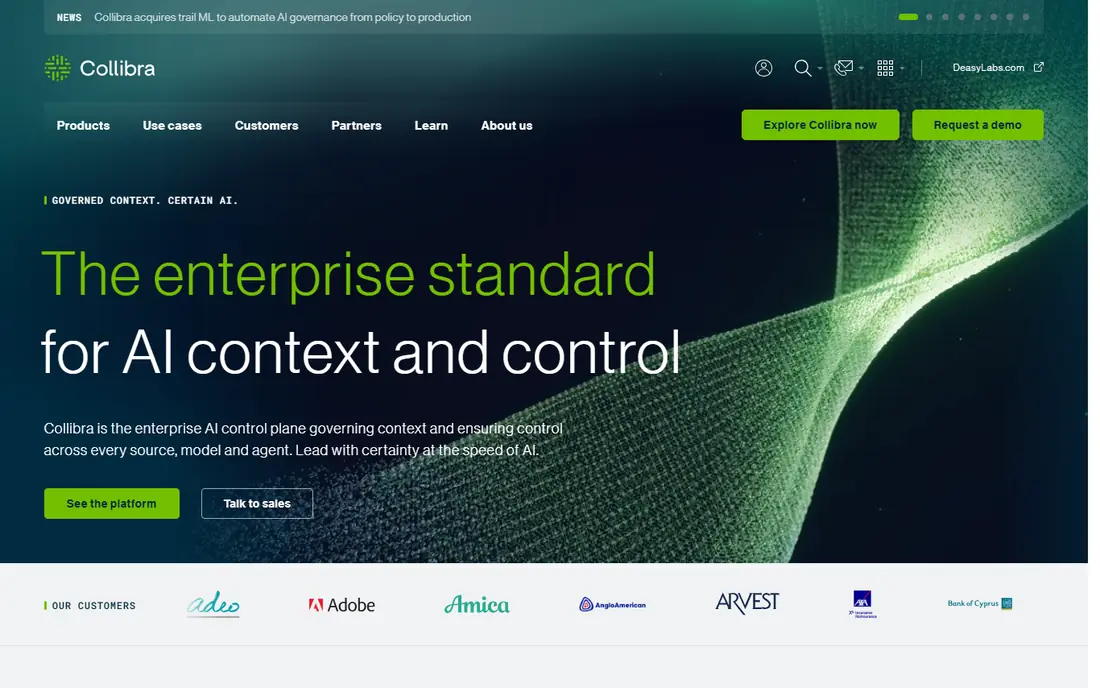
Collibra is the platform for regulated enterprises where governance is not optional. It combines a data catalog with policy management, approval workflows, a hierarchical business glossary and audit trails, so a bank, insurer or healthcare organization can show who owns data, who approved a definition and how a report was built. Its data quality module, built from its OwlDQ acquisition, adds native quality rules to that governance story.
The trade-off is weight. Collibra costs more than most rivals, implementation commonly takes six to twelve months, and analysts may find the interface more steward-focused than Alation or Atlan. That weight is justified when regulators, auditors or internal risk teams require formal control. When governance is still maturing and adoption matters more than formal policy, a lighter platform will deliver value faster.
- Deepest policy, workflow and stewardship features
- Strong business glossary and audit trails
- Native data quality module
- Highest cost and longest implementation among general catalogs
- Steward-centric interface can feel heavy for analysts
- Needs a mature governance team
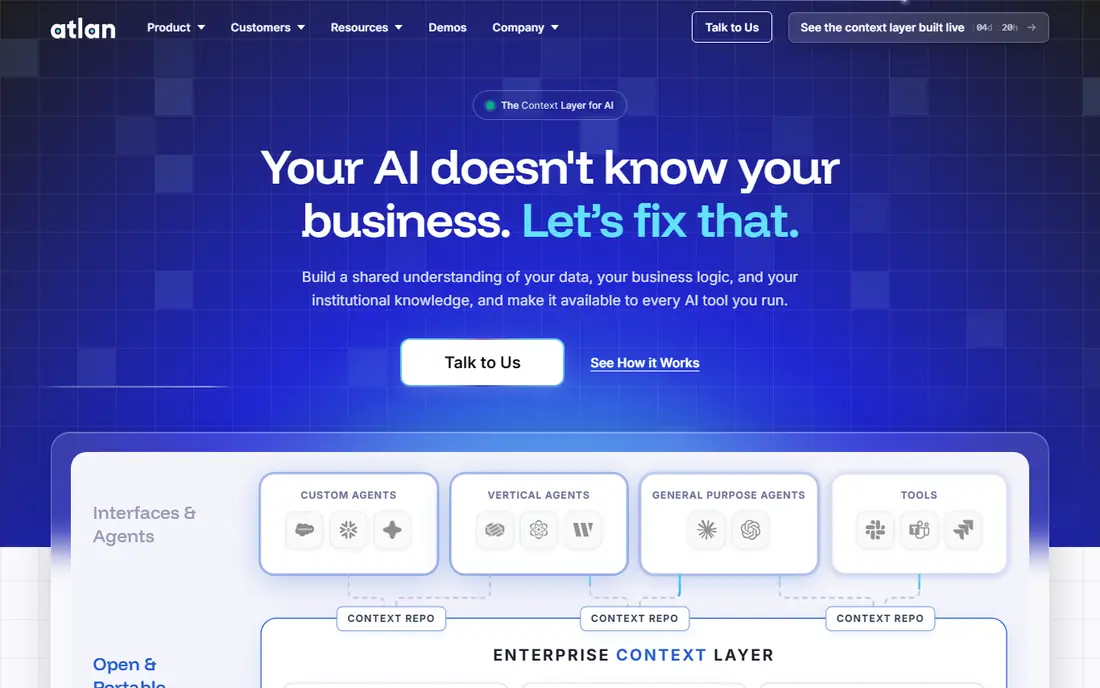
Atlan is the modern catalog most cloud-native data teams choose first. It treats the catalog as a collaboration space, with data assets, ownership, lineage and discussion in one place, and it connects well to Snowflake, BigQuery, Databricks and modern BI tools. Its active metadata approach means the catalog updates as data moves, rather than relying on manual documentation alone.
Atlan is less strong for legacy estates or for organizations that need Collibra-level policy enforcement. Pricing is also quote-based, so mid-sized teams should get a clear quote for their data volume before committing. For a cloud-first team that wants analysts, engineers and business users in the same catalog, Atlan offers the best balance of usability and depth.
- Modern interface with collaboration built in
- Active metadata and lineage for cloud stacks
- AI governance features for newer data products
- Pricing is quote-based and rises with scale
- Less suited to legacy on-premises estates
- Governance depth is lighter than Collibra
data.world takes a knowledge graph approach to cataloging, which means it models relationships between datasets, business terms, owners and systems as a connected graph rather than a flat list. That structure helps organizations with complex data, such as healthcare or financial services, answer questions about how a term, a report and a source system relate to each other. Its AI assistant helps users discover data in plain language.
The platform is enterprise-priced and, since its acquisition, enterprise deals run through ServiceNow channels, which changes the buying experience. Teams that do not need graph modeling may find a simpler catalog faster to adopt. If your data problems are about relationships and meaning rather than just finding tables, data.world is a distinctive and powerful choice.
- Knowledge graph architecture that links datasets, terms and people
- AI-assisted discovery
- Strong for organizations with complex relationships
- Enterprise pricing is quote-based
- Now sold through ServiceNow channels for enterprise deals
- Learning curve for graph concepts
OpenMetadata is the best open-source data catalog for engineering-led teams. It is free to self-host, supports a large connector range, and provides a unified metadata graph, lineage, data quality checks and data contracts in one platform. Because it is open source, you can adapt it, host it where you want and avoid a large enterprise contract.
The cost is effort. You need engineers to deploy, upgrade and maintain OpenMetadata, and you will need to build some governance processes yourself rather than buying them ready-made. Managed offerings exist for teams that want support without self-hosting. If your team has platform capacity and values control over a vendor roadmap, OpenMetadata gives remarkable capability for its price.
- Free open-source platform with a wide connector range
- Unified metadata graph and data contracts
- No vendor lock-in
- Self-hosting and maintenance are your responsibility
- Enterprise support and managed hosting cost extra
- Setup needs engineering skill
DataHub, originally built at LinkedIn and now maintained as an open-source project, is another strong open-source catalog. Its core is free, it ingests metadata from warehouses, lakes, BI tools and streaming systems, and it is designed to scale to very large metadata volumes. Large engineering organizations use DataHub as a central metadata platform rather than just a search tool.
Like OpenMetadata, DataHub rewards engineering skill and punishes teams that expect a turnkey product. Configuration, upgrades and governance workflows take work, and the managed cloud version is priced by quote. Choose DataHub if you want a proven, scalable metadata platform and have the team to run it. Choose a SaaS catalog if you want value in weeks rather than months.
- Free open-source core with managed cloud option
- Strong metadata ingestion from many systems
- Used at scale by large engineering teams
- Self-hosted setup is complex
- Governance features need configuration
- Managed cloud pricing is quote-based
Microsoft Purview is the natural catalog for organizations that already run on Azure and Microsoft 365. It scans Azure data sources, Microsoft 365 content and Power BI assets into a unified catalog, and it connects cataloging with broader Microsoft governance and compliance features. For a Microsoft-heavy estate, that native integration saves integration work that a third-party catalog would need.
Outside the Microsoft ecosystem, Purview loses much of its advantage, and its pricing model, based on assets and processing units, needs careful modeling. Configuration also takes Azure skill. If your data lives mainly in Azure and your analysts work in Power BI, Purview is a coherent and cost-effective choice. If your stack is multi-cloud, Atlan or Alation will integrate more evenly.
- Deep integration with Azure, Microsoft 365 and Power BI
- Unified catalog with governance and compliance features
- Usage-based pricing options
- Best value only inside the Microsoft ecosystem
- Configuration is complex
- Costs vary with assets and processing use
Secoda is built for mid-sized teams that want a catalog working quickly, without a six-month implementation. Its AI-assisted search helps users find data in plain language, its documentation features reduce manual catalog work, and its Business plan starts at $800 per month, which is far below enterprise catalog pricing. A free plan lets a small team test the core experience.
Secoda will not match Collibra on policy enforcement or Alation on enterprise scale, and its connector range is smaller than the leaders. That is a fair trade for speed. If your team has outgrown spreadsheets and tribal knowledge but does not need a full governance suite, Secoda is one of the fastest routes to a usable catalog.
- Fast setup with AI-assisted search and documentation
- Lightweight governance for mid-sized teams
- Free plan for testing
- Less depth than enterprise suites for regulated governance
- Pricing rises on enterprise plans
- Smaller connector range than Alation
Select Star focuses on automated discovery and lineage. It scans your warehouse and BI tools, builds lineage automatically, and shows analysts where a metric comes from and what will break if a table changes. That automation matters for teams that have tried manual catalogs and watched them go stale. Deployment is fast compared with enterprise suites, often measured in days rather than months.
The limits are governance depth and pricing transparency. Select Star is a data team tool first, not a full enterprise governance platform, and its pricing requires a sales conversation for most plans. For a small to mid-sized data team that needs trustworthy lineage and fast discovery, Select Star is a strong, focused choice. For a regulated enterprise, Collibra remains the safer governance bet.
- Automated lineage and metadata discovery
- Fast deployment for small to mid-sized teams
- Snowflake cost insights on some plans
- Pricing is not fully published
- Governance features are lighter than enterprise suites
- Best fit is data teams, not whole enterprises
How we picked these
We compared official product pages, connector lists, governance and lineage features, and public pricing comparisons for data catalog tools. We favored platforms that are actively maintained in 2026, offer a real catalog product rather than only a governance module, and serve a distinct buyer, from open-source engineers to regulated enterprises. We left out narrow data quality tools and BI tools that only catalog their own content.
How to choose a data catalog platform
Start with your main problem. If analysts cannot find trusted data, choose a discovery-first catalog such as Alation, Atlan or Secoda. If regulators or auditors require formal control, choose Collibra. If your team can build and run its own platform, OpenMetadata or DataHub will save a large license fee.
Next, test with your real stack. Connect your warehouse, your BI tool and one or two key sources, then ask an analyst to answer a real question: where does this metric come from, who owns it, and can I trust it? A catalog that answers that question in a trial will answer it in production. A catalog that only lists tables will not.
Finally, price the full deployment, not just the license. Add implementation time, admin headcount, connector costs and any data quality or governance add-ons. An open-source catalog with a dedicated engineer can cost more than a SaaS catalog with no admin, and an enterprise catalog with a year-long rollout can cost more than both. Choose the total cost you can actually staff.
Frequently asked questions
What is the best data catalog platform?
Alation is the best data catalog platform for most analytics-led organizations because it combines strong search, usage signals and broad connectors. Collibra is better for regulated governance, Atlan is better for cloud-native collaboration, and OpenMetadata is better for engineering teams that want open-source control.
What is the best data catalog software for a small team?
Secoda and Select Star are the best data catalog software options for small to mid-sized teams. Secoda starts at $800 per month for its Business plan and sets up quickly, while Select Star offers fast automated lineage. OpenMetadata is a strong free alternative if your team can self-host.
What are the best data catalog tools for governance?
Collibra offers the deepest governance features, including policy management, approval workflows, a business glossary and audit trails. Alation and Atlan offer solid governance for less regulated environments, while Microsoft Purview suits governance inside a Microsoft estate.
Is there a free data catalog platform?
Yes. OpenMetadata and DataHub both offer free open-source cores that you can self-host. Secoda also offers a free plan for testing. Free open-source catalogs save license fees but require engineering time for hosting, upgrades and maintenance.
How much does a data catalog cost?
Costs range from free open-source hosting to six-figure enterprise contracts. Secoda starts at $800 per month for its Business plan, while Alation, Collibra, Atlan and data.world use quote-based enterprise pricing that varies with data volume, users and add-ons. Always request a quote for your actual stack before budgeting.
What is the difference between a data catalog and a data governance tool?
A data catalog helps people find and understand data, while a data governance tool adds policy, ownership, workflows and compliance controls around that data. Modern platforms blend both, but Collibra leans toward governance, Alation leans toward discovery, and Atlan tries to balance the two.
Sources
See where you really rank - block by block
ProMapRanker scans Google Maps across a grid of your service area. Simple monthly plans from $19, white-label on every plan.
Start freeKeep reading
 best virtual meeting platform
Best Virtual Meeting Platforms in 2026
Searching for the best virtual meeting platform? We compare 9 video meeting tools on price, free plans, capacity, and features for teams of all sizes.
Read → best social media reporting tools
Best Social Media Reporting Tools in 2026
Compare the best social media reporting tools in 2026, with pricing and free plans, and the right pick for creators, agencies, and large marketing teams.
Read → best social media platforms for business
Best Social Media Platforms for Business in 2026
We compared the best social media platforms for business, from Facebook and Instagram to LinkedIn and TikTok, with ad strengths and who each platform suits.
Read →