 ProMapRanker
Best Compensation Management Software in 2026


Smaller teams with pay cycles · Pricing starts at: $13 per seat per month
Key takeaways
- Lattice is the most transparently priced pick for smaller teams, with compensation as an add-on to its talent platform.
- Pave suits fast-growing tech companies that want real-time market data and automated merit cycles.
- PayScale and CompAnalyst suit larger teams that need deep survey data and structured pay frameworks.
- Most enterprise compensation tools are quote-based, so budget time for demos and written quotes before you commit.
Quick comparison
| Pick | Great for | Pricing starts at | Free tier | |
|---|---|---|---|---|
| Lattice | Smaller teams with pay cycles | $13 per seat per month | No | Visit |
 Pave | Real-time tech market data | Free | Yes | Visit |
 PayScale | Enterprise benchmarking | See website | No | Visit |
 CompAnalyst | Deep survey data | See website | Free trial | Visit |
 Workday | Large global HR suites | See website | No | Visit |
 Deel | Global pay and compensation | See website | No | Visit |
 Carta Total Rewards | Equity-aware compensation | See website | No | Visit |
 beqom | Global enterprise pay | See website | No | Visit |
The best compensation management software
Compensation software covers two jobs: benchmarking pay against the market, and running pay cycles such as merit increases, bonuses, and equity grants. The tools below lean toward one job or the other, so pick based on which problem is pressing first.
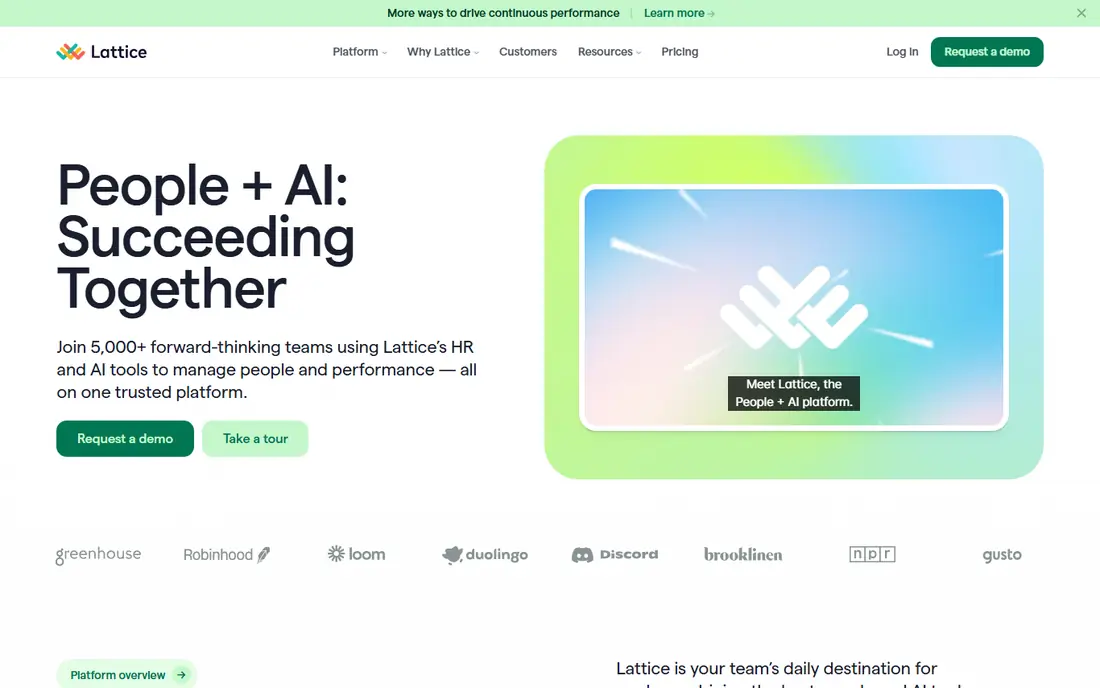
Lattice is the most accessible pick for teams that want to run structured pay cycles without an enterprise sales process. Its compensation add-on supports merit cycles, bonus planning, and manager workflows, and it connects naturally to performance reviews already in Lattice. Published pricing makes budgeting easier than with quote-only tools.
The trade-off is market data depth. Lattice is stronger on process than on deep benchmarking, so teams that need detailed survey data for many roles should pair it with a data source or pick PayScale or CompAnalyst instead. Lattice suits teams of roughly 50 or more people with a formal annual cycle.
- Published pricing for core platform
- Compensation add-on for pay cycles
- Links pay to performance reviews
- Minimum annual contract applies
- Benchmarking depth is thinner than specialist data tools
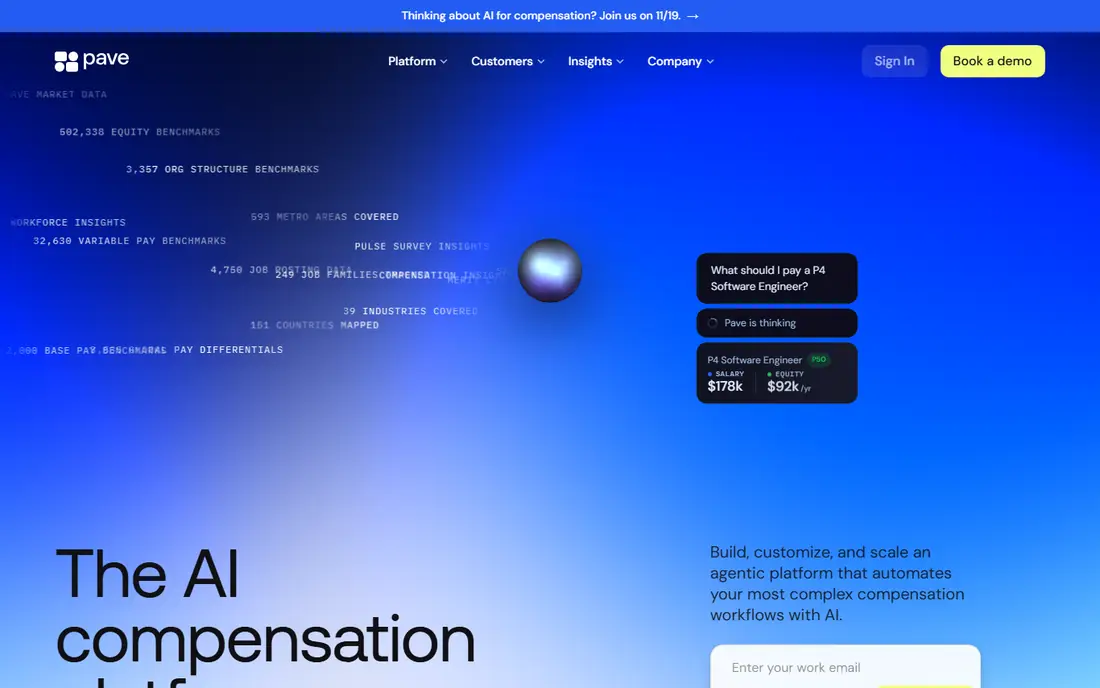
Pave suits fast-growing tech companies that need current pay data, not last year's survey. Its real-time benchmarks draw on participating company data, and its planning tools automate merit cycles, bonus calculations, and total rewards views for employees. A free market data tier helps smaller teams start benchmarking before paying for the full platform.
Coverage is strongest for tech and startup roles, so companies outside that world should check role coverage first. Full platform pricing is quote-based, so get a written quote tied to headcount and modules before you plan a budget around Pave.
- Free market data tier for smaller teams
- Real-time benchmarks
- Automated merit and bonus cycles
- Strongest for tech roles
- Full platform pricing is quote-based
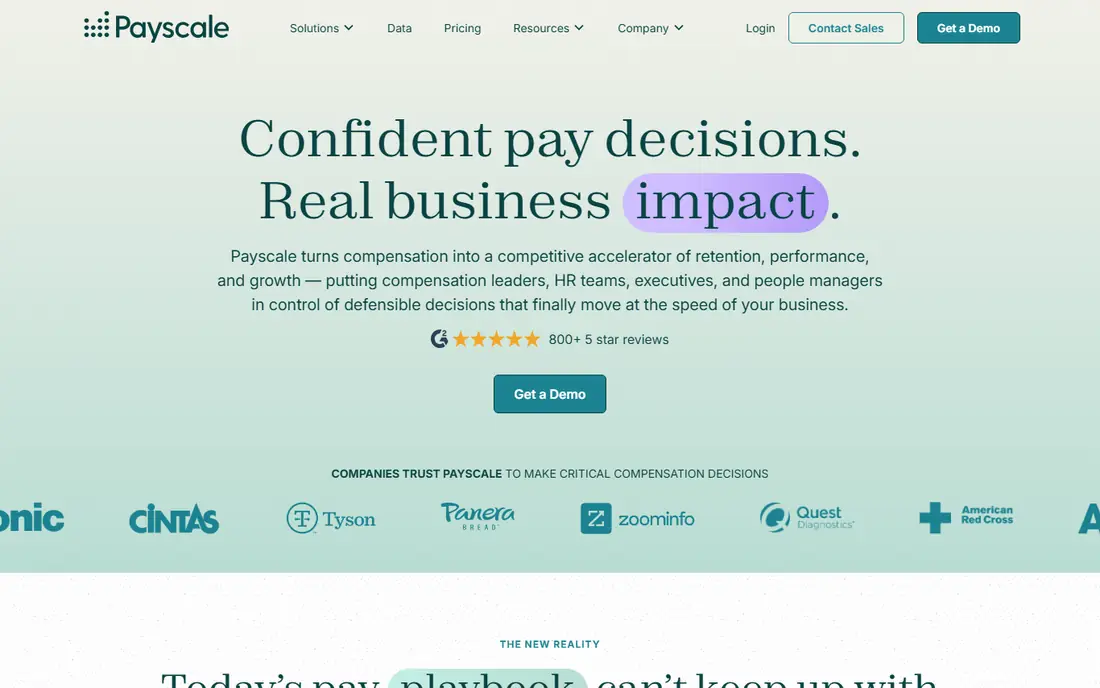
PayScale is a long-standing benchmarking pick for larger employers that need broad, defensible pay data. Its platform combines market data, pay structures, and reporting, with tools for pay equity analysis and manager guidance. That depth helps compensation teams justify ranges to leaders and to employees.
Pricing is quote-based, and the platform suits teams with dedicated compensation staff. Smaller companies may find the cost and setup heavy for a first pay tool, while larger employers will value the data breadth and reporting controls.
- Large compensation data sets
- Pay equity and reporting tools
- Strong for large employers
- Quote-based pricing
- Implementation can need dedicated resources
CompAnalyst, from Salary.com, is best for teams that want deep survey data and a structured way to build pay ranges. Its pay framework tools help create salary structures by job family, and its survey management features pull data into one library. Executive benchmarking is a particular strength.
Users often note a dated interface and a setup process that needs more IT involvement than newer tools. CompAnalyst suits larger teams with in-house compensation resources, rather than a small team looking for a quick, modern setup.
- Deep HR-reported survey data
- Pay framework builder
- Survey management tools
- Interface feels dated to some users
- Setup can need IT help for integrations
Workday suits large global companies that already run HR, payroll, and finance on the platform. Compensation management sits beside performance, talent, and payroll data, so pay decisions can draw on one system of record. Audit trails, approvals, and global pay rules support complex, regulated environments.
It is not a pick for a small team buying a standalone pay tool. Implementation is a major project, and pricing is quote-based. Workday is best when compensation is one part of a wider HR platform decision, not a single purchase.
- Compensation inside a full HR suite
- Global pay and equity support
- Strong audit and controls
- Quote-based pricing
- Implementation is a major project
Deel suits companies hiring across countries that need pay, payroll, and compliance in one place. Its compensation tools help global teams benchmark roles across markets, while its payroll and employer-of-record services handle the legal and payment side of international hiring. That combination reduces the number of vendors a global team must manage.
Standalone compensation depth is thinner than a specialist such as PayScale, and pricing depends on services used. Deel is best for global-first teams where cross-border pay and payroll matter as much as benchmarking itself.
- Global payroll and contractor support
- Compensation benchmarking for global teams
- Unified HR data
- Compensation is part of a wider platform
- Pricing depends on headcount and services
Carta Total Rewards suits private companies that need to see cash and equity together. Since many venture-backed companies already manage equity on Carta, adding compensation benchmarks there gives a fuller total rewards picture for offers and retention. Employees also benefit from clearer views of cash plus equity value.
Companies without an equity program, or public companies with different equity systems, will get less value from the Carta link. Carta is best for private, venture-backed teams where equity is a core part of pay.
- Equity data beside cash benchmarks
- Strong for venture-backed private companies
- Total rewards views
- Quote-based pricing
- Best fit is private companies with equity programs
beqom suits global enterprises with complex pay structures across countries, business units, and job families. Its modules cover salary, bonus, equity, and long-term incentives, with flexibility to adapt templates by country while keeping a global framework. Custom reporting helps compensation teams answer detailed leadership questions.
Setup can be complex, and pricing is quote-based at enterprise levels. beqom is best for large companies with dedicated compensation teams and varied global pay rules, rather than a mid-size team buying its first pay tool.
- Flexible global compensation modules
- Handles complex pay structures
- Strong reporting
- Quote-based pricing
- Setup can be complex for global templates
How we picked these
We compared official vendor pages, pricing pages, and product descriptions for compensation tools that are live in October 2026. We kept tools that cover benchmarking, pay cycle management, or both, and we mixed transparently priced tools with enterprise quote-based platforms so readers can see the real range. Where a vendor publishes no price, we wrote See website rather than repeating third-party estimates as fact.
How to choose a compensation tool
Start with company size and cycle maturity. Below about 50 employees, a spreadsheet plus a free benchmarking tier, such as Pave Market Data Lite, may be enough. Between 50 and a few hundred employees, Lattice or Pave can run a formal merit cycle without enterprise cost. Above that, or across many countries, PayScale, CompAnalyst, Workday, or beqom offer the data depth and controls a larger team needs.
Next, check data coverage for your actual roles and locations, not just the headline data set size. Ask for sample benchmarks for five hard-to-fill roles, and check how often data updates. Finally, test the manager experience: a tool that managers cannot use during a pay cycle will fail even if the data is excellent. Run a pilot cycle with one department before rolling out company-wide. In that pilot, check approval routing, budget controls, and how the tool handles employees who change roles or managers mid-cycle, since those cases often break a tidy plan. Ask how pay equity checks work, what audit records are kept, and how employee total rewards statements are presented, because those details affect trust in the final numbers. Also confirm integration with your HR and payroll systems, including how often data syncs and who fixes errors when records do not match. A pilot that covers these edge cases will reveal far more than a polished demo.
Frequently asked questions
What is the best compensation management software?
Lattice is best for smaller teams that want transparent pricing and structured pay cycles. Pave is best for tech companies that want real-time market data. PayScale and CompAnalyst are best for larger teams that need deep survey data.
Which compensation management tools are the best for benchmarking?
Pave, PayScale, and CompAnalyst are the strongest benchmarking picks here, with different strengths: Pave for real-time tech data, PayScale for broad enterprise data, and CompAnalyst for deep HR-reported survey data.
What is the best compensation management platform for global teams?
Workday and beqom suit large global enterprises with complex pay rules. Deel suits global-first teams that also need payroll and contractor compliance across countries.
Does Lattice charge extra for compensation?
Yes, compensation is an add-on to the Lattice platform, priced per seat per month in addition to the core platform price, with a minimum annual contract. Confirm the combined per-seat cost for your headcount before you buy.
Is there a free compensation management tool?
Pave offers a free market data tier for smaller teams, which covers benchmarking but not the full planning platform. Most full compensation platforms are paid, with quote-based pricing for enterprise tools.
How much does compensation software cost?
Costs range from free benchmarking tiers to quote-based enterprise contracts that run into five figures per year or more, depending on headcount, modules, and data needs. Lattice publishes per-seat pricing, while most enterprise vendors require a sales quote.
Sources
See where you really rank - block by block
ProMapRanker scans Google Maps across a grid of your service area. Simple monthly plans from $19, white-label on every plan.
Start freeKeep reading
 best rank tracking software
Best Rank Tracking Software in 2026
Searching for the best rank tracking software? We compare 8 tools for daily keyword tracking, local rankings, client reports, and competitor checks in 2026.
Read → best platform for ecommerce website
Best Platform for Ecommerce Website in 2026
Find the best platform for ecommerce website builds in 2026. We compare Shopify, WooCommerce, BigCommerce, Wix and more on price, fees and scale for stores.
Read → best math apps
Best Math Apps in 2026: 8 Apps Compared
Find the best math apps for homework, revision, and deeper study in our 2026 comparison of 8 free and paid solvers, courses, and visual tools for students.
Read →