 ProMapRanker
Best Cloud ETL Tools in 2026

Key takeaways
- Managed connector tools suit teams that want replication without pipeline code, while engines suit teams that want control.
- Pricing models differ sharply, so compare row, event, credit and compute pricing on your real volume, not on a demo.
- Transformation depth matters: some tools only replicate, while others let you reshape data before it reaches the warehouse.
- Monitoring, error handling and schema change handling are the features that keep pipelines running after launch.
Quick comparison
| Pick | Great for | Pricing starts at | Free tier | |
|---|---|---|---|---|
 Fivetran | Managed ELT replication | See website | Yes | Visit |
 Airbyte | Open-source and cloud ELT | See website | Yes | Visit |
 AWS Glue | AWS-first serverless ETL | See website | No | Visit |
 Azure Data Factory | Microsoft and Azure shops | See website | No | Visit |
 Google Cloud Dataflow | Google Cloud streaming and batch | See website | No | Visit |
 Matillion | Visual ELT for warehouses | See website | Free trial | Visit |
 Stitch | Simple row-based ELT | $100 per month | Free trial | Visit |
 Hevo Data | No-code managed ELT | $239 per month | Yes | Visit |
 Integrate.io | Low-code pipelines with flat pricing | $1,999 per month | Free trial | Visit |
 Qlik Talend Cloud | Enterprise integration and governance | See website | Free trial | Visit |
The best cloud etl tools
Cloud ETL tools move data from applications, databases and files into a warehouse or lake, clean and reshape it, and keep it fresh on a schedule. The best choice depends on whether you want a managed connector service, a code-first pipeline engine, or a visual builder for analytics engineers. The tools below cover all three paths, so a team can match the tool to its skills, not just its budget.
We compared official product pages, pricing pages and documentation, and we favoured tools with reliable connectors, clear transformation options, monitoring and error handling. Pricing models differ sharply: some charge per row, some per event, some per credit and some per compute hour, so we note the model for each tool and write See website where a vendor does not publish a price.
Start with a pilot that mirrors real volume, because a tool that looks cheap on a demo dataset can become expensive at production scale.
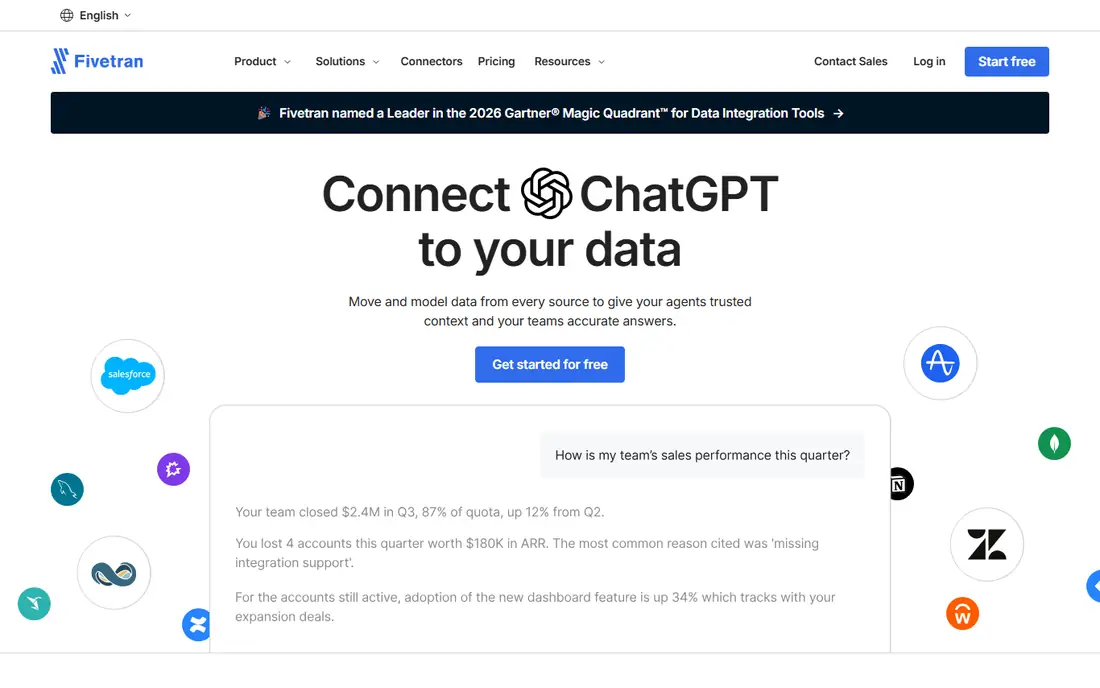
Fivetran is a strong match for managed elt replication. Fivetran is the managed replication pick, with a large connector catalogue that moves data from applications and databases into warehouses with minimal pipeline code. Automated schema handling reduces breakage when a source changes, and dbt integration gives analytics engineers a standard route for transformations after loading. A free tier covers small volumes, which helps teams test a connector before committing.
The catch is worth stating plainly. The pricing model is the main watch-out: billing by monthly active rows, per connector, can grow quickly with volume and with deletions. Monitor connector usage in the dashboard, sync only the tables you need, and model costs on production volume, not on a trial dataset. If that trade-off fits your budget and your team, it earns a place on a shortlist, but check the current plan limits and contract terms on the vendor site before you commit.
- Many managed connectors
- Automated schema handling
- Dbt integration for transforms
- Usage-based pricing can grow fast
- Connector-level billing needs careful monitoring
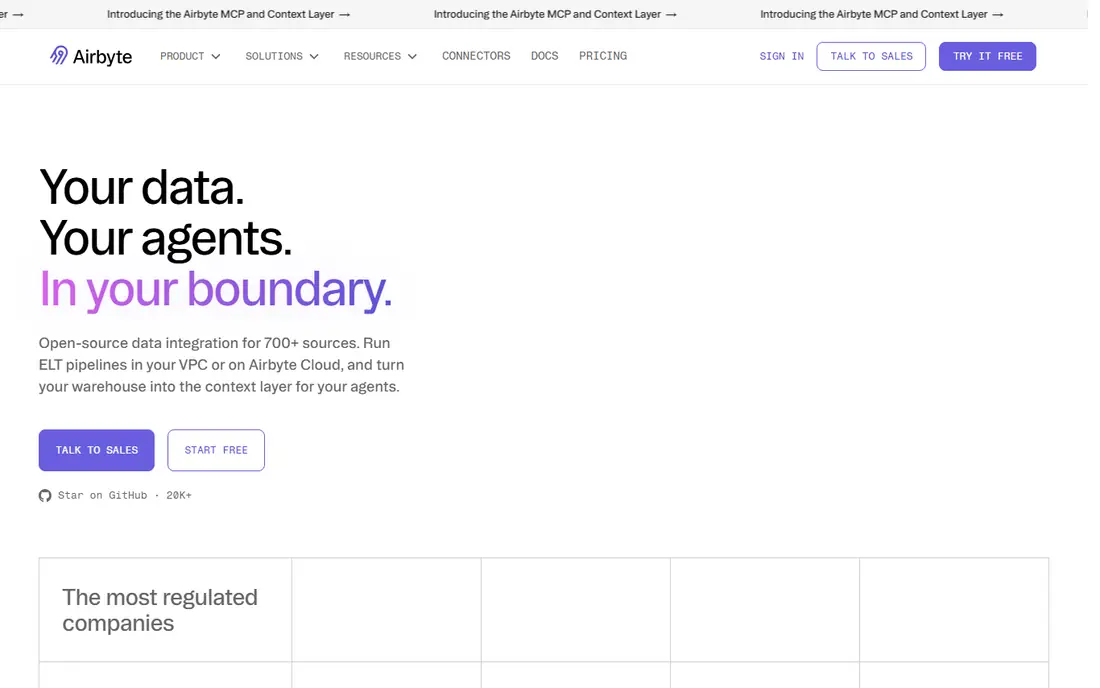
Airbyte is a strong match for open-source and cloud elt. Airbyte suits teams that want to own ingestion, because the open-source edition can be self-hosted and the cloud edition removes that operations burden. Its connector range is wide, and its community contributes connectors that smaller vendors may lack. That openness makes it a good choice for teams with engineering capacity and a preference for portable tooling.
The catch is worth stating plainly. Self-hosting is not free in practice, because infrastructure and maintenance time add up. Cloud pricing also jumps between self-serve and contract tiers, so check where your volume lands before you commit. If that trade-off fits your budget and your team, it earns a place on a shortlist, but check the current plan limits and contract terms on the vendor site before you commit.
- Open-source self-hosted option
- Large connector range
- Cloud credits for managed use
- Cloud pricing has a gap between self-serve and contract tiers
- Self-hosting needs engineering time
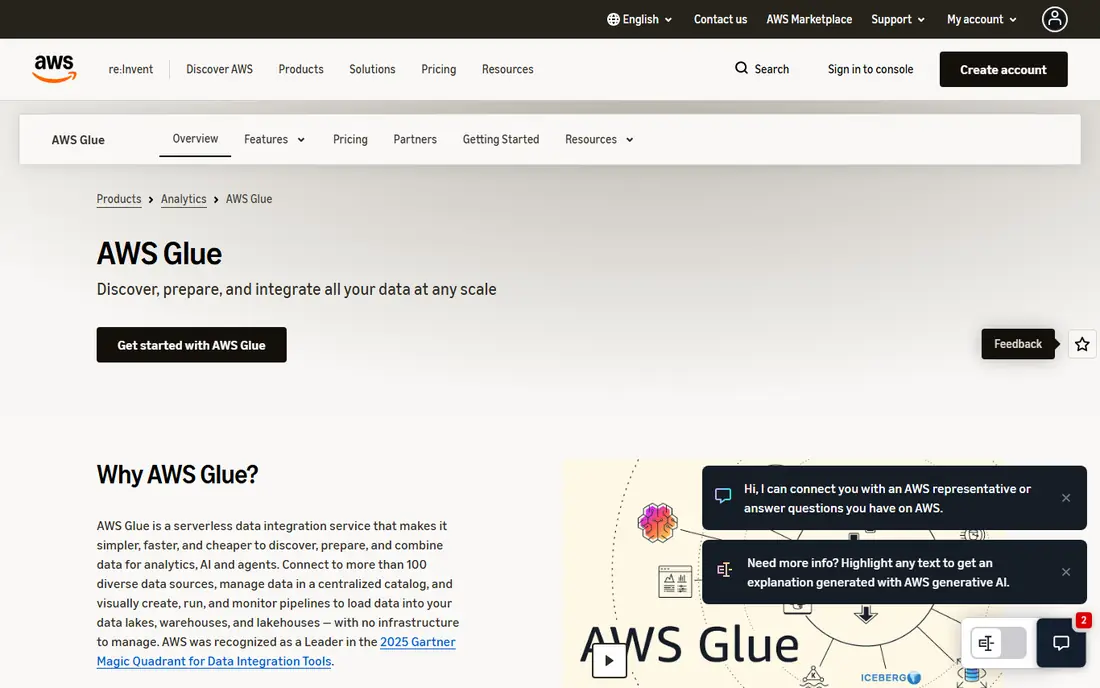
AWS Glue is a strong match for aws-first serverless etl. AWS Glue is the natural pick for teams already on AWS, because it runs serverless Spark jobs, catalogues data with crawlers, and integrates with S3, Redshift and other AWS services. It suits engineers who want code control over transformations, rather than a purely visual builder. Pay-as-you-go pricing means small jobs cost little, though large jobs need tuning.
The catch is worth stating plainly. The AWS focus is a limit for multi-cloud teams, and DPU-hour pricing rewards careful job sizing. Teams without Spark or Python skills may find a visual tool such as Matillion or Hevo faster to adopt. If that trade-off fits your budget and your team, it earns a place on a shortlist, but check the current plan limits and contract terms on the vendor site before you commit.
- Serverless Spark jobs
- Data catalogue and crawlers
- Tight AWS integration
- Pay-per-DPU-hour pricing needs job tuning
- AWS focus limits portability
Azure Data Factory is a strong match for microsoft and azure shops. Azure Data Factory is the pick for Microsoft shops, with a visual pipeline designer, connectors for Azure services and on-premises sources, and integration with Synapse and Fabric. It covers both cloud and hybrid work, which matters for firms that still run key systems on premises. Visual design plus code options give both analysts and engineers a route into pipelines.
The catch is worth stating plainly. Pricing is usage based, covering pipeline runs, data movement and compute, so forecasting needs a measured pilot. Teams outside the Microsoft ecosystem will get less value than Azure-native teams. If that trade-off fits your budget and your team, it earns a place on a shortlist, but check the current plan limits and contract terms on the vendor site before you commit.
- Visual pipeline designer
- Many Azure and on-premises connectors
- Integration with Synapse and Fabric
- Pricing is usage based and can be hard to forecast
- Microsoft focus suits Azure teams best
Google Cloud Dataflow is a strong match for google cloud streaming and batch. Google Cloud Dataflow is the streaming pick, running Apache Beam pipelines for both batch and streaming work on Google Cloud. Autoscaling adjusts workers to load, which helps pipelines that spike, and integration with BigQuery and Pub/Sub makes it a natural fit for Google Cloud analytics. Engineers who already use Beam will find it the most direct route.
The catch is worth stating plainly. Beam knowledge is a real requirement, so teams without it face a learning curve. Pricing depends on workers, streaming and storage, so model a realistic workload before comparing it with a managed connector tool. If that trade-off fits your budget and your team, it earns a place on a shortlist, but check the current plan limits and contract terms on the vendor site before you commit.
- Managed Apache Beam for batch and streaming
- Autoscaling
- Google Cloud integration
- Beam skills help
- Pricing depends on worker and streaming usage
Matillion is a strong match for visual elt for warehouses. Matillion is the visual ELT pick for analytics engineering teams on Snowflake, Databricks, BigQuery or Redshift. Its GUI builder covers most pipeline logic, while scripting options handle custom steps, and its AI assistant helps draft pipelines. Running inside the warehouse model keeps transformation close to the data, which suits teams that already work in SQL and warehouse tooling.
The catch is worth stating plainly. Pricing is credit based and not published, and warehouse compute is charged separately, so total cost needs a vendor discussion. It fits teams that value visual design and warehouse-native work, rather than teams that want a simple replication service. If that trade-off fits your budget and your team, it earns a place on a shortlist, but check the current plan limits and contract terms on the vendor site before you commit.
- Visual pipeline builder for warehouses
- GUI plus scripting
- AI-assisted pipeline help
- Credit-based pricing with no public price
- Warehouse compute is separate
Stitch is a strong match for simple row-based elt. Stitch is the simple pick for teams that want replication without pipeline complexity, with straightforward setup and row-based pricing from $100 per month. Its connector range covers common applications and databases, and the trial lets a team test volume before paying. For a small team that mainly needs data in a warehouse, that simplicity is a strength.
The catch is worth stating plainly. The main caution is direction: Stitch is being absorbed into Qlik Talend Cloud, so buyers should ask about migration and long-term support. Transformation is also limited, so teams that need heavy reshaping should pair it with dbt or choose another tool. If that trade-off fits your budget and your team, it earns a place on a shortlist, but check the current plan limits and contract terms on the vendor site before you commit.
- Simple setup with many connectors
- Row-based pricing
- 14-day trial with unlimited volume
- Product is being absorbed into Qlik Talend Cloud
- Transformation options are limited
Hevo Data is a strong match for no-code managed elt. Hevo Data is the no-code pick for lean teams that want managed pipelines without engineering a connector service. Setup is visual, connectors cover common sources, and transformations include drag-and-drop options plus dbt for deeper work. A free plan covers 1 million events a month, which lets a small team test a real pipeline.
The catch is worth stating plainly. Event-based pricing is the watch-out, because frequent updates multiply events even when the underlying data changes little. Teams with high-frequency sources should model event counts carefully and check the Starter plan from $239 per month against their real volume. If that trade-off fits your budget and your team, it earns a place on a shortlist, but check the current plan limits and contract terms on the vendor site before you commit.
- No-code pipeline setup
- Many connectors
- Drag-and-drop plus dbt transforms
- Event-based pricing can multiply with frequent updates
- Higher tiers are custom priced
Integrate.io is a strong match for low-code pipelines with flat pricing. Integrate.io suits teams that want predictable costs for ETL, CDC and reverse ETL in one platform, because its Core plan charges a flat monthly fee rather than billing per row. The low-code builder includes a wide transformation set, and reverse ETL lets a team send warehouse data back to operational tools. That breadth covers both ingestion and activation without buying two products.
The catch is worth stating plainly. The entry price from $1,999 per month rules it out for small projects, and there is no free tier. It makes sense when volume is high enough that row-based billing would cost more, or when a flat bill matters for annual budgeting. If that trade-off fits your budget and your team, it earns a place on a shortlist, but check the current plan limits and contract terms on the vendor site before you commit.
- Low-code builder with many transformations
- Flat fee with no row limits
- Reverse ETL options
- Entry price is high for small teams
- No free plan, only a trial
Qlik Talend Cloud is a strong match for enterprise integration and governance. Qlik Talend Cloud is the enterprise pick for teams that need integration, data quality and governance in one platform. Visual design plus code options suit mixed teams, and deployment on cloud, client-managed or hybrid infrastructure helps regulated firms. Data quality tools catch bad records during a run, which matters when pipelines feed compliance or financial reporting.
The catch is worth stating plainly. Pricing is quoted and setup is enterprise scale, so it is not a quick win for a small team. It fits organisations that already use Qlik or Talend, or that need governance alongside integration. If that trade-off fits your budget and your team, it earns a place on a shortlist, but check the current plan limits and contract terms on the vendor site before you commit.
- Visual design plus code
- Data quality and governance
- Cloud, client-managed and hybrid deployment
- Quote-only pricing
- Enterprise setup takes time for small teams
How we picked these
We compared vendor product pages, pricing pages and documentation, and we checked connector depth, transformation options, pricing models and deployment. We did not claim hands-on testing, and where a vendor does not publish a price we wrote See website. The list mixes managed replication services, visual builders and code-first engines, because cloud ETL work takes all three forms.
What to check before you buy
Decide whether you need replication, transformation or both. Replication tools such as Fivetran and Stitch move data fast, while builders such as Matillion and Integrate.io reshape it on the way. A team that needs both should either pair a replication tool with dbt, or choose a platform that covers both, and cost that choice honestly.
Model pricing on production volume. Row, event, credit and compute models all look similar on a demo, then diverge sharply at scale. Run a pilot with real tables, real update frequency and real deletions, and compare the projected monthly bill, not the entry price.
Test failure and schema change handling. Change a source column, delete a row, and break a connection, then watch how clearly the tool reports the problem and how easily a job recovers. Those behaviours decide whether a pipeline survives its first year.
Frequently asked questions
Which cloud ETL tool is best?
There is no single winner, because the best tool depends on your stack and skills. Fivetran suits managed replication, Airbyte suits teams that want open-source control, Matillion suits visual warehouse work, and AWS Glue, Azure Data Factory and Dataflow suit teams already on those clouds.
What is the difference between ETL and ELT in the cloud?
ETL transforms data before loading it into a warehouse, while ELT loads raw data first and transforms it inside the warehouse. Cloud tools often use ELT, because warehouses are powerful enough to transform at scale. The practical difference is where transformation code lives and who maintains it.
How much do cloud ETL tools cost?
Stitch starts at $100 per month, Hevo Data Starter from $239 per month, and Integrate.io Core from $1,999 per month. Fivetran, Airbyte Cloud, Matillion and the cloud engines price by usage, credits or compute, so model your volume before comparing entry prices.
Do I need code skills for cloud ETL?
Not always. Hevo Data, Stitch and Fivetran need little code for replication, while Matillion and Integrate.io use visual builders. AWS Glue, Azure Data Factory and Dataflow reward code skills, especially for custom or streaming pipelines.
Can cloud ETL tools handle real-time data?
Some can, especially Google Cloud Dataflow for streaming and tools with change data capture for near-real-time replication. Many managed tools sync on a schedule from minutes to hours, so check latency for your exact sources before promising real-time dashboards.
Sources
- https://fivetran.com
- https://airbyte.com
- https://aws.amazon.com/glue/
- https://azure.microsoft.com/en-us/products/data-factory
- https://cloud.google.com/dataflow
- https://www.matillion.com
- https://www.stitchdata.com
- https://hevodata.com
- https://www.integrate.io
- https://www.qlik.com
- https://kleene.ai/blog/best-etl-tools
- https://skyvia.com/blog/top-fivetran-alternatives/
See where you really rank - block by block
ProMapRanker scans Google Maps across a grid of your service area. Simple monthly plans from $19, white-label on every plan.
Start freeKeep reading
 wpforms alternatives
Best WPForms Alternatives in 2026
We compare 9 wpforms alternatives for WordPress forms, with free and paid options, current pricing notes, and honest limits for small business sites in 2026.
Read → windows task scheduler alternatives
Best Windows Task Scheduler Alternatives in 2026
Looking for Windows Task Scheduler alternatives? We compare 9 schedulers for Windows and cross-platform work, from free tools to enterprise automation.
Read → which ai video service is best
Which AI Video Service Is Best in 2026
which ai video service is best? We compare 10 legitimate AI video services on price, avatars, editing and output quality to help you pick the right tool.
Read →