 ProMapRanker
Best Cloud Communication Platform in 2026

Key takeaways
- Twilio, Vonage, Plivo, and Bandwidth are developer platforms priced by message and minute, while RingCentral, Dialpad, and Zoom Phone are per-user business phone systems.
- The cheapest headline rate is not the cheapest bill: carrier fees, number rental, 10DLC registration, and support plans all change the total.
- RingCentral Core at 20 dollars per user per month billed annually and Dialpad Standard at 15 dollars are the clearest per-user starting points.
- Teams that need WhatsApp, SMS, voice, and email in one API should shortlist Twilio or Vonage, while teams that need a phone system staff can use on day one should shortlist RingCentral or Dialpad.
- Test with real volume, real numbers, and real carrier registration before committing, because messaging compliance is where most launches stall.
Quick comparison
| Pick | Great for | Pricing starts at | Free tier | |
|---|---|---|---|---|
 Twilio | Developer-first messaging and voice | See website | No | Visit |
 Vonage Communications APIs | Omnichannel APIs with verification | See website | No | Visit |
 RingCentral RingEX | All-in-one business phone | $20 per user per month | No | Visit |
 Dialpad Connect | AI-first business phone | $15 per user per month | No | Visit |
 Zoom Phone | Teams already on Zoom | $10 per user per month | No | Visit |
 Plivo | Low-cost Twilio alternative | See website | No | Visit |
 Bandwidth | Carrier-grade voice and messaging | See website | No | Visit |
 Sinch | Enterprise omnichannel messaging | See website | No | Visit |
The best cloud communication platforms
We compared official pricing pages, API documentation, and public reviews for platforms that deliver voice, messaging, video, and phone service from the cloud. Our pick for most developers is Twilio, because its API coverage, documentation, and ecosystem are the broadest, while our pick for most office teams is RingCentral, because it bundles phone, messaging, and meetings in one system.
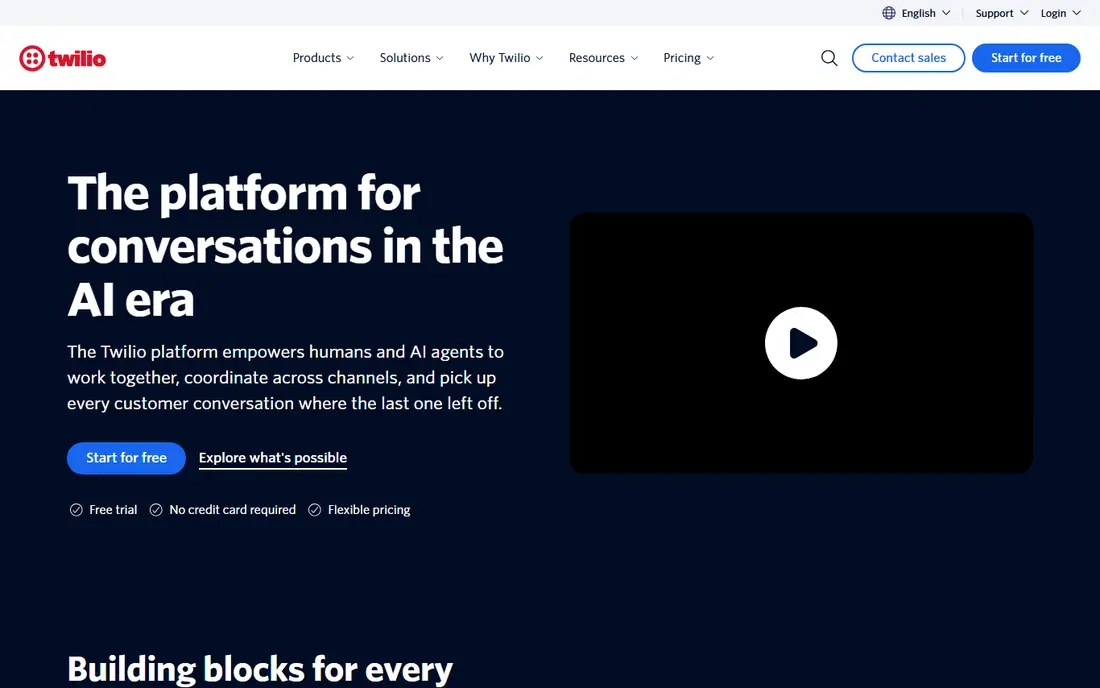
Twilio is the default developer platform for programmable communications, with APIs for SMS, MMS, RCS, voice, WhatsApp, email, and verification, plus a sandbox that makes testing easy. US pricing is usage-based, with outbound calls around 1.4 cents per minute, SMS around 0.83 cents per segment plus carrier fees, and local numbers around 1.15 dollars per month, though rates vary by country and channel. That pay-as-you-go model suits teams with variable volume and teams that already build their own front ends.
The honest catch is that Twilio ships no inbox, campaign builder, or chatbot UI, so product teams must build those pieces or buy a third-party front end. At high volume, per-message markups and carrier fees also matter more than the headline rate, so teams should model a real month of traffic, including 10DLC brand and campaign fees, before comparing Twilio with a lower-rate rival.
- Broadest API coverage
- Excellent documentation
- SMS, voice, WhatsApp, email, and verification in one platform
- No built-in inbox or campaign UI
- Per-message and per-minute fees plus carrier fees add up
Vonage Communications APIs, formerly Nexmo, give developers SMS, voice, video, messaging, verification, and number insight APIs on a global platform, with fraud defender tools that help block artificially inflated traffic. That breadth suits teams that need more than one channel, such as a login flow that uses SMS verification, a support flow that uses voice, and a marketing flow that uses WhatsApp, all under one account. Vonage also sells business phone plans separately, so a company can start with APIs and add a phone system later.
Pricing is usage-based and varies by API and destination, so buyers should check the current rate card for their countries rather than relying on a single headline figure. The platform rewards teams with engineering resources, while non-technical teams may prefer a bundled phone system with a ready-made app and admin console.
- Voice, messaging, video, and verification APIs
- Strong global coverage
- Fraud protection options
- Pricing is usage-based and varies by channel
- Business phone plans are a separate product
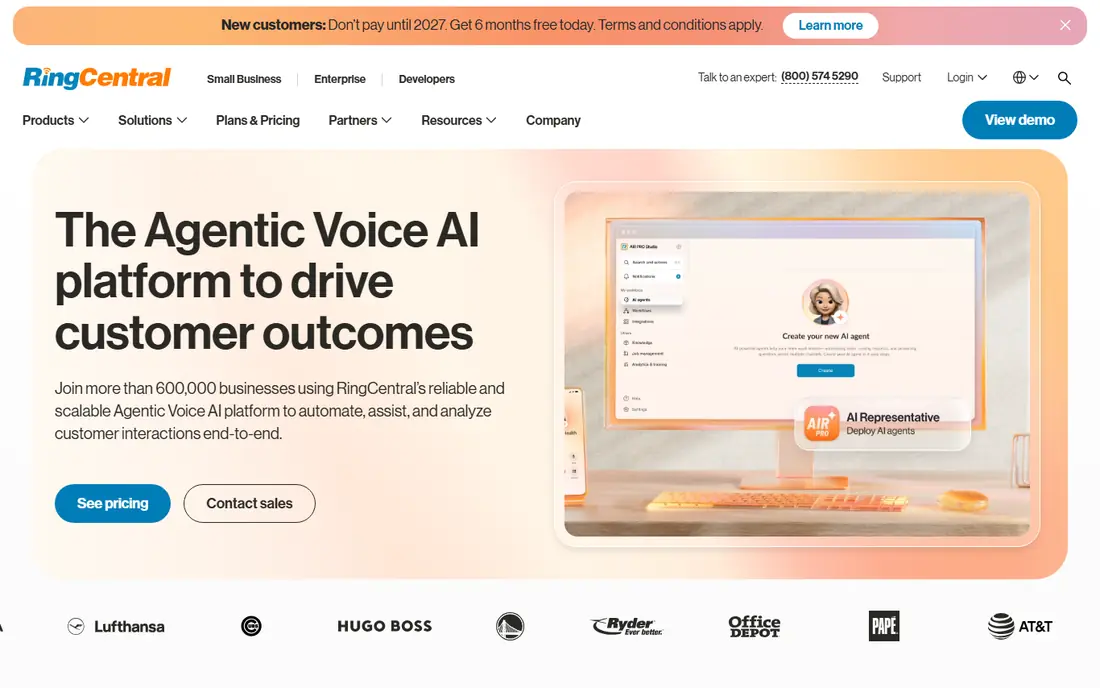
RingCentral RingEX is a cloud business phone system with calling, team messaging, video meetings, and contact centre add-ons in one app, which makes it easy for staff to adopt without juggling several tools. Core starts at 20 dollars per user per month billed annually, or 30 dollars monthly, with unlimited domestic calling, on-demand recording, and video meetings, while Advanced at 25 dollars billed annually adds CRM integrations, automatic recording, and more toll-free minutes. A 14-day trial for up to 20 lines lets a team test call quality and admin controls before buying.
The limits are the caps and extras. Core includes only 25 SMS per user per month and 100 toll-free minutes, and AI features, analytics, and contact centre tools are add-ons or higher tiers, plus taxes and regulatory fees. RingCentral still suits most office teams that want one system for calls, texts, and meetings, provided they budget for the tier that actually includes the features they will use daily.
- Phone, messaging, and meetings in one app
- Clear published tiers
- Broad integrations
- SMS and toll-free allowances are capped on lower tiers
- Fees and add-ons add to the bill
Dialpad Connect is a cloud phone system with AI built into the core, including real-time transcription, call summaries, and voicemail transcription on its standard plans. Standard starts at 15 dollars per user per month billed annually, or 27 dollars monthly, with unlimited domestic calling, SMS and MMS, team messaging, and video meetings, while Pro at 25 dollars billed annually adds CRM integrations, more ring groups, and 24/7 support. A 14-day trial gives a team time to test call quality and AI accuracy.
The catch is tier gating. Features such as custom moments, AI scorecards, and longer recording retention sit on higher tiers or add-ons, and the seat minimums can be awkward for very small or fast-growing teams. For a team that wants AI summaries from day one at a low entry price, Dialpad is hard to beat, as long as the team checks SMS caps and overage rates before signing.
- AI transcription and summaries included
- Low entry price
- Clean apps for desktop and mobile
- Advanced AI features are gated
- Pro needs a 3-seat minimum and Enterprise a 100-seat minimum
Zoom Phone adds cloud calling to the Zoom platform many teams already use for meetings, which keeps phone, video, and messaging in one app and one admin console. Metered plans start around 10 dollars per user per month, with outbound minutes billed separately, while Unlimited plans start around 15 dollars per user per month, and Global Select around 20 dollars, with broader international coverage. That range lets a low-volume team start cheap and move to unlimited when call volume grows.
The metered plan can surprise a team that makes many outbound calls, since per-minute charges add up quickly, and power-user analytics are a paid add-on. Zoom Phone is the obvious pick for a team already paying for Zoom, while a team that wants AI transcription included on every plan may prefer Dialpad, and a team that wants a standalone phone-first system may prefer RingCentral.
- Natural fit for Zoom users
- Metered and unlimited plans
- Simple admin
- Metered plan charges per outbound minute
- Advanced analytics need add-ons
Plivo is a cloud communications platform with SMS, MMS, voice, and WhatsApp APIs, plus contact centre products for teams that need an agent desktop and omnichannel inbox. Its US SMS rates are lower than Twilio's headline rates, with outbound messages in the range of a fraction of a cent to just over half a cent in some comparisons, and long-code numbers around 50 cents per month, which makes it attractive for high-volume messaging. The API is designed as a like-for-like alternative for teams migrating from Twilio.
The trade-off is ecosystem size. Plivo has fewer third-party integrations and a smaller developer community than Twilio, so teams should test their exact use case, including number porting, 10DLC registration, and delivery reporting, before switching. For cost-sensitive messaging at scale, Plivo is a credible alternative that deserves a head-to-head pilot.
- Lower US messaging rates than Twilio
- Simple API
- Contact centre and voice options
- Smaller ecosystem than Twilio
- Support and feature depth vary by product
Bandwidth is a communications platform that runs its own network, which gives it direct control over voice quality, number provisioning, and messaging delivery at scale. It suits enterprises and software companies that embed calling and texting into their own products, need large blocks of numbers, or want to manage toll-free and emergency calling with carrier-level controls. Its APIs cover voice, messaging, and emergency services, and its network ownership is a real differentiator when delivery reliability matters.
Bandwidth is not a casual small-business phone system, and pricing is generally quote-based, so smaller teams should expect a sales conversation and a volume-based proposal. For a company that treats communications as part of its product, rather than as an office phone bill, Bandwidth is a strong enterprise shortlist pick.
- Owns its network
- Strong number management
- Good for high-volume voice and messaging
- Developer and enterprise focus
- Pricing is quote-based for most buyers
Sinch is an enterprise cloud communications platform with messaging across SMS, WhatsApp, RCS, and email, plus voice, video, and verification APIs for customer engagement at global scale. It suits large brands that need to reach customers in many countries, run campaigns across channels, and verify users, with a single vendor handling routing and compliance in each market. Its enterprise focus shows in its support, delivery reporting, and partner ecosystem.
The drawback for smaller buyers is that pricing is quote-based, and details such as number setup fees and call billing increments can affect the total, so a scoped quote is essential. Sinch is best for enterprises with international reach and high message volume, while smaller US-focused teams will usually find Twilio, Plivo, or a per-user phone system simpler and cheaper to start.
- Global messaging reach
- WhatsApp, SMS, RCS, and email
- Verification and voice options
- Pricing is quote-based
- Number setup and call billing details need checking
How we picked these
We compared official pricing pages, API documentation, and public reviews, and we favoured platforms that are still sold and supported in October 2026, that clearly deliver cloud voice or messaging, and that cover both developer APIs and per-user phone systems. We checked published versus quote-based pricing, free trials, channel coverage, and the extra fees that change a bill, such as carrier fees, number rental, and 10DLC registration, and we did not claim hands-on testing.
What to check before you buy
First, decide between an API and a phone system. An API suits a team that builds its own product and needs to send messages or calls from code, while a phone system suits a team that needs staff to answer, transfer, and record calls from an app on day one. Mixing the two up is the most common buying mistake in this category, and it leads to either a tool nobody can use or a bill nobody forecast.
Next, model a real month. Take last month's call minutes, message counts, and number rentals, add carrier fees and compliance fees, and compare that total across two or three vendors, not just the headline rate. Test number porting, message delivery, call quality, and admin controls during a trial, and confirm support hours, uptime terms, and data handling. A vendor that passes a real-volume test with your numbers and your compliance setup is worth more than a vendor with the lowest advertised rate.
Frequently asked questions
What is a cloud communication platform?
It is a service that delivers voice, messaging, video, or phone service over the internet, without on-premise phone hardware. It can be a developer API that your software calls, a business phone system your staff uses, or a mix of both, and it is billed by usage, by user, or by a combination of the two.
What is the difference between CPaaS and UCaaS?
CPaaS, or communications platform as a service, gives developers APIs to add messaging and voice to their own software, while UCaaS, or unified communications as a service, gives staff a ready-made phone, messaging, and meetings system. Twilio and Vonage are CPaaS examples, while RingCentral, Dialpad, and Zoom Phone are UCaaS examples.
How much does a cloud communication platform cost?
Developer platforms are usually usage-based, with SMS at a fraction of a cent to about a cent per message plus carrier fees, and voice at about a cent per minute, while business phone systems start at 10 to 20 dollars per user per month. The total depends on volume, channels, numbers, and add-ons, so model a real month before choosing.
Do I need 10DLC registration to send business texts in the US?
Yes, in most cases, businesses sending application-to-person texts to US numbers need to register their brand and campaigns under 10DLC rules, and carriers charge brand, vetting, and campaign fees. Your vendor should guide you through registration, and you should budget for those fees and the time registration takes.
Which cloud communication platform is best for a small business?
A small business that needs a phone system for staff should start with Dialpad or RingCentral, depending on whether AI summaries or a broader phone and meetings bundle matters more. A small business that needs to send messages from its own software should start with Twilio or Plivo and test delivery and cost at real volume.
Sources
See where you really rank - block by block
ProMapRanker scans Google Maps across a grid of your service area. Simple monthly plans from $19, white-label on every plan.
Start freeKeep reading
 wpforms alternatives
Best WPForms Alternatives in 2026
We compare 9 wpforms alternatives for WordPress forms, with free and paid options, current pricing notes, and honest limits for small business sites in 2026.
Read → windows task scheduler alternatives
Best Windows Task Scheduler Alternatives in 2026
Looking for Windows Task Scheduler alternatives? We compare 9 schedulers for Windows and cross-platform work, from free tools to enterprise automation.
Read → which ai video service is best
Which AI Video Service Is Best in 2026
which ai video service is best? We compare 10 legitimate AI video services on price, avatars, editing and output quality to help you pick the right tool.
Read →