 ProMapRanker
Best CLM Software for Large Enterprises in 2026

Key takeaways
- Icertis is our pick for the largest, most regulated enterprises because obligation tracking and scale sit at the center of the platform.
- Ironclad suits legal teams that want business users to self-serve routine agreements through configurable workflows.
- DocuSign CLM fits firms already built on DocuSign signing, since it extends a tool staff already use.
- Almost every enterprise CLM platform is quote priced, so budget on a written proposal that includes implementation and AI add-ons.
Quick comparison
| Pick | Great for | Pricing starts at | Free tier | |
|---|---|---|---|---|
 Icertis | Largest regulated enterprises | See website | No | Visit |
 Ironclad | Legal teams wanting workflow self-service | See website | No | Visit |
 DocuSign CLM | Firms already using DocuSign | See website | No | Visit |
 Agiloft | No-code configurable workflows | See website | No | Visit |
 Conga CLM | Salesforce native contract teams | See website | No | Visit |
 Sirion | Supplier heavy enterprises | See website | No | Visit |
 Evisort | AI contract analysis at scale | See website | No | Visit |
 LinkSquares | Legal teams wanting signed contract insight | See website | No | Visit |
 Malbek | AI led contract lifecycle for large teams | See website | No | Visit |
The best CLM software for large enterprises
Contract lifecycle management, or CLM, runs a contract from drafting and negotiation through approval, signature, storage and obligation tracking. For a large enterprise, the test is scale: thousands of contracts, many entities, strict approvals and obligations that must be tracked after signing. We compared official product pages and enterprise CLM documentation, and we kept platforms built for large enterprise volume and governance.
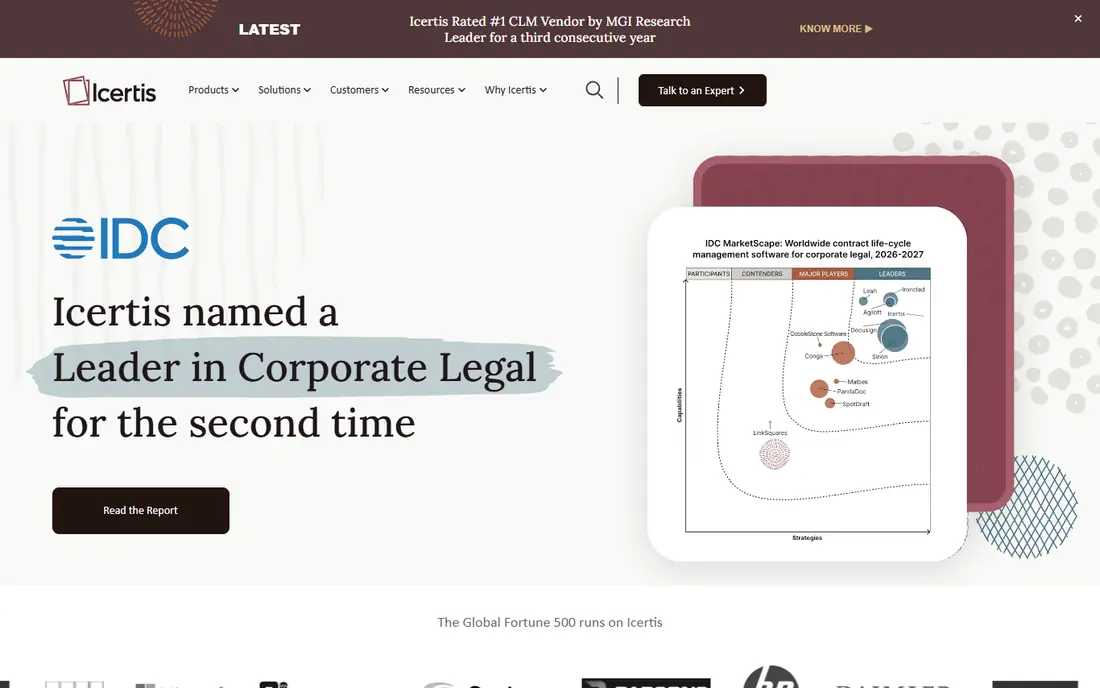
Icertis is built for the largest and most complex contract estates, including regulated industries where obligations, entitlements and compliance terms must be tracked against business systems. The platform structures contract data so legal, procurement and finance teams can query obligations, renewals and risks across thousands of agreements, rather than searching documents one by one. That depth is why Icertis appears in large enterprise evaluations even when its price sits above rivals.
Scale brings cost and effort. Pricing is quoted, implementation can take many months, and a firm needs legal operations staff to configure, govern and maintain the system. A smaller firm would pay for depth it cannot staff. For a global enterprise with high contract volume, regulatory exposure and a need to enforce obligations at scale, Icertis is the benchmark.
- Deep obligation management
- Enterprise scale
- Strong compliance and audit tools
- Quote only pricing
- Long implementation
- Needs dedicated legal operations support
Ironclad helps in-house legal teams turn routine agreements into workflows that business users can start themselves, with approvals, templates and clause controls built in. That self-service model releases legal time from standard sales, vendor and employment agreements, while keeping legal oversight where risk is higher. AI assistance supports drafting, review and data extraction, though some AI features are priced as add-ons.
Pricing is quoted and real contracts often sit in a wide annual band depending on seats, modules and volume, so a firm should get AI, implementation and renewal terms in the first proposal. Implementation also needs legal operations time to design workflows well. For a legal team that wants to scale without adding headcount for every routine contract, Ironclad is a strong choice.
- Configurable workflow designer
- Business user self-service
- AI assistance for review
- Quote only pricing
- AI features may be add-ons
- Implementation needs legal ops time
DocuSign CLM extends the signing tool that many enterprises already use into a fuller contract lifecycle, with drafting, negotiation, approval workflows, a central repository and obligation tracking. Firms that already sign through DocuSign gain adoption speed, since staff know the signing step and IT already manages the vendor relationship. Integrations with CRM, ERP and document tools help contracts move between sales, legal and finance.
CLM depth depends on the package, and AI contract insight can be an add-on rather than a base feature, so a firm should confirm what is included before comparing prices. Implementation also needs scoping for workflow design and migration of legacy contracts. For an enterprise already committed to DocuSign, DocuSign CLM is the lowest friction path to a fuller lifecycle.
- Extends widely adopted signing
- Contract repository and workflows
- Broad integrations
- Quote only pricing
- CLM depth varies by package
- AI insight may be an add-on
Agiloft appeals to enterprises that want to configure contract workflows, approvals and data models without paying for custom code on every change. The no-code platform lets legal operations teams adjust templates, rules and reports as business needs change, which helps a firm whose contract types, approval chains or compliance rules evolve often. A flexible data model also supports varied contract portfolios across departments.
Flexibility needs governance. Skilled admins must own configuration, testing and change control, or a no-code system can grow messy as teams add fields and workflows. Pricing is quoted and implementation can take months for a large estate. For an enterprise that values configurability and wants to reduce dependence on vendor services for routine changes, Agiloft is a proven option.
- No-code configuration
- Flexible data model
- Long CLM market presence
- Quote only pricing
- Implementation can take months
- Configuration needs skilled admins
Conga CLM suits enterprises that run sales and revenue processes in Salesforce, since contracts can flow from quote and opportunity through negotiation, approval and signature without retyping deal terms. That continuity reduces errors between sales and legal, and links contract data to revenue lifecycle tools for renewals and amendments. Teams that already live in Salesforce gain adoption and reporting benefits.
A firm that does not use Salesforce will get less value from Conga than from a standalone CLM platform, and implementation can still take months for a large estate. Pricing is quoted, so a firm should confirm modules, Salesforce licensing interaction and AI features in writing. For a Salesforce centered enterprise, Conga CLM is a natural and strong choice.
- Salesforce native workflows
- Quote to contract continuity
- Broad revenue lifecycle links
- Quote only pricing
- Best value inside Salesforce
- Implementation can be long
Sirion focuses on what happens after signing, especially for supplier heavy enterprises that need to measure performance against contracted terms. The platform tracks obligations, service levels, invoices and supplier performance, and flags underperformance against the contract rather than leaving terms in a document store. That post-signature strength suits procurement led enterprises with large supplier portfolios.
Pre-signature workflow depth is less of a Sirion differentiator than its post-signature analytics, so a firm that mainly needs drafting and negotiation speed should compare Ironclad or DocuSign CLM closely. Pricing is quoted and implementation for a large supplier estate takes time. For an enterprise where supplier obligations and performance drive value, Sirion stands out.
- Post-signature obligation tracking
- Supplier performance measurement
- Enterprise governance
- Quote only pricing
- Long implementation
- Strongest for buy-side and supplier contracts
Evisort, now part of Workday, is known for AI powered contract analysis that extracts clauses, dates, obligations and risks from signed and draft contracts at scale. A legal team can search a large portfolio for a clause, a renewal date or a risk term without reading each document, which helps during audits, mergers and renegotiations. The searchable repository turns legacy contracts into usable data.
Workflow depth for drafting and negotiation should be tested against full lifecycle rivals, since Evisort grew from analysis rather than end to end workflow. Pricing is quoted, and Workday ownership means a firm should confirm roadmap, integration plans and support terms. For an enterprise that needs to understand a large signed portfolio quickly, Evisort is a powerful analysis led choice.
- AI extraction and analysis
- Searchable contract repository
- Workday ownership and scale
- Quote only pricing
- CLM workflow depth varies
- Now part of Workday, so roadmap needs checking
LinkSquares helps legal operations teams answer portfolio questions without legal review time for every query. AI extraction and analytics turn signed contracts into searchable data on renewals, obligations, counterparties and key terms, while the repository keeps executed agreements organized. That insight model suits legal teams that spend too much time hunting for contract facts.
Pre-signature workflow is lighter than Ironclad or DocuSign CLM, so a firm that needs heavy drafting, negotiation and approval automation should test that side closely. Pricing is quoted and enterprise scale, including migration volume and user count, should be scoped in writing. For a legal team whose main pain is finding and understanding signed contracts, LinkSquares is a focused and useful platform.
- Post-signature analytics
- Searchable repository
- AI extraction for portfolio questions
- Quote only pricing
- Pre-signature workflow is lighter
- Enterprise scale needs scoping
Malbek offers an AI led contract lifecycle platform with drafting, negotiation, approval workflows, a central repository and obligation tracking for large teams. Configurable templates and approvals let legal teams standardize routine agreements while keeping control over higher risk terms. The AI angle supports clause suggestions, extraction and search across the portfolio.
Malbek has a smaller independent review base than Icertis, Ironclad or DocuSign, so reference checks matter more during evaluation. Pricing is quoted and implementation for a large estate needs a scoped plan for migration and workflow design. For a large team that wants an AI led lifecycle and a more configurable alternative to the largest vendors, Malbek is worth a demo.
- AI led lifecycle workflows
- Configurable templates and approvals
- Growing enterprise presence
- Quote only pricing
- Smaller review base than market leaders
- Implementation needs planning
How we picked these
We compared official product pages, enterprise CLM documentation and analyst category coverage, and we kept only platforms that exist and work in October 2026 and that serve large enterprise contract volume. We weighted full lifecycle coverage, obligation tracking, AI extraction quality, workflow configurability, governance and integration depth. We did not claim hands-on testing, and we did not include small business signature tools or proposal tools that lack true lifecycle and obligation management.
What to check before you buy enterprise CLM software
Start with your contract types, not with a feature list. List your highest volume agreements, your highest risk agreements and your most complex obligations, then run each type through drafting, negotiation, approval, signature and post-signature tracking in a trial. A platform that handles NDAs well may still struggle with master supplier agreements or multi-entity sales contracts.
Next, test AI on your own non-standard contracts. Ask each vendor to extract clauses, dates and obligations from your messiest legacy agreements, and check accuracy against a human review. AI claims vary widely, and a demo on clean templates will not reveal limits on real documents.
Finally, get the full commercial picture in writing. Include license, implementation, AI add-ons, migration, support and renewal caps, plus a scoped implementation timeline with named responsibilities. Enterprise CLM fails more often on adoption and data migration than on feature gaps, so plan training, legal operations staffing and legacy contract migration before you sign.
Frequently asked questions
What is the best CLM software for large enterprises?
Icertis is our pick for the largest regulated enterprises, thanks to obligation depth and scale. Ironclad suits legal teams that want workflow self-service, while DocuSign CLM suits firms already using DocuSign signing. The best choice depends on contract volume, obligation complexity and existing systems.
How much does enterprise CLM software cost?
Almost every platform here is quote priced, with enterprise contracts commonly running into tens of thousands to hundreds of thousands of dollars per year depending on seats, modules and volume. Get a written proposal that includes implementation, AI add-ons and renewal terms, since the license price alone understates total cost.
What is the difference between contract management and CLM?
Contract management often means storage and reminders. CLM runs the full lifecycle from drafting and negotiation through approval, signature, repository storage and obligation tracking, with contract data structured for search and reporting. Large enterprises need CLM when volume and obligations exceed what a document store can handle.
Does CLM software use AI for contract review?
Leading platforms use AI for clause extraction, obligation tracking, drafting assistance and risk flags, but depth and accuracy vary. Test AI on your own non-standard contracts before you buy, and confirm whether AI features are included or sold as add-ons.
How long does enterprise CLM implementation take?
Implementation commonly takes several months for a large enterprise, depending on contract volume, workflow complexity and legacy migration. Ask for a scoped timeline in writing, including data migration, workflow design, testing and training, rather than accepting a general estimate.
Sources
See where you really rank - block by block
ProMapRanker scans Google Maps across a grid of your service area. Simple monthly plans from $19, white-label on every plan.
Start freeKeep reading
 wpforms alternatives
Best WPForms Alternatives in 2026
We compare 9 wpforms alternatives for WordPress forms, with free and paid options, current pricing notes, and honest limits for small business sites in 2026.
Read → windows task scheduler alternatives
Best Windows Task Scheduler Alternatives in 2026
Looking for Windows Task Scheduler alternatives? We compare 9 schedulers for Windows and cross-platform work, from free tools to enterprise automation.
Read → which ai video service is best
Which AI Video Service Is Best in 2026
which ai video service is best? We compare 10 legitimate AI video services on price, avatars, editing and output quality to help you pick the right tool.
Read →