 ProMapRanker
Best Card Scanner App in 2026

Key takeaways
- CollX is the best free card scanner app for most collectors, with unlimited scans on its free tier and a built-in marketplace.
- Ludex is the most accurate scanner for modern parallels and variations, but its best features require a paid plan.
- Collectr is the best collection app for trading card game collectors who track many games in one portfolio.
- TCGplayer is the best scanner for sellers, since scanning feeds directly into marketplace inventory.
- Every in-app value is an estimate. Check recent sold prices before buying, selling or paying to grade a card.
Quick comparison
| Pick | Great for | Pricing starts at | Free tier | |
|---|---|---|---|---|
 CollX | Free scanning and marketplace | Free | Yes | Visit |
 Ludex | Accurate parallel scanning | Free | Yes | Visit |
 Collectr | Multi-game TCG portfolios | Free | Yes | Visit |
 TCGplayer | Seller inventory | Free | Yes | Visit |
 Card Ladder | Collection value from sold data | Free | Yes | Visit |
 Cardbase | Pokemon collection tracking | Free | Yes | Visit |
 ManaBox | Magic collection and decks | Free | Yes | Visit |
 SportsCardsPro | Sports card value tracking | See website | No | Visit |
 PriceCharting | Price checks across hobbies | Free | Yes | Visit |
The best card scanner apps
This list focuses on collectible and trading card scanning and collection apps, for sports cards, Pokemon, Magic: The Gathering, Yu-Gi-Oh and other trading card games. A few of these apps also scan business cards or offer other features, but we judged them here on how well they identify a collectible card, value it and organize a collection. Scanning accuracy, price source and collection tools matter more than any single headline feature.
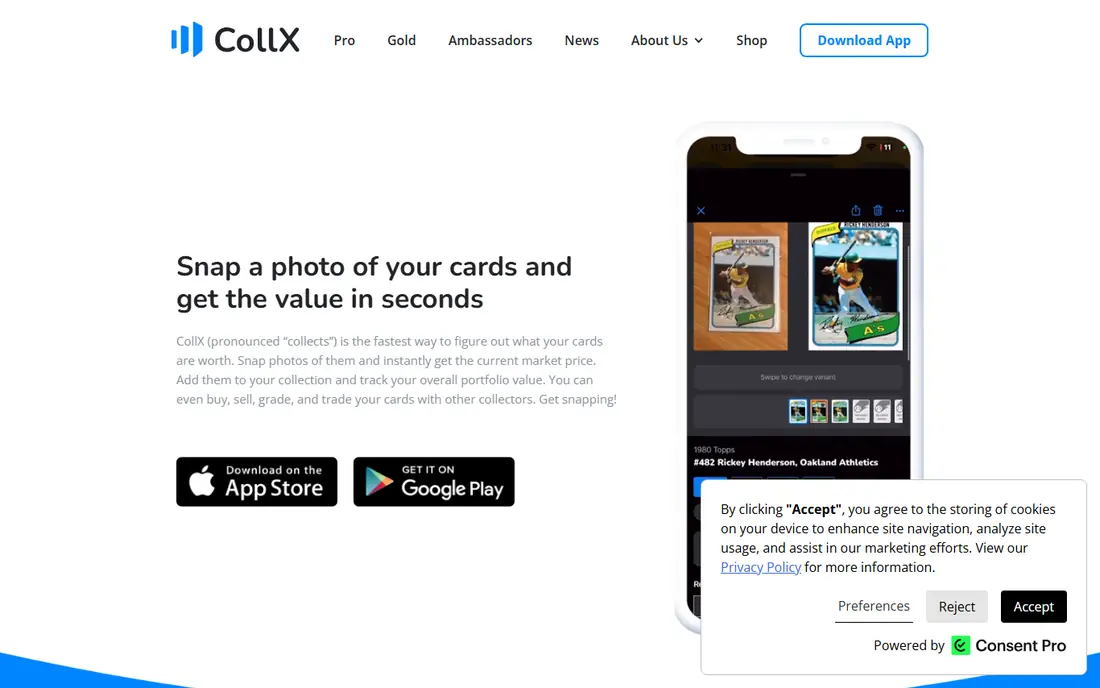
CollX is our pick for most collectors because it is free to start and genuinely useful without paying. Snap a photo of a card, get an identification and an estimated market value, then add it to a collection and track the total value over time. The database covers sports cards and trading card games, and the marketplace lets you buy and sell with other collectors, with payments held until a card arrives.
The honest weakness is accuracy on tricky cards. Independent comparisons put CollX behind Ludex on parallels and refractors, and its values can sit above recent sold prices because they blend asking prices into the average. That does not make CollX a bad scanner. It makes it a scanner whose values you should treat as a starting point, then confirm against sold listings before a big decision. For everyday collecting, CollX is the best free place to start.
- Free tier with unlimited scans
- Large card database across sports and trading card games
- Built-in marketplace with buyer protection
- Parallel and variation accuracy is lower than Ludex
- In-app values blend asking prices with sales, so they can run high
- Pro features needed for exports
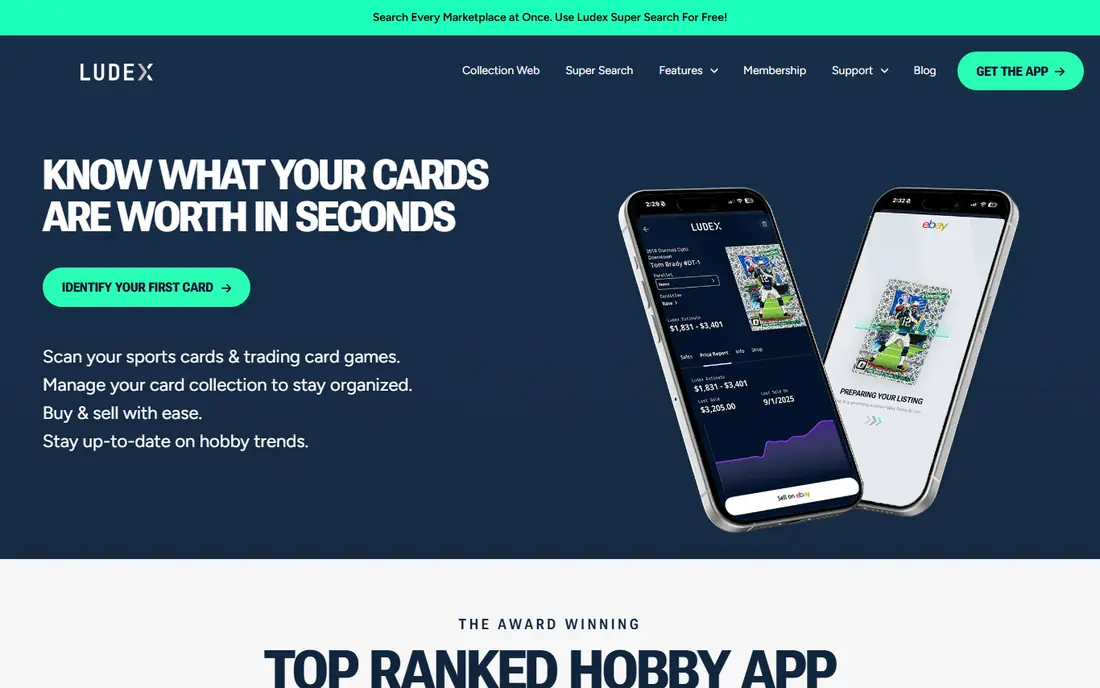
Ludex is the scanner dealers and serious modern-set collectors tend to trust most for identification. It scans sports cards and trading card games, including Pokemon, Magic and Yu-Gi-Oh, and it is notably better than rivals at telling apart parallels, refractors and similar variations that look almost identical in a photo. Its values draw on completed sales from major marketplaces, which gives a firmer basis than an asking-price average.
The free tier lets you test Ludex, but heavy use and full features require Premium, which has been listed at different prices over time, so check the current app store listing before subscribing. Ludex also lacks a peer-to-peer marketplace as complete as CollX, though it does offer a listing feature for eBay. If accuracy on modern parallels matters more than a free price tag, Ludex is the scanner to beat.
- Strong accuracy on parallels and variations
- Values based on completed marketplace sales
- Collection tools with custom binders and exports
- Full use requires a paid Premium plan
- No built-in peer marketplace like CollX
- Sports pricing lacks some grading breakdowns
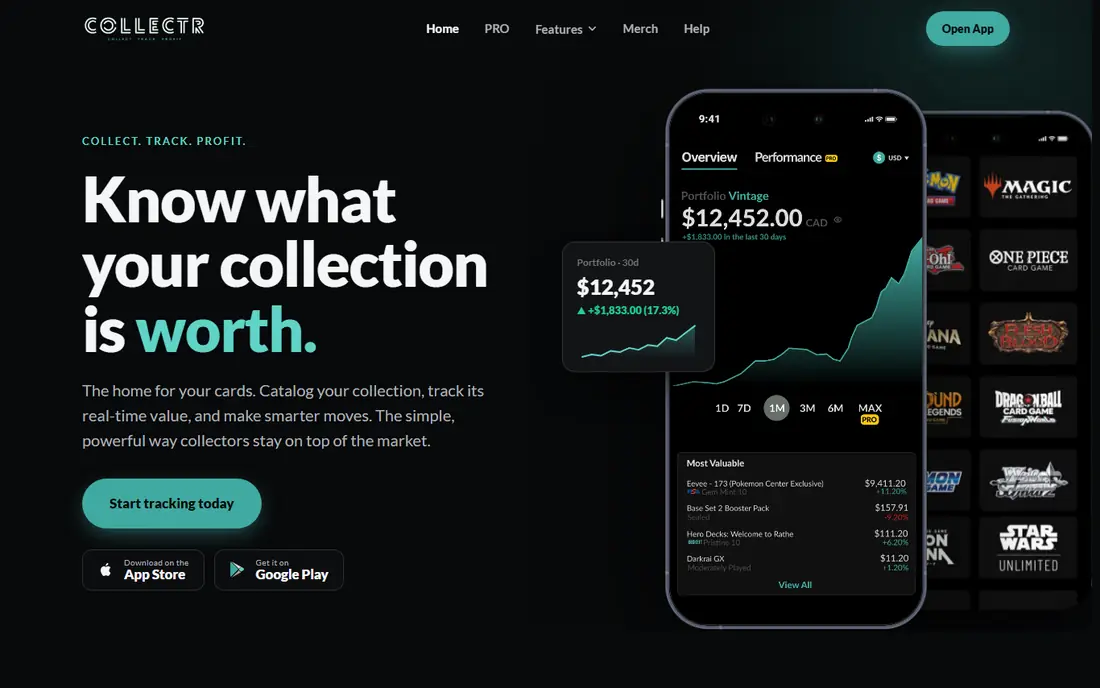
Collectr is best understood as a portfolio manager for trading card game collectors, with scanning as one way to add cards. It supports Magic, Yu-Gi-Oh, Pokemon, Lorcana, One Piece and many other games, and it lets you track raw, graded and sealed products as a single portfolio with values in your chosen currency. For a collector who follows several games at once, that breadth is hard to match.
Collectr Pro, listed at $7.99 per month or $59.99 per year in recent comparisons, adds unlimited scanning, longer price history and export features. The free plan is useful for a smaller collection, but its scan limit is not always published clearly, so test it with your own binder before relying on it. If you collect one game deeply, a specialist app may fit better. If you collect many games, Collectr is the cleanest single portfolio.
- Tracks many trading card games in one portfolio
- Real-time values for raw, graded and sealed products
- Multi-currency portfolio view
- Pro plan needed for unlimited scanning and long price history
- Price sources are not always clearly documented
- Scanning is one part of a portfolio tool
TCGplayer's official app is the best card scanner app for sellers. Scanning a card matches it to a TCGplayer product, so you can set quantities, manage seller inventory and list cards without retyping details. That workflow saves real time for a seller with a large inventory, and the market price shown comes from the marketplace where the card will actually sell.
As a private collection app, TCGplayer is plainer than Collectr or CollX, with fewer portfolio charts and social features. It also rewards careful scanning, since a plain background and controlled lighting improve accuracy, as TCGplayer's own guidance notes. If selling is your main goal, TCGplayer is the obvious pick. If private collecting is your main goal, start with CollX or Collectr and use TCGplayer for price checks.
- Scanning tied directly to marketplace listings and inventory
- Large product catalog for trading card games
- Clear market prices from its own marketplace
- Collection experience is less rich than Collectr or CollX
- Best value only if you sell on TCGplayer
- Scanning needs good lighting and a plain background
Card Ladder is less about snapping a photo and more about trusting the number that follows. It pulls real eBay sale data to value a collection, which makes its portfolio totals more grounded than apps that blend asking prices. Collectors who want to know what their collection actually sold for, rather than what sellers hope to get, will appreciate that approach.
Card Ladder Pro, listed at $20 per month in recent comparisons, adds fuller features and deeper history. The app is also less camera-first than CollX or Ludex, so collectors who want to scan a whole binder quickly may prefer to scan elsewhere and track value here. Use Card Ladder when portfolio value accuracy matters most, and pair it with a fast scanner for bulk intake.
- Collection values based on real eBay sale data
- Useful for tracking value over time
- Covers sports and trading cards
- Pro plan needed for full features
- Not primarily a camera-first scanner
- Price history depth depends on plan
Cardbase is a Pokemon-first collection app that does one job well. It helps Pokemon collectors scan cards, track sets, follow completion progress and see values for their collection in a clean interface. For a collector whose binder is mostly Pokemon, that focus means less clutter and clearer set views than a general app that tries to cover every game.
The focus is also the limit. Sports collectors and multi-game collectors will find Cardbase too narrow, and some advanced features sit behind a paid plan. If Pokemon is your main game, Cardbase is a strong and focused choice. If you collect Pokemon alongside Magic, sports or other games, Collectr or CollX will cover more of your collection in one place.
- Pokemon-focused collection and set tracking
- Scanning and price data for Pokemon cards
- Clean set completion views
- Narrower game coverage than Collectr
- Advanced features require a paid plan
- Less useful for sports collectors
ManaBox is the best card scanner app for Magic: The Gathering players who also build decks. It combines collection tracking, deck construction and prices from multiple marketplaces, so a card you scan can move from your collection into a deck list without a second tool. That workflow matters for players who care about playability as much as value.
ManaBox is not a general scanner for sports or Pokemon collectors, and its breadth can feel complex for a casual collector who only wants to scan and value cards. If Magic is your game and you play as well as collect, ManaBox is the most complete companion. If you only collect and never build decks, a simpler scanner may be faster.
- Combines collection management, deck building and prices from multiple marketplaces
- Strong for Magic players
- Scanning supports collection entry
- Magic-focused, so other games are limited
- Scanning is part of a larger workflow, not the sole focus
- Learning curve for new Magic players
SportsCardsPro is a sports-first tracking tool for collectors who want to follow the value of a sports portfolio without the extra features of a marketplace app. It covers major sports, lets you organize cards by player, team and set, and gives a clear view of how a collection's value changes over time. For a sports-only collector, that focus keeps the experience simple.
The app is less prominent than CollX or Ludex as a camera scanner, so collectors who scan large binders should test its scanning speed before committing. Its pricing also needs checking on its own site, since plan details change. Use SportsCardsPro when sports tracking is your main job, and use CollX or Ludex when fast, accurate scanning is the priority.
- Sports-focused price tracking and collection tools
- Useful for tracking a sports portfolio over time
- Simple web and app access
- Less known than CollX or Ludex for scanning
- Pricing and plan details need checking on the site
- Trading card game coverage is limited
PriceCharting is best used as a price reference rather than a primary scanner. It tracks prices for trading cards and other collectibles, and recent comparisons found its values close to real sales on many test cards. That makes it a useful second opinion when a scanner's value looks high or low, especially before a purchase or a grading decision.
The Collector plan, listed at $5.99 per month, adds deeper price history and collection features, but the free experience is still useful for spot checks. PriceCharting will not replace CollX or Ludex for scanning a binder, and its interface feels more like a price database than a collection app. Keep it in your toolkit as the check you run before you trust any single app's number.
- Price data across trading cards, video games and other collectibles
- Collector plan adds deeper history
- Useful as a second opinion on value
- Not a camera-first scanner
- Collector plan costs $5.99 per month for full features
- Interface is more data-focused than collection-focused
How we picked these
We compared official app store listings, vendor feature pages and public comparisons of scanning accuracy and pricing. We favored apps that are actively available in 2026, scan or track collectible and trading cards, and serve a distinct collector need, from free scanning to seller inventory to portfolio valuation. We left out generic business card scanners, since this list is about collectible cards, and we left out apps that had stopped working or offered only a price feed without collection tools.
How to choose a card scanner app
Start with your main game and your main job. Sports collectors should test CollX and Ludex first, Pokemon collectors should test Cardbase and Collectr, Magic players should test ManaBox, and sellers should test TCGplayer. A scanner that covers your game well will save more time than a general app with a larger but shallower database.
Next, test scanning on ten difficult cards before you commit to a full binder. Include a foil, a sleeved card, a parallel, a reprint with the same art, a promo and a non-English printing if you own them. The best app should make uncertainty visible and let you correct the printing quickly, rather than confidently misidentifying a card.
Finally, treat every value as an estimate. Check recent sold prices on eBay or a second price source before buying, selling or grading, since condition, grade and centering move real prices far more than a quick scan can show. A scanner tells you what a card is and roughly what it is worth. Sold listings tell you what someone actually paid.
Frequently asked questions
What is the best card scanner app?
CollX is the best card scanner app for most collectors because its free tier offers unlimited scans and a built-in marketplace. Ludex is better for accuracy on modern parallels, while Collectr is better for tracking many trading card games in one portfolio.
What is the best card collection app?
Collectr is the best card collection app for trading card game collectors who follow several games, while CollX is the best free collection app for sports and trading cards together. Cardbase is the best choice for Pokemon-only collectors, and ManaBox is the best choice for Magic players who also build decks.
Is there a free card scanner app?
Yes. CollX offers a free tier with unlimited scans, Ludex offers a free tier for testing, and TCGplayer, Cardbase, ManaBox and PriceCharting all offer free plans. Paid plans add unlimited scanning, exports, deeper price history or marketplace features, so test the free tier before subscribing.
How accurate are card scanner apps?
Base card identification is usually reliable on the leading apps, but parallels, variations and foils are harder. Independent comparisons have put Ludex ahead of CollX on parallel accuracy, while CollX covers a larger database for free. Always confirm a difficult card manually before buying or selling based on a scan alone.
What is the best card scanning app for Pokemon?
Collectr and Cardbase are the strongest Pokemon options in this list. Cardbase is more focused on Pokemon set tracking, while Collectr covers Pokemon alongside many other trading card games in one portfolio. CollX also scans Pokemon cards and suits collectors who also follow sports cards.
Can a card scanner app tell me if a card is worth grading?
A scanner can tell you the card's identity and a rough raw value, which are inputs to the grading decision, but it cannot judge condition. Centering, corners, edges and surface determine the grade, and a separate grading assessment is needed for a reliable decision. Compare the raw value with the graded value and the grading cost before submitting a card.
Sources
See where you really rank - block by block
ProMapRanker scans Google Maps across a grid of your service area. Simple monthly plans from $19, white-label on every plan.
Start freeKeep reading
 free alternatives to grok imagine
Free Alternatives to Grok Imagine in 2026
We compared the best free alternatives to grok imagine for image generation, from fast daily credits to design tools, so you can create without paying.
Read → best tools for instagram content creation
Best Tools for Instagram Content Creation in 2026
Compare the best tools for Instagram content creation, from Canva and CapCut to Later and Buffer, on design, video, planning, scheduling, and price in 2026.
Read → best tool to split pdf files
Best Tool to Split PDF Files in 2026
We compared the best tool to split pdf files on split modes, file limits, privacy and price, so you can split a PDF cleanly and keep every page in one go.
Read →