 ProMapRanker
Best Beginner Stock Investing Apps in 2026

Key takeaways
- Most leading brokers now charge $0 commission on online US stock and ETF trades, so the real differences are education, account types, and automation.
- Fractional shares matter for beginners, because they let a small amount buy part of an expensive stock or fund.
- A managed portfolio can suit a hands-off beginner, while a self-directed broker suits someone who wants to pick investments.
- This is general information only, not financial advice, and investing carries risk, including possible loss of money.
Quick comparison
| Pick | Great for | Pricing starts at | Free tier | |
|---|---|---|---|---|
 Fidelity | All-around beginners | Free | Yes | Visit |
 Charles Schwab | Education and support | Free | Yes | Visit |
 Robinhood | Simple mobile investing | Free | Yes | Visit |
 SoFi Invest | Banking plus investing | Free | Yes | Visit |
 Webull | Learning active trading | Free | Yes | Visit |
 E*TRADE | Wide choice and research | Free | Yes | Visit |
 Vanguard | Long-term index investing | Free | Yes | Visit |
 Acorns | Automatic small investing | $4 per month | No | Visit |
 Betterment | Hands-off managed portfolios | $5 per month | No | Visit |
 Public | Fractional and multi-asset investing | Free | Yes | Visit |
The best beginner stock investing apps
We compared official pricing pages, account types, fractional share rules, and learning tools. The picks below suit different starting points, from a first retirement account to a first small stock purchase.
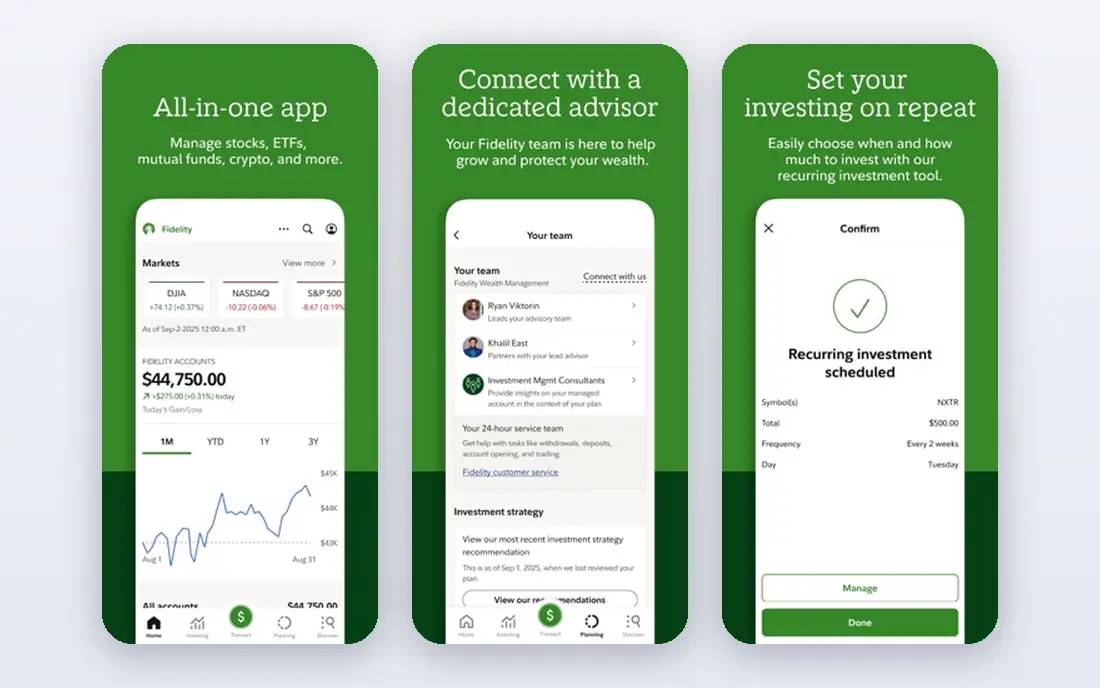
Fidelity is our pick for most beginners because it covers the basics well and still leaves room to grow. A new investor can open a brokerage account or an IRA, buy fractional shares, and set up recurring investments without paying commission on online US stock and ETF trades. The learning hub explains terms in plain language, which helps when a first statement or a market drop raises questions.
The trade-off is choice. Fidelity offers many account types, funds, and research tools, and that breadth can feel busy on a first visit. Start with one account and one simple plan, such as a broad ETF or a retirement account, and ignore the rest until you need it. That approach keeps the low cost without turning a first account into a daily trading habit.
- $0 commission on online US stock and ETF trades
- Fractional shares from $1
- Broad retirement and education tools
- The full platform can feel large at first
- Some advanced tools take time to learn
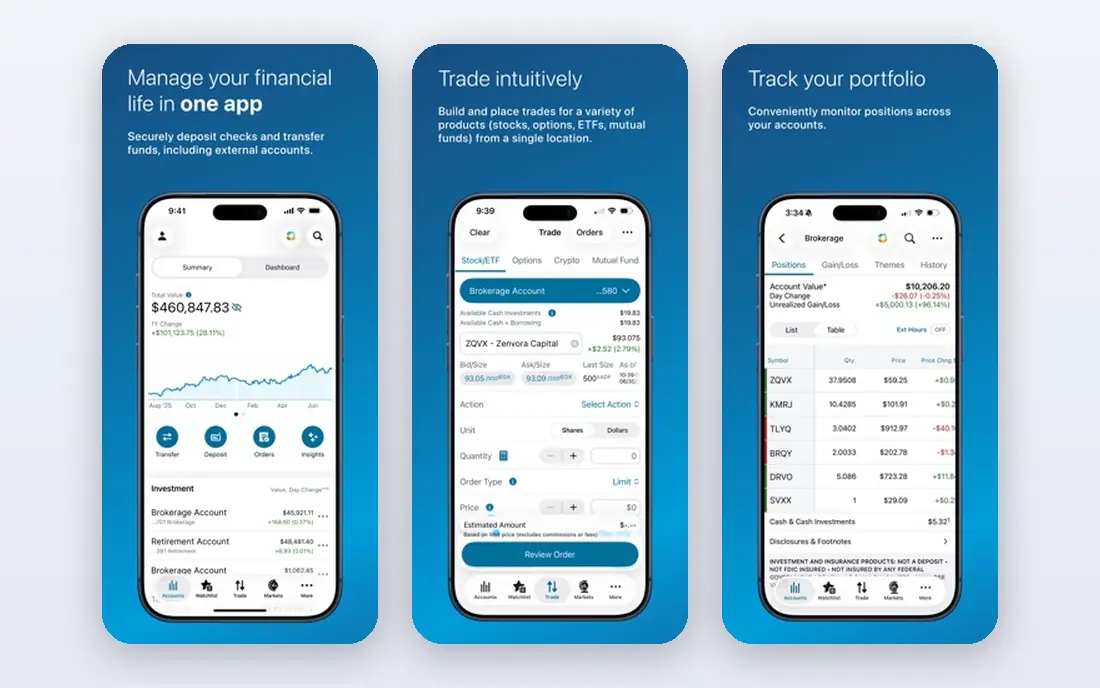
Schwab suits a beginner who wants help nearby while learning. It offers $0 commission on online listed stock and ETF trades, fractional shares through its stock slices program, and retirement accounts that fit a long-term plan. Its education library covers account types, risk, and diversification in short lessons rather than long lectures.
The catch is that Schwab also serves experienced traders, so menus include options a beginner may not need yet. That is not a reason to avoid it, but it is a reason to set a simple goal first. If you want a broker with human support and a steady learning path, Schwab is a strong second choice behind Fidelity.
- $0 commission on online US stock and ETF trades
- Strong learning resources
- Branch and phone support
- The range of products can feel complex
- Some tools suit active traders more than pure beginners
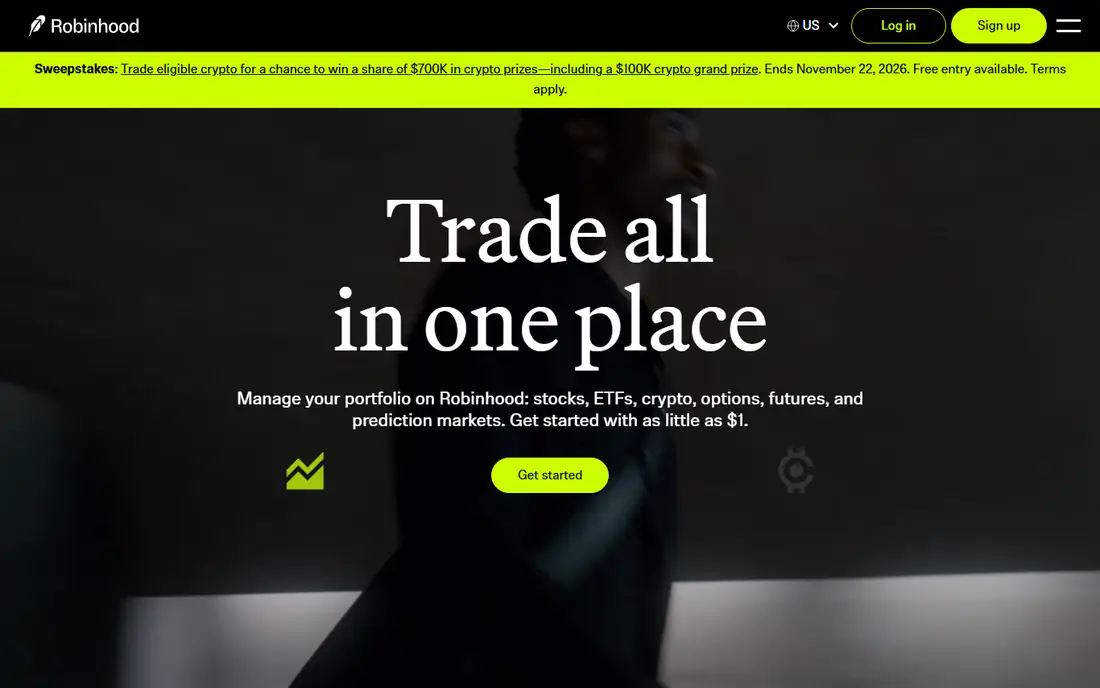
Robinhood is the easiest app on this list to open and use, and that simplicity is both its strength and its risk. Trades, fractional shares, and recurring investments sit in a clear mobile flow, and stock and ETF trades carry $0 commission. For a beginner who wants to start small and learn by doing, that low friction helps.
The honest catch is behavior. When trading takes seconds, it is easy to check prices often and trade on short-term moves. A beginner should decide in advance how often to invest and what to buy, then use the app to follow that plan. Robinhood Gold, at $5 per month, adds features such as larger instant deposits, but it is not needed to start.
- Clean mobile design
- $0 commission on stock and ETF trades
- Fractional shares from $1
- Recurring investments
- The simple design can encourage frequent trading
- Research depth is thinner than at Fidelity or Schwab
SoFi Invest fits a beginner who already banks with SoFi or wants investing beside checking, savings, and loans. Active investing offers $0 commission stock and ETF trades, while automated investing builds a portfolio based on goals and risk answers. Fractional investing from $5 keeps first purchases small.
The limit is depth. SoFi is a good all-in-one app, but its research and trading tools are lighter than those at Fidelity, Schwab, or E*TRADE. That matters less if the plan is steady, long-term investing. It matters more if you want detailed stock screening or advanced charting from day one.
- $0 commission on stock and ETF trades
- Active and automated investing in one app
- Fractional investing from $5
- Research tools are lighter than specialist brokers
- Automated portfolios carry a separate advisory fee
Webull suits a beginner who wants to learn how markets move before risking much money. Its paper trading mode lets a new investor practice with virtual funds, while real accounts offer $0 commission on US stock and ETF trades. Charts, news, and screening tools are stronger than at most simple apps.
That strength is also the warning. Webull is built for people who follow markets closely, and its screens can push a beginner toward short-term trading. Use the practice mode first, set a small real budget, and keep retirement money in a separate, simpler plan if that is the main goal.
- $0 commission on US stock and ETF trades
- Free paper trading
- Detailed charts and market data
- The interface can overwhelm a pure beginner
- Active trading tools do not suit a simple retirement plan
E*TRADE, part of Morgan Stanley, gives beginners a wide menu without charging commission on online US stock and ETF trades. It covers stocks, ETFs, mutual funds, bonds, and options, plus retirement accounts and learning material. That breadth helps when a beginner later wants income investments or a managed account.
The downside is navigation. E*TRADE has more than one app and platform, and a new user may need time to find the right one. Start with the main mobile app and one account type, and treat the advanced platform as a later step. Managed accounts are separate products with their own fees, so check those terms before choosing them.
- $0 commission on online US stock and ETF trades
- Broad investment choice
- Strong research and education
- Two apps and several platforms can confuse a first-time user
- Managed accounts carry separate fees
Vanguard is a natural fit for a beginner whose main goal is steady, long-term investing rather than picking individual stocks. Its index funds and ETFs are known for low costs, and its IRA options suit retirement saving. Online trades in most US stocks and ETFs carry $0 commission.
The trade-off is the trading experience. Vanguard's app is functional rather than flashy, and active traders may find its tools basic. That is fine for a buy-and-hold plan, and it may even help, because fewer prompts mean fewer chances to trade on impulse. Choose Vanguard when low fund costs and a long horizon matter more than charts and alerts.
- $0 commission on most online US stock and ETF trades
- Low-cost index funds
- Strong retirement account options
- The app is simpler for active trading
- The experience favors patient, fund-based investors
Acorns is built for people who struggle to invest regularly. Linked card purchases round up to the nearest dollar, and those round-ups go into a managed portfolio once they reach $5. Recurring deposits add a steady habit on top of that. Bronze starts at $4 per month in current listings, with higher tiers adding banking and IRA features.
The honest catch is the fee math. At $4 per month, a $100 balance pays a large share in fees over a year, even though the dollar amount looks small. Acorns makes more sense once regular deposits build a balance, or when automation is the only way investing will actually happen. If cost is the top concern and the balance will stay tiny, a free broker with recurring buys may fit better.
- Round-ups invest spare change automatically
- Recurring deposits
- Managed ETF portfolios
- Monthly fee is high on a very small balance
- Investment choice is narrower than at a full broker
Betterment suits a beginner who wants a managed plan and does not want to choose funds. After answering goal and risk questions, Betterment builds and rebalances a portfolio, and its digital plan starts at $5 per month for smaller balances, or 0.25% a year with qualifying balances or deposits. Goal tools help separate retirement saving from a house fund or a general goal.
The limit is control. Betterment is not the right pick for someone who wants to research and pick individual stocks, because stock picking is not its purpose. It is also not free, so a beginner should weigh the fee against the value of automation and rebalancing. For a hands-off investor, that trade can be worth it.
- Managed portfolios based on goals
- Automatic rebalancing
- Clear goal planning tools
- Monthly fee applies even on small balances
- Less control for investors who want to pick stocks
Public fits a beginner who wants one account for several asset types without a complex broker layout. It offers $0 commission on stock and ETF trades, fractional investing, recurring plans, and access to bonds and Treasuries alongside stocks. The design explains each holding in plain terms, which helps a first-time investor learn as they go.
The catch is that not every feature is free. Public Premium and certain asset types carry separate fees, so a beginner should read the fee page for the exact product they plan to use. As a free starting account for stocks and ETFs, Public is a solid option. As a home for many asset types, it is worth checking each fee line before adding a new product.
- $0 commission on US stock and ETF trades
- Fractional shares
- Stocks, ETFs, bonds, and Treasuries in one place
- Some asset types and premium features carry separate fees
- Research tools vary by asset
How we picked these
We compared official pricing pages, account types, fractional share minimums, and learning resources, and we favored brokers that are open to US beginners today. We left out platforms that require a large minimum, focus only on advanced traders, or could not be verified as live in October 2026. Prices change, so check the broker's own pricing page before opening an account.
What to check before you open an account
Start with the account type, not the app design. A Roth IRA suits many beginners saving for retirement, while a taxable brokerage account suits general investing with more flexible withdrawals. Each has tax rules, so read the broker's explanation and consider professional advice for a large decision. Next, check the fee page for items beyond stock commissions, such as options contract fees, transfer fees, and managed account fees.
Then test the habit you will actually keep. Set a recurring amount you can afford in a normal month, not just a good month, and choose a simple first holding such as a broad ETF. Keep an emergency fund separate from investments, because money needed soon should not sit in stocks. Finally, read the risk disclosure. Prices fall as well as rise, and no app can remove that risk.
Frequently asked questions
What is the best stock investing app for beginners?
For most US beginners, Fidelity is a strong starting point because it pairs $0 commission stock and ETF trades with fractional shares, retirement accounts, and learning tools. Schwab is a close alternative when human support matters more. The best choice depends on the account type and how much guidance you want.
What are the best stock investing apps for beginners with little money?
Apps with fractional shares and no account minimum help most, including Fidelity, Robinhood, Schwab, and Public. Fractional shares let a small amount buy part of a stock or fund. Acorns can also help through round-ups, but its monthly fee weighs more heavily on a very small balance.
How much money do I need to start investing?
Many brokers on this list have no account minimum, and fractional shares start from $1 at several brokers. That does not mean investing $1 is a full plan. A steady recurring amount, even a small one, matters more than a single tiny trade.
Is investing through an app safe?
Reputable US brokers are members of SIPC, which protects securities and cash up to set limits if a broker fails. That protection does not cover market losses. Keep login security strong, use two-factor authentication where offered, and treat any promise of guaranteed returns as a warning sign.
Should a beginner pick stocks or funds?
A broad fund spreads risk across many holdings, which suits most beginners better than betting on one stock. Individual stocks can be part of a plan later, once the basics are clear. This article is general information only, not financial advice, and it does not promise returns.
Sources
See where you really rank - block by block
ProMapRanker scans Google Maps across a grid of your service area. Simple monthly plans from $19, white-label on every plan.
Start freeKeep reading
 wpforms alternatives
Best WPForms Alternatives in 2026
We compare 9 wpforms alternatives for WordPress forms, with free and paid options, current pricing notes, and honest limits for small business sites in 2026.
Read → windows task scheduler alternatives
Best Windows Task Scheduler Alternatives in 2026
Looking for Windows Task Scheduler alternatives? We compare 9 schedulers for Windows and cross-platform work, from free tools to enterprise automation.
Read → which ai video service is best
Which AI Video Service Is Best in 2026
which ai video service is best? We compare 10 legitimate AI video services on price, avatars, editing and output quality to help you pick the right tool.
Read →