 ProMapRanker
Best Apps to Improve Communication Skills in 2026

Key takeaways
- Orai and Yoodli suit private daily practice, with Orai focused on short phone sessions and Yoodli focused on conversation roleplay.
- Poised is the distinct pick for live meetings, because it gives feedback during real calls rather than only in practice sessions.
- Tandem and HelloTalk improve conversation through real people, which helps fluency in a way that solo drills alone cannot.
- Toastmasters adds live human feedback and a club structure, which suits people who want regular speaking in front of others.
Quick comparison
| Pick | Great for | Pricing starts at | Free tier | |
|---|---|---|---|---|
 Orai | Short daily speech practice on a phone | $12 per month | Free trial (7 days) | Visit |
 Yoodli | Conversation roleplay and interview practice | $8 per month | Yes | Visit |
 Poised | Real-time feedback during live meetings | See website | Yes | Visit |
 VirtualSpeech | VR practice for high-stakes presentations | $45 per month | Free trial | Visit |
 ELSA Speak | English pronunciation and speaking fluency | $13.33 per month | Yes | Visit |
 Tandem | Conversation practice with native speakers | Free | Yes | Visit |
 HelloTalk | Language exchange through chat and voice | Free | Yes | Visit |
 Toastmasters | Live speaking in front of a real audience | See website | No | Visit |
The best apps to improve communication skills
Communication skill covers several different habits, from pace and filler words to listening, structure and confidence in a live room. We grouped apps by the kind of practice they give, so you can pick the format you will actually repeat.
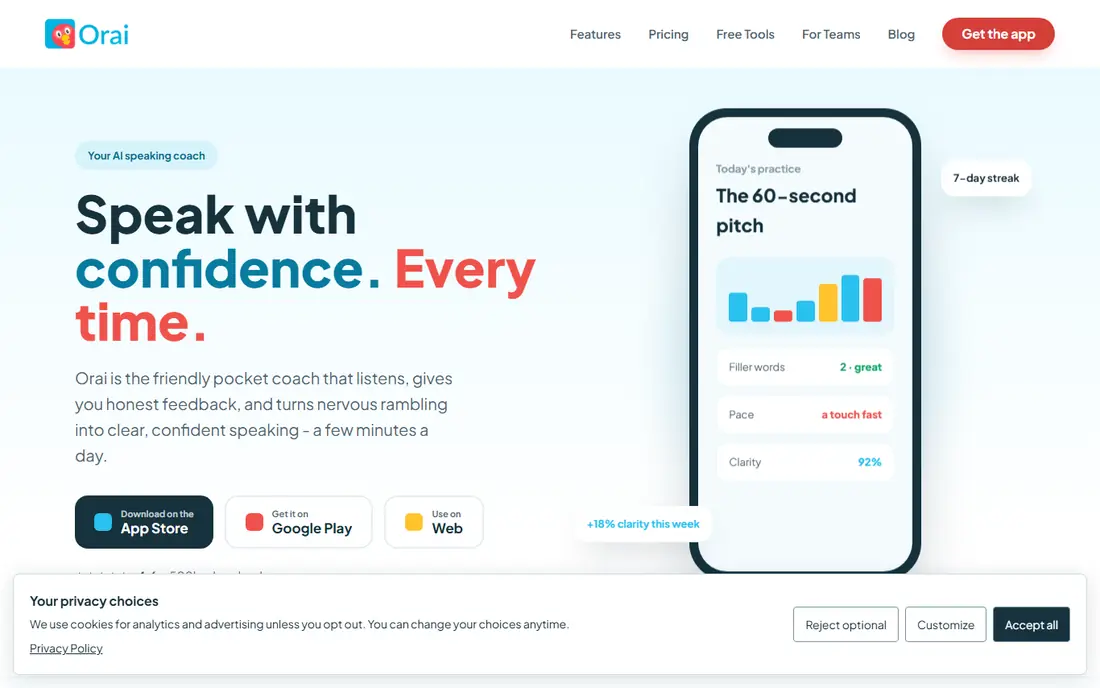
Orai is built around private repetition. You record a short practice response, review a scorecard for filler words, pace, clarity and energy, then record again with one change in mind. Guided scenarios cover presentations, interviews and everyday conversations, and streaks and progress tracking help turn a single session into a habit.
We like Orai for people who will practice for a few minutes a day but do not want to book a course. The individual plan is listed at $12 per month, or $49.99 per year, with a seven-day Pro trial. The limit is clear, it prepares you before the event, and it does not coach you during a live meeting.
- Instant feedback on pace, fillers, clarity and energy
- Guided lessons and scenarios
- Works on web, iOS and Android
- No live meeting coaching
- No team dashboard for managers on the individual plan
Yoodli differs from Orai because it rehearses a conversation, not just a speech. You can practise an interview answer, a sales call or a difficult discussion with an AI partner, then review feedback on delivery and structure. You can also upload a recording and get analysis, which helps if you want to review a real practice talk.
The free Starter tier gives a limited number of roleplays in total, so it works as a test rather than an ongoing plan. Pro is listed at $8 per month billed annually, with a higher monthly rate, and Advanced adds unlimited roleplays. For interview and conversation practice, Yoodli is our first test.
- AI roleplay for difficult conversations
- Feedback on uploaded recordings
- Private by default with a free starter tier
- Free tier is limited to a small number of lifetime roleplays
- Advanced plans cost more for unlimited use
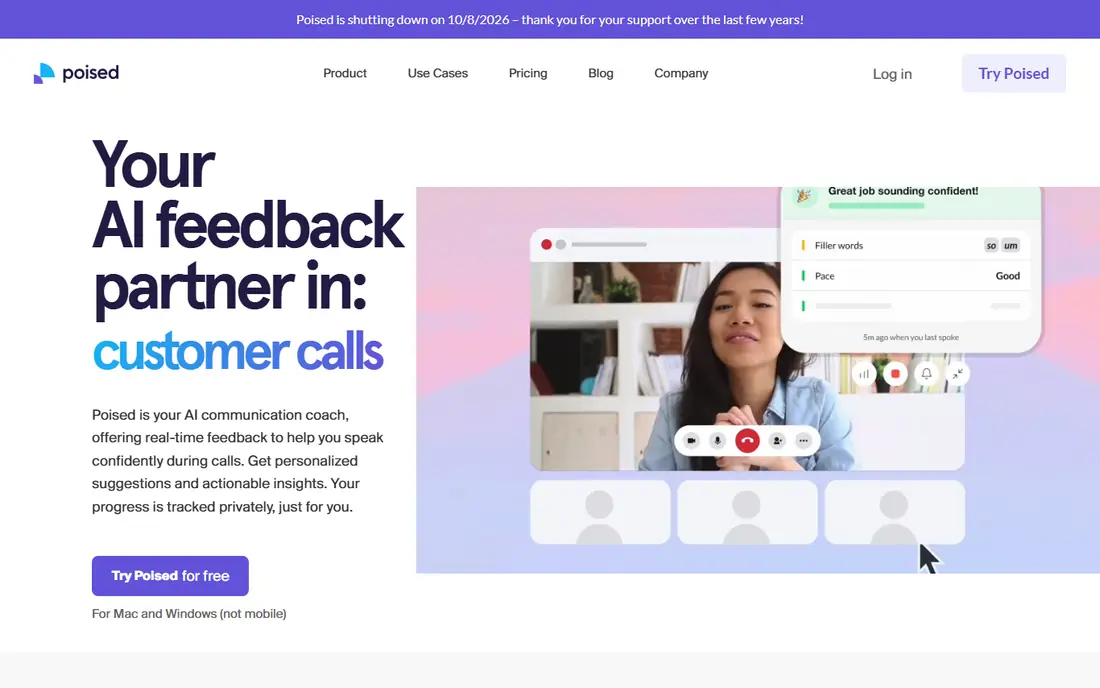
Poised sits in your meetings and gives feedback while you speak, which is a different job from rehearsal. It can flag filler words, long pauses and pace, and it summarises patterns after the call. For a manager or salesperson who speaks in meetings all day, that live loop can change habits faster than a weekly practice session alone.
We list the starting price as See website because Poised presents current individual and team pricing through its own pricing page and checkout, and published third-party figures vary. Try the free tier in real meetings first, and check whether the desktop coverage matches the meeting tools you use every day.
- Live prompts during video calls
- Tracks filler words, pace and confidence
- Works on Mac and Windows
- Not mobile-first
- Full value depends on how often you take video meetings
VirtualSpeech is the pick when anxiety about a room, not just word choice, is the main problem. It places you in front of a simulated audience in a boardroom, conference hall or similar setting, so you can practise eye contact, pace and handling questions under mild pressure. Courses on presentation and interview skills sit alongside the practice rooms.
The trade is price and hardware. Plans are reported from $45 per month, with an annual option, and the VR experience needs a compatible headset. If you only need filler-word feedback, a phone app is cheaper. If a big talk is coming and the room itself worries you, this simulation is worth testing.
- Simulated audiences in VR and on the web
- Soft-skill courses alongside practice
- Feedback after each session
- Higher price than phone apps
- VR hardware adds cost and setup for the full experience
ELSA Speak is a pronunciation coach first, and that focus is its strength. It listens to your English, points to specific sounds and words that need work, and builds lessons around those gaps. Roleplays, interview practice and a bilingual tutor on higher plans extend the work beyond single words into full conversations.
The free plan gives limited lessons, enough to test the feedback style. Premium is listed at $13.33 per month billed annually. If your main barrier is being understood clearly in English, start here. If your main barrier is structure or confidence in your first language, Orai or Yoodli will fit better.
- Detailed pronunciation feedback at sound level
- Large lesson library
- Personalised learning path and progress tracking
- Focused on English, not general communication
- Full access needs a paid plan
Tandem pairs you with native speakers for language exchange, which is the closest practice to a real conversation. You can correct each other, practise everyday topics and build confidence speaking without a script. That human back-and-forth teaches listening and turn-taking in a way that a solo drill cannot fully copy.
The core exchange is free, with paid tutoring and extra features available. The catch is consistency, because partners have their own schedules and skill levels. We suggest setting a regular short session, preparing two topics in advance, and asking your partner to correct one habit each time.
- Real conversation with native speakers
- Text, voice and video options
- Community and tutor options
- Partner quality and availability vary
- Paid tutoring costs extra
HelloTalk works in a similar way to Tandem, with a strong chat-first design. You can message native speakers, use translation and correction tools inside the chat, and move to voice or video when you are ready. Moments and group features add a social layer, which helps some learners stay active.
The free tier covers the core exchange, with VIP listed at $6.99 per month or $45.99 per year in app store listings. The risk is drift, because a social app can turn into scrolling rather than speaking. Set a speaking goal for each session, such as a two-minute voice note on one topic, and keep the chat focused on that goal.
- Large language community
- Built-in translation and correction tools
- Voice and video call options
- Social feed can distract from structured practice
- VIP features cost extra
Toastmasters is not an app, but it belongs in this list because it solves the part apps cannot, speaking to real people who react, ask questions and give honest feedback. Members prepare speeches, take meeting roles and receive evaluations, following structured paths for different communication goals. Clubs meet in person and online, so location is less of a barrier than it once was.
Costs vary by club, and published guidance points to club dues plus a path fee, so we list the starting price as See website. If you want private daily drills, pick an app first. If you want to build confidence in a room, a club gives you the audience, the feedback and the habit in one place.
- Regular live speeches with human feedback
- Structured learning paths
- Clubs in many cities and online
- Needs regular club attendance
- Dues and path costs vary by club and region
How we picked these
We compared official feature and pricing pages, app store listings and public guidance on each format. We included private AI practice, live meeting feedback, VR simulation, pronunciation coaching, human conversation exchange and live club practice, because communication skill is not one habit. We left out general course platforms that do not give speaking feedback or live conversation, since practice without feedback is harder to improve from.
How to choose the right format
Start by naming the moment that troubles you. If it is a presentation next month, short daily rehearsal in Orai or a VR run in VirtualSpeech will help most. If it is interviews or difficult conversations, Yoodli roleplay matches that moment directly. If it is daily meetings, Poised gives feedback where the habit actually happens.
Next, pick a practice rhythm you can keep for four weeks. Five minutes a day in an app beats a long weekend course that you never repeat, because pace, fillers and structure change through repetition. Pair a solo app with one human format when you can, such as Tandem for conversation or Toastmasters for live feedback, so you learn how your speech lands on real listeners.
Finally, measure one habit at a time. Track filler words for two weeks, then work on pace, then work on pauses. Apps give you numbers for those habits, but the numbers only help if you record a second take right after the feedback. Choose the tool whose feedback you understand at a glance, and whose practice you still open in week three.
Frequently asked questions
What is the best app to improve communication skills?
Orai is a strong general pick for daily practice, Yoodli for conversation roleplay, and Poised for live meetings. The best app is the one that matches your main speaking moment and that you will open regularly.
Can an app replace a public speaking course?
An app can build daily habits and give delivery feedback, but it cannot fully replace human feedback on content, structure and audience reaction. Many people get the best result by pairing an app with Toastmasters or a trusted colleague who listens to practice talks.
How long does it take to see improvement?
Most users need several weeks of regular short practice to see a stable change in pace or filler words. Record the same short talk at the start and after a month, and compare the two, rather than relying on a single session score.
Are these apps good for non-native English speakers?
ELSA Speak, Tandem and HelloTalk are built for that need, with pronunciation feedback and native-speaker conversation. For general delivery in your first language, Orai, Yoodli and Poised are the closer fits.
Do I need VR to practise public speaking?
No. VR helps if the audience setting itself causes anxiety, but most delivery habits improve with phone or web practice. Try a phone app first, and add VirtualSpeech only if room pressure remains the main barrier.
Sources
See where you really rank - block by block
ProMapRanker scans Google Maps across a grid of your service area. Simple monthly plans from $19, white-label on every plan.
Start freeKeep reading
 wpforms alternatives
Best WPForms Alternatives in 2026
We compare 9 wpforms alternatives for WordPress forms, with free and paid options, current pricing notes, and honest limits for small business sites in 2026.
Read → windows task scheduler alternatives
Best Windows Task Scheduler Alternatives in 2026
Looking for Windows Task Scheduler alternatives? We compare 9 schedulers for Windows and cross-platform work, from free tools to enterprise automation.
Read → which ai video service is best
Which AI Video Service Is Best in 2026
which ai video service is best? We compare 10 legitimate AI video services on price, avatars, editing and output quality to help you pick the right tool.
Read →