 ProMapRanker
Best Apps for Mindfulness in 2026


Beginners and structured courses · Pricing starts at: $12.99 per month
Key takeaways
- Insight Timer and Medito offer the most free content, while Headspace and Calm offer the most structured courses and sleep material behind a subscription.
- Headspace is our top pick for beginners who want a clear course path, and Calm is our top pick for sleep, with Sleep Stories, music, and wind-down sessions.
- Waking Up suits experienced meditators who want depth and theory, and Smiling Mind suits families and classrooms because it is free.
- Check the free trial and renewal price before you subscribe, because monthly and annual prices differ and some apps renew automatically.
- Mindfulness apps can support calm and focus, but they are not a substitute for professional care if you are struggling with your mental health.
Quick comparison
| Pick | Great for | Pricing starts at | Free tier | |
|---|---|---|---|---|
| Headspace | Beginners and structured courses | $12.99 per month | Free trial | Visit |
 Calm | Sleep and relaxation | $14.99 per month | Free trial | Visit |
 Insight Timer | Free variety and community | Free | Yes | Visit |
 Waking Up | Depth and theory | $19.99 per month | Free trial | Visit |
 Aura | Personalised daily sessions | $11.99 per month | Free trial | Visit |
 Balance | Adaptive personal plans | See website | Free trial | Visit |
 Medito | Fully free meditation | Free | Yes | Visit |
 Smiling Mind | Families and schools | Free | Yes | Visit |
 Buddhify | Short on-the-go sessions | See website | No | Visit |
The best apps for mindfulness
We compared the best mindfulness apps on guided content, sleep tools, free access, pricing, and ease of use. The best meditation app for you depends on whether you want a course, a sleep aid, a large free library, or a short daily practice.
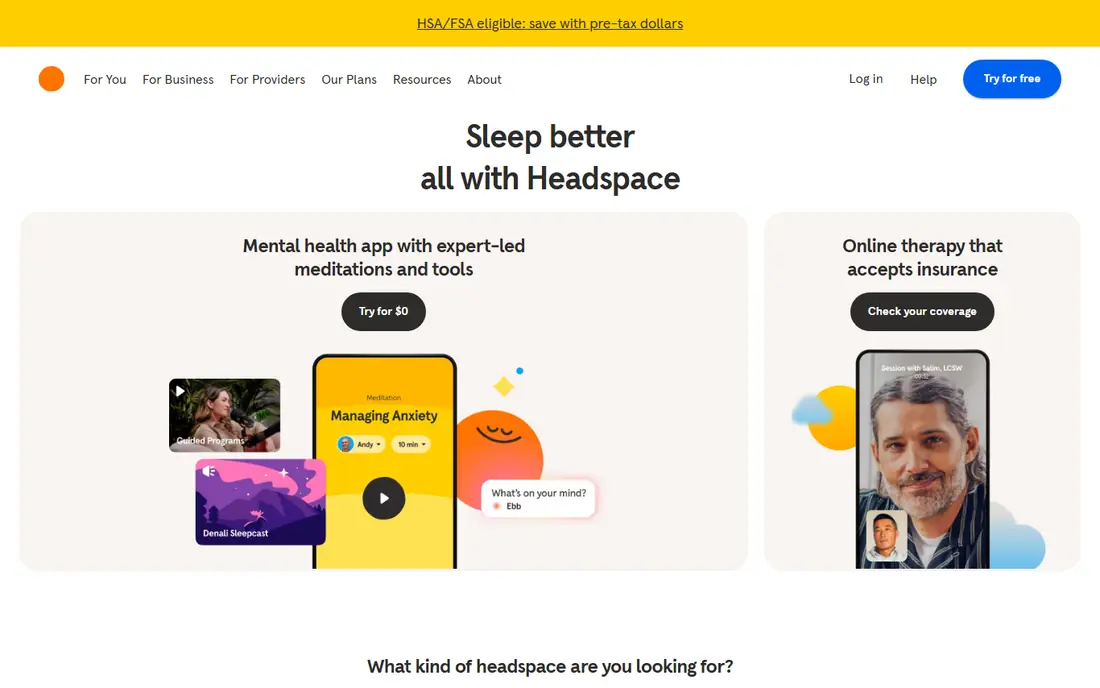
Headspace is the easiest place to start a meditation habit. Courses build skill step by step, starting with short sessions and adding length and technique as you go. That structure helps beginners who open an app and wonder what to press first, and the animations and plain language keep the teaching approachable.
Beyond courses, Headspace offers sleepcasts, sleep sounds, focus music, and short exercises for stressful moments. The catch is access. Once a trial ends, most content needs a paid plan, so try the trial with a real daily slot in mind. If you want a guided path rather than a large library to browse, Headspace is our top pick.
- Clear step-by-step courses
- Sleepcasts and focus music
- Short sessions for stress and focus
- Most of the library sits behind a subscription
- The same voices appear often
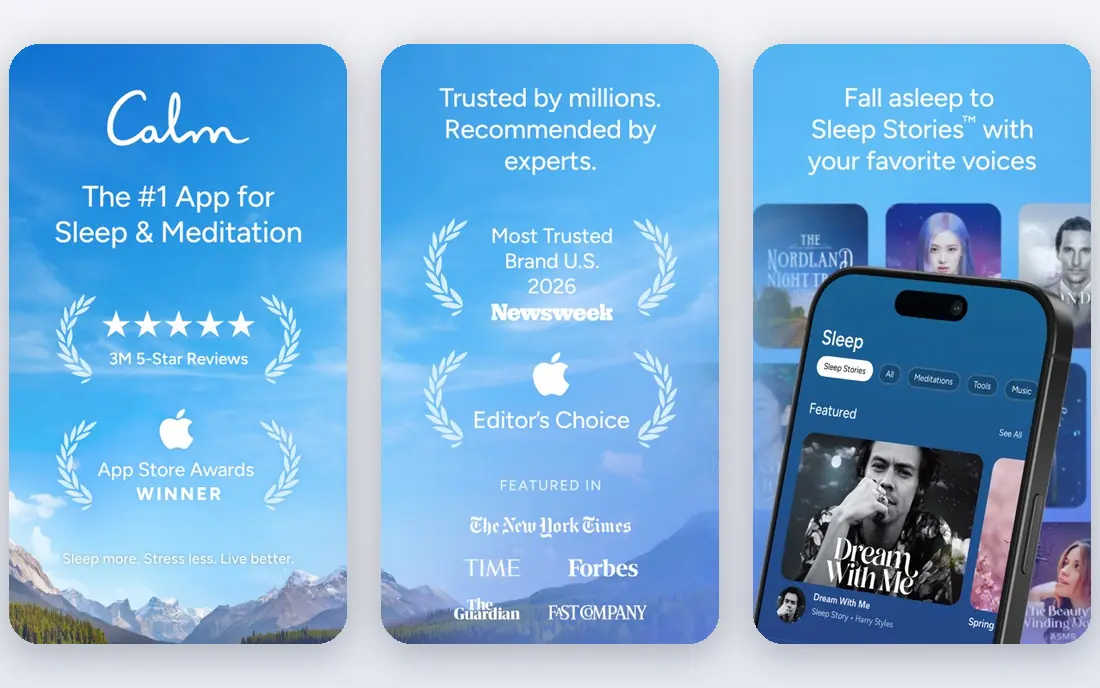
Calm is the strongest choice if sleep is your main goal. Sleep Stories, narrated by a range of well-known voices, plus sleep music and soundscapes, give you a clear wind-down routine. The Daily Calm offers a short daily meditation, and themed series cover anxiety, gratitude, focus, and relationships.
The trade-off is navigation. Because Calm covers sleep, music, and meditation in one app, pure meditation learners may need to search a little to find a course path. Some content is free, but most of the library needs Premium. If falling asleep is the problem you want to solve first, Calm is the pick we point to most often.
- Large Sleep Stories library
- Daily Calm sessions
- Music and nature sounds for wind-down
- Most content needs Premium
- Meditation sessions can be hard to find among sleep and music content
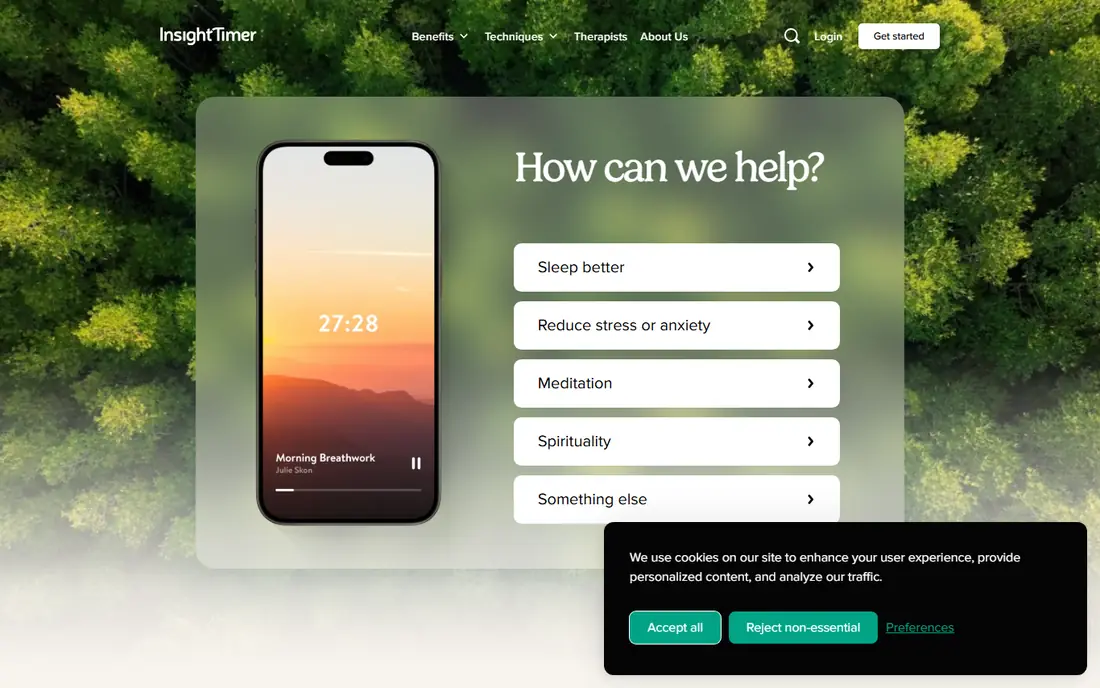
Insight Timer is the best free option in this list, and it is not close on volume. Thousands of guided meditations from teachers around the world cover anxiety, sleep, grief, self-compassion, body scans, and breathwork, and most of that content is free. A flexible timer, sleep tracks, talks, and community groups add to the core library.
The size is both the strength and the catch. Quality varies because many teachers contribute, and finding voices you trust takes some searching and saving favourites. Premium adds courses, offline listening, and higher quality audio, but you can build a solid daily practice without paying. For variety on a budget, start here.
- Very large free guided library
- Timer for silent practice
- Live events and community groups
- Quality varies across teachers
- The size of the library can feel overwhelming at first
Waking Up treats meditation as a skill to understand, not just a way to relax for ten minutes. A 28-day introductory course leads into daily guided sessions, short lessons, and conversations with teachers and scholars. Practices draw on several traditions, including Vipassana, Zen, and Dzogchen, and the teaching is precise and direct.
That depth comes at a higher price, and the tone will not suit everyone. If you want background music and sleep stories, look at Calm or Insight Timer instead. If you want to understand what you are doing and why, and you value a free scholarship option for people who cannot afford the subscription, Waking Up is worth the trial.
- 28-day introductory course
- Daily meditations plus lessons and conversations
- Free scholarship for people who cannot afford it
- Higher price than most rivals
- Theory-heavy approach may feel like a lot for a quick calm-down session
Aura builds a daily plan around how you feel and what you want to work on, which suits people who do not want to browse a large catalogue each morning. You can filter by mood, goal, and length, and the app covers meditation, sleep, stress, and focus in short, usable sessions.
The main limit is free access. Aura offers a trial, but the core library needs a subscription, and one-to-one coaching is a separate cost. If you like a plan made for you and you are willing to pay for it, Aura is a neat, modern alternative to the bigger names.
- Sessions matched to mood and goals
- Coaching options
- Strong filtering for meditation, sleep, and stress
- Little free content
- Coaching costs extra
- No live sessions in the core library
Balance stands out because it adapts. Instead of asking you to pick from a long list, it asks about your experience, builds a plan, and adjusts future sessions based on your feedback. That makes it a good fit for people who have tried meditation before and stopped because a fixed course felt wrong.
The catch is pricing clarity. Balance has offered a free first year in some promotions, with an annual plan after that, and prices vary by store and offer, so check the purchase screen before you commit. If you want a personal plan without browsing, Balance deserves a trial.
- Plans that adapt to your experience and feedback
- Single-voice guidance that builds familiarity
- Sleep and focus plans
- Pricing and offers vary by store and promotion
- The library is smaller than Insight Timer
Medito is made by a non-profit foundation, and that shows in the model. Every session is free, with no ads, no paywall, and no account needed for core use. You get guided meditations, courses, sleep stories, and breathing exercises, plus downloads for offline practice.
The library is smaller than Headspace or Insight Timer, and the range of teachers is narrower. For many beginners, though, that smaller library is a benefit, because choice is simpler. If cost is the barrier, or you want a free app with a clear conscience on ads and tracking, Medito is an excellent starting point.
- Completely free with no ads and no paywall
- Guided courses, sleep stories, and breathing exercises
- Offline downloads
- Smaller library than commercial apps
- Fewer teachers and less polished design in places
Smiling Mind is a free, non-profit app built for schools, families, and workplaces. Programs are grouped by age, from young children to adults, which makes it easy for a teacher or parent to find a suitable session. The content is developed with psychologists and follows a clear mental fitness model.
Adult meditators looking for deep theory or a huge library may find it light. That is not the point of the app. If you want a free, safe, and structured option for children, students, or a classroom, Smiling Mind is the clearest pick in this list.
- Completely free
- Programs by age group, including children and teens
- Developed with psychologists
- Less content for advanced adult meditators
- Design is simpler than commercial rivals
Buddhify takes a different approach. Instead of asking you to sit for a formal session, it offers short meditations for moments you already have: walking, commuting, working, and going to sleep. That design suits busy people who struggle to find a quiet twenty minutes.
The model also differs. Buddhify has often used a one-time purchase rather than a monthly subscription, though store pricing varies, so check the current listing. The library is smaller than Headspace or Calm, and sleep content is thinner. If short, practical sessions fit your day better than courses, Buddhify is worth a look.
- Sessions designed for real moments, such as commuting and work breaks
- One-time purchase model in many stores
- No subscription pressure
- Smaller library than big rivals
- No free plan in most stores
- Less sleep content than Calm
How we picked these
We compared official feature pages, pricing pages, app store listings, privacy policies, and public reviews for each app. We focused on guided content, sleep tools, free access, trial terms, pricing clarity, and ease of use for beginners and experienced meditators. We did not claim hands-on testing, and prices vary by store and region, so check the purchase screen before you subscribe.
How to choose a mindfulness app that you will actually use
Start with your main goal. If you want to learn meditation, pick a course-based app such as Headspace. If sleep is the issue, pick Calm. If cost matters most, pick Insight Timer, Medito, or Smiling Mind. If you want depth, try Waking Up. A clear goal beats a long feature list, because the app you open daily is the one that helps.
Then test the habit, not just the app. Use the trial or free tier for at least a week, at the same time each day, and notice whether you look forward to the session or avoid it. Check session length, voice, and music, because those small details decide whether a habit sticks. Finally, read the privacy policy and subscription terms. Some apps collect mood data, and most paid plans renew automatically, so set a reminder before a trial ends.
Frequently asked questions
What is the best meditation app for beginners?
The best meditation app for beginners is usually Headspace, because its courses teach the basics step by step and sessions start short. Insight Timer and Medito are also good if you want free content first. Try a free tier or trial before paying, and pick the voice and style you find easiest to follow.
Which are the best mindfulness apps for sleep?
Calm is the strongest sleep pick in this list, thanks to Sleep Stories, sleep music, and wind-down sessions. Insight Timer and Medito also offer free sleep tracks, and Headspace offers sleepcasts. If you wake often or sleep problems persist, speak to a clinician rather than relying on an app alone.
What is the best free meditation app?
Insight Timer offers the largest free library, while Medito offers a fully free app with no ads and no paywall. Smiling Mind is also completely free and suits families. The best free option depends on whether you want variety, simplicity, or programs for children.
Are the best meditation apps worth paying for?
Paid apps are worth it if you use the structured courses, sleep content, or offline access often enough to justify the monthly or annual cost. If you only meditate a few times a week, a free app may cover your needs. Compare the annual price, not just the monthly price, because annual plans are usually cheaper per month.
What is the best app for mindfulness at work?
For short work breaks, Buddhify and Aura work well, because sessions are short and matched to moments in the day. Headspace also offers short focus sessions. Pick an app with sessions under ten minutes if you plan to practise between meetings.
Can mindfulness apps replace therapy?
No. The best apps for meditation can support calm, focus, and sleep, but they are not a substitute for professional care. If you feel distressed, unsafe, or unable to cope, contact a clinician, a local crisis line, or emergency services in your country. In the United States, you can call or text 988 for the Suicide and Crisis Lifeline.
Sources
See where you really rank - block by block
ProMapRanker scans Google Maps across a grid of your service area. Simple monthly plans from $19, white-label on every plan.
Start freeKeep reading
 zoom alternatives
Best Zoom Alternatives in 2026
Compare Zoom alternatives in 2026, with free meeting limits and prices, so you can pick the best alternative to Zoom for your team, class, or community.
Read → which software is best for remote work
Which Software Is Best for Remote Work in 2026
Answering which software is best for remote work, we compare Slack, Zoom, Asana, Notion, Teams and more, with pricing and honest tradeoffs in 2026 now.
Read → which ai tool is best for content writing
Which AI Tool Is Best for Content Writing in 2026
Wondering which ai tool is best for content writing? We compare ChatGPT, Claude, Jasper, Grammarly, and more on price, quality, and best use in 2026 now.
Read →