 ProMapRanker
Best Answering Service for Small Business in 2026

Key takeaways
- Live receptionists cost more per call than AI answering, but they handle awkward, emotional, or complicated calls better.
- Per-minute and per-call billing look similar at first glance, yet they produce very different bills once call length changes.
- Ruby and Smith.ai suit businesses that want a polished first impression, while PATLive and MAP Communications suit tighter budgets.
- Always check what counts as a billable minute or call, and what happens when you go over your plan, before you sign up.
- A free trial or money-back period is worth using to hear how agents actually greet your callers.
Quick comparison
| Pick | Great for | Pricing starts at | Free tier | |
|---|---|---|---|---|
 Ruby | A polished, high-touch first impression | $250 per month | No | Visit |
 Smith.ai | Choosing between live staff and AI answering | $300 per month | Free trial | Visit |
 AnswerConnect | Around the clock human answering | See website | Free trial | Visit |
 PATLive | Flexible live answering without a large commitment | $49 per month | Free trial | Visit |
 Abby Connect | Mixing live agents and AI on one plan | $165 per month | Free trial | Visit |
 MAP Communications | Low cost live receptionist cover | $49 per month | Free trial | Visit |
 Upfirst | Low cost AI answering for routine calls | $24.95 per month | Free trial | Visit |
 VoiceNation | Simple live answering with an AI add-on path | $165 per month | No | Visit |
The best answering services for small businesses
A missed call is often a missed customer, and small teams cannot always pick up while they are on a job, with a client, or out of the office. The services below answer in your business name, take messages, book appointments, and pass urgent calls through. We compared their official pricing pages, plan structures, and published features to see which ones fit different kinds of small businesses.
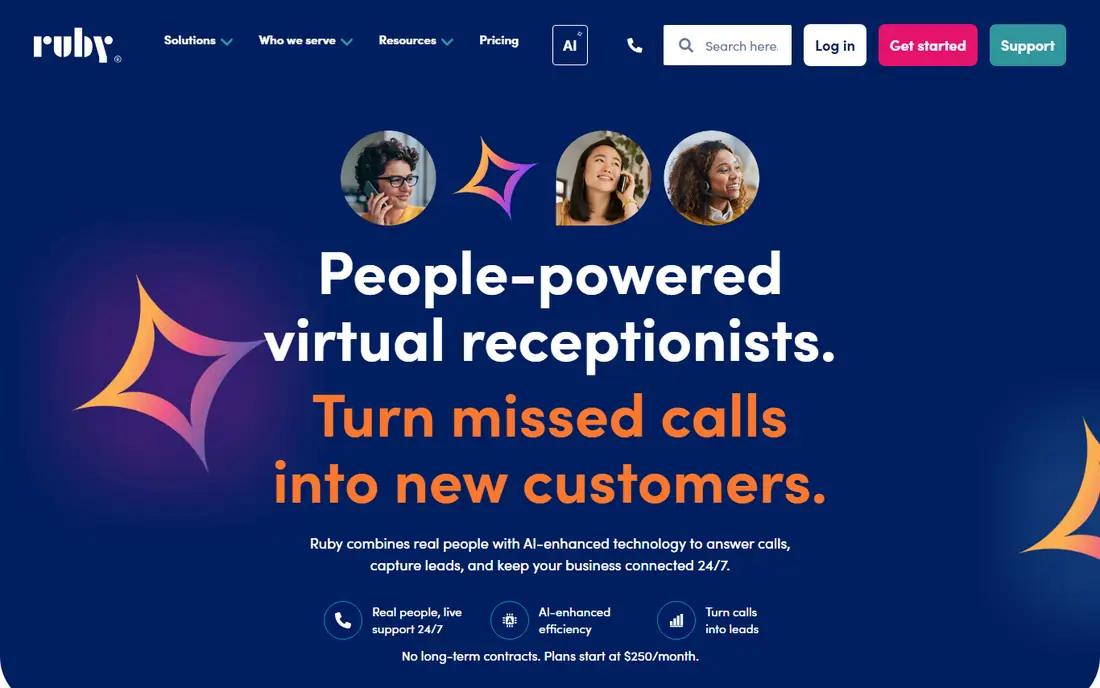
Ruby is the service to look at first if the way your phone is answered matters as much as the answer itself. Its receptionists greet callers in your business name, follow your instructions, and send messages to your team so nothing sits in a voicemail box unnoticed.
The catch is price. Ruby plans are priced by minutes, with the entry plan reported at $250 per month for 50 minutes, and larger plans rising steeply from there. Long, chatty calls will eat through a minute allowance fast, so Ruby fits best when call volume is modest and each call is valuable. If you take dozens of short calls a day, a per-call or flat AI plan may work out cheaper, so do the maths on your real call lengths before you commit.
- US-based live receptionists
- Strong call handling and message delivery
- 21-day money-back guarantee reported on pricing comparisons
- Higher starting price than most rivals
- Per-minute costs add up on long calls
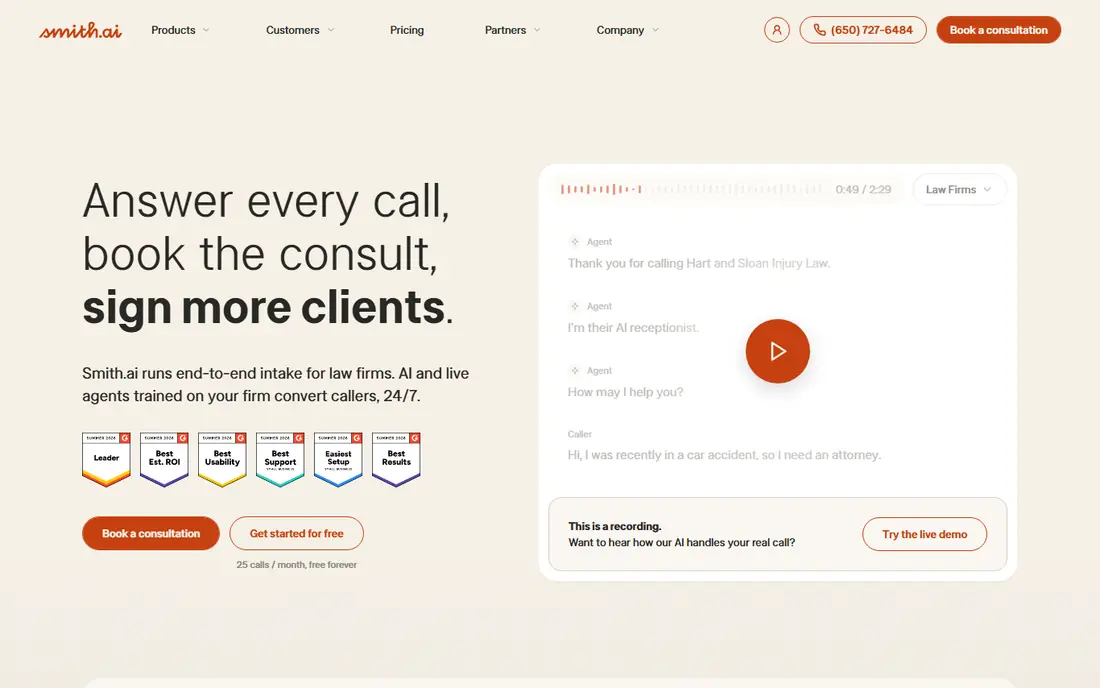
Smith.ai stands out because it does not force one model on every business. Its live receptionists handle calls, qualify leads, and book appointments, while its AI receptionist offers a lower cost route for routine calls, with a free tier for a small number of calls and paid plans from around $150 per month. That split lets a business start with AI for overflow and move to live staff for its most valuable lines, or use both at different times of day.
The honest weakness is that the two services need separate thinking about cost. Live plans are billed per call, starting around $300 per month for 30 calls in published comparisons, with extra calls charged on top. If most of your calls are quick questions, per-call billing can feel expensive. Check which service your quoted plan covers, and test the AI voice on your own typical questions before you rely on it for new customers.
- Separate live receptionist and AI receptionist services
- Lead intake and appointment booking
- Money-back guarantee on live plans reported in comparisons
- Live plans are priced per call, which penalises long calls less but short calls more
- AI and live services are separate products to manage
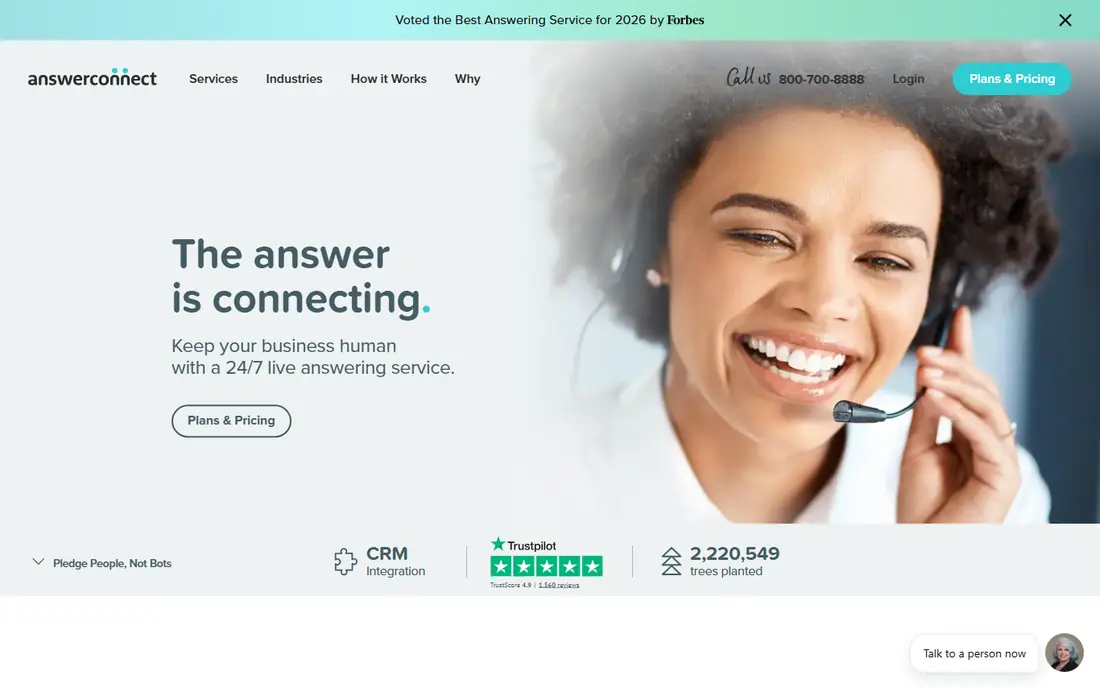
AnswerConnect appeals to businesses that want a person on the line at any hour, without hiring night staff. Its agents answer, screen, transfer, and take detailed messages, and the service is often used by medical, legal, and home service businesses that cannot afford to miss an urgent call. The breadth of coverage is the point here, since a single missed emergency call can cost far more than a month of service.
The drawback is transparency. Published comparisons report plans around $350 per month for 200 minutes, but the company itself directs visitors to a quote form rather than a simple price list. That means you will need a sales conversation to get a firm number, and you should ask directly about setup fees, rounding rules, and overage rates. For a business that values a quote tailored to its hours, that is fine. For a business that wants to compare prices in ten minutes, it is friction.
- Live agents available day and night
- Scheduling and message handling
- Reported plans scale by minutes
- Pricing is not published plainly on its main pages, so you must request a quote
- Per-minute rounding can raise costs
PATLive is a practical pick for trades, clinics, and small offices that need live cover but do not want to start at several hundred dollars a month. Its entry pricing has been reported at $49 per month plus a per-minute rate, with bundled minute plans from $99 for 50 minutes and $349 for 200 minutes. That structure lets a small business buy a modest bundle, test how agents handle real calls, and scale up only if volume grows.
The weakness is the same as with any per-minute plan. A handful of long calls can push you into overage charges, and the per-minute rate varies by plan size. PATLive fits best when your calls are fairly short and your volume is predictable. Keep a log of call lengths for a month, compare it with the bundle you are considering, and you will know quickly whether the low entry price stays low for you.
- Low pay-as-you-go entry point
- US-based agents
- Scheduling and dispatch support
- Per-minute overage rates can climb on larger plans
- Long calls cost more than on per-call plans
Abby Connect tries to solve the live versus AI argument by letting you use both. You can send routine calls to AI and keep human agents for complex or sensitive conversations, and published comparisons note that an AI minute counts as half a plan minute, so a 50-minute plan can cover up to 100 AI minutes. For a business with a mix of simple bookings and trickier enquiries, that flexibility is genuinely useful.
The trade-off is complexity. You need to decide which calls go where, write good instructions for both routes, and watch how minutes are consumed in practice. If you set the routing badly, you may pay human rates for calls AI could have handled, or frustrate callers who needed a person. Abby Connect suits owners who are willing to spend an hour setting up call flows properly, and who want one vendor for both kinds of cover.
- Human, AI, or hybrid answering
- AI minutes count as half a plan minute in published comparisons
- Free trial on plans
- Hybrid billing takes care to understand
- Human minutes are used up faster than AI minutes
MAP Communications is worth a look when budget is the main constraint and you still want a person answering. Its entry pricing has been reported at $49 per month plus $1.37 per minute, which keeps the fixed cost low for a business that only needs occasional cover, such as overflow during busy periods or after-hours messages. The agents handle greetings, messages, and transfers in the usual way, without the premium price tag of larger brands.
The catch is that the low base fee is not the whole bill. Every minute adds up, so a business with steady daily volume may end up paying more than it would on a bundled plan elsewhere. MAP fits best as overflow or part-time cover, or for a very small business with a handful of calls a week. Run your expected minutes through the per-minute rate before you judge it against a bundled plan.
- Low monthly entry fee
- Live agents
- Free trial with no card reported in comparisons
- Per-minute charges on top of the base fee
- Smaller feature set than premium rivals
Upfirst is an AI-first option for businesses whose calls follow a pattern: opening hours, prices, bookings, directions, and simple messages. Its entry plan has been reported at $24.95 per month for 30 calls, with larger plans at higher flat rates, which makes budgeting simple compared with per-minute billing. For a solo operator or a tiny team that mainly needs to stop missing routine enquiries, that price is hard to beat.
The honest limit is that AI is still AI. It handles structured questions well and struggles when a caller is upset, confused, or describing something unusual. Upfirst fits best when you pair it with a clear handoff, such as transferring urgent calls to your mobile or taking a detailed message for a callback. If most of your callers need reassurance from a person, a live service will serve you better, even at a higher price.
- Low entry price for AI answering
- Flat monthly plans with included calls
- 14-day free trial reported in comparisons
- AI only, so no human fallback in the same service
- Complex or emotional calls may need a transfer route you set up yourself
VoiceNation, now closely linked with Moneypenny in the US market, offers a straightforward live answering service for small businesses that want calls handled by people. Its published entry point of $165 per month for 50 minutes sits below Ruby and Smith.ai live plans, which makes it a middle-ground choice for firms that want human cover without premium pricing. AI answering plans are also listed from around $69 per month for 25 calls, giving a cheaper route for routine traffic.
The weakness is clarity. VoiceNation and Moneypenny branding overlap, and plan details can differ depending on which page you land on, so confirm exactly what you are buying, including overage rates and any setup fees. VoiceNation suits a business that wants a dependable human service and is happy to confirm details on a call, rather than one that wants every price published online before it speaks to anyone.
- Live answering from $165 per month for 50 minutes in published comparisons
- AI plans also offered
- Long-running US answering brand
- No free plan listed
- Per-minute overage charges apply
- Pricing details vary across its brands
How we picked these
We compared official pricing pages, plan structures, and published October 2026 pricing comparisons for live and AI answering services, and we kept only services that are currently offered to US small businesses and that handle real inbound calls. We looked at how each service bills, whether it uses live agents, AI, or both, what a small team actually gets for the entry price, and where the costs hide, such as overage rates and rounding. We did not claim hands-on testing, and we used "See website" wherever a price could not be verified from a current vendor page.
What to check before you choose
Start with your own call pattern, not with a feature list. Count your calls for two weeks, note how long they last, and mark how many are simple questions, bookings, or urgent problems. A business with short, routine calls will usually do best on a flat AI plan or a per-call plan, while a business with long, sensitive calls will usually do better on a bundled per-minute live plan, even if the headline price looks higher.
Next, test the greeting. Use the trial period to call your own number at different times, listen to how agents introduce your business, and check how fast messages reach you. Ask how agents handle a caller who will not give a name, a caller who needs an urgent callback, and a caller who asks a question outside the script. Also ask about holiday cover, bilingual agents if you need them, and how to change instructions without waiting days. The cheapest plan that mishandles your best leads is not cheap at all.
Finally, read the billing rules in full. Ask what counts as a billable minute, whether calls are rounded up, what the overage rate is, and whether unused minutes roll over. Ask about setup fees, contract length, and how to cancel. A service that is easy to leave is often a service that works harder to keep you, and that matters when your call volume changes with the seasons.
Frequently asked questions
What is the best virtual answering service for a small business?
The best virtual answering service depends on your call type. Ruby and Smith.ai suit businesses that want a polished live impression, while Upfirst suits businesses with routine calls and a tight budget. Start with a trial, listen to real calls, and compare the total monthly cost on your actual call volume, not just the headline price.
What is the best AI answering service for a small business?
The best AI answering service is one that handles your most common questions accurately and hands off cleanly when a caller needs a person. Upfirst and Smith.ai AI Receptionist are both worth testing for routine bookings and FAQs. Set up a transfer route for urgent or emotional calls, and review the AI transcripts weekly at first.
What is the best telephone answering service for after-hours calls?
A service with genuine around the clock live cover, such as AnswerConnect or PATLive, fits after-hours needs best, since callers reach a person rather than voicemail. Make sure urgent calls are forwarded to the right on-call person, and that non-urgent messages wait until morning without waking anyone.
How much does a small business answering service cost?
Costs vary widely. AI plans can start under $30 per month, low entry live plans start around $49 per month plus per-minute charges, and premium live plans start around $165 to $300 per month for bundled minutes or calls. Your total depends on call count, call length, and overage rates, so price it on your real numbers.
Should I choose a live answering service or an AI answering service?
Choose live answering when callers need empathy, judgement, or complex problem solving, and choose AI when calls are routine, predictable, and high in volume. Many small businesses do best with a mix, using AI for simple enquiries and live agents for valuable or sensitive calls, which is exactly what hybrid services like Abby Connect are built for.
Do answering services book appointments?
Most of the services in this list offer appointment booking or scheduling, either by taking details for your calendar or by connecting to a booking tool. Confirm which calendar your service supports, how double bookings are avoided, and how cancellations are handled before you switch your main number over.
Sources
- https://www.usecarly.com/blog/after-hours-answering-service/
- https://upfirst.ai/blog/how-much-does-an-answering-service-cost
- https://www.attainmentlabs.com/blog/how-much-does-an-answering-service-cost
- https://www.ruby.com
- https://smith.ai
- https://www.answerconnect.com
- https://www.patlive.com
- https://www.abbyconnect.com
- https://www.mapcommunications.com
- https://upfirst.ai
- https://www.voicenation.com
See where you really rank - block by block
ProMapRanker scans Google Maps across a grid of your service area. Simple monthly plans from $19, white-label on every plan.
Start freeKeep reading
 zoom alternatives
Best Zoom Alternatives in 2026
Compare Zoom alternatives in 2026, with free meeting limits and prices, so you can pick the best alternative to Zoom for your team, class, or community.
Read → which software is best for remote work
Which Software Is Best for Remote Work in 2026
Answering which software is best for remote work, we compare Slack, Zoom, Asana, Notion, Teams and more, with pricing and honest tradeoffs in 2026 now.
Read → which ai tool is best for content writing
Which AI Tool Is Best for Content Writing in 2026
Wondering which ai tool is best for content writing? We compare ChatGPT, Claude, Jasper, Grammarly, and more on price, quality, and best use in 2026 now.
Read →