 ProMapRanker
Best AML KYC Software in 2026


Sanctions, PEP and adverse media screening · Pricing starts at: $99.00 per month
Key takeaways
- Sumsub and Veriff suit smaller teams that want published per-check pricing without a sales call first.
- ComplyAdvantage suits teams that need sanctions, PEP and adverse media screening depth, with a low published starter plan.
- Onfido, Jumio and Alloy suit larger firms that need enterprise identity checks and workflow control.
- Unit21 and Trulioo suit teams that need transaction monitoring or global data coverage alongside onboarding.
- This is general buying information, not legal or compliance advice, and your regulator's rules come first.
Quick comparison
| Pick | Great for | Pricing starts at | Free tier | |
|---|---|---|---|---|
| ComplyAdvantage | Sanctions, PEP and adverse media screening | $99.00 per month | Free trial | Visit |
 Sumsub | All-in-one KYC, KYB and AML in one platform | $1.35 per verification | Free trial | Visit |
 Veriff | Fast self-serve identity checks | $0.80 per verification | No | Visit |
 Onfido | Enterprise identity verification at scale | See website | No | Visit |
 Jumio | High-assurance onboarding for banks | See website | No | Visit |
 Alloy | Orchestrating KYC, AML and fraud checks | See website | No | Visit |
 Unit21 | Transaction monitoring and investigations | See website | No | Visit |
 Trulioo | Global identity data and watchlist coverage | See website | No | Visit |
The best AML KYC software
We compared official feature pages, pricing pages and product docs for platforms that cover anti-money laundering (AML) and know your customer (KYC) work. AML covers screening, monitoring and reporting for financial crime risk, while KYC covers proving who a customer is at onboarding. Some tools do both, while others focus on one side, so the list below notes that split for each product. Prices for enterprise tools are often quoted, so we mark those as See website rather than guessing.
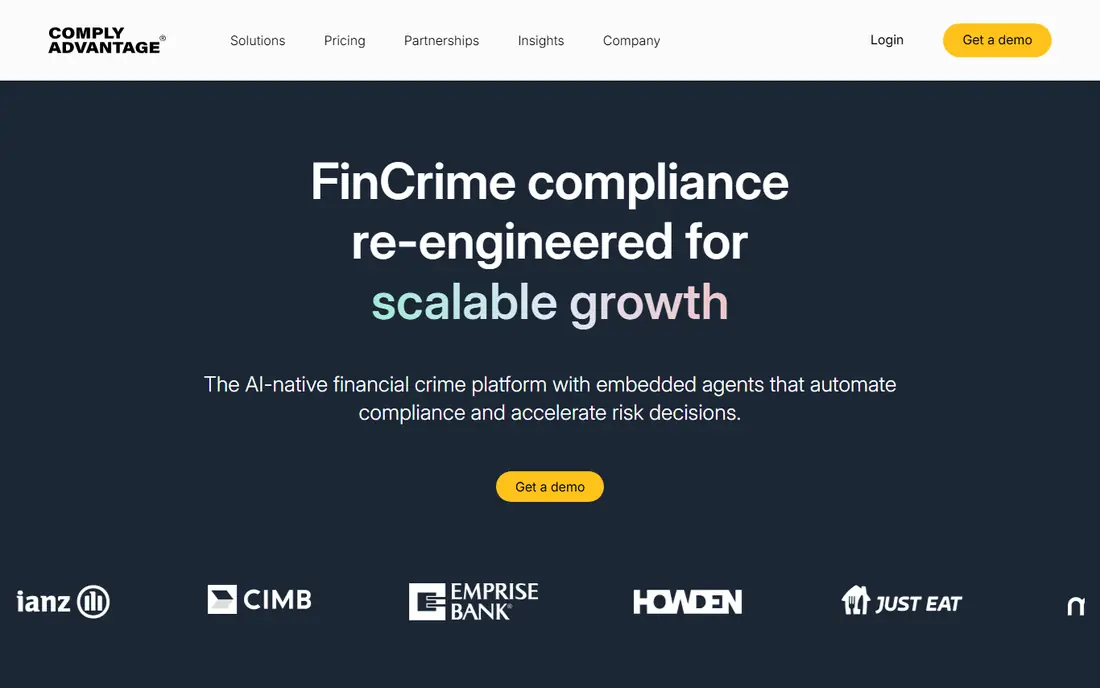
ComplyAdvantage is a screening specialist, not an identity document checker. It screens customers and companies against sanctions lists, politically exposed persons (PEP) lists and adverse media, then monitors them on an ongoing basis. That depth matters for banks and payment firms that need to show regulators they checked the right lists and kept checking after onboarding.
The starter plan gives smaller teams a published entry point, which is rare in this category. The limit is scope. You will still need a separate identity verification tool for document and selfie checks, and transaction monitoring sits on higher tiers. If screening depth is your main gap, ComplyAdvantage is a strong core choice.
- Deep sanctions and watchlist data
- Ongoing monitoring
- Starter plan published
- Company screening included
- Does not verify identity documents itself
- Transaction monitoring sits on higher tiers

Sumsub is the easiest all-in-one option to evaluate without a sales call, because it publishes its rates. The Basic tier covers identity verification, liveness and face matching, while the Compliance tier adds AML screening and ongoing monitoring. That combination suits fintechs, crypto platforms and marketplaces that need onboarding and screening together.
Monthly minimums are the catch, so very small teams should model their real monthly volume first. Business verification and transaction monitoring also sit on higher plans. For mid-size teams that want one vendor for onboarding and AML, Sumsub offers the clearest pricing in this list.
- Published per-check pricing
- Identity, business and AML checks in one place
- Reusable KYC across platforms
- Monthly minimums apply
- Business verification and transaction monitoring sit on higher or custom plans

Veriff suits teams that want to start fast. Its self-serve pricing starts at a low per-check rate with a monthly minimum, and it covers a wide range of identity documents with facial matching and liveness checks. That makes it a good fit for SaaS firms and startups that need conversion-friendly onboarding without an enterprise sales cycle.
AML depth is thinner than ComplyAdvantage or Sumsub Compliance, since screening can sit as an add-on rather than the core. Teams with heavy AML duties should confirm what screening and monitoring each Veriff tier includes before committing. For identity-first onboarding with a clear price, Veriff is a strong pick.
- Published self-serve rates
- Large ID document coverage
- Quick start for startups
- Fraud and liveness checks
- AML screening is an add-on in some setups
- No free plan, only paid self-serve tiers
Onfido, now part of Entrust and trading as Entrust IDV, is built for large firms that need dependable identity checks at volume. It verifies documents, matches selfies with liveness detection and offers workflow controls that compliance teams can audit. Its coverage across many countries suits firms onboarding customers in several markets.
Pricing is quote-only, so budgeting needs a sales conversation and a volume estimate. It is also identity-first, so AML screening depth depends on the setup you choose. For a large bank or fintech that needs enterprise-grade identity verification, Onfido remains a safe shortlist choice.
- Document and biometric checks
- Motion-based liveness
- Broad country coverage
- Enterprise controls
- Quote-only pricing
- AML screening often needs separate configuration or add-ons
Jumio pioneered the ID plus selfie method, and it remains a top choice for regulated firms that need high assurance. It matches a selfie to an ID document, runs liveness checks and screens against watchlists, with a large set of risk signals from device and network data. Its document coverage suits firms with a global customer base.
The trade-off is cost and complexity. Pricing is custom and volume-based, and the platform is geared toward larger teams. Small startups will find Sumsub or Veriff easier to start with. For a bank that needs to defend its onboarding decisions to a regulator, Jumio offers depth that cheaper tools may not match.
- Very wide ID document coverage
- Biometric matching and liveness
- AML watchlist checks in the platform
- Risk signals
- Enterprise pricing only
- Platform can be more than a small team needs
Alloy is less a single check and more a control layer. It lets a firm connect identity, fraud and compliance data sources, set decision rules and route cases to analysts when a check needs review. That orchestration helps teams that use several vendors and want one place to manage risk decisions and audit trails.
That strength comes with a condition. Alloy pays off most when you build your onboarding around it, which takes integration work. Pricing is quote-only, and smaller teams may find an all-in-one tool simpler. For a fintech with complex rules across products and markets, Alloy is a strong platform choice.
- Connects many data vendors in one workflow
- Configurable decision rules
- Ongoing monitoring and case tools
- Quote-only pricing
- Value depends on adopting it as your main decision layer
Unit21 suits teams whose main pain is what happens after onboarding. It monitors transactions, screens payments, manages cases and helps prepare regulatory filings, with AI tools that gather evidence for analysts. That focus helps banks, fintechs and crypto firms that face a high alert volume.
Identity document verification is not its lead strength, so many teams pair it with an IDV tool like Onfido or Veriff. Pricing is also quote-only. If your alerts and investigations are the bottleneck, Unit21 is worth a close look. If onboarding checks are the gap, start with Sumsub, Veriff or Jumio instead.
- Real-time transaction monitoring
- Case management
- Regulatory filing support
- Fraud and AML in one platform
- Quote-only pricing
- Less focused on document identity verification than dedicated IDV tools
Trulioo suits firms onboarding customers in many countries, where local data sources matter. It verifies people and businesses against a wide set of global data, and it screens against sanctions, PEP and adverse media lists with ongoing monitoring. That breadth helps when a single vendor's document coverage leaves gaps in certain markets.
It is not primarily a transaction monitoring platform, so teams with heavy monitoring needs may pair it with Unit21 or ComplyAdvantage. Pricing is quote-only. For global coverage and data-driven verification, Trulioo is a solid enterprise option.
- Broad global person and business data sources
- Sanctions, PEP and adverse media screening
- Continuous monitoring
- Quote-only pricing
- Less transaction-monitoring depth than Unit21
How we picked these
We compared official feature pages, pricing pages and product docs, and we kept only platforms that are live and serve banks, fintechs or payment firms today. We looked for a mix of screening specialists, identity verification tools, all-in-one platforms and monitoring tools, and we favoured vendors with published pricing where it exists. Where a vendor does not publish a price, we wrote See website rather than inventing a figure. This article is general information, not legal or compliance advice.
What to check before you buy
Start with your regulator and your risk profile. A bank, a crypto exchange and a marketplace face different duties, and the right tool depends on which checks your licence requires. List the checks you must run at onboarding, the lists you must screen, and the monitoring you must do after onboarding, then match vendors to that list rather than to a feature count.
Next, test false positives and analyst workload. A screening tool that flags too many clean customers will swamp your team, while a weak tool will miss real risk. Ask for a trial with your real data mix, check how matches are resolved, and confirm audit trails, data residency and retention rules. Finally, model total cost, including per-check fees, monthly minimums, add-ons for screening or monitoring, and integration time, since the headline rate rarely tells the full story.
Frequently asked questions
What is the best AML software for banks?
ComplyAdvantage suits banks that need screening depth, while Jumio and Onfido suit high-assurance identity checks. Many banks use more than one tool, with one for screening and one for identity verification.
What is the best KYC AML software for a startup?
Sumsub and Veriff are the easiest to evaluate, thanks to published per-check pricing and self-serve starts. Sumsub suits teams that want KYC and AML together, while Veriff suits teams that mainly need fast identity checks.
What is the difference between AML and KYC software?
KYC software proves who a customer is at onboarding, usually with document and selfie checks. AML software screens for financial crime risk, monitors transactions and helps with reporting. Many platforms now cover both, but the split still matters when you compare vendors.
How much does AML KYC software cost?
It varies widely. Published entry points here range from $0.80 per check at Veriff and $1.35 per verification at Sumsub to $99 per month for ComplyAdvantage Starter, while enterprise tools are quote-only. Model per-check fees, minimums and add-ons together.
Do I need both an IDV tool and a screening tool?
Often, yes. A document check proves identity, while screening checks that identity against sanctions, PEP and adverse media lists. All-in-one platforms cover both, while specialists like ComplyAdvantage pair well with a dedicated IDV vendor.
Sources
See where you really rank - block by block
ProMapRanker scans Google Maps across a grid of your service area. Simple monthly plans from $19, white-label on every plan.
Start freeKeep reading
 best rank tracking software
Best Rank Tracking Software in 2026
Searching for the best rank tracking software? We compare 8 tools for daily keyword tracking, local rankings, client reports, and competitor checks in 2026.
Read → best platform for ecommerce website
Best Platform for Ecommerce Website in 2026
Find the best platform for ecommerce website builds in 2026. We compare Shopify, WooCommerce, BigCommerce, Wix and more on price, fees and scale for stores.
Read → best math apps
Best Math Apps in 2026: 8 Apps Compared
Find the best math apps for homework, revision, and deeper study in our 2026 comparison of 8 free and paid solvers, courses, and visual tools for students.
Read →