 ProMapRanker
Best AI Stock Prediction App in 2026

Key takeaways
- Danelfin is the best pick for explainable stock ranking, with an AI score that shows its reasoning rather than a bare buy or sell call.
- Trade Ideas is the strongest real-time scanner for active traders, led by its Holly AI signals, but its premium price is high.
- Tickeron suits learners who want pattern recognition with confidence scores, while TrendSpider suits traders who build and backtest their own ideas.
- Composer and Magnifi make AI investing more approachable, with no-code strategies and plain-language stock search.
- No tool here can promise returns, and published win rates usually come from backtests, so treat every signal as research, not a decision.
Quick comparison
| Pick | Great for | Pricing starts at | Free tier | |
|---|---|---|---|---|
 Danelfin | Explainable AI stock scores | $24 per month | Yes | Visit |
 Trade Ideas | Real-time AI scanning | $84 per month | Yes | Visit |
 Tickeron | AI pattern recognition | $37 per month | Yes | Visit |
 TrendSpider | Backtesting and chart analysis | See website | Free trial | Visit |
 Magnifi | Plain-language stock search | $14 per month | Yes | Visit |
 Composer | No-code automated strategies | Free | Yes | Visit |
 TipRanks | Analyst data with AI research | See website | Yes | Visit |
 TradingView | Charts and screening base | Free | Yes | Visit |
The best AI stock prediction tools
AI stock tools promise to read more data than any person can: price action, financial statements, analyst revisions, news sentiment and technical indicators, all at once. The useful ones turn that reading into something you can check: a score with reasons, a pattern with a confidence level, or a strategy you can backtest. The weak ones sell certainty. This list keeps only tools that are live in October 2026 and that show their work in some form.
This is general information only, not financial advice, and no tool here can promise returns. Markets change, models trained on past conditions can fail in new ones, and trading carries risk, including loss of money. Use these tools for research, paper trade first, and never invest money you cannot afford to lose.
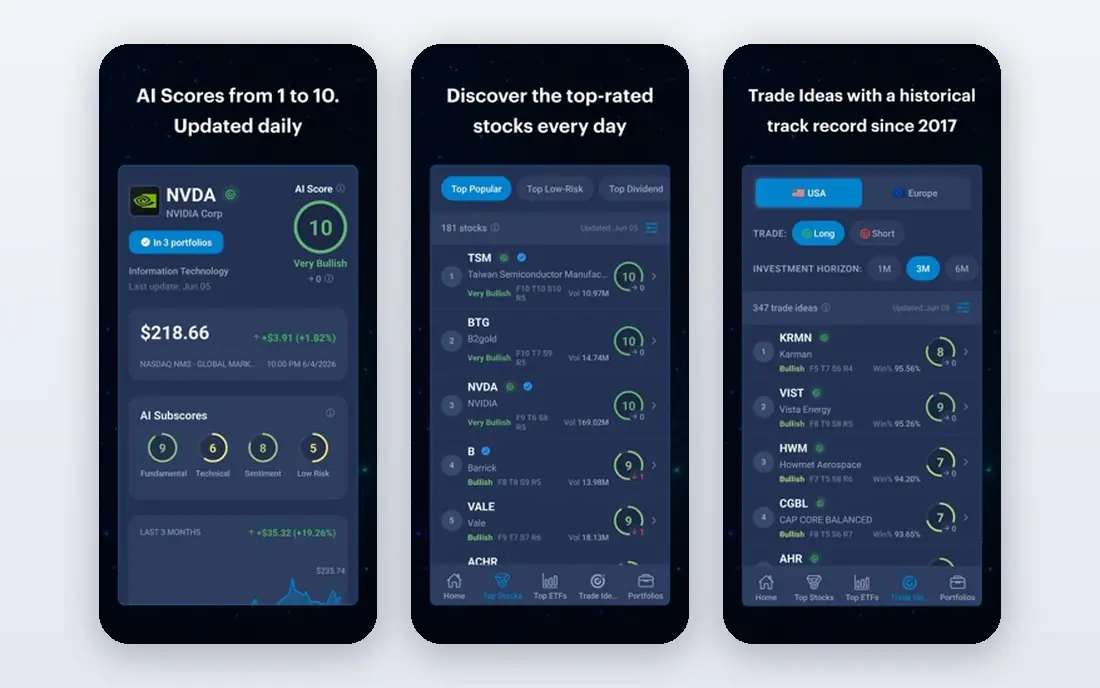
Danelfin is the best starting point for investors who want an AI opinion they can inspect. Its AI Score ranks stocks using fundamental, technical and sentiment data, and it shows the factors behind the score rather than asking you to trust a black box. That transparency matters, because a score you cannot question is just marketing with numbers attached.
The free plan lets you explore scores before paying, while the paid plan from $24 per month adds fuller coverage, price forecasts and trade ideas. The honest limit is depth: Danelfin is stronger on systematic ranking than on written company research or analyst context. Pair it with your own reading of filings and earnings calls, and use it to rank a shortlist you built yourself, not to replace that shortlist.
- AI Score ranks stocks with visible reasoning
- Covers a large stock universe
- Track record data helps you judge the model
- Less qualitative research than analyst platforms
- Paid plan needed for full coverage and forecasts
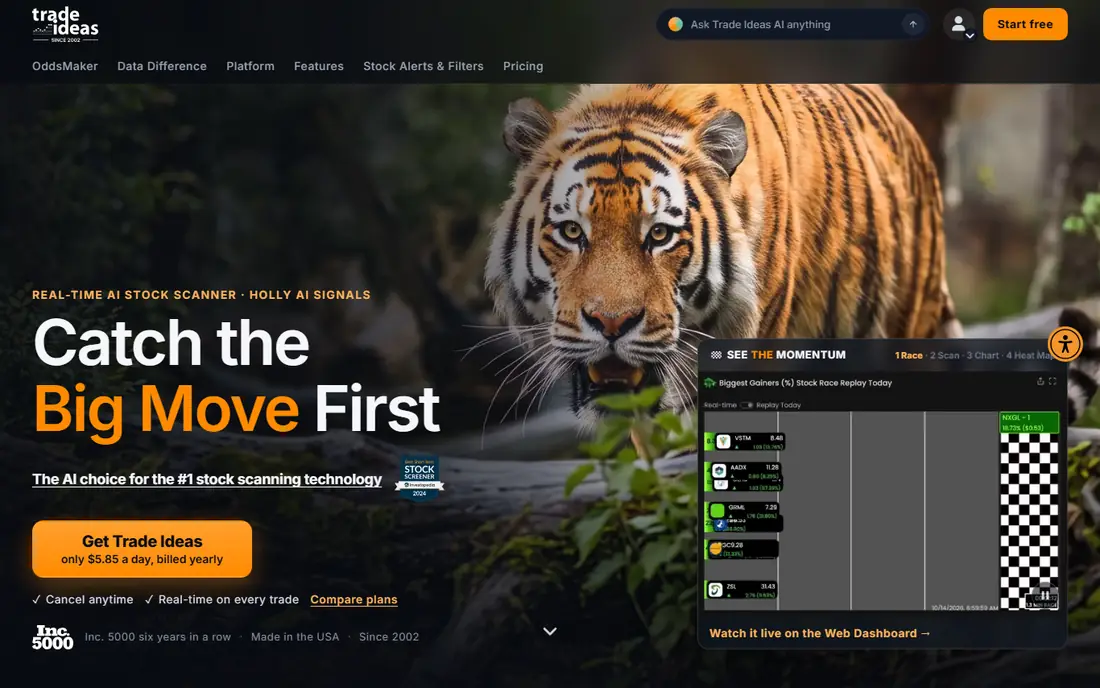
Trade Ideas is built for active traders, and its Holly AI engine is the reason it leads this category. Each morning Holly scans the market and ranks trading opportunities, and the real-time scanner lets you filter by hundreds of criteria during the session. Brokerage integration means you can act on a signal without switching tools, and paper trading lets you practice with no real money at risk.
The price is the honest objection. Plans start at $84 per month, and the premium tier with full Holly access costs substantially more, with some comparisons putting it near $178 per month on annual billing. That only makes sense if you trade often enough for the scanner to earn its keep. Beginners should start on the free plan, paper trade for at least a month, and only upgrade when the free tier limits real work.
- Holly AI scans and ranks opportunities each morning
- Real-time scanner with deep filters
- Paper trading mode included
- Premium plan is costly
- Interface can overwhelm beginners
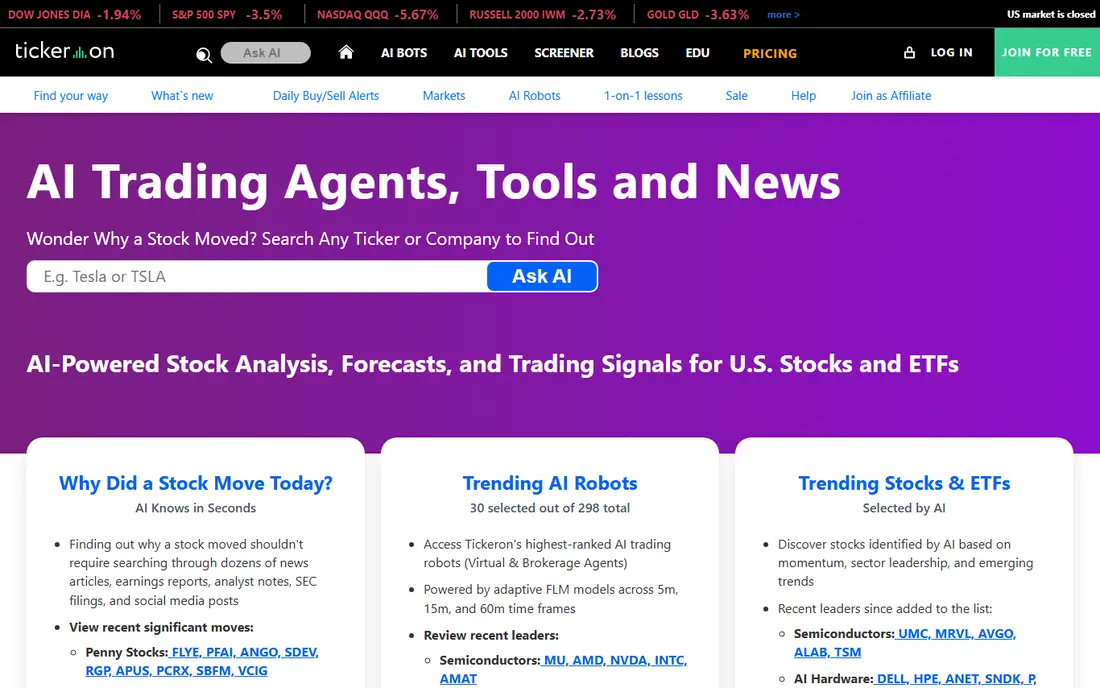
Tickeron suits traders who want to learn while they follow signals. Its AI bots each track a specific strategy, such as trend following or pattern recognition, and every prediction carries a confidence score, so you can see how sure the model claims to be. The interface explains patterns in plain terms, which helps beginners connect a chart shape to the signal behind it.
The free plan is limited, and the paid plan from $37 per month is where the fuller bot set lives. The deeper catch applies to every tool here: a confidence score is a model output, not a promise, and a pattern that worked in a backtest can fail in live markets. Use Tickeron to learn pattern logic and to shortlist ideas, then confirm each idea with your own checks before risking money.
- AI bots track strategies you choose
- Confidence scores on predictions
- Beginner-friendly pattern explanations
- Free tier is limited and pushes upgrades
- Predictions are probabilities, not guarantees
TrendSpider is the pick for traders who live in charts. Its automated trendline detection, pattern recognition and multi-timeframe analysis save hours of manual drawing, and its no-code strategy builder lets you test an idea against decades of historical data without writing code. That backtesting loop, build, test, adjust, is the most honest use of AI in trading, because it forces you to see how an idea did in past markets, including bad ones.
The drawback is fit and pricing. TrendSpider suits swing traders and strategy builders, not investors who want a simple ranked list, and its starting price is best confirmed on its own pricing page, since tiers and offers change. If you will not use backtesting, Danelfin or Magnifi will serve you better for less effort.
- Flexible no-code strategy builder
- Strong automated trendline and pattern detection
- Deep historical data for backtesting
- No single published starting price on its main pages
- Built for chart traders, not passive investors
Magnifi lets you search for stocks the way you would ask a question, such as finding profitable companies in a sector with low debt. Its AI turns that plain-language request into a screen, which lowers the barrier for investors who find traditional screeners full of jargon and menus. A free plan lets you try the search before paying, with paid access from $14 per month.
The catch is verification. Natural-language screens can misread a request, turning a tight filter into a loose one, so always open the generated criteria and check what the tool actually searched for. Magnifi also suits research and longer-term investing better than fast intraday trading. For a beginner building a first shortlist, though, it is one of the friendliest tools here.
- Conversational search in plain language
- AI-assisted screening for beginners
- Portfolio tools included
- Less depth for active day traders
- Screening logic still needs your own verification
Composer turns an investing idea into an automated strategy without code. You drag building blocks into a plan, backtest it against history, and let it run on US stocks and ETFs, with rebalancing handled for you. The Starter plan is free, and paid plans run from $10 per month, making it the cheapest route to hands-off automation on this list.
The limits are scope and expectations. Composer covers US markets only, and automation does not remove risk: a strategy that backtested well can still lose money in live markets. The free plan is the right place to start, and you should paper-test any strategy and understand every block in it before you fund it. For investors who want rules-based discipline rather than daily signals, Composer is the best value here.
- Free Starter plan
- Drag-and-drop strategy builder
- Backtesting and automated trading for US stocks and ETFs
- US markets only
- Paid plans from $10 per month add features beginners may not need at first
TipRanks blends human analyst data with AI research, which makes it a useful counterweight to pure model scores. Its Smart Score combines analyst ratings, blogger opinions, insider activity and technical factors into one ranking, while its AI tools add plain-language equity research, chart analysis and portfolio checks. That mix gives you both a number and context for it.
The drawback is clutter. Several scores measure different things, and a new user can mistake one for another or follow the highest number without asking what it measures. Pricing is also best confirmed on its own site, since tiers change. Use TipRanks when you want analyst consensus beside an AI view, and take time to learn what each score actually tracks.
- Smart Score combines analyst, blogger and insider signals
- AI research tools explain stocks in plain terms
- Broad coverage
- Several overlapping scores can confuse new users
- Best AI features sit behind paid tiers
TradingView is not a prediction engine in the same sense as Danelfin or Trade Ideas, but it belongs here because so many AI setups run on top of it. Its charts, screening, alerts and paper trading form the base layer for traders who combine signals from other tools with their own analysis. The free plan is genuinely usable, and paid plans add more indicators, alerts and data.
The honest limit is that TradingView alone will not predict a stock for you. Its AI-assisted features are thinner than the dedicated tools above, and its value shows when you pair it with a scorer or scanner. If you already use it for charts, keep it as your base. If you want AI predictions specifically, start with Danelfin or Tickeron and use TradingView to check their ideas.
- Free plan with strong charts and screening
- Huge indicator library
- Alerts and paper trading included
- AI features are limited compared with dedicated prediction tools
- Best features need paid plans
How we picked these
We searched for AI stock prediction tools that are live in October 2026, then checked each one against its official site or app store listing. We kept tools that show their reasoning in some form, whether a score with factors, a confidence level, a backtest or a plain-language screen, and we excluded tools that only promised returns without evidence. Where a vendor did not publish a single starting price, we wrote See website instead of guessing. We favored a mix of ranking tools, scanners, backtesting platforms and approachable search tools, because different traders need different kinds of AI help.
What to check before you pay for predictions
Start with what the tool actually shows you. A useful tool explains its signal: the factors behind a score, the pattern behind a call, or the backtest behind a strategy. A tool that only shows a win rate or a cherry-picked return deserves skepticism, because published returns often come from backtests or selected strategies, not typical future results. Ask how the model did out of sample, in markets unlike the ones it trained on.
Next, match the tool to your trading style. Active traders need real-time scanning from Trade Ideas. Longer-term investors need ranking and research from Danelfin or TipRanks. Strategy builders need backtesting from TrendSpider or Composer. Finally, paper trade any signal for at least a month before risking real money, and set a rule for position size in advance. No AI score should decide how much you risk on a single trade.
Frequently asked questions
What is the best AI stock prediction app?
Danelfin is our best overall pick for most investors, because its AI Score ranks stocks with visible reasoning and a track record you can inspect. Active traders should look at Trade Ideas instead, since its real-time scanner and Holly AI signals fit intraday work better. The best tool depends on whether you invest for months or trade during the day.
What are the best AI stock prediction tools for beginners?
Magnifi and Composer are the friendliest starting points, with plain-language search and no-code strategies plus free plans. Danelfin's free plan is also a good beginner step for learning how AI scores work. Start free, paper trade, and only pay once you understand what the tool measures and where it can be wrong.
Can AI really predict stock prices?
AI can find patterns and rank probabilities better than a person scanning thousands of stocks by hand, but it cannot predict prices with certainty. Models learn from past markets, and conditions change. Treat every output as a research signal with a confidence level, check it against fundamentals and valuation, and never treat a score as a promise of profit.
Do these tools offer a free plan?
Most do. Danelfin, Trade Ideas, Tickeron, Magnifi, Composer, TipRanks and TradingView all offer free plans or free tiers, though the free versions limit coverage, signals or data speed. TrendSpider offers a free trial rather than a permanent free plan. Start free in every case, and upgrade only when the free tier blocks work you actually do.
Is AI stock trading safe?
Trading always carries risk, and AI tools do not remove it. A model can be wrong, data can lag, and automated strategies can lose money in fast markets. Reduce risk by paper trading first, sizing positions conservatively, diversifying, and never investing borrowed money or money you need soon. If a tool promises guaranteed returns, treat that promise as a warning sign.
Sources
See where you really rank - block by block
ProMapRanker scans Google Maps across a grid of your service area. Simple monthly plans from $19, white-label on every plan.
Start freeKeep reading
 wpforms alternatives
Best WPForms Alternatives in 2026
We compare 9 wpforms alternatives for WordPress forms, with free and paid options, current pricing notes, and honest limits for small business sites in 2026.
Read → windows task scheduler alternatives
Best Windows Task Scheduler Alternatives in 2026
Looking for Windows Task Scheduler alternatives? We compare 9 schedulers for Windows and cross-platform work, from free tools to enterprise automation.
Read → which ai video service is best
Which AI Video Service Is Best in 2026
which ai video service is best? We compare 10 legitimate AI video services on price, avatars, editing and output quality to help you pick the right tool.
Read →