 ProMapRanker
Best AI Penetration Testing Tools in 2026


Internal networks and Active Directory · Pricing starts at: See website
Key takeaways
- Every tool here is for lawful, authorised testing only, on systems you own or have written permission to test, with scope agreed in advance.
- NodeZero suits internal networks and Active Directory, while XBOW and Aikido Attack suit web apps and APIs.
- Astra Security pairs autonomous testing with human review and retesting, which helps teams that need validated findings.
- Open source options such as PentAGI suit staging tests on a budget, but they still need careful scope control and human review.
Quick comparison
| Pick | Great for | Pricing starts at | Free tier | |
|---|---|---|---|---|
| NodeZero | Internal networks and Active Directory | See website | No | Visit |
 XBOW | Autonomous web app testing | See website | No | Visit |
 Pentera | Enterprise attack validation | See website | No | Visit |
 Astra Security | Managed autonomous pentesting | $2,999 per year | No | Visit |
 Aikido Attack | Developer-led app pentests | $4,000 per assessment | No | Visit |
 RunSybil | Cross-layer app and cloud testing | See website | No | Visit |
 Hadrian | Continuous external testing | See website | No | Visit |
 Cobalt Autonomous Pentest | Expert-reviewed autonomous testing | See website | No | Visit |
 PentAGI | Open source autonomous testing | Free | Yes | Visit |
The best ai penetration testing tools
These tools use AI agents or AI-assisted engines to map an attack surface, chain weaknesses, and prove exploitability, rather than only listing possible issues. Use them only on in-scope targets with written authorisation, a defined test window, and a kill switch or stop plan. Do not use them on systems you do not own, on production systems without controls, or to gain access you are not authorised to have.
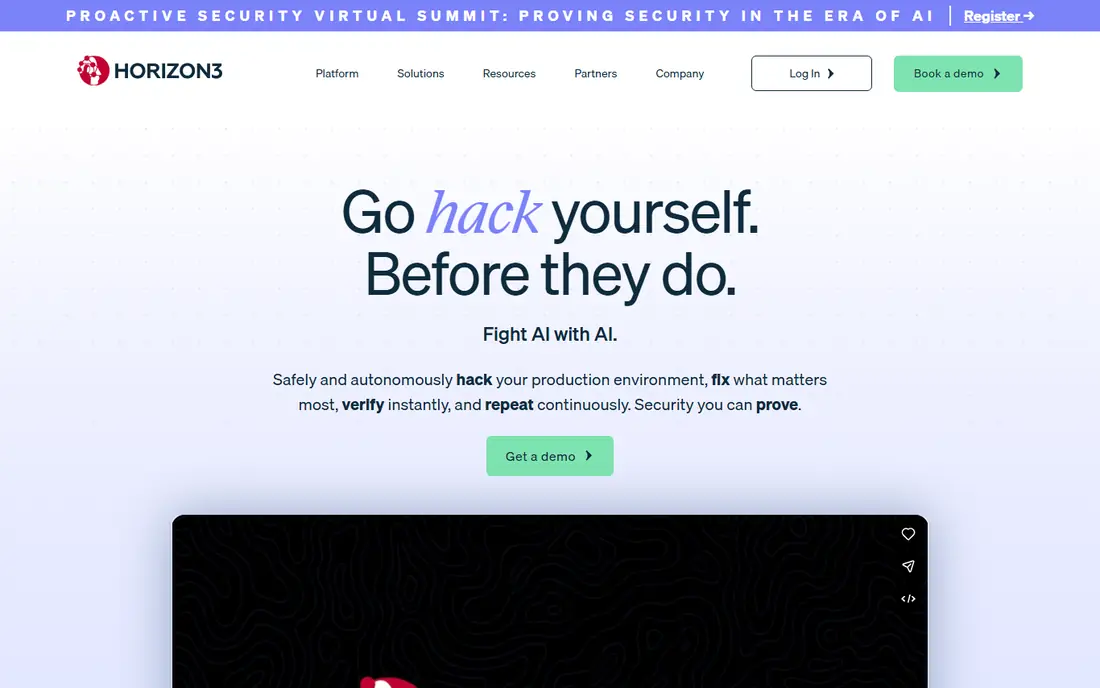
NodeZero, from Horizon3.ai, runs as a container inside your network and tests how weak credentials, misconfigurations, and known flaws chain into real access. That focus on attack paths, rather than single findings, helps teams judge which weaknesses actually matter. Coverage includes internal networks, external surfaces, cloud, Kubernetes, and Active Directory, with a federal option for government teams.
The practical cost is setup. You need an on-network host before a test starts, and smaller teams may find that heavier than a pure web app tool. Web and API testing is also less deep than dedicated app tools. For network and identity risk, NodeZero is the strongest pick here, provided the scope and host are prepared in advance.
- Chained attack paths with proof
- Internal, external, cloud, and Kubernetes coverage
- One-click retest of fixes
- Deployment needs an on-network host
- Web and API depth is thinner than app specialists
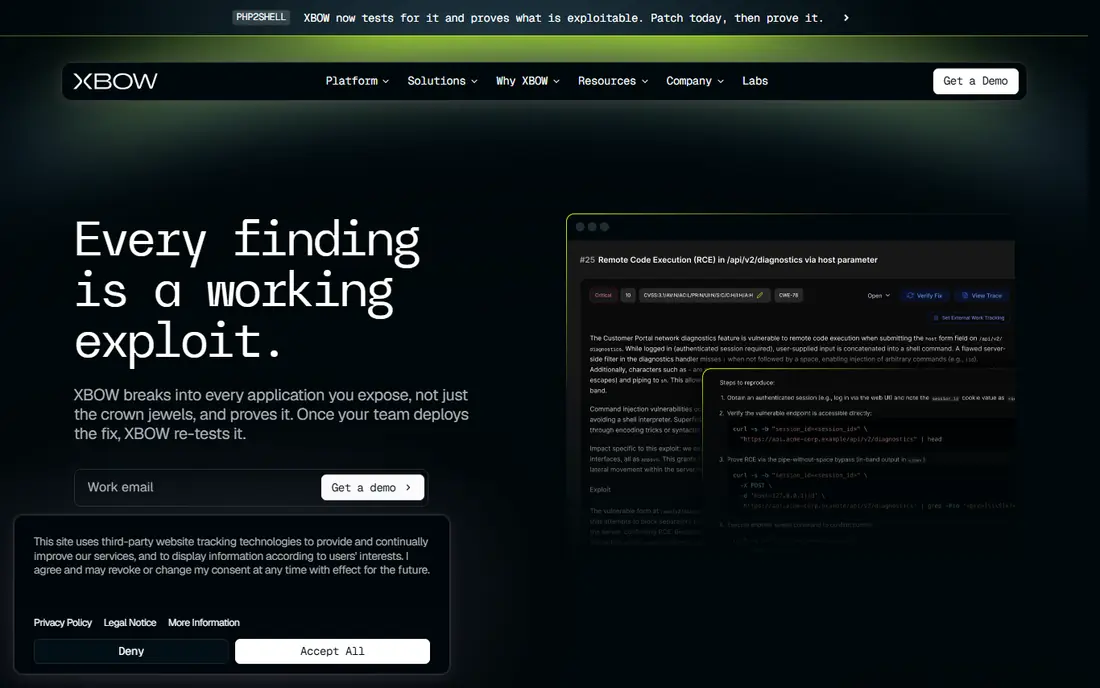
XBOW runs autonomous agents against web apps and APIs, with a coordinator directing short-lived agents and a validator checking each exploit before it is reported. That validation step matters, because it reduces the time spent chasing findings that cannot actually be exploited. Coverage is focused on apps and APIs, which keeps the tool deep in that area.
The limits are scope and price. XBOW does not cover internal networks in the same way NodeZero does, and pricing is quote-based, with per-test figures reported in the $4,000 to $8,000 range. Authenticated testing also needs proper test accounts and scope. For a web app team that wants proof, not just a scan list, XBOW is a leading choice.
- Autonomous agents with validated exploits
- Strong web app and API coverage
- Independent validation of findings
- Web and API only
- Pricing is quote-based
- Needs test accounts for authenticated areas
Pentera emulates real attacks across internal, external, cloud, and identity surfaces, using a long-standing attack engine with an AI layer that adapts payloads. That approach suits enterprises that need repeatable, scheduled validation and a workflow for assigning and re-checking fixes. It can run against production with controls, though scope and safety rules still need careful agreement.
Pricing is the main barrier. Pentera is quote-based and aimed at enterprise budgets, with outside estimates often in five figures per year. Small teams will find a better fit in Aikido, Astra, or an open source tool. For a large estate that needs continuous validation, Pentera is a serious, if costly, option.
- Deterministic attack engine with AI adaptation
- Internal and external validation
- Remediation workflow
- Enterprise pricing
- Less suited to small teams or single-app budgets
Astra Security pairs autonomous agents with human offensive security experts, which helps when a finding needs judgment about business logic or risk. Agents map the app, chase exploitable paths, and chain findings, while experts handle high-context cases and the platform retests fixes after they ship. Integrations with issue trackers and chat tools keep findings in the developer workflow.
Autonomous coverage today centers on web apps and APIs, so teams that also need deep cloud infrastructure testing should check the current scope carefully. The autonomous tier starts at $2,999 per year in published comparisons, with expert-led tiers higher. For teams that want validated findings without running a tool alone, Astra is a balanced pick.
- Autonomous testing plus human expert review
- Retesting after fixes
- Dashboard and integrations
- Cloud testing is less central
- Higher tiers cost more for expert-led work
Aikido Attack sends red-team-style agents at web apps and APIs, and it sits inside a broader application security platform that also covers code, dependencies, and cloud posture. That placement suits developer teams that want pentest findings beside the other security checks they already use, with fix pull requests to speed remediation. The published price of $4,000 per assessment makes budgeting clearer than quote-only rivals.
The trade-off is depth. Because pentesting is one module in a broad stack, it may not match a pure-play app pentest tool on every app type. Check whether the assessment covers your authenticated flows and APIs before you buy. For a team shipping often that wants a clear price and a developer workflow, Aikido is a practical choice.
- Clear per-assessment price
- Fix pull requests
- Retests included for a period
- Pentest is one module in a broader platform
- Depth varies by app type
RunSybil runs autonomous testing across web apps, APIs, code, cloud, and infrastructure, with an emphasis on chaining findings across layers rather than testing each layer alone. That cross-layer view helps when a flaw in one area only matters because of a weakness in another. On-demand runs and CI use suit teams that ship changes often.
Pricing is quote-based and a demo is normally required to scope a job, so budgeting takes a sales conversation. As a newer vendor, RunSybil also deserves a reference check for apps like yours. For teams whose risk spans app and cloud together, it is worth shortlisting beside XBOW and NodeZero, with scope split by layer.
- Black-box testing across apps, cloud, and infrastructure
- Chaining across layers
- On-demand or CI use
- Pricing is quote-based
- Needs a demo to scope well
- Newer vendor, so check references
Hadrian focuses on the external attack surface, discovering assets and testing them continuously for exploitable weaknesses. That suits companies with a changing public footprint, where new subdomains, services, or cloud assets appear often and need checking without waiting for an annual test. The platform gives a risk view across those assets, so teams can prioritize what is actually exposed.
Internal network testing is not its main strength, so pair Hadrian with a network tool if internal paths matter to you. Pricing is not published, so a sales conversation is needed. For continuous external coverage, Hadrian is a focused and useful pick.
- Continuous external attack surface testing
- AI-assisted discovery
- Asset and risk views
- Pricing is not published
- Internal network depth is not its main focus
Cobalt Autonomous Pentest combines autonomous testing with expert review from its wider pentest community, which helps when a finding needs human judgment before it reaches engineers. The credit-based model lets teams buy testing capacity and use it across apps, though the exact cost depends on scope and credits used.
The main questions to ask are price per app and whether the resulting report meets your auditor or customer requirements. Some teams need a specific attestation format, and that should be confirmed before purchase. For teams that want automation with a human check, Cobalt is a credible option.
- Autonomous testing with expert review
- Broad pentest portfolio
- Credit-based model
- Pricing is credit-based and not published
- Attestation needs checking for your auditor
PentAGI is an open source autonomous pentesting agent that can test networks and web apps on your own infrastructure. It suits security teams that want to try agentic testing in staging, learn how agents behave, or run regular checks without a vendor contract. Self-hosting keeps test data under your control, which matters for sensitive staging systems.
The limits are real. You need technical setup, a model key, and careful scope control, because an autonomous agent can create accounts, change data, or trigger rate limits in a test system. Its own guidance and wider reviews stress that it is not a replacement for human pentesters, especially for business logic. Use PentAGI in staging first, with a human reviewing every finding.
- Free and open source
- Autonomous agent testing for networks and web apps
- Self-hosted
- Needs technical setup and a model key
- Not a replacement for human pentesters
- Support is community based
How we picked these
We compared vendor pages, published comparisons, and pricing reports, and we kept only tools that are available for authorised testing in 2026. We favored tools that prove exploitability or validate findings, rather than tools that only list possible issues. We used See website where pricing is quote-based, and we did not invent prices. We did not claim hands-on testing, and we framed every pick for lawful use only.
What to check before you choose
Start with a written scope. List every domain, IP range, app, API, and cloud account in scope, and list what is out of scope. Agree on test accounts, data handling, rate limits, and a stop plan, and get written authorisation from the system owner before any test starts. Without that scope, even a good tool becomes a risk.
Next, split the job by surface. Networks and Active Directory point to NodeZero or PentAGI, web apps and APIs point to XBOW, Aikido, Astra, or RunSybil, and external assets point to Hadrian. Ask each vendor how findings are validated, how retests work, and whether the report will satisfy your auditor or customers. Finally, keep a human in the loop for business logic, because agents can miss flaws that only make sense in the context of your product.
Frequently asked questions
What are the best ai tools for penetration testing?
For networks and Active Directory, NodeZero is the strongest pick here. For web apps and APIs, XBOW, Aikido Attack, and Astra Security lead, with RunSybil as a cross-layer option. PentAGI is the best open source start for staging tests, with human review of every finding.
Is AI penetration testing legal?
It is legal only with authorisation. You must own the system or have written permission from the owner, with a clear scope, test window, and safety rules. Testing a system without permission, even with a tool sold for security work, can be unlawful and can cause real harm.
How is AI pentesting different from a vulnerability scan?
A scan matches known patterns and lists possible issues. AI pentesting uses agents to map a surface, form hypotheses, chain steps, and prove exploitability through actual, controlled exploitation in scope. That proof helps teams prioritize, but it also means scope and safety controls matter more.
Can AI pentesting replace a human pentester?
No, not on its own. Agents are strong at chaining known weakness types and proving exploit paths, but human testers are still needed for business logic, complex authentication flows, and judgment about risk. Most teams get the best result from AI testing plus human review, or from a managed service that includes experts.
How much does AI pentesting cost?
Costs vary widely. Aikido Attack publishes $4,000 per assessment, Astra autonomous testing starts at $2,999 per year in published comparisons, and PentAGI is free apart from infrastructure and model costs. Enterprise tools such as Pentera, NodeZero, XBOW, and RunSybil are quote-based, so price them for your exact scope.
Sources
See where you really rank - block by block
ProMapRanker scans Google Maps across a grid of your service area. Simple monthly plans from $19, white-label on every plan.
Start freeKeep reading
 wpforms alternatives
Best WPForms Alternatives in 2026
We compare 9 wpforms alternatives for WordPress forms, with free and paid options, current pricing notes, and honest limits for small business sites in 2026.
Read → windows task scheduler alternatives
Best Windows Task Scheduler Alternatives in 2026
Looking for Windows Task Scheduler alternatives? We compare 9 schedulers for Windows and cross-platform work, from free tools to enterprise automation.
Read → which ai video service is best
Which AI Video Service Is Best in 2026
which ai video service is best? We compare 10 legitimate AI video services on price, avatars, editing and output quality to help you pick the right tool.
Read →