 ProMapRanker
Best AI LMS Platform in 2026

Key takeaways
- TalentLMS and 360Learning are the easiest AI LMS options to price and start, with published plans and a free plan or trial.
- Docebo, Cornerstone, Absorb, and CYPHER Learning suit larger organisations that need scale, integrations, and governed AI features.
- LearnUpon and iSpring suit mid-size teams that want a balance of ease of use, AI authoring, and clear reporting.
- AI should support legitimate teaching and learning, such as drafting outlines, suggesting practice, and personalising review, not replace student work.
- Academic integrity needs a written policy: state what AI help is allowed, how work is checked, and how learner data is handled before rollout.
Quick comparison
| Pick | Great for | Pricing starts at | Free tier | |
|---|---|---|---|---|
 TalentLMS | Small teams with clear pricing | Free | Yes | Visit |
 360Learning | Collaborative course creation | $8 per user per month | No | Visit |
 Docebo | Enterprise AI learning at scale | See website | No | Visit |
 Cornerstone | Skills-based enterprise learning | See website | No | Visit |
 Absorb LMS | Mid to large employee training | See website | No | Visit |
 CYPHER Learning | Personalised AI learning paths | See website | No | Visit |
 LearnUpon | Employee and customer training | See website | No | Visit |
 iSpring Learn | Fast course creation and quizzes | See website | Free trial | Visit |
The best AI LMS platforms
We compared official pricing pages, product documentation, and public reviews for learning management systems with genuine AI features, such as AI-assisted authoring, recommendations, translation, and skill mapping. Our pick for most small and mid-size teams is TalentLMS, because its pricing is published, its free plan is usable, and its AI authoring credits are easy to understand.
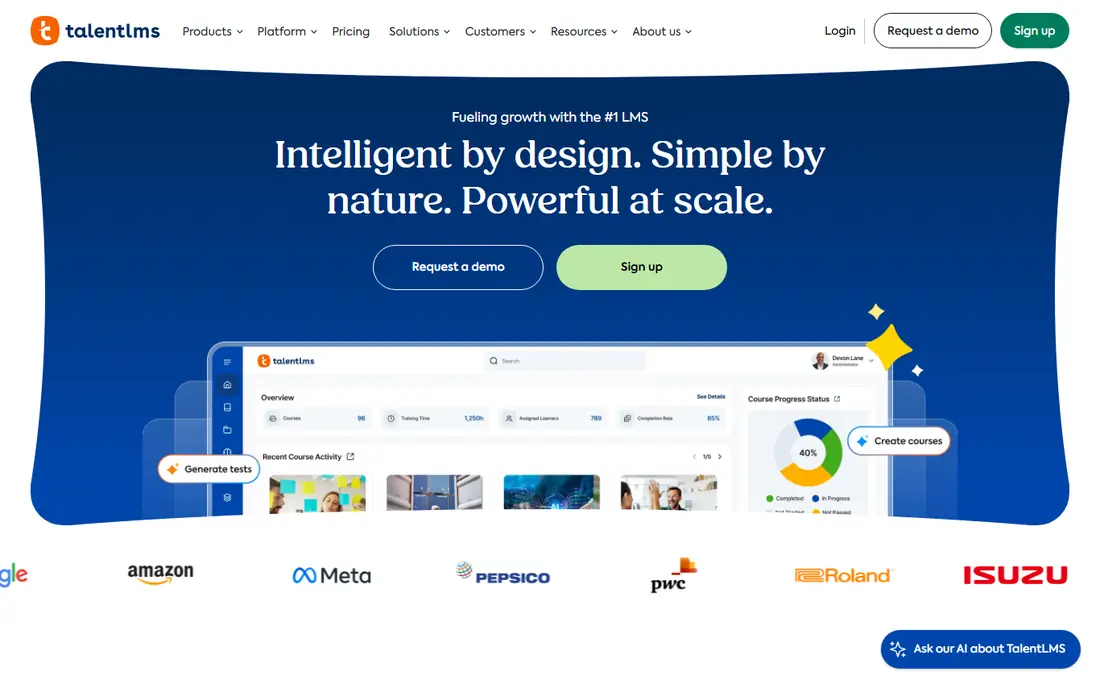
TalentLMS is a cloud training platform for employees, partners, and customers, with courses, learning paths, assessments, certificates, and reporting in one place. Its free plan covers up to 5 users and 10 courses, which is enough to test a real onboarding course, while Core starts at 119 dollars per month billed annually for up to 40 users, Grow at 229 dollars for up to 70 users, and Pro at 449 dollars for up to 100 users. TalentCraft AI helps draft and improve course content, and paid plans include monthly AI credits that scale with the tier.
The limits are the user brackets and the feature gates. Teams that grow past a bracket pay the next tier, and skills, branches, and advanced automations sit on higher plans, so a growing programme should map its learner count a year ahead. For a team that wants training running in days with a price it can quote to finance, TalentLMS is the simplest starting point here.
- Free plan for up to 5 users
- Published pricing
- AI course authoring with TalentCraft
- Free plan caps users and courses
- Advanced skills and branches need higher tiers
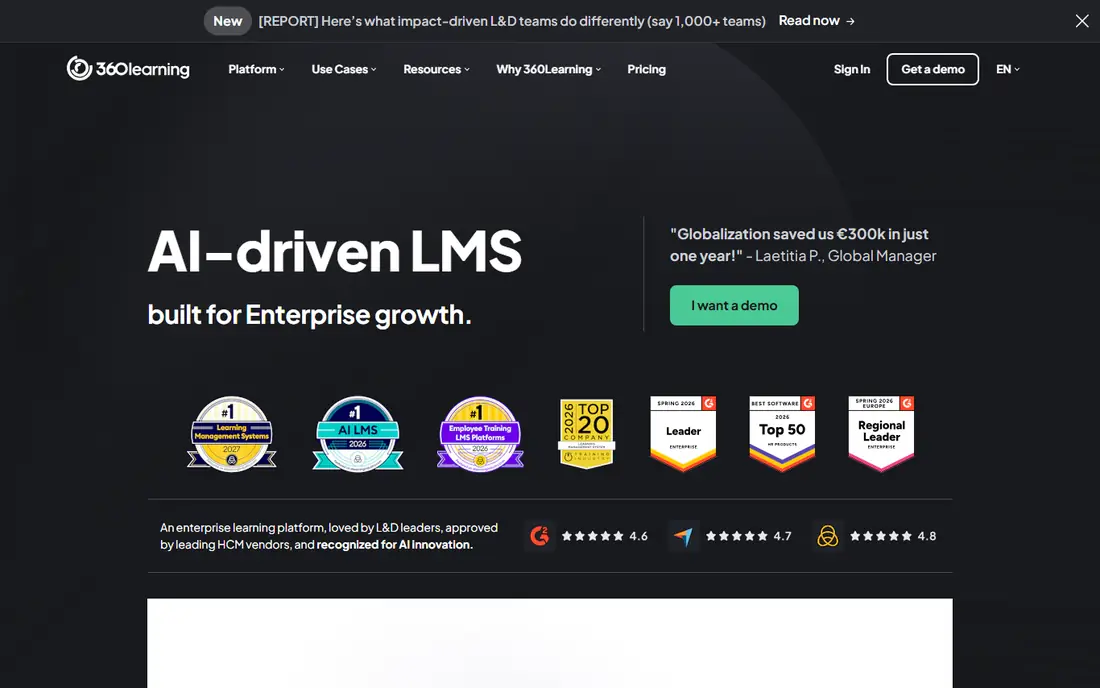
360Learning is an AI-driven LMS built around collaborative learning, where subject experts co-author courses with learning teams instead of waiting for a central team to produce everything. Its Team plan starts at 8 dollars per user per month, includes AI-assisted authoring, co-authoring, SCORM playback, and instructor-led sessions, and a free trial is available. Business and Enterprise tiers add flexible user models, HR system integrations, advanced analytics, and premium support, all priced by quote.
The model works best when an organisation actually wants experts to create content. If only one admin will ever build courses, the collaborative strength matters less, and the team should weigh the quoted higher tiers carefully. For companies that want to capture internal know-how and turn it into training quickly, 360Learning is a strong fit.
- Collaborative authoring
- AI-assisted content creation
- Low published entry price
- No free plan
- Business and Enterprise tiers are quote-based
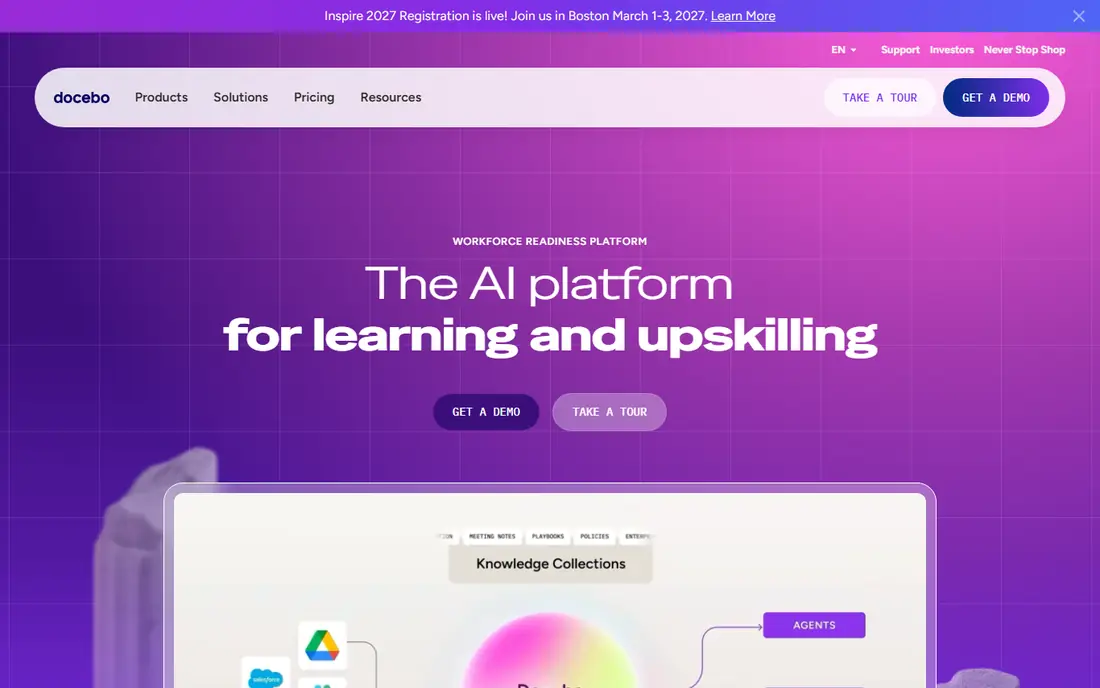
Docebo is an enterprise learning platform for employee training, compliance, and customer education, with AI tools that tag content, translate courses, and recommend learning paths. It connects to hundreds of HR, CRM, and content systems, supports branded mobile apps with offline learning, and handles multiple audiences such as staff, partners, and customers from one platform. That breadth is why large, global teams shortlist it first.
The trade-off is cost and complexity. Pricing is quote-based, third-party estimates put typical starting points in five figures per year, and smaller teams often need dedicated admin help to get full value. Docebo suits organisations with hundreds or thousands of learners and a clear need for automation, while smaller teams will find TalentLMS or 360Learning faster to run.
- AI tagging, translation, and recommendations
- Very broad integrations
- Branded mobile apps
- Quote-based pricing
- Setup can be heavy for small teams
Cornerstone is a talent and learning platform that links courses to skills, career development, and internal mobility, so learning is framed as progress toward a role rather than a list of completed modules. Its AI features help recommend content, surface skill gaps, and connect learning to performance and succession planning, which appeals to large employers building a skills-based workforce. Reporting and compliance tracking are strong, and the platform integrates with major HR systems.
Cornerstone is an enterprise purchase, with quote-based pricing and an implementation that needs planning, data work, and change management. Teams that only need straightforward course delivery will find it more platform than they need. For large organisations that want learning tied to workforce planning, it is one of the most complete options in this list.
- Skills mapping and career paths
- Broad talent suite
- Strong enterprise reporting
- Quote-based pricing
- Implementation is a larger project
Absorb LMS is a learning platform for employee, partner, and customer training, with course delivery, assessments, reporting, and e-commerce for selling courses. Its newer AI features include Aura AI agents and skills tracking, which help admins automate routine work and help learners find relevant content. The interface is consistently praised for ease of use, which matters when learners are busy staff rather than students who chose to enrol.
Pricing is quote-based and scales with learner count, so buyers should request a quote tied to active learners, not total accounts, and confirm which AI features are included in their package. Absorb suits mid to large organisations that want a polished learner experience without the heavier setup of a full talent suite, and it is a good middle ground between TalentLMS and Docebo.
- Clean learner experience
- AI agents and skills features
- Strong integrations
- Pricing is quote-based
- AI features vary by package
CYPHER Learning is a platform for creating, managing, and scaling training across employees, partners, customers, and members, with AI features that personalise learning paths, map skills, and automate grading and reporting workflows. Its AI360 tools help recommend content and focus learners on what matters next, while multi-portal support lets one organisation run separate branded learning environments for different audiences. That combination suits training businesses and large programmes with varied learners.
Pricing is quote-based, and the platform is priced like infrastructure rather than a self-serve tool, so small teams may find it expensive for a simple course library. Teams that will use its personalisation, automation, and multi-portal features across a large audience will get the most value, while teams with one audience and a handful of courses can start simpler.
- AI personalisation and skills mapping
- Adaptive learning paths
- Multi-portal support
- Quote-based pricing
- Can feel heavyweight for small teams
LearnUpon is a learning platform for employee, partner, and customer training, with courses, exams, surveys, certifications, and reporting, plus portals that let different audiences see their own branded training. It is known for fast deployment and responsive support, which helps teams that need training live without a long implementation project. Its AI features support content and recommendations, though AI is less central to its pitch than at some rivals.
The main drawback is pricing transparency. LearnUpon is quote-based, so buyers should ask for a quote based on active learners and confirm portal, integration, and support costs up front. For mid to large teams that value ease of use and support over newer AI, LearnUpon is a dependable choice.
- Easy to deploy
- Strong support reputation
- Portals for different audiences
- Pricing is quote-based
- AI depth is less central than at Docebo or CYPHER
iSpring Learn is a learning platform paired with iSpring Suite, a well-known authoring tool for turning slides and documents into interactive courses, quizzes, and simulations. That pairing makes it a fast route from existing training material to a finished course, with assessments, certificates, and detailed reports for managers. A free trial is available, and pricing is published by plan on its site, though it varies by user count and billing terms, so buyers should confirm the current rate for their team size.
The AI story here is narrower than at Docebo or CYPHER, focused more on helping authors create and improve content than on deep skills mapping or adaptive paths. For teams with a lot of existing slide-based training and a need for solid quizzes and tracking, iSpring is a practical pick, while teams that want AI-driven skills planning should look higher in this list.
- Fast authoring with iSpring Suite
- Strong quizzes and assessments
- Clear reporting
- Pricing varies by plan and region
- AI features are more authoring-focused
How we picked these
We compared official pricing and product pages, documentation, and public reviews, and we favoured LMS platforms that are still sold and supported in October 2026 and that offer real AI features, not just a chatbot added to a course page. We checked published versus quote-based pricing, free plans and trials, authoring, personalisation, reporting, and integrations, and we did not claim hands-on testing. We also kept the framing on legitimate teaching and learning: AI that helps teachers create material, helps learners practise and review, and helps managers see progress, with clear rules on academic integrity.
What to check before you buy
Start with the learner, not the AI feature list. A compliance team needs certificates, expiry tracking, and audit reports, while a sales team needs short, mobile-friendly modules and quick assessments, and a school needs gradebook, enrolment, and accessibility support. Pilot one real course with real learners, and measure completion, assessment scores, and time spent, rather than judging a demo course.
Next, set the academic integrity and data rules in writing. State which AI uses are allowed for learners, such as brainstorming, drafting outlines, and practising with feedback, and which are not, such as submitting AI-generated work as one's own. Check how the vendor handles learner data, whether AI outputs are reviewed for errors, and whether teachers can see AI use in submissions. A clear policy, shared before rollout, prevents most disputes and keeps AI as a study aid rather than a shortcut.
Frequently asked questions
What is an AI LMS platform?
An AI LMS platform is a learning management system that uses AI to help create courses, recommend content, personalise learning paths, translate material, and analyse progress. It still needs teachers and managers to set goals, check quality, and decide what counts as successful learning.
Which AI LMS is best for a small business?
TalentLMS is often the simplest choice for a small business, because it has a free plan, published pricing, and AI authoring that a small team can use without a dedicated learning specialist. 360Learning is a good alternative when several experts will co-author courses and the team wants a low per-user entry price.
Can AI in an LMS replace teachers?
No, and it should not be sold as a replacement. AI can draft outlines, suggest practice questions, and surface learners who need help, but teachers still set learning goals, judge quality, give feedback, and make final assessment decisions. The best results come from AI handling routine work so teachers can spend more time with learners.
How do I keep academic integrity with AI tools?
Publish a clear policy before rollout, teach learners what AI help is allowed, use assessments that check understanding such as in-class work, oral checks, and applied tasks, and review AI-generated content for errors. Keep records of policy, assessments, and any AI use that is disclosed, so decisions are consistent and fair.
What does an AI LMS cost?
Prices range from free for small TalentLMS teams and 8 dollars per user per month at 360Learning, to quote-based enterprise pricing at Docebo, Cornerstone, Absorb, CYPHER Learning, and LearnUpon. The total depends on active learner count, portals, integrations, and support, so ask for a quote tied to your real learner numbers.
Sources
See where you really rank - block by block
ProMapRanker scans Google Maps across a grid of your service area. Simple monthly plans from $19, white-label on every plan.
Start freeKeep reading
 wpforms alternatives
Best WPForms Alternatives in 2026
We compare 9 wpforms alternatives for WordPress forms, with free and paid options, current pricing notes, and honest limits for small business sites in 2026.
Read → windows task scheduler alternatives
Best Windows Task Scheduler Alternatives in 2026
Looking for Windows Task Scheduler alternatives? We compare 9 schedulers for Windows and cross-platform work, from free tools to enterprise automation.
Read → which ai video service is best
Which AI Video Service Is Best in 2026
which ai video service is best? We compare 10 legitimate AI video services on price, avatars, editing and output quality to help you pick the right tool.
Read →