 ProMapRanker
Best AI Healthcare Companies in 2026

Key takeaways
- Imaging and pathology vendors tend to sell to hospitals and labs through enterprise contracts, not through a self-serve checkout.
- Ambient documentation vendors focus on cutting note time for clinicians, but they still need careful review and consent processes.
- Precision medicine and data platforms suit large cancer centres and research teams more than small clinics.
- No vendor on this list replaces clinical judgement, and software alone does not make an organisation compliant with health privacy rules.
- Ask every vendor for published validation, integration effort, and data handling terms before signing.
Quick comparison
| Pick | Great for | Pricing starts at | Free tier | |
|---|---|---|---|---|
 Tempus AI | Precision oncology and clinical data | See website | No | Visit |
 Aidoc | Hospital imaging triage | See website | No | Visit |
 Viz.ai | Time-critical care coordination | See website | No | Visit |
 PathAI | Digital pathology and biomarkers | See website | No | Visit |
 Abridge | Ambient clinical documentation | See website | No | Visit |
 Ambience Healthcare | Documentation plus coding support | See website | No | Visit |
 Nabla | Clinician documentation for smaller teams | See website | Free trial | Visit |
 Hippocratic AI | Patient-facing agent workflows | See website | No | Visit |
The best AI healthcare companies
This guide covers companies whose products are used in real clinical and operational work, based on publicly reported factors such as product focus, stated integrations, and deployment type. It is not a verified ranking, and no scores are claimed here.
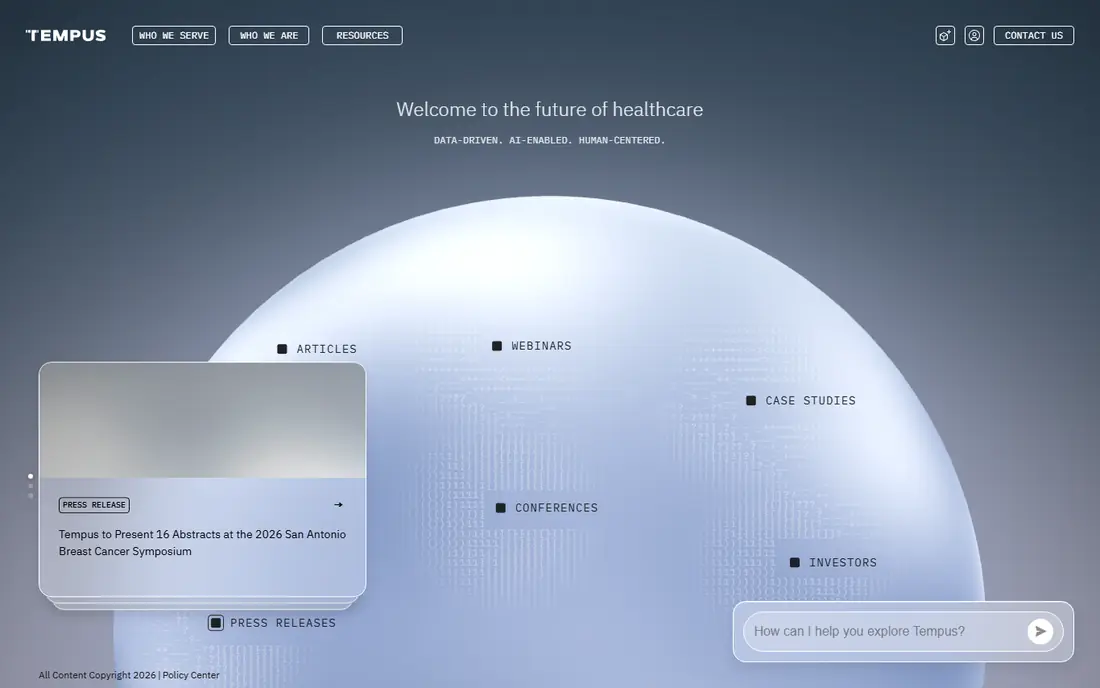
Tempus AI works mainly in precision medicine, combining genomic testing with clinical data to support oncology decisions and research. For a cancer centre, the appeal is the combination of testing, data, and analysis in one vendor relationship, rather than a single point tool. That breadth also means procurement, data governance, and integration work need serious attention before a team commits.
The honest catch is scale. Tempus is built for large organisations, and a small practice will find little that can be bought and used on its own. Ask for the exact tests, data products, and support included in a contract, and confirm who controls patient data and how it may be used.
- Large genomic and clinical data platform
- Oncology focus
- Tools for research and care teams
- Enterprise sales process
- Not a fit for small clinics
- Pricing is not published
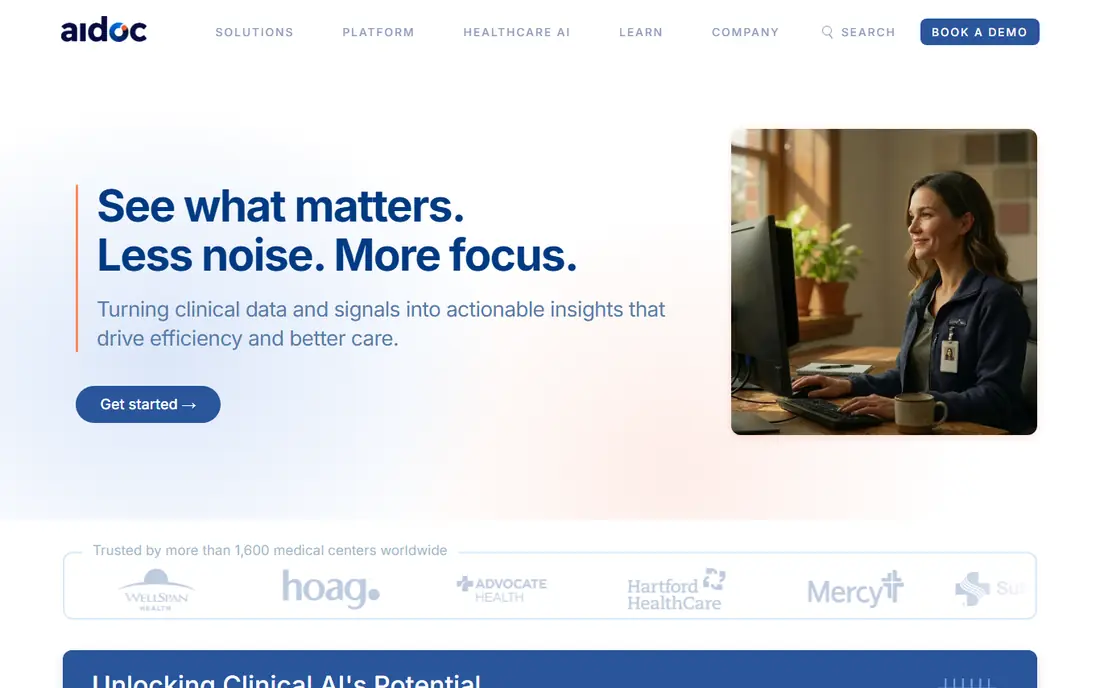
Aidoc focuses on radiology, flagging suspected urgent findings in imaging studies and routing them to the right team faster. Hospitals use this kind of tool to shorten the gap between a scan and a response, especially when cases arrive overnight or across sites. Its platform approach, covering several imaging use cases, can be easier to govern than a shelf of separate tools.
Buyers should still test the workflow in their own setting. Triage alerts only help if radiologists and downstream teams agree on who acts, how fast, and what happens when an alert is wrong. Confirm clearance status for each use case you plan to switch on, since that varies by product.
- Broad imaging triage coverage
- Hospital workflow tools
- Alert and routing features
- Enterprise pricing only
- Implementation needs IT time
- Value depends on local imaging volume
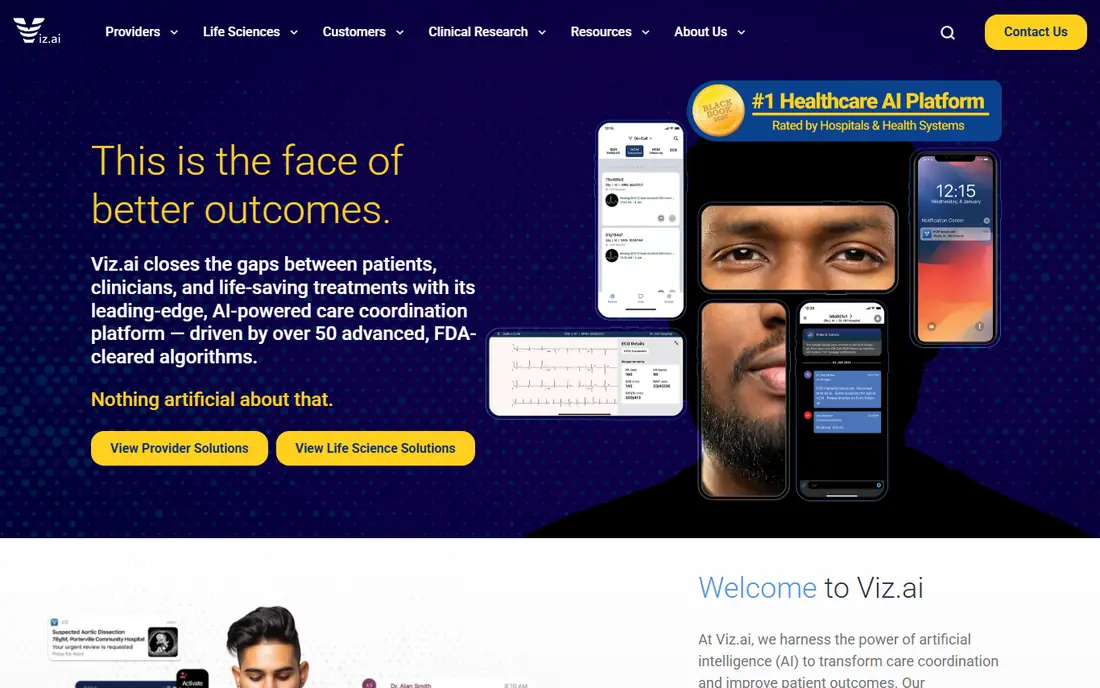
Viz.ai is known for stroke and other time-critical conditions, where minutes change outcomes. Its software surfaces suspected findings from imaging and connects the care team, so specialists can review and act without waiting for a chain of phone calls. For hospitals with stroke or similar emergency pathways, that coordination layer is often the main benefit.
The limit is that software cannot fix a weak response pathway on its own. If a hospital lacks rapid specialist cover or transfer agreements, alerts will pile up without changing care. Viz.ai fits best where the clinical pathway is already defined and the team wants faster, better tracked communication around it.
- Stroke and time-critical care focus
- Care team coordination
- Mobile alerts
- Enterprise contracts
- Needs strong local response pathways
- Not a general diagnostic tool
PathAI builds tools for digital pathology, helping labs analyse tissue images and quantify biomarkers used in oncology and drug development. For pathology departments moving to digital slides, this kind of analysis can add structure to work that is otherwise hard to measure consistently. It also supports pharmaceutical research teams working with large image sets.
Digitisation is the gate. A lab without slide scanners, storage, and image management will not get value from analysis tools alone. PathAI suits labs and research groups that already have, or are ready to fund, that foundation, and that can validate each algorithm on their own cases.
- Pathology image analysis
- Biomarker quantification
- Research and pharma work
- Lab and IT investment required
- Enterprise pricing
- Pathology digitisation comes first
Abridge listens to clinician and patient conversations and drafts structured clinical notes for review in the record system. Health systems choose it to cut documentation time and reduce after-hours charting, which is a real source of clinician strain. Its large health system deployments give buyers reference sites to check, which matters for a tool that touches every visit.
A draft is not a finished note. Clinicians must review, correct, and sign, and organisations need a clear consent process for recording. Abridge does not publish pricing, and small practices cannot buy it directly, so it fits large systems that can run a proper pilot with measured time savings.
- Conversation based note drafting
- Health system deployments
- EHR integration focus
- Enterprise only
- No self-serve purchase
- Consent and review processes still needed
Ambience Healthcare offers ambient documentation that covers many specialties, with added support for coding and clinical documentation improvement. That second layer matters, because a note that reads well but codes poorly still creates downstream work for billing and compliance teams. Emergency and inpatient teams are a natural fit, where notes are long and time pressure is high.
As with other enterprise documentation vendors, the rollout is a change project, not a simple install. Teams need training, audit of early notes, and a plan for specialties where the tool performs less well. Ask for specialty specific results from the pilot, not just a general accuracy claim.
- Ambient documentation across specialties
- Coding and CDI support
- Inpatient and emergency use
- Enterprise sales
- Pricing not published
- Rollout needs workflow change
Nabla Copilot is a documentation assistant aimed at clinicians and teams that want a quicker start than a large enterprise deployment. It offers ambient note generation and dictation, which suits virtual, hybrid, and international care settings. Smaller practices often prefer this shape of product, since they can trial it without a months long procurement cycle.
The trade-off is scope. Nabla will not carry the same deep enterprise governance or custom integration work as the largest vendors, and every note still needs clinician review. Use the trial to test your own specialties, accents, and record system, and confirm data residency and privacy terms before wider use.
- Faster setup than enterprise rivals
- Multilingual support
- Dictation and ambient options
- Still needs clinician review
- Enterprise features vary by plan
- Pricing needs confirmation
Hippocratic AI builds agents for patient facing work such as outreach, appointment follow-up, and chronic care check-ins. The idea is to handle routine, scripted conversations at scale while escalating anything clinical or uncertain to a human. For health systems and payers with large patient lists, that can fill gaps where staff time is short.
Guardrails decide whether this kind of product is safe to use. Buyers should ask how agents are tested, what triggers escalation, how errors are logged, and what happens outside scripted topics. No agent replaces clinical judgement, and any deployment needs clinical oversight, privacy review, and a clear plan for patients who need a person.
- Agents for outreach and follow-up
- Safety focused design claims
- Health system and payer use
- Pricing not published
- Needs careful guardrails
- Not a replacement for clinical staff
How we picked these
We compared official product pages, public deployment reports, and vendor descriptions of integrations and pricing, and we left out vendors whose products could not be confirmed as live enterprise offerings in October 2026. We favoured companies with distinct clinical or operational roles, from imaging and pathology to documentation and patient outreach, rather than listing several near identical tools. Prices are marked as See website where vendors do not publish them, which is common for enterprise health software.
What to check before you buy
Match the product to the workflow
Start from the bottleneck. Imaging triage helps radiology throughput, ambient documentation helps note burden, and patient agents help outreach volume. A strong product in the wrong workflow will still disappoint, so name the workflow, the owner, and the measure of success before a pilot.
Validation, privacy, and consent
Ask for validation on cases like your own, clearance or authorisation status for each use case, and the exact data handling terms, including whether data trains models. For recording tools, confirm consent practice and retention, since rules differ by state and organisation. Software alone does not make an organisation compliant, and no tool here replaces clinical judgement. This guide is general information, not medical advice.
Pilot small and measure honestly
Run a short pilot in one department, compare note time, response time, or outreach completion against a baseline, and review errors, not just averages. If a vendor cannot agree to those measures in writing, that tells you plenty about the partnership.
Frequently asked questions
What are the best healthcare AI companies?
The best healthcare AI companies depend on the job. Imaging teams tend to look at Aidoc and Viz.ai, pathology teams at PathAI, and documentation teams at Abridge, Ambience Healthcare, and Nabla, while Tempus AI suits precision oncology work.
What is the best AI healthcare company for hospitals?
Hospitals often start with imaging triage or ambient documentation, since those touch daily throughput and clinician time. Aidoc and Viz.ai fit imaging and coordination, while Abridge and Ambience Healthcare fit documentation at health system scale.
How much do AI healthcare companies charge?
Most enterprise vendors on this list do not publish prices and quote per contract, based on size, use cases, and integration work. Nabla is the exception here with a trial, but its paid price still needs confirmation from the vendor.
Do these tools replace doctors?
No. These tools draft notes, flag images, or handle routine outreach, but clinicians review notes, confirm findings, and make care decisions. Any vendor claim that suggests otherwise should be treated with caution.
Is AI healthcare software HIPAA compliant?
A vendor can offer HIPAA aligned controls and sign a business associate agreement, but compliance also depends on how your organisation configures, uses, and governs the tool. Ask for security documentation and confirm data use terms in the contract.
Sources
See where you really rank - block by block
ProMapRanker scans Google Maps across a grid of your service area. Simple monthly plans from $19, white-label on every plan.
Start freeKeep reading
 wpforms alternatives
Best WPForms Alternatives in 2026
We compare 9 wpforms alternatives for WordPress forms, with free and paid options, current pricing notes, and honest limits for small business sites in 2026.
Read → windows task scheduler alternatives
Best Windows Task Scheduler Alternatives in 2026
Looking for Windows Task Scheduler alternatives? We compare 9 schedulers for Windows and cross-platform work, from free tools to enterprise automation.
Read → which ai video service is best
Which AI Video Service Is Best in 2026
which ai video service is best? We compare 10 legitimate AI video services on price, avatars, editing and output quality to help you pick the right tool.
Read →