 ProMapRanker
AI Headless Ecommerce Software: Best Picks of 2026

Scalable multi-channel storefront operations · Pricing starts at: See website
Direct answer
BigCommerce is the first pick on this list for scalable multi-channel storefront operations. Listed starting prices: Medusa from $29 per month. Alternatives: Medusa for developers wanting an open-source commerce core, and Salesforce Commerce Cloud for brands inside the Salesforce ecosystem. Prices, free plans and limits for all 5 tools follow.
Choosing AI headless ecommerce software usually comes down to price, fit and limits. This ProMapRanker guide sets 5 tools side by side on those three points, with the facts kept short and checkable.
Key takeaways
- Top of the list is BigCommerce, which targets scalable multi-channel storefront operations.
- Medusa is the lowest-priced starter here at $29 per month.
- Shopify Hydrogen suits Shopify merchants building custom storefronts.
- Just one of the 5 tools, Medusa, has a free plan.
- BigCommerce comes with a trade-off: headless setups need additional development.
Quick comparison
| Pick | Great for | Pricing starts at | Free tier | |
|---|---|---|---|---|
| BigCommerce | Scalable multi-channel storefront operations | See website | Not stated | Visit |
 Medusa | Developers wanting an open-source commerce core | $29 per month | Yes | Visit |
 Salesforce Commerce Cloud | Brands inside the Salesforce ecosystem | See website | Not stated | Visit |
 commercetools | Enterprise commerce infrastructure for AI agents | See website | Free trial | Visit |
 Shopify Hydrogen | Shopify merchants building custom storefronts | See website | Not stated | Visit |
Every option for AI headless ecommerce software explained

BigCommerce serves scalable multi-channel storefront operations. Its strength is as a managed system instead of a bare commerce engine.
Where it is weaker: Headless setups need additional development.
So teams wanting maximum architectural freedom may prefer commercetools or Medusa. Check the vendor site for BigCommerce pricing; none is listed in this comparison. Free access: Not stated.
- Single foundation across regions and channels
- Supports brand and regional expansion
- Less developer-first than pure API platforms
Medusa is a good fit for developers wanting an open-source commerce core. Medusa is described as an open-source agentic commerce system and the most adaptable commerce product for agents and developers.
Drawbacks to consider: Needs development resources.
It fits engineering-led teams that want to own their commerce core, customize freely and build storefronts or agent interfaces on top of an open foundation instead of a closed hosted product. Medusa pricing: $29 per month. Medusa includes a free tier.
- Built for agents and developers
- Open-source and highly flexible
- Less managed than hosted products
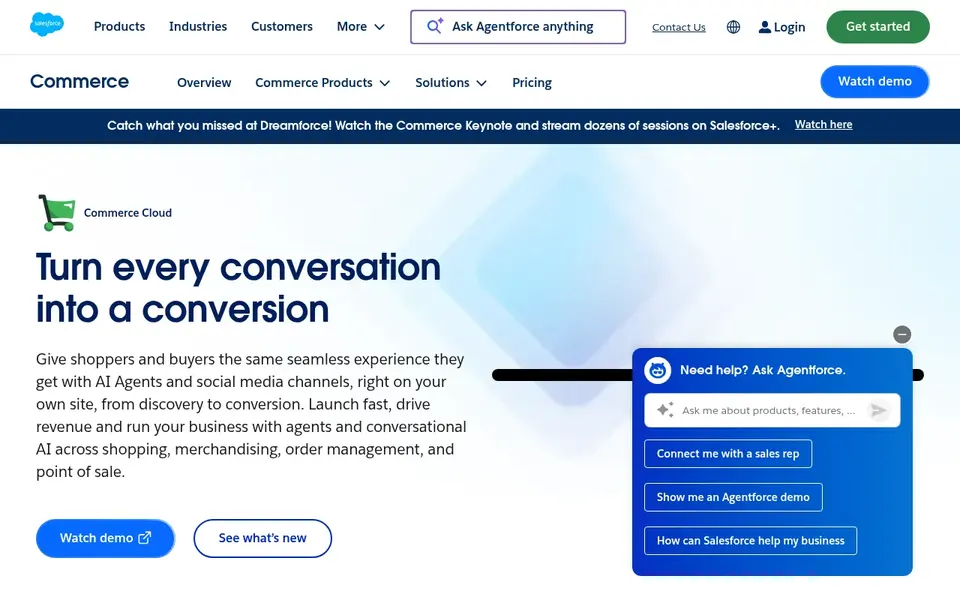
Salesforce Commerce Cloud was built for brands inside the Salesforce ecosystem. Commerce Cloud is Salesforce's commerce offering, targeted at brands that want shopping experiences connected to their broader customer and marketing data.
Points against: Most valuable within Salesforce stack.
More specifically, implementation and integration need planning, and lighter headless choices may suit smaller catalogs. Salesforce Commerce Cloud shows no starting price here, so confirm the cost on the vendor site. Free access: Not stated.
- Suits Salesforce customer data workflows
- Solid for service and marketing alignment
- Configuration and integration take effort
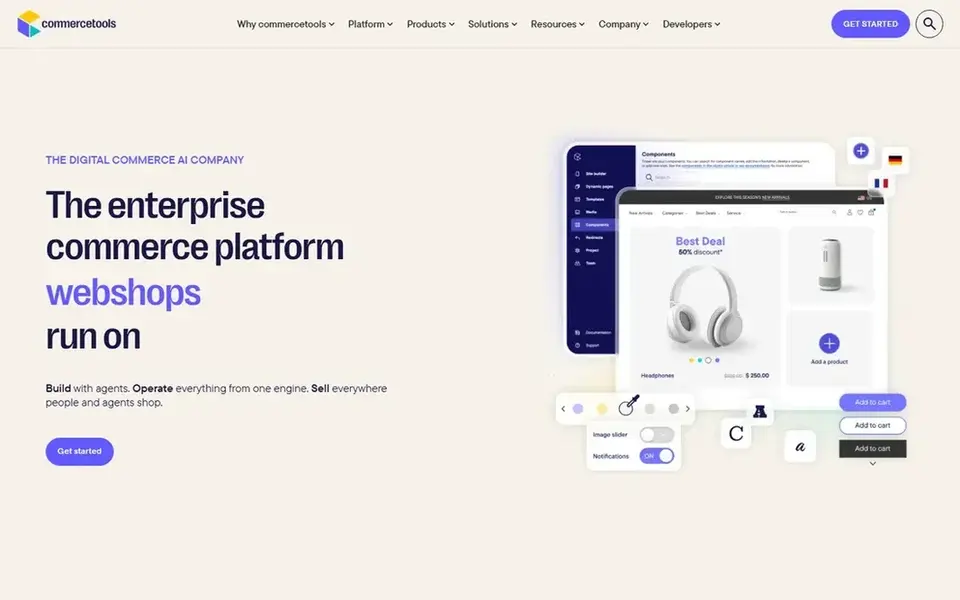
commercetools works best for enterprise commerce infrastructure for AI agents. Since it targets enterprise infrastructure, it is heavier than a storefront-first product and assumes dedicated engineering and integration work.
commercetools does not show a starting price in this comparison, so check the vendor site for current pricing. Free plan details: Free trial.
Points against: Geared toward bigger organizations.
- Built for agent-to-agent commerce
- Enterprise-grade composable architecture
- Implementation demands technical resources
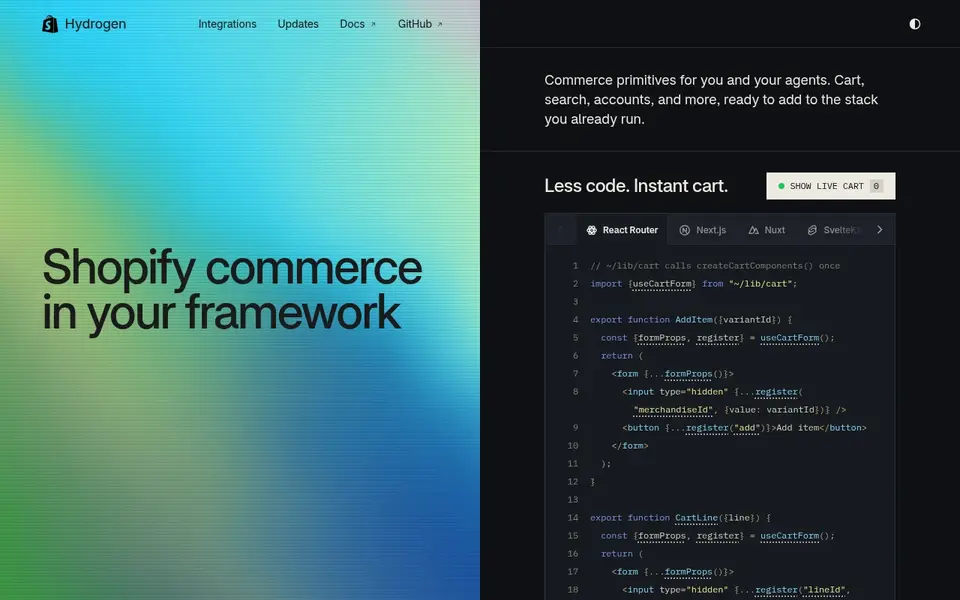
Shopify Hydrogen is a good fit for Shopify merchants building custom storefronts. Hydrogen is Shopify's framework for building custom storefronts, described as commerce in your framework with commerce primitives for you and your agents. Also, teams comfortable with modern JavaScript frameworks will find the model familiar.
Also, the main limit is ecosystem lock-in: Hydrogen makes most sense when Shopify is your commerce engine, so brands wanting a fully engine-agnostic stack should look at commercetools or Medusa. It also assumes real developer capacity, so more straightforward hosted storefronts may be a better fit for small teams. This comparison lists no price for Shopify Hydrogen; ask the vendor. On free options: Not stated.
Downsides: Needs front-end development skill.
- Suits teams already on Shopify
- Commerce primitives built for your framework
- Tied to the Shopify ecosystem
How the list was put together
ProMapRanker looked at what each vendor publishes: pricing, plan limits, feature coverage for AI headless ecommerce software and stated drawbacks. No hands-on testing is claimed. Treat prices as a snapshot: vendors change plans often, so check the vendor site for the figure that applies today. Position on the page reflects fit for a typical buyer first, with price clarity and free access breaking ties. Treat it as a guide, not a ruling.
A buyer's checklist
- Get a written quote from BigCommerce, Salesforce Commerce Cloud, commercetools and Shopify Hydrogen; the list shows no starting price for them.
- Look at the free plan from Medusa closely: its caps decide whether it is usable for real work.
- Take the trial from commercetools and push a live task through it before you pay.
- Before choosing BigCommerce, weigh its main limit: headless setups need additional development.
- Compare total cost, not headline price: for Shopify Hydrogen, add extra seats, add-ons and any usage-based charges.
- Before rolling out Medusa, verify the integrations your workflow depends on.
Frequently asked questions
Can I try these options before paying?
Often, yes. Medusa has a free plan and commercetools offers a free trial. Use your own data and a real task during the test, and check what the free tier or trial limits before you rely on it.
Do these tools publish their prices?
Not all of them. BigCommerce, Salesforce Commerce Cloud, commercetools and Shopify Hydrogen publish no starting price, so expect a quote request for those. The rest, Medusa included, show a starting price, though seats and billing terms still change the final cost.
What is the cheapest option for AI headless ecommerce software in this list?
On published monthly entry prices, Medusa is the lowest here at $29 per month. Entry price is only part of the cost, because seats, add-ons and billing terms can change the total.
Is BigCommerce the right pick for everyone comparing AI headless ecommerce software?
No single tool suits every team. BigCommerce comes first because it fits scalable multi-channel storefront operations, while Medusa suits developers wanting an open-source commerce core and Salesforce Commerce Cloud suits brands inside the Salesforce ecosystem. Match the tool to your own size, budget and workflow before deciding.
How does Shopify Hydrogen differ from commercetools?
Hydrogen is a framework for building storefronts on Shopify's commerce backend, so it suits merchants already on Shopify. commercetools is engine-agnostic enterprise infrastructure built for numerous channels and agent-to-agent commerce.
Sources
See where you really rank - block by block
ProMapRanker scans Google Maps across a grid of your service area. Simple monthly plans from $19, white-label on every plan.
Start freeBrowse all guides
← Best Bot Platform for Ecommerce: 2026 Prices and PicksAI Productivity Bots Software: 5 Options Compared in 2026 →
 best ai virtual reality marketplaces software
Best AI Virtual Reality Marketplaces Software (2026)
Weighing the best AI virtual reality marketplaces software? We lined up 5 products by cost, free access and fit. Caveats come with every verdict. Numbers first.
Read → best ai talent marketplace platforms
AI Talent Marketplace Platforms in 2026: Top 6 Compared
6 best AI talent marketplace platforms, with entry costs, free tiers and the buyer each one serves. Short, factual notes on every option. Refreshed for 2026.
Read → best ai shopify setup experts software
6 Best AI Shopify Setup Experts Software for 2026
Weighing the best AI shopify setup experts software? We lined up 6 products by cost, free access and fit. Strengths and weak spots are spelled out. Plain facts.
Read → top productivity software recommendations
Top Productivity Software Recommendations in 2026
Our top productivity software recommendations for 2026 compare Notion, Todoist, Asana and more on price, free plans and the work each tool fits best today.
Read → best e-commerce platforms
Best E-Commerce Platforms in 2026
We compared the best e-commerce platforms on pricing, checkout, design, and apps, so small businesses can pick a store platform with confidence in 2026.
Read → best ecommerce platform for wholesale
Best Ecommerce Platform for Wholesale in 2026
Find the best ecommerce platform for wholesale with tiered pricing, buyer accounts and bulk ordering compared for distributors and brands in 2026 now.
Read →More in Ecommerce & Retail · All guides A to Z by date · Latest guides