 ProMapRanker
Best Ecommerce Platform for Wholesale in 2026


Wholesale-first distributors · Pricing starts at: $29 per month
Key takeaways
- BigCommerce gives wholesale buyers account pricing and quotes on published plans, while Shopify keeps its full B2B toolset on Plus.
- WooCommerce and SparkLayer suit smaller wholesalers that want lower starting costs and an existing store to build on.
- OroCommerce and Adobe Commerce suit complex catalogs, contract pricing and ERP-linked operations, but both need a larger budget and implementation help.
- Faire and NuORDER are not general storefronts, so use them to reach retail buyers rather than as a replacement for your own wholesale site.
Quick comparison
| Pick | Great for | Pricing starts at | Free tier | |
|---|---|---|---|---|
| BigCommerce B2B | Wholesale-first distributors | $29 per month | Free trial | Visit |
 Shopify B2B | Brands selling wholesale and retail together | $2,300 per month | Free trial | Visit |
 Adobe Commerce | Large enterprise catalogs | See website | No | Visit |
 WooCommerce | WordPress stores adding wholesale | Free | Yes | Visit |
 OroCommerce | Complex B2B pricing and workflows | See website | Free trial | Visit |
 Faire | Reaching independent retail buyers | Free | Yes | Visit |
 NuORDER | Brand-to-retailer wholesale ordering | See website | No | Visit |
 SparkLayer | Adding B2B ordering to an existing store | Free | Yes | Visit |
The best ecommerce platform for wholesale
Wholesale selling needs buyer accounts, price lists, bulk ordering and payment terms, not just a checkout page. We compared platforms on those features, on published pricing, and on how much help a team needs to launch.
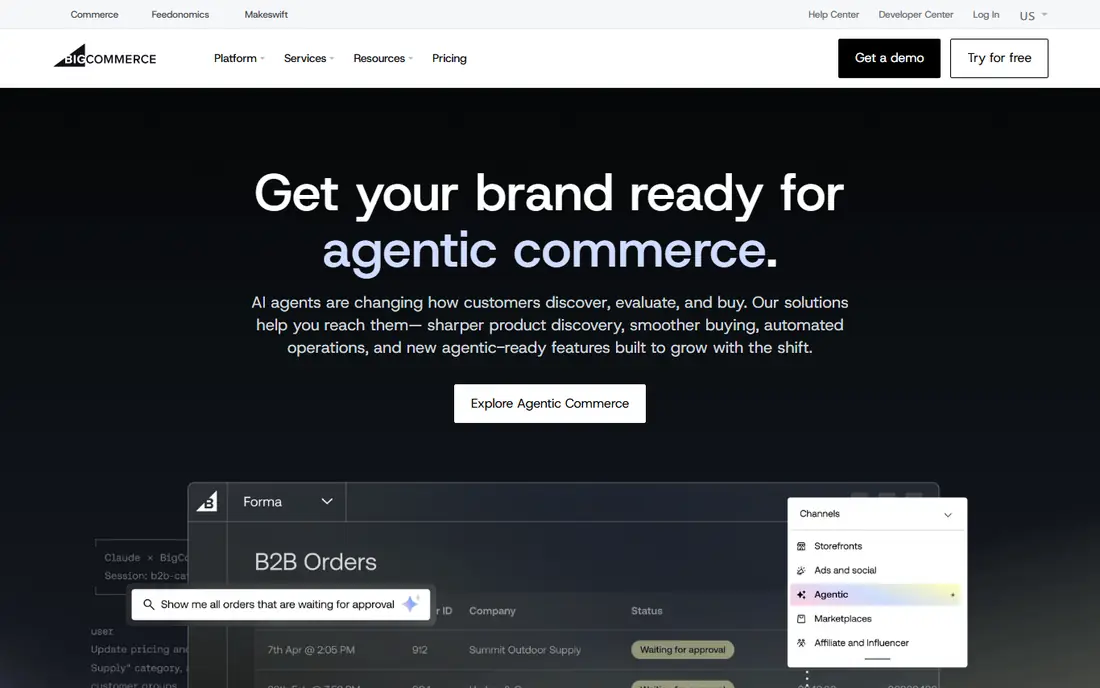
BigCommerce suits a distributor that wants wholesale ordering to be central, not an add-on. Its B2B tools cover company accounts, customer-specific pricing, quotes and approval steps, which are the features that separate a wholesale store from a retail store with a discount code. The published plan ladder also makes early budgeting easier than on quote-only platforms.
The catch is scale. Lower plans carry annual sales limits, and payment provider choice affects fees, so a growing wholesaler should check both before committing. For many mid-size distributors, the Scale or Performance tier is the realistic starting point for full B2B work, even though the entry plan is cheaper.
- Published pricing
- Strong B2B features on higher plans
- No extra platform fee with embedded payment providers
- Sales caps on lower plans
- Open payment provider fees apply to some gateways
- Enterprise pricing is custom

Shopify B2B is our pick for a brand that already sells direct to consumers and wants wholesale buyers on the same system. Company accounts, catalogs, price lists, net terms and purchase order numbers sit alongside the retail store, so inventory and product data do not need to live in two places. That shared setup is a real advantage for brands with a small operations team.
The price is the main barrier. Plus starts at $2,300 per month on a three-year term, so it only makes sense once wholesale volume justifies it. Smaller brands can start with wholesale apps on lower plans, but they should not expect the full B2B toolset at that price.
- One store for wholesale and retail
- Large app ecosystem
- Strong checkout and agency support
- Full B2B features require Plus
- High monthly cost
- Wholesale setup still needs planning
Adobe Commerce, formerly Magento, fits enterprises with complex catalogs, many buyer groups and custom workflows. It supports negotiated quotes, shared catalogs, company accounts and approval rules, and it can be shaped to match unusual pricing or ordering rules. Companies with an in-house development team or a long-term agency partner get the most from it.
That flexibility comes with cost and time. Pricing is quoted, implementation often takes months, and ongoing maintenance is not trivial. It is a poor fit for a small wholesaler that wants to launch quickly, but a strong fit when no standard platform can model the pricing structure.
- Deep customization
- Strong B2B quote and account features
- Large partner network
- Custom pricing
- Long implementation
- Needs developer support
WooCommerce is the lowest-cost route to a wholesale store for a business already on WordPress. The core plugin is free, and B2B plugins add tiered pricing, wholesale registration, bulk order forms and hidden categories. A small wholesaler can launch without an enterprise contract and keep control of the data and design.
The trade-off is assembly. There is no single wholesale edition, so the team must choose, test and maintain plugins, plus hosting, security and updates. Costs stay low at first, but they rise with paid plugins and support. It works best when someone on the team is comfortable with WordPress.
- Free core software
- Huge plugin range
- Full control over the store
- B2B features need paid plugins
- Hosting and maintenance are your job
- Plugin quality varies
OroCommerce was built for business-to-business selling, so its core covers multiple buyer roles, price lists, quotes, requests for quote and workflow approvals without a stack of add-ons. It also offers connectors for common ERP systems, which matters when pricing and stock live outside the storefront. Distributors with layered accounts and contract terms will find its model closer to how they already sell.
It is not a quick self-serve launch. Pricing is quoted and implementation usually needs a specialist partner. Teams that want a managed, low-code setup should look at BigCommerce or Shopify first, while teams with complex rules and ERP data should shortlist OroCommerce.
- Built for B2B from the start
- Account hierarchies and punchout support
- Native ERP connectors
- Enterprise pricing
- Specialist implementation needed
- Steep learning curve
Faire is a wholesale marketplace, not a storefront platform, and that distinction matters. Brands list products, retailers discover them, and Faire handles much of the discovery and first-order friction. For a small brand without a sales team, it can open retail accounts that cold outreach would take months to win.
The cost is commission and reduced control over presentation and buyer terms. Faire should sit alongside a wholesale store, not replace it. Use it for discovery, then move repeat buyers to your own portal for pricing and ordering where that makes sense.
- Large network of independent retailers
- Handles retailer discovery
- Free to join for brands
- Commission on orders
- Less control than your own store
- Not a full storefront replacement
NuORDER focuses on the brand-to-retailer side of wholesale, with digital line sheets, catalogs and ordering tools that replace PDF price lists and email orders. Retail buyers can browse, order and reorder in one place, and brands can manage assortments by account. That focus makes it practical for apparel, home goods and similar wholesale categories.
It is less useful as a general distributor storefront for end business buyers outside retail. Pricing is quoted, so brands should request a quote based on catalog size and buyer count. Pair it with a storefront if you also sell direct to business customers outside retail channels.
- Built for wholesale line sheets and ordering
- Retailer network
- Order management tools
- Pricing is quoted
- Best for brands selling to retailers
- Less suited to direct distributor portals
SparkLayer adds a wholesale layer to a store you already run, rather than asking you to rebuild. It provides a buyer portal, price lists, quoting, rep ordering and catalog tools, and it connects to systems such as QuickBooks, Xero and common inventory tools. Brands that like their current storefront but need proper B2B ordering can often go live in days rather than months.
The limit is that it inherits the strengths and limits of the host store. It will not fix a weak catalog or a poor checkout on its own, and larger setups still need paid plans. For a brand with an existing store and a clear wholesale buyer list, it is one of the fastest routes to proper wholesale ordering.
- Fast setup on an existing store
- Self-serve portal and quoting
- ERP and accounting links
- Layer on another platform, not a standalone store
- Paid plans scale with use
- Feature depth varies by host platform
How we picked these
We compared official feature pages, pricing pages and app store listings, plus public reviews, in October 2026. We kept only platforms that support real wholesale work such as buyer accounts, customer pricing, bulk ordering or retailer ordering, and we left out retail-only store builders. Where a vendor does not publish a price, we wrote See website rather than guessing.
What to check before you choose a wholesale platform
Start with your price lists. If every buyer pays the same wholesale price, a simpler setup will do. If prices vary by buyer, contract or volume, you need customer-specific pricing and quote tools from day one, and that narrows the list fast. Ask for a demo using your own price list, not a generic sample.
Next, check payment terms and ordering habits. Some buyers need net terms, purchase orders and approval steps, while others just need fast reordering of past items. Map those steps before comparing features, because a platform that lacks one required step will force workarounds for years. Also confirm how inventory and pricing sync with your accounting or ERP system, since manual sync breaks down as order volume grows.
Budget for implementation, not just the subscription
The monthly fee is only part of the cost. Data cleanup, catalog setup, buyer onboarding and ERP links often cost more than the first year of software. Ask each vendor for an implementation estimate and a realistic launch date, and keep a buffer for training your buyers, since a portal that buyers do not use saves no time at all.
Frequently asked questions
What is the best wholesale ecommerce platform for a small business?
WooCommerce with B2B plugins or SparkLayer on an existing store usually fits a small wholesaler best, because both keep starting costs low. BigCommerce is the next step when you want managed hosting and stronger built-in B2B features.
What is the best b2b wholesale platform for large distributors?
OroCommerce and Adobe Commerce suit large distributors with complex pricing, account hierarchies and ERP links. Both need implementation help and a larger budget, so request a scoped quote before deciding.
Is Faire a replacement for a wholesale storefront?
No. Faire is a marketplace for reaching independent retailers, while a storefront gives you control over pricing, buyer accounts and terms. Many brands use both, with Faire for discovery and their own portal for repeat orders.
How much does wholesale ecommerce software cost?
Costs range from free core software with paid plugins to $2,300 per month for Shopify Plus and custom enterprise quotes. Implementation, apps and ERP integration often add more than the subscription itself.
Do I need ERP integration for wholesale ecommerce?
If pricing, stock or buyer terms live in an ERP, integration is worth budgeting from the start. If you manage pricing in a spreadsheet and have few buyers, a simpler platform without ERP links will work for now.
Sources
See where you really rank - block by block
ProMapRanker scans Google Maps across a grid of your service area. Simple monthly plans from $19, white-label on every plan.
Start freeKeep reading
 zoho inventory alternatives
6 Alternatives to Zoho Inventory, Compared on Price and Fit
Zoho Inventory alternatives: 6 tools compared on price, free plans and fit. Katana leads the list for manufacturers. Fit and flaws are laid out for each entry.
Read → zoho crm alternatives
Best Zoho CRM Alternatives (2026)
Need Zoho CRM alternatives? We compare 7 tools on cost, free access and who each suits. Every pick gets a straight assessment. Built for quick decisions.
Read → zelle alternatives
Best Zelle Alternatives in 2026
Compare the best Zelle alternatives for sending money to friends, paying sellers and moving funds abroad, with honest notes on fees, speed and safety in 2026.
Read →