 ProMapRanker
Best AI E-Commerce Development Companies Software (2026)

Scalable multi-channel commerce operations · Pricing starts at: See website
Direct answer
Our first pick is BigCommerce, best for scalable multi-channel commerce operations. Listed starting prices: WooCommerce from $29 a month and Shopify from $19 a month. WooCommerce fits open-source commerce on WordPress; Shopify fits quick AI-assisted store building. The other 2 tools in the list cover narrower or pricier cases.
ProMapRanker compared 5 tools for AI e-commerce development companies software. The goal is a practical shortlist: published prices, free plan facts, best-fit use cases and honest limits for every entry.
Key takeaways
- BigCommerce takes the first slot, best suited to scalable multi-channel commerce operations.
- Shopify comes with a trade-off: less control over core code.
- Just one of the 5 tools, Algolia, has a free plan.
- Shopify is the lowest-priced starter here at $19 per month.
- Algolia is the one to check for AI search and retrieval experiences.
Quick comparison
| Pick | Great for | Pricing starts at | Free tier | |
|---|---|---|---|---|
| BigCommerce | Scalable multi-channel commerce operations | See website | Not stated | Visit |
 WooCommerce | Open-source commerce on WordPress | $29 a month | Not stated | Visit |
 Shopify | Quick AI-assisted store building | $19 a month | Free trial | Visit |
 commercetools | Composable enterprise commerce infrastructure | See website | Free trial | Visit |
 Algolia | AI search and retrieval experiences | See website | Yes | Visit |
Tool-by-tool breakdown

Choose BigCommerce for scalable multi-channel commerce operations. BigCommerce describes itself as commerce aimed at momentum, powering buying experiences across brands, regions and channels from a single scalable foundation.
Worth adding: the system's breadth means setup and governance can become involved, and highly bespoke storefronts still need developer effort. More specifically, consider it when multi-region, multi-channel operations are on the roadmap; for a more straightforward single-store launch, a lighter product may be simpler to run. Pricing for BigCommerce is not stated here, so ask the vendor for current figures. Free options: Not stated.
Where it falls short: Deep customization needs developer work.
- Made for momentum and growth
- Supports several brands and channels
- Enterprise features add complexity
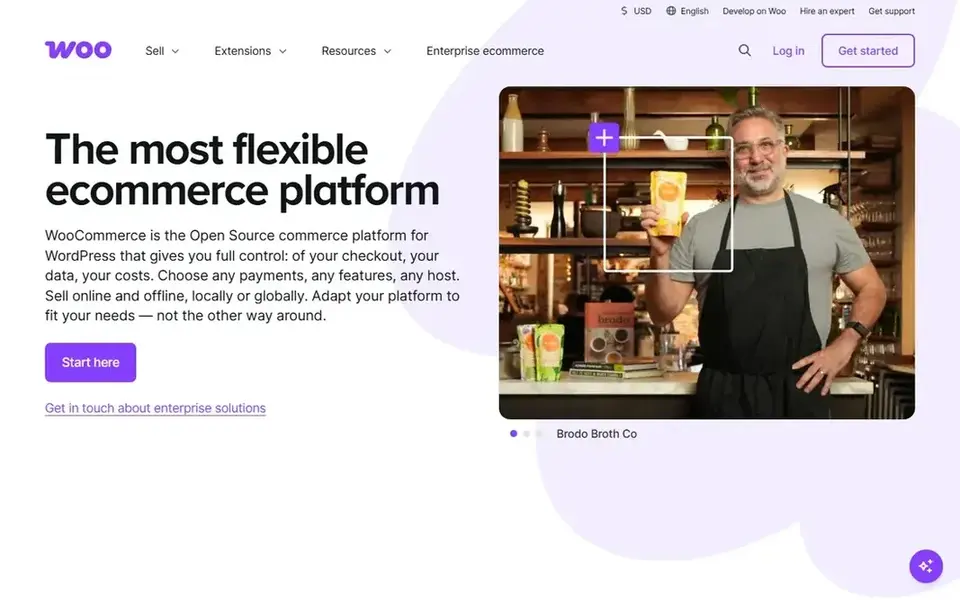
Think of WooCommerce for open-source commerce on WordPress. Choose WooCommerce when customization and ownership are priorities; choose a managed system when you would rather not run the infrastructure. Since it is open source, teams can host it themselves, extend it with plugins and keep control of their data and code.
That freedom brings responsibility: hosting, security updates and performance tuning fall to the merchant, and advanced capabilities frequently rely on external extensions. WooCommerce is the open-source e-commerce system that helps merchants and developers build companies for the long term. WooCommerce starts at: $29 per month. Free access: Not stated.
Drawbacks to consider: Needs hosting and maintenance.
- Made for merchants and developers
- Open-source and extensible
- Feature depth relies on extensions

Think of Shopify for quick AI-assisted store building. Pick Shopify when speed and an integrated toolkit matter more than owning every layer of the stack, and look at API-first systems when custom commerce logic is the core requirement.
Where it falls short: Less control over core code.
What users get: Handles plenty of parts of a business.
Shopify presents itself as an all-in-one commerce system, pairing storefront software with AI tools intended to help firms build and grow rapidly. It also handles tools for managing broader parts of a business beyond the storefront itself. Shopify pricing: $19 per month. Free plan details: Free trial.
- All-in-one commerce product
- AI tools for building and growth
- Complicated custom logic can be constrained
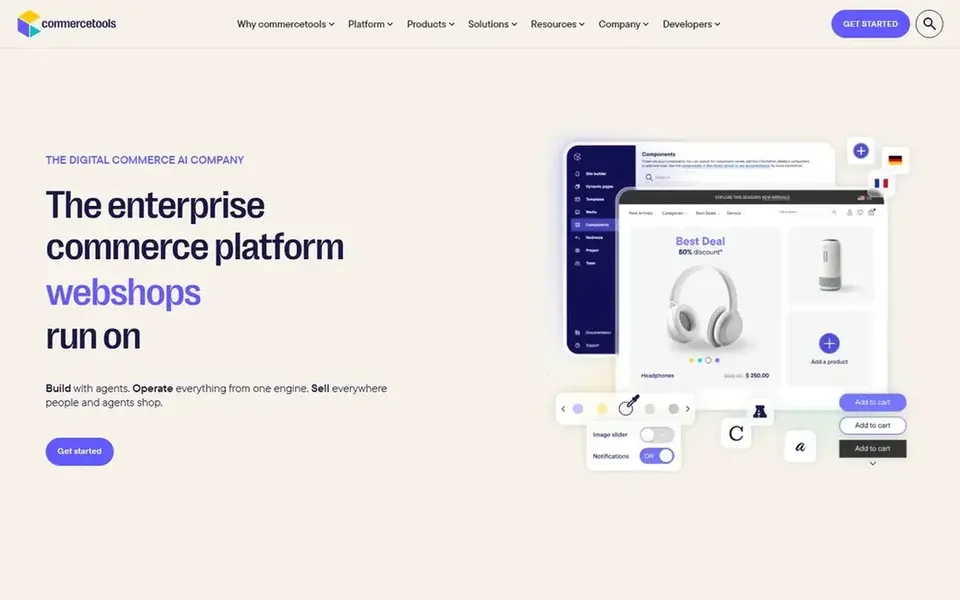
commercetools is aimed squarely at Composable enterprise commerce infrastructure. It targets enterprises and development teams building custom, composable commerce where the system supplies the commerce core and the frontend is built separately.
commercetools shows no starting price here, so confirm the cost on the vendor site. As for free access: Free trial.
Limits to weigh: No ready-made storefront included.
- Unified commerce engine
- Channels bundle in-store and agent-to-agent
- Developer-centric by design

Algolia is built with AI search and retrieval experiences in mind. Algolia describes itself as an AI search and retrieval product spanning agentic, generative and classic search, used to build easy-to-learn, adaptive and high-performing experiences. It is the search and discovery layer instead of a storefront, so it complements a commerce system by improving product finding, navigation and conversational experiences.
Honest limits: Not a full commerce platform.
Teams whose central pain is search relevance and discovery should evaluate it alongside their store system instead of as a standalone replacement. More specifically, Algolia does not replace catalog, checkout or order management, so it must be paired with a commerce backend. Pricing for Algolia is not stated here, so ask the vendor for current figures. Algolia includes a free tier.
- Adapts across plenty of experience types
- Unified AI search and retrieval
- Pairs with a separate store backend
Pre-purchase checklist
- Ask BigCommerce, commercetools and Algolia for a written quote, since no starting price is shown.
- Look at the free plan from Algolia closely: its caps decide whether it is usable for real work.
- Use real work to test the free trial from Shopify and commercetools, rather than a demo project.
- Read the limits listed for BigCommerce first: enterprise features add complexity.
- Read the plan comparison for Algolia carefully; key features often start on a higher tier.
- Look at the renewal terms for BigCommerce: auto-renewal, notice periods and price changes can matter more than the first-year price.
Frequently asked questions
What is the difference between an e-commerce system and an AI search tool like Algolia?
Algolia is meant to sit alongside a commerce backend instead of replace it. Plenty of teams combine both for better on-site and conversational search.
Is WooCommerce a solid fit for AI-driven stores?
The trade-off is that hosting, maintenance and integration work fall to your team. It fits companies that want ownership and are comfortable with WordPress.
How are the tools for AI e-commerce development companies software ordered?
BigCommerce sits first and Algolia last because the order follows typical fit for AI e-commerce development companies software, then price clarity and free access. It is a judgement call, so read each profile for fit and limits.
Do these tools publish their prices?
Not all of them. BigCommerce, commercetools and Algolia publish no starting price, so expect a quote request for those. The rest, WooCommerce included, show a starting price, though seats and billing terms still change the final cost.
When should a business choose a composable product like commercetools?
Composable commerce makes sense when you need custom frontends, several channels and full control over the architecture. It needs engineering resources since the storefront is built separately.
Is BigCommerce the right pick for everyone comparing AI e-commerce development companies software?
No single tool suits every team. BigCommerce comes first because it fits scalable multi-channel commerce operations, while WooCommerce suits open-source commerce on WordPress and Shopify suits fast AI-assisted store building. Match the tool to your own size, budget and workflow before deciding.
Sources
See where you really rank - block by block
ProMapRanker scans Google Maps across a grid of your service area. Simple monthly plans from $19, white-label on every plan.
Start freeBrowse all guides
← Best AI Copywriting Tool for Ecommerce Product Descriptions (2026)6 Best AI Productivity Tools for Enterprise in 2026 →
 best ai api marketplaces software
AI API Marketplaces Software: Best Picks of 2026
Shortlisting the best AI API marketplaces software? 5 products compared on cost, free access and ideal buyer. With pricing notes and limits. Facts only.
Read → amazon bedrock alternatives
Top Amazon Bedrock Alternatives for 2026, With Prices
Need Amazon Bedrock alternatives? We compare 5 tools on cost, free access and who each suits. Every pick gets a straight assessment. Refreshed for 2026.
Read → best ai production scheduling software
AI Production Scheduling Software in 2026: Top 5 Compared
Best AI production scheduling software in 2026: 5 tools with starting prices, free plans and limits. Honest caveats for every entry. Jump to the table.
Read → best edi software for small businesses
Best EDI Software for Small Businesses in 2026
We compared the best EDI software for small businesses on retailer connections, onboarding, pricing and support to help suppliers trade without EDI expertise.
Read → ga4 alternatives
Best GA4 Alternatives in 2026
Looking for ga4 alternatives? We compare 10 analytics tools, from Plausible to Matomo, on privacy, pricing, self-hosting, traffic and product features in 2026.
Read → netsuite alternatives
Best NetSuite Alternatives in 2026
Best NetSuite alternatives compared for 2026, covering cloud ERP pricing, finance, inventory, manufacturing and the right fit for small and mid size firms.
Read →More in Ecommerce & Retail · All guides A to Z by date · Latest guides