 ProMapRanker
Best EDI Software for Small Businesses in 2026


Retail suppliers wanting full service · Pricing starts at: See website
Key takeaways
- EDI software for small business use should hide X12 codes behind plain language, because most small suppliers do not have an EDI specialist.
- The first question is always which trading partners you must connect to, since a tool without your retailer map will cost time, not save it.
- Web EDI suits a supplier with a few partners and low volume, while integrated EDI suits a supplier whose orders already live in an ERP or store system.
- Published starting prices are only a starting point, because most EDI pricing grows with trading partners and document volume.
- Chargebacks for late or wrong documents are a real cost, so compliance testing and support matter as much as the monthly fee.
Quick comparison
| Pick | Great for | Pricing starts at | Free tier | |
|---|---|---|---|---|
| SPS Commerce Fulfillment | Retail suppliers wanting full service | See website | No | Visit |
 TrueCommerce | Small businesses with an ERP | See website | No | Visit |
 Orderful | Fast API first onboarding | $189 per month | No | Visit |
 Cin7 Omni | Inventory plus EDI in one tool | $349 per month | Free trial | Visit |
 DiCentral | First time EDI users | See website | No | Visit |
 EDI2XML | Low volume suppliers | $99 per month | No | Visit |
 Stedi | Developer friendly pay as you go | Free | Yes | Visit |
 eZCom Software | Ease of implementation | See website | No | Visit |
 Celigo | Self service EDI plus app integration | See website | Yes | Visit |
 Cleo | EDI, API and file transfer in one platform | See website | No | Visit |
The best EDI software for small businesses
Electronic data interchange, or EDI, is how retailers, distributors and suppliers exchange purchase orders, invoices, shipping notices and other documents in a structured format, usually X12. For a small business, the goal is simple: accept a retail order without retyping it, ship correctly, invoice correctly, and avoid chargebacks. The tools below serve that goal in different ways, from fully managed services to developer platforms.
SPS Commerce Fulfillment suits a small supplier that wants a vendor to run EDI, rather than learning it. Its network covers tens of thousands of retail trading partners, including large chains, and its team helps with partner setup, testing and compliance. Integrations with common accounting and store systems reduce retyping, which is where most small supplier errors start.
The cost is the catch. Pricing is quoted, scales with partners and volume, and can feel high for a supplier with only one retail partner. For a supplier with several retailers and a real chargeback risk, the full service model often pays for itself in avoided errors. For a single partner with low volume, a cheaper web EDI tool below may be wiser.
- One of the largest retail partner networks
- Full service model with compliance help
- Strong NetSuite, QuickBooks and Shopify links
- Pricing is quoted and can grow with partners
- Cost can feel high for a single partner supplier

TrueCommerce fits small businesses that already run an ERP, a storefront or a marketplace and want EDI beside those systems. Its map library covers a very large number of partners, and its Transaction Manager gives staff a web view of documents without needing to read raw X12. Integrations with ERPs and accounting tools help orders flow into fulfilment without manual entry.
Pricing is quoted per customer, with transaction fees built into many deals, so a small team should get a written quote for its own partners and volume. Some users also find the interface click heavy for routine tasks. For an ERP centred supplier, TrueCommerce is a strong, well supported choice, especially when partner coverage matters more than the lowest headline price.
- Very large pre built partner map library
- ERP, storefront and marketplace integrations
- Web and integrated options
- Pricing is quoted
- Interface can feel click heavy in places
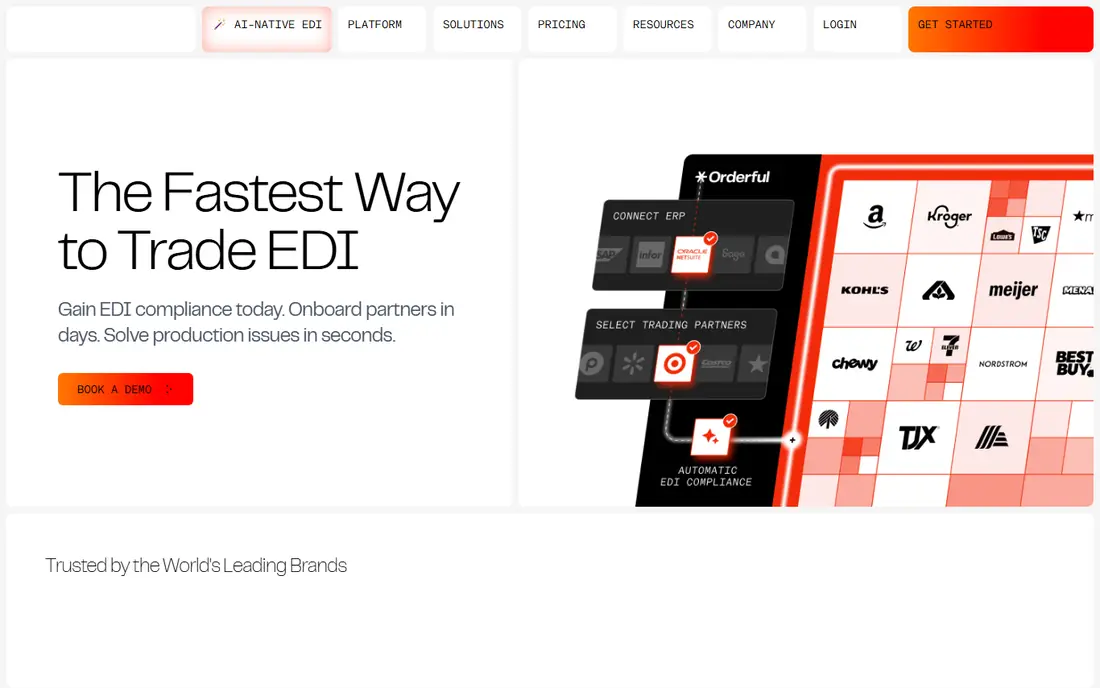
Orderful appeals to tech forward small businesses that want clear pricing and fast partner onboarding. Its published model starts web EDI at 189 dollars a month per trading partner, with integrated and managed options above that, which makes budgeting easier than with quoted rivals. An API first design suits teams whose orders already live in an ERP, warehouse system or custom app.
Per partner pricing cuts both ways. One partner is affordable, but ten partners cost ten times the base, so a supplier with many retailers should compare the total with a full service quote. Non technical teams may also need managed help. For a growing brand moving from direct sales to wholesale, Orderful is a modern, transparent option worth a trial.
- Published per partner pricing
- Fast onboarding claims
- API first design for modern systems
- Per partner price adds up with many partners
- Less suited to non technical teams without help
Cin7 Omni suits product businesses that need inventory control and EDI together, rather than EDI alone. Stock, orders, warehouses and channels sit in one system, so an EDI purchase order can reserve stock, trigger picking and feed an invoice without a separate integration project. That single flow reduces the retyping and stock errors that cause chargebacks.
The entry price is high for a supplier that only needs EDI, and setting up inventory properly takes time. A business that already needs inventory software will see the value quickly, while a business with a simple stock list may prefer a cheaper EDI only tool. Choose Cin7 when inventory and EDI are both real needs.
- Inventory, orders and EDI in one system
- Product business focus
- Warehouse and channel tools
- Entry price is high if EDI is the only need
- Learning curve for full inventory setup
DiCentral fits first time EDI users with one or two retail partners who want a managed service to handle compliance. Its team guides a supplier through partner requirements, testing and go live, which matters when a retailer chargeback can follow a single wrong document. Retail supplier compliance is the centre of the service, not an add on.
Pricing is quoted, so a small supplier should ask for a written quote covering its partners and expected document volume. The service is less suited to a developer led team that wants to own its own maps and APIs. For a new supplier facing its first Walmart, Target or similar requirement, DiCentral offers a calm, guided start.
- Managed service focus for retail compliance
- Guided onboarding for new suppliers
- Strong retail partner experience
- Pricing is quoted
- Smaller public pricing detail than Orderful
EDI2XML is built for low volume suppliers starting out with EDI, and its starting price near 99 dollars a month reflects that focus. A managed service handles the EDI translation and partner connection, so a small team does not need to learn X12 to trade. That low entry point makes it a fair first step for a supplier testing a retail channel.
Complex needs, such as deep ERP integration or many document types, may outgrow it sooner than a larger platform. A supplier that expects rapid growth should check upgrade paths before committing. For a low volume start, EDI2XML keeps the cost and the learning curve in proportion to the business.
- Low cost managed service built for small businesses
- Simple pricing for low volume use
- Guided setup
- Less depth for complex integrated EDI
- Feature set is narrower than large platforms
Stedi suits small businesses with a developer who wants modern, API based EDI without a large monthly commitment. A free plan lets a team test the platform, and pay as you go pricing means low volume months cost little. Developer tools, guides and a cloud native design make it a natural fit for a software led supplier or a small team building its own order system.
A non technical team will struggle without that developer, since Stedi offers less managed hand holding than SPS Commerce or DiCentral. Support and onboarding are more self service. For a developer led small business, Stedi is a low cost, flexible way to add EDI, provided someone owns the integration.
- Free plan to start
- Pay as you go transaction pricing
- Modern API and developer tools
- Needs a developer on staff
- Less hand holding than a managed service
eZCom Software EDI earns its place through user reviews that praise ease of implementation and support, especially compared with larger enterprise platforms. For a small business without EDI experience, a smoother implementation and a responsive support team can matter more than a long feature list. Its platform covers common retail and wholesale partners, with document handling that staff can learn without X12 training.
Pricing is quoted, and onboarding can take longer when many partners or custom workflows are involved, which reviewers also note. A team should agree a timeline and a partner list in writing before signing. For a small supplier that values a guided, human implementation, eZCom is a strong shortlist option.
- High user ratings for ease of use
- Implementation help praised in reviews
- Broad trading partner support
- Pricing is quoted
- Onboarding can lengthen with many partners or custom workflows
Celigo suits teams that want to own their EDI maps and pair EDI with other app integrations, such as connecting a store, an ERP and a warehouse in one platform. Its B2B Manager handles EDI inside that wider automation system, so a team can build and maintain partner connections without a separate EDI only tool. A free plan with limits, after a trial, lets a team test the approach.
Pricing is quoted by trading partners and document types, so the total needs a written quote. Owning maps also needs technical confidence, and a team without it may prefer a managed service. For a technically comfortable small business already automating apps, Celigo offers EDI as part of a larger integration story.
- B2B Manager for self service EDI
- Pairs EDI with wider app integration
- Free plan with limits after trial
- Pricing is quoted by partners and document types
- Needs technical confidence to own maps
Cleo fits suppliers that need more than EDI alone, such as API connections and secure file transfer beside traditional X12 documents. Its platform lets a team choose self service, managed or blended support by partner, which helps a growing supplier that wants control in some areas and help in others. That flexibility is useful when a supplier trades with both modern API partners and classic EDI retailers.
Breadth is also the drawback. A very small supplier with one EDI partner may find Cleo more platform than it needs, and pricing is quoted. For a supplier planning to consolidate several integration types, or growing from a few partners toward many, Cleo is a scalable choice that can grow without a platform change.
- One platform for EDI, API and managed file transfer
- Self service, managed or blended models
- Strong for growing suppliers
- Pricing is quoted
- Platform breadth can overwhelm a very small team
How we picked these
We compared official feature pages, pricing pages and recent EDI comparisons for tools that serve small business suppliers, not just large enterprise gateways. We kept only tools that are live in October 2026 and that support retail or wholesale EDI, partner onboarding and document compliance. Prices shown are starting prices from vendor pages or recent comparisons of those pages, and where pricing is quoted we wrote See website rather than guessing.
Choosing EDI without a costly false start
EDI mistakes show up as chargebacks, delayed payments and strained retailer relationships, so the choice deserves a careful check before signing. Use the steps below to avoid the most common small business pitfalls.
List partners and documents first
Write down every trading partner, every document type you must exchange, and your monthly volume per partner. A tool that lacks one partner map, or charges heavily per partner, can turn a cheap headline price into an expensive total. Get that list into the quote.
Decide between web EDI, integrated EDI and managed service
Web EDI suits low volume and a few partners, because staff enter and view documents in a browser. Integrated EDI suits higher volume and ERP use, because orders flow automatically. A managed service suits teams without EDI skill, because the vendor handles maps and compliance. Pick the model that fits your team, not the cheapest label.
Test compliance before go live
Ask how partner testing works, what a failed test costs in time, and who fixes a rejected document. A vendor that tests thoroughly before go live will save chargebacks later. Keep a test order, a test invoice and a test shipping notice on file, so staff can compare a live document when something looks wrong.
Get the total price in writing
Ask for a quote that covers partners, document types, transaction volume, onboarding and support. Many EDI deals grow with partners and volume, so a starting price alone is not a budget. Compare at least two written quotes on the same partner list before choosing.
Frequently asked questions
What is the best EDI software for a small business?
It depends on partners and team skill. SPS Commerce and DiCentral suit teams that want a managed service, TrueCommerce suits ERP users, Orderful suits tech forward teams that want published pricing, and EDI2XML suits low volume starters. Start with your partner list, then shortlist by model.
What is the difference between web EDI and integrated EDI?
Web EDI lets staff view and enter documents in a browser, which suits low volume use. Integrated EDI connects EDI directly to an ERP, store or warehouse system, so orders and invoices flow without retyping. Integrated EDI costs more to set up, but saves time and errors at volume.
How much does EDI software cost for a small business?
Entry points range from free or low cost developer plans to about 99 dollars a month for low volume managed services, and several hundred dollars a month per partner for published API plans. Most enterprise EDI pricing is quoted and grows with partners and volume, so get a written quote.
Do I need EDI if I only sell to one retailer?
Yes, if that retailer requires it. Many large retailers will not accept orders by email or portal alone for ongoing supply, and they may charge back for non compliant documents. A low cost web EDI tool is often enough for a single partner with low volume.
What are EDI chargebacks?
Chargebacks are fees a retailer charges when a supplier misses a requirement, such as late shipping notices, wrong labels or incorrect invoices. Good EDI software and thorough partner testing reduce chargebacks, but staff still need to ship and invoice on time.
Can a small business set up EDI without an IT team?
Yes, with a managed or web EDI service. Vendors such as SPS Commerce, DiCentral and eZCom guide onboarding and handle maps, so staff can work in plain language. Developer platforms such as Stedi need technical staff, and should not be chosen for a non technical team.
Sources
See where you really rank - block by block
ProMapRanker scans Google Maps across a grid of your service area. Simple monthly plans from $19, white-label on every plan.
Start freeKeep reading
 zscaler alternatives
Best Zscaler Alternatives in 2026
Looking for zscaler alternatives? We compare 9 SASE and zero trust platforms on architecture, data protection, pricing, and fit for your network and team.
Read → zapier alternatives free
Best Zapier Alternatives Free in 2026
Nine automation tools for zapier alternatives free in 2026, all with genuinely free tiers, plus free plan limits, starting prices and upgrade paths explained.
Read → which platform is best for online reputation
Which Platform Is Best for Online Reputation in 2026
Wondering which platform is best for online reputation? We compare 8 review, listing, and response tools for small and multi-location businesses and agencies.
Read →