 ProMapRanker
Best AEO Tool for AI Product in 2026

Key takeaways
- Otterly.AI gives the lowest-cost entry to AEO tracking, while Profound and Scrunch suit larger AI product teams that need depth and action.
- Peec AI, AthenaHQ, and Semrush suit teams that want prompt-level detail, credit-based flexibility, or AEO inside an existing SEO suite.
- Goodie AI and Ahrefs Brand Radar suit high-volume tracking and teams that want AI visibility tied to search data.
- Prompt choice matters more than tool choice at first: track the questions buyers actually ask, not generic brand terms alone.
Quick comparison
| Pick | Great for | Pricing starts at | Free tier | |
|---|---|---|---|---|
 Profound | Enterprise AI visibility | See website | Free trial (7 days) | Visit |
 Peec AI | Prompt-level SaaS tracking | See website | No | Visit |
 Otterly.AI | Lowest-cost AEO entry | $29 per month | Free trial | Visit |
 Scrunch AI | Turning gaps into content | $250 per month | No | Visit |
 Goodie AI | High-volume prompt coverage | $495 per month | No | Visit |
 AthenaHQ | Credit-based AI tracking | $295 per month | Yes | Visit |
 Semrush AI Visibility Toolkit | SEO teams adding AEO | $99 per month | Free trial | Visit |
 Ahrefs Brand Radar | Search-backed AI tracking | $199 per month | No | Visit |
 HubSpot AEO | HubSpot CRM teams | $50 per month | No | Visit |
The best aeo tool for ai product
Answer engine optimisation, or AEO, tracks how AI assistants answer questions about your product, and whether they mention or cite you. For an AI product company, this matters twice over: buyers ask ChatGPT, Gemini, and Perplexity which tool to use, and those answers shape shortlists before a human ever visits your site. The tools below track prompts, mentions, citations, and sentiment across AI answers.
Profound is the best-known AEO platform for larger brands. It tracks prompts across ChatGPT, Gemini, Google AI Overviews, and other engines, and its enterprise tiers cover up to nine engines with agent features that suggest content fixes. Agent analytics also help teams see AI referral traffic beside mention data.
The trade-off in 2026 is access. Profound withdrew its low-cost starter plans, so new users start with a free trial and then move to a custom enterprise package. Profound suits AI product teams with budget and a dedicated owner, rather than a solo founder looking for a cheap tracker.
- Broad engine coverage on enterprise tiers
- Agent features for acting on gaps
- Detailed analytics
- Self-serve starter plans were withdrawn in 2026
- Enterprise pricing needs a sales process
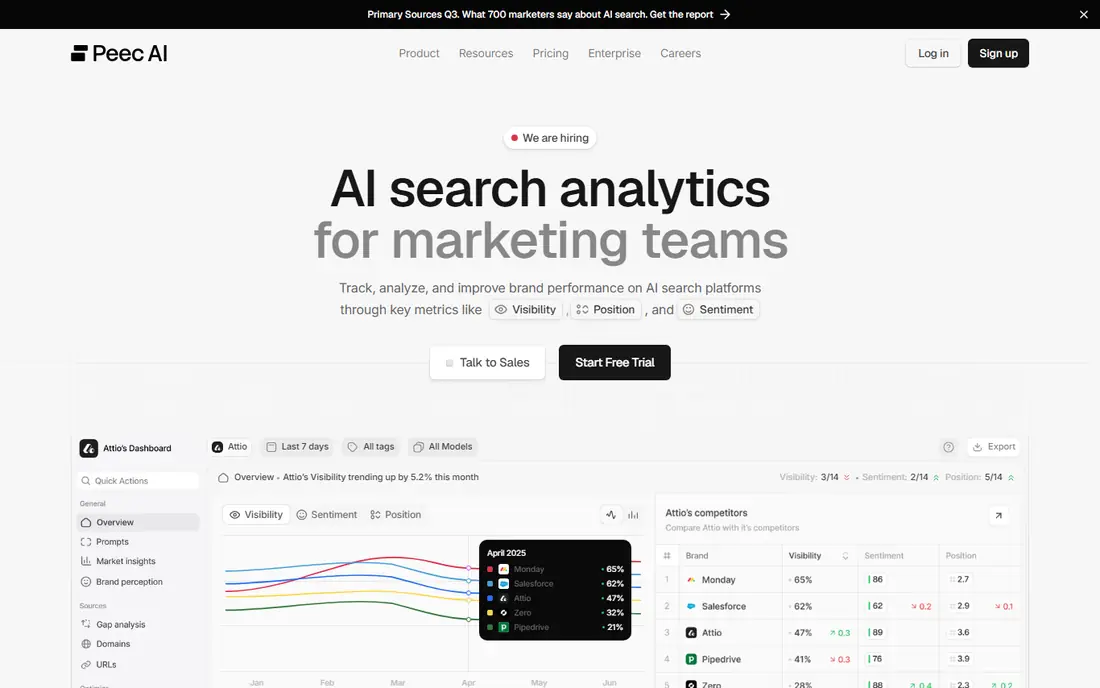
Peec AI suits B2B and SaaS teams that want prompt-level detail. You choose the questions buyers ask, and Peec tracks whether your brand is mentioned, cited, and viewed positively across a set of AI engines. Daily runs help teams spot changes after a launch, a press story, or a competitor move.
Pricing is less public than Otterly.AI, with recent listings showing euro pricing around 85 euros per month for entry plans, so confirm the current rate before budgeting. Peec fits SaaS teams that want clear daily tracking and are comfortable with a mid-price subscription.
- Daily prompt tracking
- Sentiment and position detail
- Multi-market options on higher tiers
- Public pricing is limited
- Entry plans cover a small set of engines
Otterly.AI is the cheapest credible entry point for AEO tracking. Entry plans cover ChatGPT, Perplexity, Gemini, Copilot, and AI Overviews in recent listings, with prompt limits that suit a small product team tracking its core questions. The interface is simple enough for a founder to set up without an agency.
Prompt limits are the main constraint, since a growing product will soon want more questions, competitors, and regions. Otterly.AI suits AI startups testing AEO for the first time, before graduating to a deeper platform such as Profound or Scrunch.
- Lowest entry price here
- Covers major engines at entry
- Simple prompt tracking
- Prompt limits are tight on entry plans
- Extra engines cost more
Scrunch AI goes beyond tracking: it helps teams turn citation gaps into shipped content. When an AI answer cites a competitor instead of you, Scrunch points to the pages and content changes that could close that gap. Persona and journey views help AI product teams see how different buyer types meet the brand in AI answers.
The entry price is high for a small team, and the value depends on acting on the recommendations. Scrunch suits AI product companies with a content team that can publish regularly, not teams that only want a monthly report.
- Combines tracking with content actions
- Multi-engine coverage
- Persona and journey views
- High entry price
- Needs a content owner to act on findings
Goodie AI suits teams that need to track many prompts across many models. High-volume coverage helps larger AI products that serve several use cases, since each use case brings its own set of buyer questions. Citation and share-of-voice detail helps managers compare their brand with rivals across engines.
The price puts it beyond most early-stage teams. Goodie fits funded AI products and agencies that manage AEO for several clients and need volume that cheaper tools cannot cover.
- High prompt volume
- Broad model coverage
- Revenue and citation detail on higher tiers
- High entry price
- Overkill for a single-product startup
AthenaHQ offers a free Essential tier with a limited credit allowance, which lets a team test AEO tracking before paying. Paid plans use credits, where one credit covers one AI response, and cover many models including ChatGPT, Gemini, Perplexity, Claude, and Google AI surfaces. Analytics links to search and shop data on higher plans, which helps product teams connect AI visibility to traffic.
Credit-based pricing needs careful planning, since prompt counts and run frequency decide monthly use. AthenaHQ suits teams that want to test first and scale prompt volume in a controlled way.
- Free Essential tier for testing
- Credit model suits variable use
- Broad model coverage
- Credit maths needs care
- Starter price is high for small teams
Semrush AI Visibility Toolkit adds AEO tracking to the Semrush SEO suite, which suits teams already paying for Semrush. It tracks prompts across ChatGPT, Google AI, Gemini, and Perplexity, with a large prompt database and country-level data. Keeping SEO and AEO in one place helps teams compare classic search rankings with AI answer visibility.
The toolkit costs extra per domain, so multi-product teams should count domains before comparing prices. Semrush suits SEO-led AI product teams that want one vendor for search and AI visibility, rather than a standalone AEO specialist.
- AEO beside SEO in one suite
- Large prompt database
- Wide country coverage
- Price is per domain on top of a Semrush plan
- Prompt limits apply
Ahrefs Brand Radar layers AI visibility tracking onto Ahrefs search data. Prompts are grounded in real query data, and citation detail links AI mentions to backlinks and pages, which helps SEO teams act on findings. That search grounding is a real advantage over tools that invent prompt lists from scratch.
Pricing is per AI index on top of a base Ahrefs subscription, so the total cost is higher than the headline figure. Ahrefs suits teams already using Ahrefs for SEO who want AI tracking with search context, rather than buyers starting from zero.
- Ties AI prompts to real search data
- Strong backlink and citation context
- Trusted SEO brand
- Price is per index on top of a base Ahrefs plan
- Costs add up for many brands
HubSpot AEO suits teams already running marketing in HubSpot. It tracks AI visibility for ChatGPT, Gemini, and Perplexity, and links findings to CRM and content tools, so a marketer can move from a visibility gap to a content task without a second system. Entry pricing is low beside enterprise AEO platforms.
Engine coverage is narrower than Profound or Scrunch, and entry prompt counts are small. HubSpot AEO fits small AI product teams inside HubSpot that want a first AEO view, while larger teams will outgrow it and move to a specialist.
- AEO tied to CRM and marketing data
- Low entry price
- Simple setup for HubSpot users
- Fewer engines than specialists
- Prompt set is small on entry plans
How we picked these
We compared vendor pricing pages and current October 2026 AEO comparisons, and required each tool to track brand mentions or citations across AI answer engines. We covered low-cost entry, enterprise depth, credit-based plans, and SEO-suite add-ons, so AI product teams can match price to need. Where vendors withdrew plans or gated pricing in 2026, we show See website or a trial rather than an outdated price.
What to check before you choose
Start with prompt selection. List the questions buyers actually ask when choosing an AI product like yours, including comparison questions, use-case questions, and competitor questions. A tool tracking the wrong prompts will report good numbers while missing the answers that shape buying decisions.
Next, check engine coverage on the plan you will buy, not the headline plan. Some tools cover fewer engines on entry tiers, and extra engines cost more. Also check how often prompts run, whether citations are shown at page level, and whether reports can be shared with a content or product team that will act on them.
AEO for an AI product specifically
AI product buyers often ask assistants for a direct recommendation, so track recommendation prompts, not just brand mentions. Check whether the answer names you, cites your pages, and describes your product accurately. When an answer is wrong, fix the source pages and help docs first, since AI answers draw on public content you can improve.
Frequently asked questions
What is the best AEO tool for an AI product?
Otterly.AI suits startups testing AEO at low cost, Profound suits larger teams needing depth, and Scrunch suits teams that will act on content gaps. The best pick depends on budget, prompt volume, and whether you have a content owner.
What is AEO for AI products?
AEO, or answer engine optimisation, tracks and improves how AI assistants mention and cite your product in answers. For AI products, it matters because buyers increasingly ask assistants which tool to choose before visiting vendor sites.
How is AEO different from SEO?
SEO tracks rankings in classic search results, while AEO tracks mentions, citations, and sentiment inside AI-generated answers. Both need good public content, but AEO adds prompt tracking across ChatGPT, Gemini, Perplexity, and Google AI surfaces.
How much does an AEO tool cost?
Entry prices range from 29 dollars per month for Otterly.AI to 495 dollars per month for Goodie AI, with enterprise tools priced by quote. Add-on tools such as Semrush and Ahrefs charge extra per domain or index on top of a base plan.
Which AI engines should an AEO tool track?
At minimum, track ChatGPT, Gemini, Perplexity, and Google AI Overviews, since those cover most buyer research. Add Copilot and Claude if your buyers use them, and check that your plan includes those engines rather than only the headline set.
Can a small AI startup benefit from AEO tools?
Yes, a low-cost tool such as Otterly.AI or a free tier such as AthenaHQ can show whether AI answers mention your product at all. Start with a small prompt set, fix the source content behind wrong answers, and expand only when tracking proves useful.
Sources
See where you really rank - block by block
ProMapRanker scans Google Maps across a grid of your service area. Simple monthly plans from $19, white-label on every plan.
Start freeKeep reading
 wpforms alternatives
Best WPForms Alternatives in 2026
We compare 9 wpforms alternatives for WordPress forms, with free and paid options, current pricing notes, and honest limits for small business sites in 2026.
Read → windows task scheduler alternatives
Best Windows Task Scheduler Alternatives in 2026
Looking for Windows Task Scheduler alternatives? We compare 9 schedulers for Windows and cross-platform work, from free tools to enterprise automation.
Read → which ai video service is best
Which AI Video Service Is Best in 2026
which ai video service is best? We compare 10 legitimate AI video services on price, avatars, editing and output quality to help you pick the right tool.
Read →