 ProMapRanker
Best Advocacy Software in 2026

Key takeaways
- Quorum and FiscalNote suit larger public affairs teams that need tracking, stakeholder records and advocacy in one place.
- VoterVoice, Muster and Action Network focus more directly on turning supporters into messages to lawmakers.
- NationBuilder is the most affordable starting point here, with published pricing from $29 per month.
- Most enterprise advocacy tools still price by quote, so budget for a sales conversation and a demo before you commit.
- The best platform for advocacy depends on whether you need policy tracking, grassroots action, or both in one system.
Quick comparison
| Pick | Great for | Pricing starts at | Free tier | |
|---|---|---|---|---|
 Quorum | Large public affairs teams | See website | No | Visit |
 VoterVoice | Associations running grassroots campaigns | See website | No | Visit |
 FiscalNote PolicyNote | Policy tracking with analyst context | See website | No | Visit |
 NationBuilder | Small campaigns and community building | $29 per month | No | Visit |
 Muster | Nonprofits and associations | See website | No | Visit |
 Action Network | Movement groups on a tight budget | See website | Yes | Visit |
 New/Mode | Multi-channel advocacy campaigns | $149 per month | No | Visit |
 Bonterra EveryAction | Nonprofits combining fundraising and advocacy | See website | No | Visit |
The best advocacy software
Advocacy software helps an organisation turn supporters into action, and helps staff keep track of the bills, officials and messages behind that action. We compared official feature pages, pricing pages and public documentation for the tools below, and we focused on fit for US-based groups.
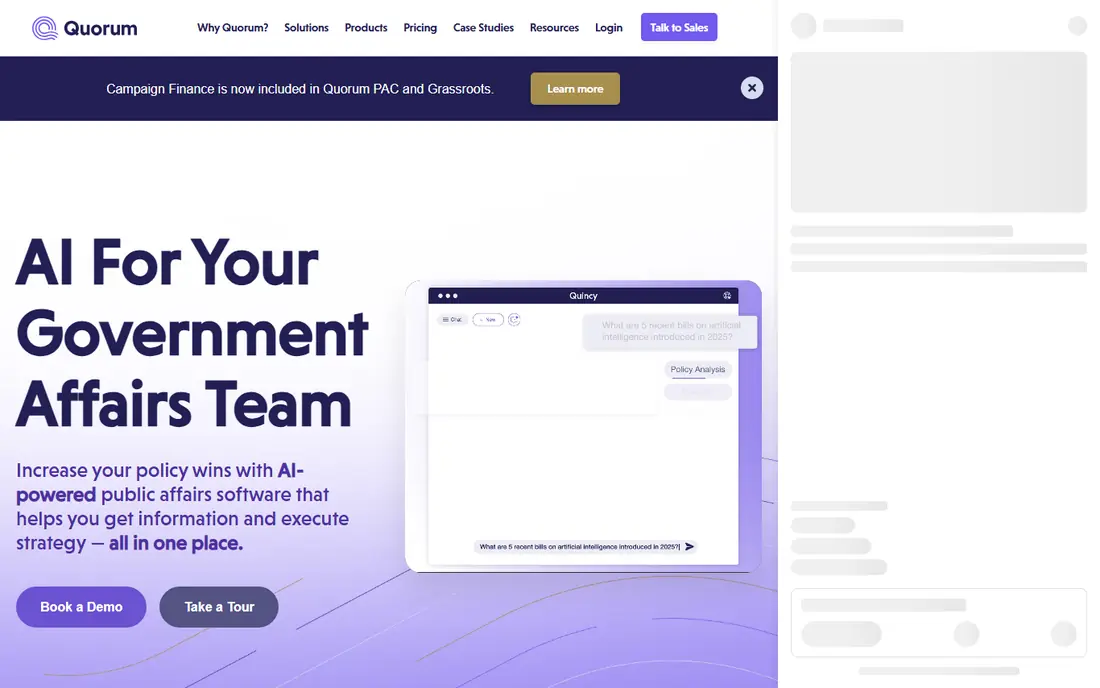
Quorum is the broadest platform on this list, and that breadth is the reason larger teams pick it. It brings legislative tracking, contact management, grassroots advocacy and PAC tools together, so staff do not have to move data between separate systems to prepare a briefing. Its AI assistant helps summarise legislation and surface relevant activity, which matters when a team follows dozens of bills at once.
The trade-off is cost and complexity. Quorum does not publish prices, and its separate products for federal, state, local, grassroots and PAC work mean the final quote depends on coverage and team size. Small nonprofits may find the setup heavy for a single campaign. For a public affairs team that reports to executives and manages many stakeholders, though, the combined view is hard to match.
- Combines tracking, stakeholder records and advocacy
- Covers federal, state and EU policy
- Reporting built for leadership updates
- Pricing is quote-only
- Likely too costly for small groups
VoterVoice, now part of FiscalNote, is built around one job: getting the right message to the right lawmaker. Its address matching connects each supporter with their local, state and federal officials, which avoids the common failure of advocacy emails landing with the wrong office. Supporters can sign petitions, send messages and follow campaigns from an action centre the organisation controls.
VoterVoice also supports legislator scorecards and election-related work, which suits associations that need to show members how officials voted. It is less of a standalone bill-tracking research tool than Quorum or PolicyNote, so teams that need deep tracking often pair it with another product. For a membership group whose main goal is mobilisation, that focus is a strength rather than a gap.
- Strong address matching to the right lawmakers
- Action centres, petitions and scorecards in one place
- Built for associations and their members
- Pricing is quote-only
- Less of a full policy tracker than Quorum
PolicyNote is FiscalNote's policy intelligence platform, formed after the company migrated customers from its legacy platform in early 2026. It tracks legislation and regulation, adds reporting from CQ and Roll Call, and uses AI tools to search, summarise and analyse policy documents. For a government affairs team, that combination of tracking plus context saves time spent reading long bills and hearing transcripts.
Buyers should note the split in the FiscalNote family. PolicyNote covers intelligence, while grassroots advocacy runs through VoterVoice, so ask for a clear demo of how the two share contacts, campaigns and reporting data. Pricing is also quote-only and varies with jurisdictions and seats. Teams that mainly need to understand and follow policy, rather than run supporter campaigns, will get the most from PolicyNote on its own.
- Federal and state tracking with news and analysis
- AI search and summaries for long documents
- API access for compatible systems
- Pricing is quote-only
- Grassroots action sits in the separate VoterVoice product
NationBuilder is the pick for a small campaign, local cause or community group that needs one system rather than a stack of tools. It combines a website builder, a supporter database, fundraising pages, email and texting, so a new group can launch, collect supporters and ask them to act without hiring a developer. Its published starting price of $29 per month makes budgeting far easier than with quote-only rivals.
The limit is depth. NationBuilder does not match the specialist tracking of Quorum or the dedicated advocacy workflows of VoterVoice, and larger lists push the price up through higher tiers. Still, for a group whose first problem is building a supporter base and keeping it organised, it is a practical and affordable place to start, with room to grow into higher plans.
- Published pricing from $29 per month
- Website, CRM, fundraising and email in one system
- Approachable for small teams
- Advocacy features are narrower than specialist tools
- Costs rise with contacts and features
Muster is a digital advocacy platform built for nonprofits, associations and agencies that want grassroots campaigns without buying a full public affairs suite. Organisations can create action centres, send action alerts by email and text, track advocate engagement and report on campaign results. Its modular approach lets a group buy the pieces it needs, which helps teams that already have a CRM or email tool and only need the advocacy layer.
Reviewers often praise Muster for ease of use and reporting, and its pricing is described as competitive for grassroots work, even though exact prices are not published. The honest catch is scale: Muster is a smaller vendor, so very large enterprises with complex global tracking needs may still prefer Quorum or FiscalNote. For most nonprofits, Muster hits a good balance of focus, usability and value.
- Flexible, modular buying
- Action alerts, CRM and analytics in one platform
- Positive reputation for ease of use
- Pricing is quote-only
- Smaller vendor than FiscalNote or Quorum
Action Network is the budget-friendly option for unions, movement groups and small nonprofits. It offers petitions, letter campaigns, event organising and email tools, with a free tier that lets a small group start without a contract or a sales call. That low barrier matters for volunteer-led campaigns that need to move quickly on a breaking issue.
Paid plans add more capacity, customisation and support, and larger organisations should check the limits of the free tier before relying on it for a national campaign. Action Network is not a bill-tracking research platform, so teams that need legislative intelligence will need a second tool. For groups whose priority is mobilising people rather than monitoring bills, it is a strong and low-risk choice.
- Free tier for small groups
- Petitions, events and email actions in one tool
- Widely used by movement organisations
- Advanced features sit on paid plans
- Less policy tracking than enterprise tools
New/Mode stands out for campaigns that want more than email. Its tools cover email, phone calls, SMS, fax, social media actions and letters to the editor, so supporters can reach decision makers through the channel most likely to get attention. It works in the US and several other countries, which suits international organisations and cross-border campaigns.
The published starting price of $149 per month puts it above NationBuilder and Action Network, so very small groups should weigh whether they will actually use the extra channels. A campaign that only sends emails will not get its money's worth. A campaign that plans coordinated calling days, text drives and social actions, however, will find the multi-channel toolkit genuinely useful.
- Email, calling, SMS, fax and social actions
- Works across the US, UK, EU, Australia and Canada
- Published starting price
- Starting price is high for tiny groups
- Setup takes care to use every channel well
Bonterra EveryAction suits nonprofits that already raise money online and want advocacy on the same supporter record. Instead of keeping donors in one system and advocates in another, staff can see giving, email engagement and advocacy actions together, which makes segmentation and follow-up far simpler. It covers email campaigns, online actions and reporting alongside its fundraising tools.
The catch is that EveryAction makes most sense as part of the wider Bonterra suite. A group that only needs advocacy may find a specialist tool simpler and cheaper, and pricing is quote-only, so the full cost only emerges in a demo. For a nonprofit that wants one home for fundraising and advocacy, though, the shared data is a real advantage.
- Fundraising, email and advocacy in one nonprofit platform
- Supporter records shared across campaigns
- Built for nonprofit workflows
- Pricing is quote-only
- Best value only for groups that use the wider suite
How we picked these
We compared official product pages, pricing pages and public documentation for advocacy tools that are live in October 2026, and we checked whether each product genuinely fits grassroots advocacy, policy tracking, or both. We favoured tools with a clear US presence, a working public site and a defined advocacy use, and we wrote "See website" wherever a vendor prices by quote rather than repeating a third-party estimate. We did not claim hands-on testing, and we treated published prices as the starting point, not the final quote.
What to check before you buy
Start with the job, not the feature list. If your team tracks bills across many states, a tracking-led tool such as Quorum or PolicyNote should lead the shortlist. If your goal is to mobilise members, start with VoterVoice, Muster or Action Network and judge them on action-centre design, address matching and reporting.
Ask every vendor the same practical questions. How are supporters matched to lawmakers, and what happens when an address is incomplete? What does reporting show after a campaign, beyond a raw message count? How are email deliverability, texting consent and data privacy handled? What is the total cost at your supporter count, including texting fees and any per-message charges? A short paid pilot on one live campaign will reveal more than a long demo, and it gives your team a real report to show leadership before signing a longer contract.
Frequently asked questions
What is the best platform for advocacy?
The best platform for advocacy depends on your goal. Quorum and FiscalNote PolicyNote lead for policy tracking, VoterVoice and Muster lead for grassroots mobilisation, and NationBuilder leads for small groups that need a website and CRM as well. Match the tool to the job, then test it on one real campaign.
How much does advocacy software cost?
Costs range from a free tier on Action Network and $29 per month for NationBuilder to quote-only enterprise pricing for Quorum, VoterVoice, PolicyNote, Muster and EveryAction. Texting fees, supporter counts and extra jurisdictions can add to the bill, so ask for a total quote at your expected volume.
Do I need policy tracking and advocacy in one tool?
Not always. Teams that follow many bills benefit from a combined tool, because tracking and action share the same data. Smaller groups can run advocacy alone and follow bills through free legislative sites, then add tracking later when the workload grows.
Can small nonprofits use advocacy software?
Yes. Action Network offers a free tier, NationBuilder starts at $29 per month, and Muster sells modular plans for nonprofits. Start small, prove one campaign works, and only upgrade when supporter numbers or reporting needs demand it.
Is advocacy software different from a CRM?
A CRM stores supporter records, while advocacy software adds action centres, lawmaker matching, petitions and campaign reporting on top. Some tools, such as NationBuilder and EveryAction, combine both, while others, such as Muster, are designed to sit alongside an existing CRM.
Sources
See where you really rank - block by block
ProMapRanker scans Google Maps across a grid of your service area. Simple monthly plans from $19, white-label on every plan.
Start freeKeep reading
 wpforms alternatives
Best WPForms Alternatives in 2026
We compare 9 wpforms alternatives for WordPress forms, with free and paid options, current pricing notes, and honest limits for small business sites in 2026.
Read → windows task scheduler alternatives
Best Windows Task Scheduler Alternatives in 2026
Looking for Windows Task Scheduler alternatives? We compare 9 schedulers for Windows and cross-platform work, from free tools to enterprise automation.
Read → which ai video service is best
Which AI Video Service Is Best in 2026
which ai video service is best? We compare 10 legitimate AI video services on price, avatars, editing and output quality to help you pick the right tool.
Read →