 ProMapRanker
Best Admission-Based Nonprofit Software in 2026


Large colleges and universities · Pricing starts at: See website
Key takeaways
- Slate and Blackbaud suit large admissions teams that need a full funnel, while smaller schools may prefer a focused tool such as OpenApply or Ravenna.
- Most of the tools on this list are priced by quote, so the real comparison is scope, setup time and how well the system fits your existing student records.
- A single student record matters more than a long feature list, because admissions, enrollment and tuition data that live apart create extra work at re-enrollment.
- Family experience is a buying factor in its own right: confusing forms and slow replies cost applications before a reviewer ever sees a file.
Quick comparison
| Pick | Great for | Pricing starts at | Free tier | |
|---|---|---|---|---|
| Slate by Technolutions | Large colleges and universities | See website | No | Visit |
 Blackbaud Enrollment Management System | Independent K-12 schools on Blackbaud | See website | No | Visit |
 Veracross | Schools wanting one student system | See website | No | Visit |
 Finalsite SchoolAdmin | Private K-12 enrollment teams | See website | No | Visit |
 Ravenna | Private K-12 lifecycle management | See website | No | Visit |
 TADS Admissions | K-12 schools needing aid and billing links | See website | No | Visit |
 OpenApply | International and independent schools | See website | No | Visit |
 PowerSchool Enrollment Express | Districts and schools on PowerSchool | See website | No | Visit |
The best admission-based nonprofit software
These tools help nonprofit schools and colleges take an applicant from first inquiry to enrolled student, without losing forms, decisions and payments along the way.
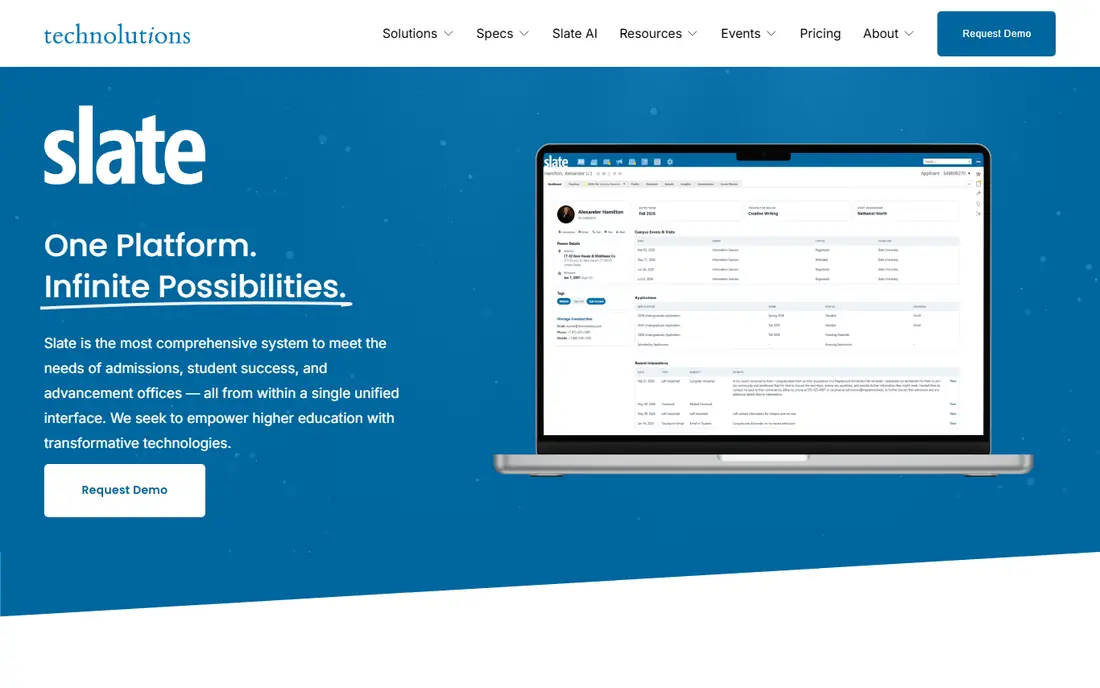
Slate is the admissions system many higher education teams compare everything else against, and for good reason. It covers inquiry management, online applications, application reading, events, travel and communications in one place, so a file does not have to move between separate tools to be reviewed. That breadth helps when several offices touch the same applicant, from recruitment through to enrollment and alumni contact.
The catch is effort. Slate rewards teams that can invest in configuration and upkeep, and it can feel like too much system for a school with a small admissions staff and a short timeline. If your team has a CRM administrator, or can hire help for setup, the payoff is a process you can shape closely to your own decisions. If not, ask for a realistic setup plan before you sign.
- Full admissions funnel in one system
- Flexible forms and communications
- One license covers the main modules
- Needs dedicated staff time to set up well
- Pricing is quote only
- Smaller teams may find it heavy
Blackbaud Enrollment Management System
Great for: Independent K-12 schools on Blackbaud
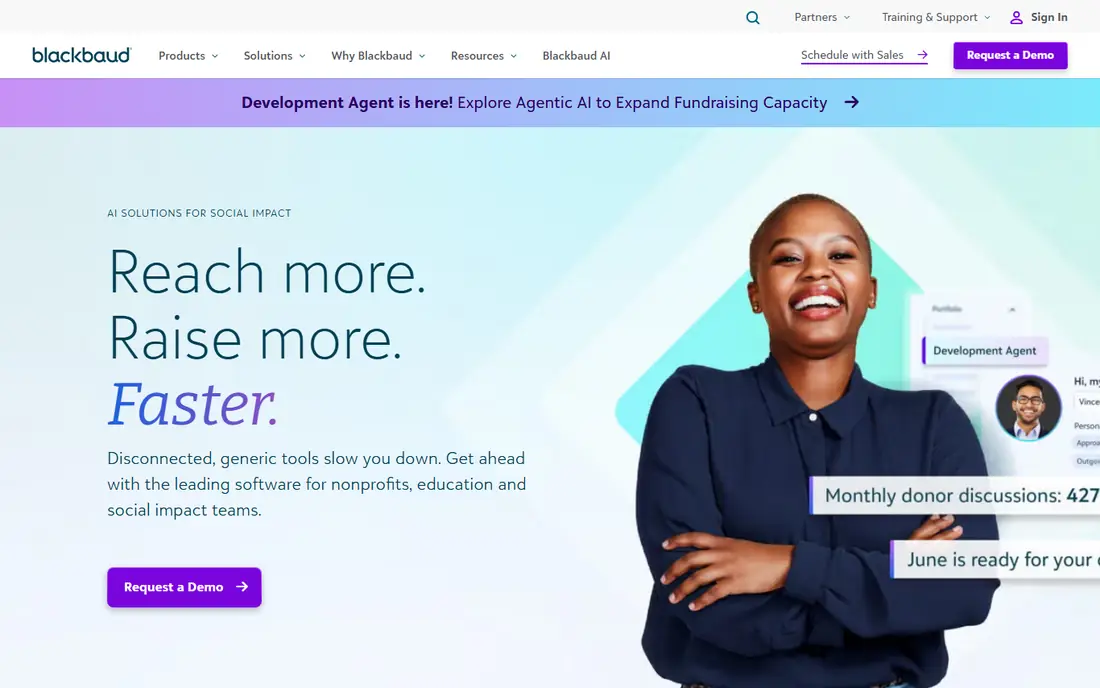
Blackbaud Enrollment Management System is aimed at independent schools that want admissions, enrollment and re-enrollment handled inside the Blackbaud world. Families apply online, staff review files and track decisions, and enrollment contracts can flow into the same record that later handles billing. For a school already using Blackbaud for fundraising or tuition, that link removes a lot of manual copying.
Standalone buyers should weigh the total picture. The product makes most sense as part of a wider Blackbaud setup, and a school that only needs a simple application form may not need this much structure. Ask what is included in the quote, how long setup takes, and how the system handles returning families, since re-enrollment is where many schools feel the benefit or the friction.
- Built for K-12 admissions and enrollment
- Connects with Blackbaud fundraising and tuition tools
- Familiar to many independent schools
- Pricing is quote only
- Best value comes when you already use other Blackbaud products
- Setup can take time
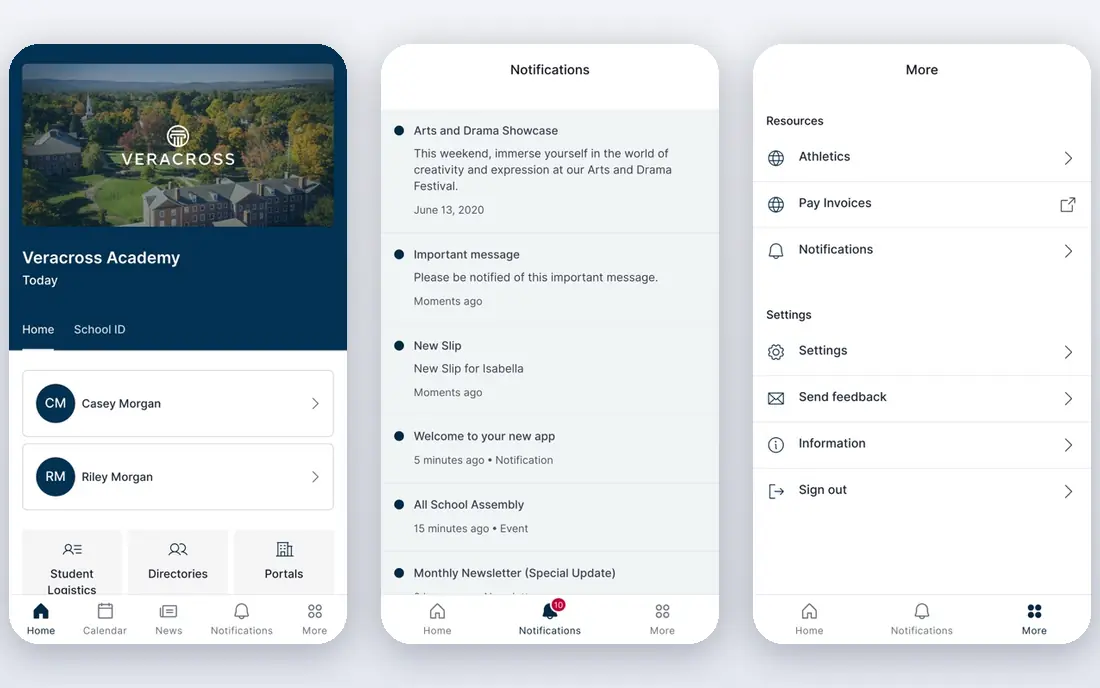
Veracross is a full student information system, and admissions is one part of it. Applicants become students in the same database, with household records that link parents, guardians and siblings. That matters when a family has two children applying in different years, or when billing and academic records need to stay tied to the admissions file.
The trade-off is scope. Buying Veracross for admissions alone is like buying a whole campus system for one office, and implementation will touch more than the admissions team. For a school planning a wider system change, that scope is a strength. For a school that only wants to replace its application forms, a narrower tool will be quicker and cheaper to run.
- Admissions, academics and billing share one record
- Household records link siblings and guardians
- Broad reporting
- Pricing is quote only
- A full system change is a large project
- Small schools may use only part of it
SchoolAdmin, now part of Finalsite, is built around strategic enrollment for private K-12 schools. It covers prospect management, applications, decisions, enrollment contracts and tuition billing, with events and communications to keep families moving through each stage. Because Finalsite also builds school websites, the enrollment pages and the main site can feel like one experience for families.
Our pick for a private K-12 team that wants enrollment and billing together is this one, provided the price fits. The limit is focus: a college, a camp or a public district will find parts of the workflow shaped for a different kind of school. Check how it handles your decision letters, waitlists and financial aid steps before you commit.
- Admissions, enrollment and tuition billing in one enrollment suite
- Prospect tracking and events
- Ties to Finalsite websites
- Pricing is quote only
- Aimed mainly at private K-12 schools
- Schools outside that niche should check fit
Ravenna Student Management brings applications, enrollment agreements, online forms and tuition management into a single student record. Staff can follow a family from first application through enrollment and ongoing billing, and reporting tools help an admissions director see where applications stall. Families get one portal rather than a set of disconnected forms, which tends to cut down on follow-up emails.
Ravenna is not a general higher education CRM, and schools outside private K-12 should confirm that its academic and grading pieces match their needs. For its core audience, the appeal is clarity: one record, one workflow, and less time spent joining data from separate systems. Ask for a demo using your own application steps, not a generic tour, to see how much setup your forms will need.
- One record from application to enrollment and tuition
- Configurable workflows
- Reporting dashboards for admissions teams
- Pricing is quote only
- Strongest for private K-12 schools
- Larger system changes still need planning
TADS Admissions suits K-12 schools that want the admissions file to connect cleanly with tuition management and financial aid. Applications, documents and decisions sit in a trackable workflow, and families receive status updates as their file moves. When aid awards feed into billing, the school avoids retyping award amounts and chasing mismatched totals.
The honest catch is that TADS is strongest inside its own ecosystem. A school that already uses TADS for tuition or aid will get more from it than a school buying admissions alone. If you run a separate billing system, ask how the two will share data, and who owns that link when something breaks mid-cycle.
- Admissions workflow tied to tuition and financial aid
- Document-driven application review
- Status communications for families
- Pricing is quote only
- Part of a wider Community Brands suite
- Interface can feel dated next to newer tools
OpenApply is a web-based admissions system for schools, from first enquiry to enrollment. It is free for applicants and families, while schools pay an annual subscription, and the vendor builds your application forms from your existing Word or PDF forms. Typical setup takes four to six weeks, which is short compared with a full student system change, and support and training are included in the subscription.
That simplicity is the point, and also the limit. OpenApply does not try to be a full student information system, so a school that later wants grading, attendance and billing in the same product will need another system alongside it. For an independent or international school that wants a clean admissions process without a long project, that focus is a fair trade.
- Free for families
- Annual subscription for schools
- Forms built from your existing applications
- 24/7 support included
- Pricing is quote only
- Built for schools, not colleges
- Schools with complex higher education needs may outgrow it
PowerSchool Enrollment Express, formerly part of the PowerSchool enrollment family, handles online enrollment and registration for schools and districts. Families complete forms online, staff track submissions, and approved records flow into PowerSchool rather than being retyped. That link is the main reason to choose it: it cuts duplicate entry for registrars and front-office staff.
If your school does not use PowerSchool, there is less reason to pick this tool over a dedicated admissions product. It is built for enrollment and registration at scale, not for the full recruitment and reading workflow a college needs. Districts already on PowerSchool should still check how it handles returning students, document uploads and payment steps for their own forms.
- Enrollment forms feed the PowerSchool student record
- Built for districts and large school groups
- Online registration at scale
- Pricing is quote only
- Most useful inside PowerSchool
- Standalone admissions teams may find it plain
How we picked these
We compared official product pages, admissions feature lists and pricing pages, plus public reviews and comparison listings, for tools that serve nonprofit schools and colleges. We kept only products that are live today and that handle applications, decisions or enrollment as a core job, not as a side feature of a general CRM. We left out generic form builders and general fundraising tools, since they do not carry an admissions file through review and enrollment.
What to check before you sign
A good demo can hide a bad fit, so test the parts your team will use every week. Run one real application through the system, from family form to staff decision to enrollment contract, and time how long each step takes. Check who can see sensitive applicant data, how decisions are recorded, and how easily you can export your data if you leave.
Match the tool to your size
A college with several readers and a long review season needs reading queues, scoring and committee tools. A small K-12 school needs clear family forms, quick decisions and a simple re-enrollment step. Buying the larger system for the smaller job usually means paying for setup and training you will never use.
Price the whole project, not just the license
Ask for setup, migration, training and annual support as separate lines. Quote-based tools often differ more in those lines than in the headline license, and a cheap license with a long setup can cost more in staff time than a pricier tool that goes live in weeks.
Protect applicant data
Admissions files hold sensitive information about children and families. Ask where data is hosted, who can access it, how long it is kept, and how families can request a copy or deletion. A clear answer on those points matters more than a long list of extra features.
Frequently asked questions
What is admission-based nonprofit software?
It is software that manages applications, review, decisions and enrollment for nonprofit schools, colleges and similar organizations. It replaces paper forms and scattered spreadsheets with one file per applicant, so staff can see documents, decisions and payments in one place.
How much does admission-based nonprofit software cost?
Most tools on this list are priced by quote, based on school size, enrollment volume and modules. OpenApply charges schools an annual subscription while families use it free, and other vendors quote after a demo. Always ask for setup, migration and support costs in the same quote.
Is Slate only for colleges?
Slate is built mainly for higher education admissions, and it is widely used by colleges and universities. A K-12 school can use it in theory, but its strength is the higher education funnel, so K-12 teams often find a K-12 focused tool a better fit.
Can small schools use these tools?
Yes, but size matters. OpenApply and Ravenna suit smaller school teams with a focused admissions job, while Veracross and Slate suit larger teams that can staff a bigger system. A small school should favor a tool it can run with its current staff.
Do these tools handle tuition and financial aid?
Some do, and some do not. Blackbaud, TADS and Ravenna link admissions to tuition or aid workflows, while OpenApply focuses on admissions itself. If aid and billing links matter to you, test that flow in the demo rather than assuming it is included.
What should we ask in a demo?
Ask the vendor to run your own application form, show how a decision is recorded, and show how a family re-enrolls the next year. Also ask how data is exported, how permissions work, and what support is included after go-live.
Sources
- https://technolutions.com
- https://www.blackbaud.com
- https://www.veracross.com
- https://www.finalsite.com
- https://www.ravennasolutions.com
- https://www.tads.com
- https://www.openapply.com
- https://www.powerschool.com
- https://help.openapply.com/hc/en-us/articles/4405387488013-OpenApply-FAQs
- https://rankite.com/blog/best-crm-software-for-higher-education
See where you really rank - block by block
ProMapRanker scans Google Maps across a grid of your service area. Simple monthly plans from $19, white-label on every plan.
Start freeKeep reading
 wpforms alternatives
Best WPForms Alternatives in 2026
We compare 9 wpforms alternatives for WordPress forms, with free and paid options, current pricing notes, and honest limits for small business sites in 2026.
Read → windows task scheduler alternatives
Best Windows Task Scheduler Alternatives in 2026
Looking for Windows Task Scheduler alternatives? We compare 9 schedulers for Windows and cross-platform work, from free tools to enterprise automation.
Read → which ai video service is best
Which AI Video Service Is Best in 2026
which ai video service is best? We compare 10 legitimate AI video services on price, avatars, editing and output quality to help you pick the right tool.
Read →