 ProMapRanker
Best AutoSys Alternatives in 2026

Key takeaways
- Control-M is our pick for large enterprises that need deep hybrid and mainframe coverage with strong governance.
- Apache Airflow suits data teams that want open source, Python-based pipelines without enterprise license costs.
- RunMyJobs by Redwood suits teams moving from legacy schedulers that want a cloud-first, low-code platform.
- JAMS Scheduler is the clearest fit for Microsoft-heavy shops, with strong Windows, SQL Server, and PowerShell support.
- Enterprise pricing is often custom, so request quotes at your agent count and job volume before shortlisting.
Quick comparison
| Pick | Great for | Pricing starts at | Free tier | |
|---|---|---|---|---|
 Control-M | Large enterprise hybrid workloads | $2,400 per month | No | Visit |
 RunMyJobs by Redwood | Cloud-first enterprise scheduling | See website | No | Visit |
 Apache Airflow | Open source data pipelines | Free | Yes | Visit |
 ActiveBatch | Low-code cross-platform automation | See website | Free trial | Visit |
 JAMS Scheduler | Microsoft-heavy environments | $833 per month | Free trial | Visit |
 Stonebranch Universal Automation Center | Real-time orchestration | See website | No | Visit |
 IBM Workload Automation | IBM hybrid and mainframe shops | See website | No | Visit |
 Tidal Automation | Enterprise workload automation | See website | No | Visit |
 Automic Automation | Broadcom enterprise automation | See website | No | Visit |
 Rundeck | Open source job scheduling for IT teams | Free | Yes | Visit |
The best autosys alternatives
AutoSys, now part of Broadcom, is an enterprise workload automation tool for batch jobs across platforms, ERP systems, and cloud. The tools below cover the same ground in different ways: some are enterprise platforms, some are data pipeline tools, and some are open source schedulers.
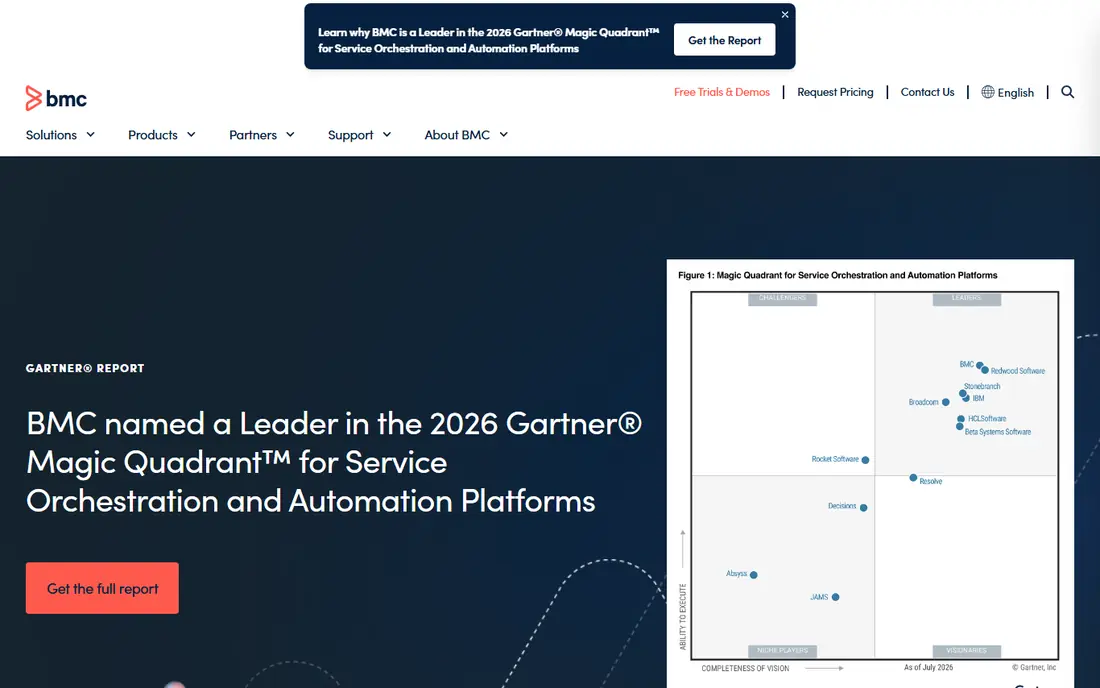
Control-M from BMC is the most direct enterprise replacement for AutoSys, with orchestration across hybrid cloud, on-premises, and mainframe environments. It offers centralized monitoring, governance, and audit trails, plus predictive analytics and event-driven triggers that go beyond simple time-based schedules. That depth suits banks, telecoms, and manufacturers with mission-critical batch work.
The cost is the main barrier. SaaS pricing starts around $2,400 per month, and larger deployments cost far more, with per-endpoint and task-based licensing. Smaller teams will find it heavy, both in price and in setup. For large enterprises that need scale and control, Control-M is the benchmark in this list.
- Deep hybrid and mainframe coverage
- Centralized visibility and governance
- Predictive and event-driven automation
- High licensing costs
- Complex for smaller teams
- Implementation takes time
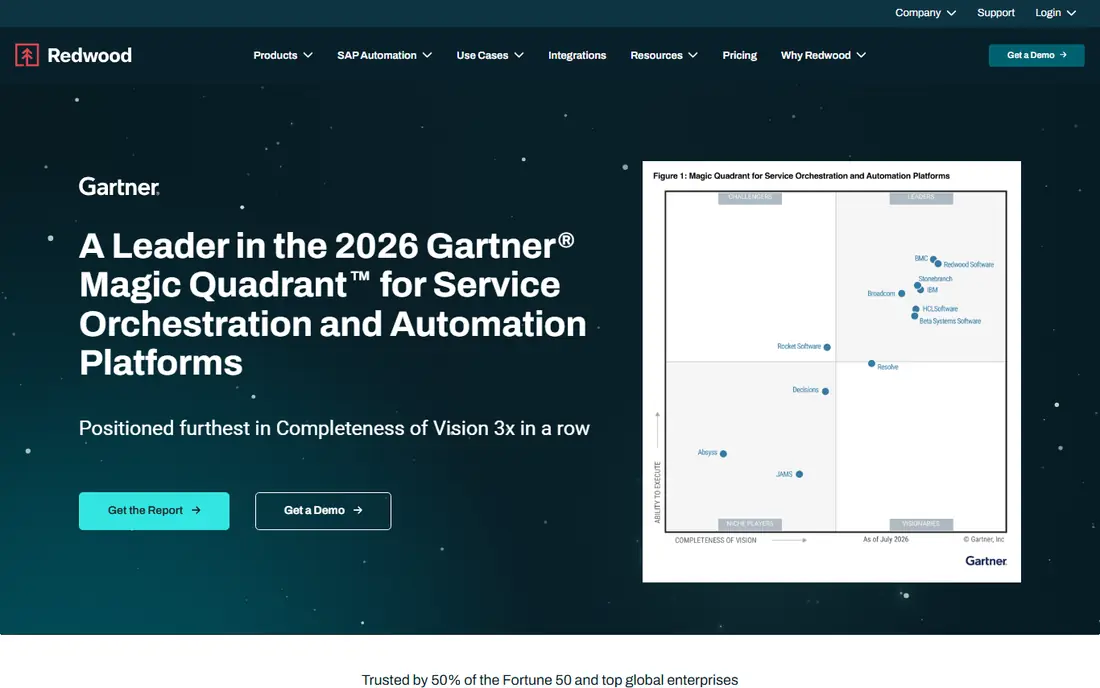
RunMyJobs by Redwood is a cloud-first workload automation platform that suits teams moving away from legacy, on-premises schedulers. It offers low-code workflow design, API access, and strong support for SAP and Oracle workloads, plus mainframe coverage for enterprises that still run those systems. The SaaS model removes much of the infrastructure work that comes with older tools.
Pricing is usage-based and custom, so smaller teams may find it costly, and migration from AutoSys needs careful planning for job definitions and dependencies. For enterprises that want a modern, cloud-based scheduler without managing servers, RunMyJobs is a strong contender.
- Cloud-first SaaS model
- Low-code workflow design
- Strong SAP and Oracle support
- Custom pricing
- Less suited to small teams
- Migration needs planning for legacy jobs
Apache Airflow is the open source pick for data teams, with workflows defined as Python DAGs and a web interface for monitoring and retries. It suits ELT pipelines, machine learning workflows, and data operations, and its large community provides many integrations. Managed versions, such as Astronomer, add hosting and support for teams that do not want to run it themselves.
Airflow is not a direct AutoSys clone. It has no mainframe support, and it needs engineering time to deploy, monitor, and scale. It also lacks some enterprise batch features, such as native ERP job controls, unless you build them. For data-focused teams with Python skills, it offers powerful orchestration at no license cost.
- Free and open source
- Python-based DAGs
- Large community and integration range
- No mainframe support
- Needs engineering time to run
- Not a full enterprise batch platform on its own
ActiveBatch, also by Redwood, is a low-code workload automation platform for cross-platform jobs, scripts, and file transfers. It offers hundreds of native connectors, a managed file transfer suite, and high-availability failover, so jobs move to standby systems if a primary system fails. A 30-day free trial with customized demos helps teams test it against real use cases.
Pricing is based on servers and scheduling environments, with unlimited jobs and no overage penalties for job count, but the total is custom and enterprise-focused. The interface is feature-rich, which takes time to learn. For teams that want low-code design with deep connector coverage, ActiveBatch is a capable choice.
- Low-code drag-and-drop design
- Hundreds of native connectors
- High-availability failover
- Pricing is custom and agent-based
- Enterprise focus
- Interface is feature-rich and takes learning
JAMS Scheduler is the clearest fit for organizations that run heavily on Microsoft infrastructure, with native support for Windows Server, SQL Server, PowerShell, Azure Data Factory, and Python. The Core plan starts at $833 per month billed yearly, with unlimited executions and a managed file transfer client, and a free trial is offered. Calendar exception controls help with month-end closes and reporting cycles.
The Advanced plan, which adds enterprise security, compliance controls, and migration support, uses custom pricing. JAMS is also less focused on data pipelines than Airflow, so data teams may prefer a different tool. For Microsoft shops outgrowing Windows Task Scheduler and SQL Server Agent, JAMS is a natural next step.
- Strong Windows, SQL Server, and PowerShell support
- Unlimited executions on Core
- Calendar and dependency controls
- Core plan is $833 per month billed yearly
- Advanced features need the higher plan
- Less data-pipeline focus than Airflow
Stonebranch Universal Automation Center offers real-time orchestration across on-premises, cloud, and mainframe environments, with event-driven triggers and an intuitive drag-and-drop workflow designer. It suits enterprises that need to react to events as they happen, rather than only running jobs on a fixed schedule. Its agent-based subscription model scales with the environments you manage.
Pricing is custom and enterprise-focused, so smaller teams will find it costly. Migration from AutoSys also needs planning, especially for complex dependencies and calendars. For large teams that want real-time orchestration with strong hybrid coverage, Stonebranch is a serious alternative.
- Real-time, event-driven orchestration
- Hybrid and mainframe support
- Intuitive workflow design
- Subscription pricing is custom
- Enterprise focus
- Migration from AutoSys needs planning
IBM Workload Automation suits organizations with IBM Z, hybrid cloud, and large enterprise estates, offering job streams, APIs, and web-based management. It handles unattended and event-driven tasks across legacy and cloud systems, with governance and audit features that large IT teams need. That IBM depth is its main advantage over general schedulers.
Pricing is subscription and capacity-based, with no simple published entry tier, and it offers the best value inside IBM environments. Shops without IBM systems may find Control-M or Stonebranch a better fit. For IBM-heavy enterprises, it is a natural AutoSys alternative to evaluate.
- Strong IBM Z and hybrid cloud support
- Job streams and APIs
- Enterprise governance
- Pricing is custom and capacity-based
- Best value inside IBM environments
- Complex for non-IBM shops
Tidal Automation, from Tidal Software, is an enterprise workload automation platform for cross-platform jobs, data workflows, and application processes. It offers centralized scheduling, monitoring, and dependency management, which helps IT teams replace scattered cron jobs and manual scripts with a governed system. Its focus on enterprise reliability suits regulated and high-volume environments.
Pricing is custom, and its community is smaller than Control-M or Airflow, so finding public guides can take more effort. Implementation also needs expertise, especially for complex migrations. For enterprises that want a dedicated, vendor-supported scheduler, Tidal remains a credible option.
- Enterprise job scheduling
- Cross-platform support
- Strong for data and application workflows
- Pricing is custom
- Smaller community than Control-M
- Implementation needs expertise
Automic Automation, also from Broadcom, is an enterprise automation platform for complex workflows across applications, databases, and infrastructure. It suits large organizations that need to orchestrate multi-system processes with governance, audit trails, and high availability. Since it shares a vendor with AutoSys, existing Broadcom customers may find licensing and support simpler.
The overlap with AutoSys needs careful evaluation, since both tools cover enterprise batch work and the right choice depends on your current estate and future plans. Pricing is custom, and the platform is complex for smaller teams. For Broadcom shops planning a long-term automation strategy, Automic deserves a place in the comparison.
- Broad enterprise automation
- Strong for complex, multi-system workflows
- Part of the Broadcom portfolio
- Pricing is custom
- Enterprise complexity
- Overlap with AutoSys needs careful evaluation
Rundeck is an open source job scheduler for IT operations, with a community edition that covers job definitions, schedules, access controls, and execution history. It suits teams that want to replace ad hoc scripts and cron jobs with a shared, auditable scheduler, without paying enterprise license fees at the start. Commercial editions add clustering, support, and advanced features.
Rundeck is less focused on data pipelines than Airflow, and its enterprise features sit behind paid plans. Scaling to very large estates also needs planning. For IT teams that want an open source, operations-first scheduler, Rundeck is a practical AutoSys alternative.
- Open source community edition
- Job scheduling with access controls
- Good for IT operations teams
- Less data-pipeline focus than Airflow
- Enterprise features need paid plans
- Scaling needs planning
How we picked these
We compared official product pages, pricing information, and current feature lists, and we favored tools that are live in October 2026 and support enterprise job scheduling or data orchestration. We included enterprise platforms, open source tools, and Microsoft-focused schedulers, and we used See website where pricing is custom or capacity-based. We noted where a tool lacks mainframe support, since that matters for many AutoSys users.
How to choose the right workload tool
Start with your estate, not the feature list. A mainframe-heavy shop needs Control-M, Stonebranch, IBM, or RunMyJobs, while a data team may be happier with Airflow. A Microsoft shop should shortlist JAMS first, and an operations team with limited budget should test Rundeck before committing to an enterprise license.
Map jobs before you migrate
List every job, dependency, calendar exception, and alert before you move, since hidden dependencies cause most migration failures. Run the new tool in parallel for a cycle, compare results, and keep the old scheduler active until the new one proves itself. That parallel run costs time, but it prevents missed month-end jobs.
Get pricing at your real scale
Enterprise pricing depends on agents, endpoints, job volume, and capacity, so a headline monthly figure rarely tells the full story. Request quotes at your current agent count and at your expected growth, and ask what support, migration help, and training cost. Open source tools are free to license, but they still cost engineering time to run.
Frequently asked questions
What are the best alternatives to AutoSys for large enterprises?
Control-M, RunMyJobs by Redwood, Stonebranch, IBM Workload Automation, and ActiveBatch are the strongest enterprise picks, with hybrid, mainframe, and governance features. Control-M offers the deepest hybrid coverage, while RunMyJobs suits cloud-first teams. Request quotes at your scale, since pricing is custom for most of these tools.
Is there a free alternative to AutoSys?
Yes. Apache Airflow and Rundeck both offer free, open source editions, and both suit teams with engineering time to run them. Airflow suits data pipelines, while Rundeck suits IT operations jobs. Managed versions and enterprise editions cost extra, but the core tools are free to use.
Which alternative is best for Microsoft environments?
JAMS Scheduler is the clearest fit, with native Windows Server, SQL Server, PowerShell, and Azure Data Factory support. Its Core plan starts at $833 per month billed yearly, with a free trial. Other tools support Windows jobs too, but JAMS is built around the Microsoft stack.
Can I migrate from AutoSys without downtime?
You can reduce risk by running the new tool in parallel, migrating jobs in groups, and keeping AutoSys active until each group proves itself. Map dependencies and calendar exceptions first, since those cause most migration problems. Vendor migration help can be worth the cost for large estates.
Do these tools support data pipelines?
Airflow is built for data pipelines, and Control-M, Stonebranch, and RunMyJobs also support data workflows alongside traditional batch jobs. Rundeck and JAMS focus more on IT operations and application jobs. Pick based on whether data pipelines or enterprise batch jobs dominate your workload.
Sources
- https://www.bmc.com
- https://www.redwood.com
- https://www.airflow.apache.org
- https://www.advsyscon.com
- https://www.jamsscheduler.com
- https://www.stonebranch.com
- https://www.ibm.com/products/workload-automation
- https://www.tidalautomation.com
- https://www.broadcom.com/products/software/automation/automic-automation
- https://www.rundeck.com
See where you really rank - block by block
ProMapRanker scans Google Maps across a grid of your service area. Simple monthly plans from $19, white-label on every plan.
Start freeKeep reading
 wpforms alternatives
Best WPForms Alternatives in 2026
We compare 9 wpforms alternatives for WordPress forms, with free and paid options, current pricing notes, and honest limits for small business sites in 2026.
Read → windows task scheduler alternatives
Best Windows Task Scheduler Alternatives in 2026
Looking for Windows Task Scheduler alternatives? We compare 9 schedulers for Windows and cross-platform work, from free tools to enterprise automation.
Read → which ai video service is best
Which AI Video Service Is Best in 2026
which ai video service is best? We compare 10 legitimate AI video services on price, avatars, editing and output quality to help you pick the right tool.
Read →