 ProMapRanker
Best Appian Alternatives in 2026

Key takeaways
- Pega Platform is our pick for large regulated enterprises that need decisioning, case management, and scale.
- OutSystems and Mendix suit teams building customer-facing apps with low-code tools and governance.
- Microsoft Power Apps and Power Automate suit organizations already on Microsoft 365, with clear per-user pricing.
- Kissflow and Bizagi suit business teams that want process automation without an enterprise rollout.
- Camunda suits developer-led teams that need precise process orchestration with open standards.
Quick comparison
| Pick | Great for | Pricing starts at | Free tier | |
|---|---|---|---|---|
 Pega Platform | Large regulated enterprises | See website | Free trial | Visit |
 OutSystems | Large-scale customer apps | See website | Free trial | Visit |
 Mendix | Mixed dev and business teams | See website | Free trial | Visit |
 Microsoft Power Apps | Microsoft 365 organizations | $20 per user per month | Free trial | Visit |
 Microsoft Power Automate | Microsoft workflow automation | $15 per user per month | Yes | Visit |
 Kissflow | Business-team process apps | See website | Free trial | Visit |
 Camunda | Developer-led orchestration | See website | Yes | Visit |
 Bizagi | Visual process modeling | See website | Free trial | Visit |
 ProcessMaker | Low-code process design | See website | Free trial | Visit |
The best appian alternatives
Appian combines low-code app building with business process management, case management, and automation. Teams look for an alternative when they want lower cost, a different vendor ecosystem, stronger developer control, or a simpler tool for approvals and forms. The nine platforms below are live in October 2026, and Appian itself is not listed. We compared official product pages, pricing pages, and public comparisons.
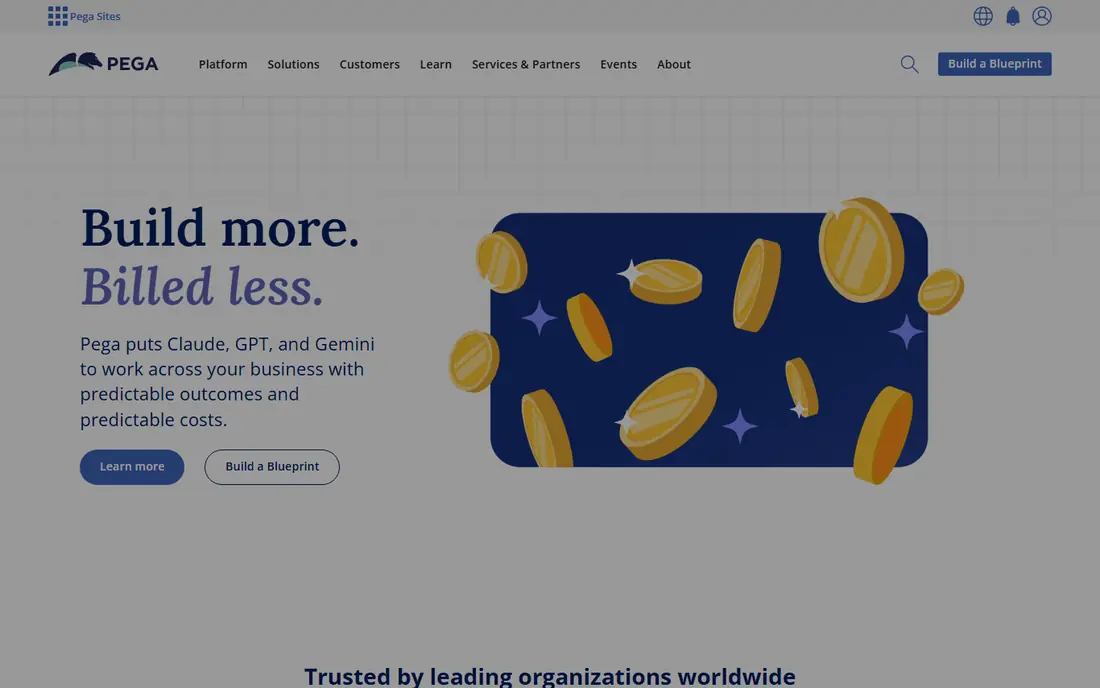
Pega Platform is the closest enterprise match to Appian for complex, mission-critical processes. It combines workflow, case management, decision rules, and AI-assisted automation in one system, with governance for large teams. Banks, insurers, and government agencies use it for processes that span many roles and systems.
That power comes with cost and complexity. Pricing is quoted, implementations often need specialists, and smaller teams may find it heavy. For a large regulated organization, Pega is the first alternative to evaluate.
- Strong case management and decisioning
- Built for complex regulated workflows
- Large enterprise support
- Quote-based pricing
- Implementation is a major project
- Learning curve is steep
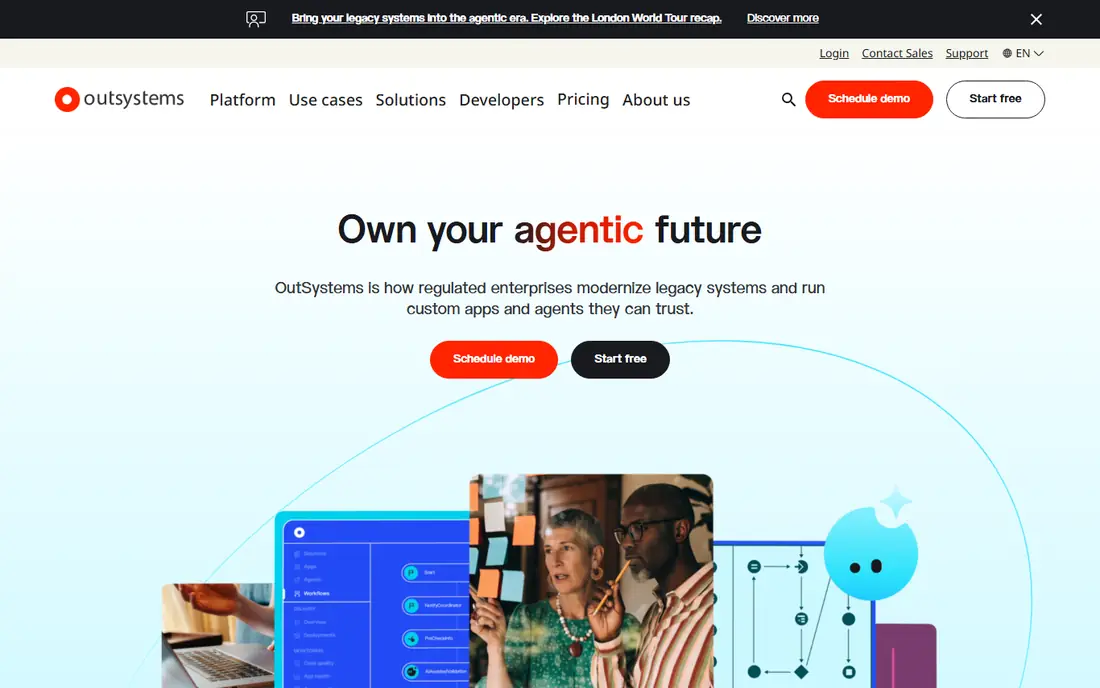
OutSystems suits teams building customer-facing web and mobile apps quickly with low-code tools. Visual modeling, reusable components, and deployment pipelines help larger teams ship and maintain apps. Governance features support multi-team development.
Pricing is quoted and can be high at scale, so budget for growth, not just launch. Teams that need a full process engine with long-running case work should test that depth carefully, since OutSystems leans more toward app building than pure BPM.
- Fast low-code app building
- Strong for customer-facing apps
- Governance and lifecycle tools
- Quote-based pricing
- Costs rise with scale
- Vendor lock-in needs planning
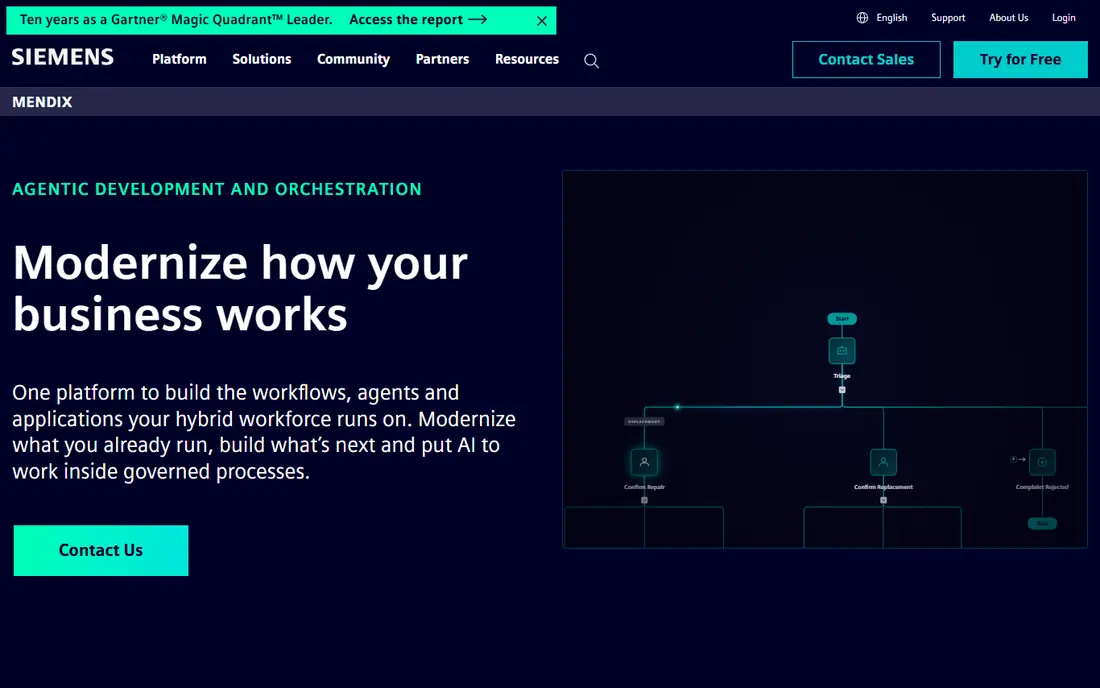
Mendix, part of Siemens, targets teams where business users and developers build together. Visual modeling covers data, logic, and interfaces, while developers can extend apps with code where needed. That mix suits digital transformation projects with both business and IT owners.
Pricing is quoted, and the platform is aimed at mid-size to large organizations rather than tiny teams. For a company that wants governed low-code development with room to grow, Mendix is a strong Appian rival.
- Collaboration between business and developers
- Strong app building
- Siemens ecosystem support
- Quote-based pricing
- Enterprise focus
- Learning curve for advanced features
Microsoft Power Apps is the natural choice if your organization already uses Microsoft 365, Teams, SharePoint, and Dataverse. Staff can build internal apps and portals with low-code tools, and pricing starts at $20 per user per month for premium plans. Connectors cover hundreds of services.
Outside the Microsoft ecosystem, the value drops. Complex apps still need developer help, and licensing can get confusing across Power Apps, Power Automate, and Dataverse. For Microsoft-centric teams, it is the lowest-friction alternative.
- Deep Microsoft 365 and Teams integration
- Clear per-user pricing
- Large connector library
- Best inside Microsoft ecosystem
- Complex apps need developer skill
Power Automate focuses on workflows: approvals, notifications, data movement, and scheduled tasks across apps. A free plan exists, and premium per-user plans start at $15 per user per month billed annually in recent comparisons. Templates cover common approvals and alerts, so teams can automate quickly.
It is not a full case management system on its own. Long-running cases with SLAs, escalations, and complex state often need Power Apps, Dataverse, or another BPM tool alongside it. For approval and form workflows, it is often enough.
- Large template library
- Works with Microsoft and third-party apps
- AI builder for documents
- Not a full BPM suite alone
- Complex long-running cases need Power Apps or other tools
Kissflow suits business teams that want to automate approvals, requests, and operational workflows without an enterprise rollout. Visual builders cover forms, processes, boards, and reports, and teams can launch a process in days rather than months. That speed is the main reason to pick it over Appian.
Very complex, regulated case work with deep integration needs may exceed its depth. For HR requests, procurement approvals, and service workflows, Kissflow offers a practical middle path.
- Business-friendly process builder
- Forms, approvals, and dashboards
- Faster setup than enterprise BPM
- Less depth for very complex enterprise cases
- Pricing varies by edition
Camunda is built for developers who need exact control over long-running processes. It uses BPMN standards, offers a cloud platform and self-hosted options, and orchestrates microservices, human tasks, and system steps with precision. That control suits technical teams building core systems.
Business users will find less drag-and-drop app building than Appian or Kissflow. If your team is developer-led and values standards and code-level control, Camunda is the strongest technical alternative here.
- Open BPMN standards
- Precise process orchestration
- Developer-friendly APIs and tooling
- Needs developer skill
- Business-user tooling is thinner than low-code rivals
Bizagi focuses on visual process design, letting teams model, automate, and monitor processes in one suite. Its modeler is a strength for organizations that need clear process documentation alongside automation. Low-code tools help turn models into working apps.
Pricing is quoted, so budgeting requires a conversation with the vendor. Teams that prioritize process modeling and documentation should shortlist Bizagi alongside Camunda and Kissflow.
- Strong visual process modeling
- Low-code app building
- Good for process documentation
- Pricing is quoted
- Enterprise features need a sales conversation
ProcessMaker offers a low-code platform for designing, automating, and monitoring business processes. Dashboards, forms, and reporting help operations teams track work, and recent versions add AI-assisted design. It suits mid-size organizations that need real process automation without the largest enterprise price tag.
Pricing is quoted, with some public material listing platform plans from around $1,475 per month, so confirm current terms before budgeting. For a team moving from manual approvals to automated processes, ProcessMaker is a credible step up.
- Low-code process builder
- Dashboards and reporting
- AI-assisted process features
- Pricing is quoted
- Smaller ecosystem than Pega or Microsoft
How we picked these
We compared official product pages, pricing pages, and public comparisons for low-code and BPM platforms that are live in October 2026. We favored a mix of enterprise BPM, low-code app platforms, Microsoft tools, and developer-led orchestration, and we left Appian itself out. Prices shown are entry prices where vendors publish them clearly, and we wrote See website where pricing is quoted or varies by users and apps.
What to check before you switch
Define the process job clearly
App building, long-running case work, and simple approvals are different jobs. List your top five processes, their steps, roles, SLAs, and systems, then test each candidate on one real process rather than a demo flow.
Check governance and integration early
Confirm single sign-on, audit logs, data residency, and connectors to your core systems on the plan you will buy. A tool that works in a pilot can fail on security review if those features sit in a higher tier.
Budget for implementation, not just licenses
Enterprise BPM projects often cost more in implementation and change management than in licenses. Ask vendors for a realistic timeline, required roles, and total first-year cost, including training and support.
Frequently asked questions
What is the best Appian alternative for large enterprises?
Pega Platform is the strongest large-enterprise pick, with case management, decisioning, and regulated-industry depth. OutSystems and Mendix are close for app-led transformation, while Microsoft Power Apps suits Microsoft-centric enterprises.
What is the cheapest Appian alternative?
For simple workflows, Microsoft Power Automate and Kissflow are usually cheapest to start, with clear per-user or trial options. Camunda also offers a free tier for developers. Enterprise platforms such as Pega, OutSystems, and Mendix are quoted and cost more.
Can low-code tools replace a full BPM platform?
For approvals, forms, and simple workflows, yes. For long-running cases with SLAs, escalations, and complex rules, a full BPM platform such as Pega, Camunda, or Bizagi fits better. Test your hardest process before deciding.
Do I need developers to use these tools?
Business teams can build simple processes in Kissflow, Power Automate, and Power Apps with little code. Complex integrations, custom interfaces, and core systems still need developers, even on low-code platforms.
How long does it take to switch from Appian?
Simple approval workflows can move in weeks, while enterprise case systems can take months. Migration time depends on process count, integrations, data migration, and training, so run a pilot on one process first.
Sources
- https://www.pega.com
- https://www.outsystems.com
- https://www.mendix.com
- https://www.microsoft.com
- https://kissflow.com
- https://camunda.com
- https://www.bizagi.com
- https://www.processmaker.com
- https://techilu.com/best-low-code-platforms/
- https://www.jotform.com/blog/appian-alternatives/
- https://thedigitalprojectmanager.com/tools/best-appian-alternatives/
See where you really rank - block by block
ProMapRanker scans Google Maps across a grid of your service area. Simple monthly plans from $19, white-label on every plan.
Start freeKeep reading
 wpforms alternatives
Best WPForms Alternatives in 2026
We compare 9 wpforms alternatives for WordPress forms, with free and paid options, current pricing notes, and honest limits for small business sites in 2026.
Read → windows task scheduler alternatives
Best Windows Task Scheduler Alternatives in 2026
Looking for Windows Task Scheduler alternatives? We compare 9 schedulers for Windows and cross-platform work, from free tools to enterprise automation.
Read → which ai video service is best
Which AI Video Service Is Best in 2026
which ai video service is best? We compare 10 legitimate AI video services on price, avatars, editing and output quality to help you pick the right tool.
Read →