 ProMapRanker
Alternatives to PyTorch in 2026

Key takeaways
- TensorFlow is the strongest pick for production pipelines, mobile, and serving, while JAX suits research that needs compilation and speed.
- Keras gives beginners and prototypers the fastest start, and it can run on more than one backend.
- ONNX Runtime is not a training framework, but it is a strong choice for running trained models fast on many devices.
- All nine tools on this list are free and open source, so the choice comes down to ecosystem, hardware, and deployment needs.
Quick comparison
| Pick | Great for | Pricing starts at | Free tier | |
|---|---|---|---|---|
 TensorFlow | Production pipelines and serving | Free | Yes | Visit |
 JAX | High-performance research | Free | Yes | Visit |
 Keras | Fast prototyping for beginners | Free | Yes | Visit |
 PaddlePaddle | Industrial and applied AI work | Free | Yes | Visit |
 MindSpore | Performance work in aligned environments | Free | Yes | Visit |
 ONNX Runtime | Fast model inference | Free | Yes | Visit |
 MLX | Apple silicon research and apps | Free | Yes | Visit |
 scikit-learn | Classical machine learning | Free | Yes | Visit |
 Deeplearning4j | Java and enterprise teams | Free | Yes | Visit |
The best alternatives to PyTorch
PyTorch is popular for research because its dynamic graphs feel close to plain Python. The tools below cover the same ground in different ways: some focus on production, some on speed, and some on a simpler API. We compared official documentation, feature pages, and public guides, and we kept only frameworks that are live and maintained in October 2026.
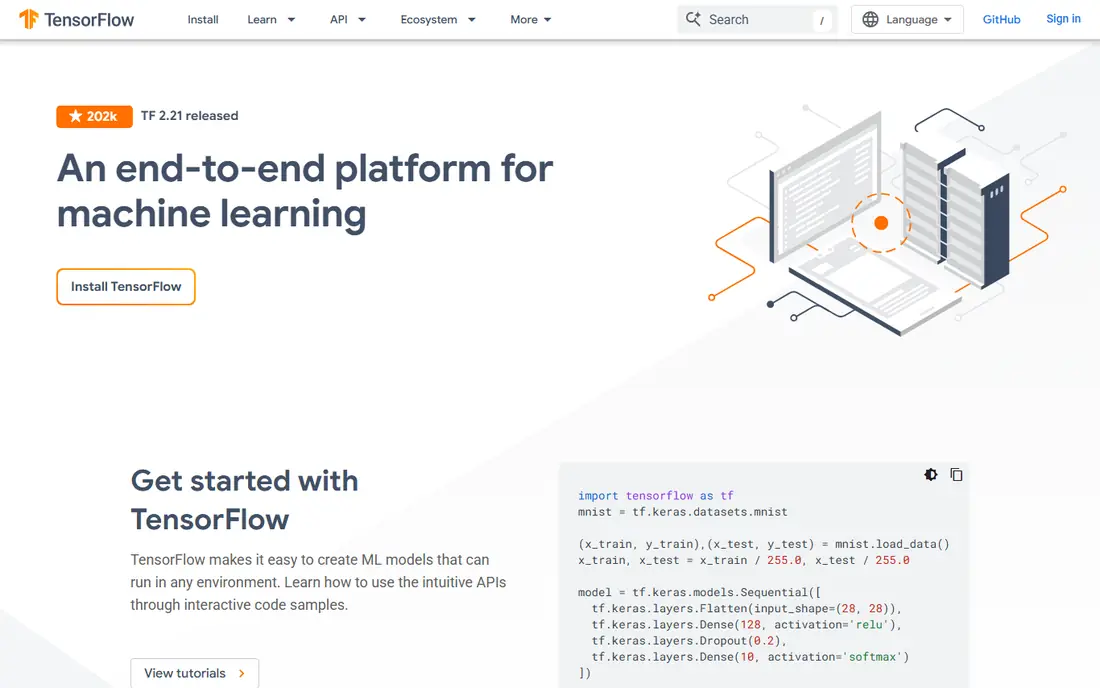
TensorFlow is the default alternative for teams that need to ship a model, not just train one. It includes tools for data pipelines, distributed training, model serving, and deployment to mobile and edge devices. The Keras API sits on top of it, so you can prototype in a high-level style and still use the production tooling underneath.
The trade-off is feel. TensorFlow code can read more structured and less flexible than PyTorch code, especially for custom research loops. If your goal is a reliable pipeline that other engineers can maintain, that structure is a strength. If your goal is fast experimental code, Keras or JAX may feel closer to PyTorch.
- Mature production and serving tools
- Mobile and edge support
- Large community and docs
- API feels heavier than PyTorch for quick research
- Debugging can take longer
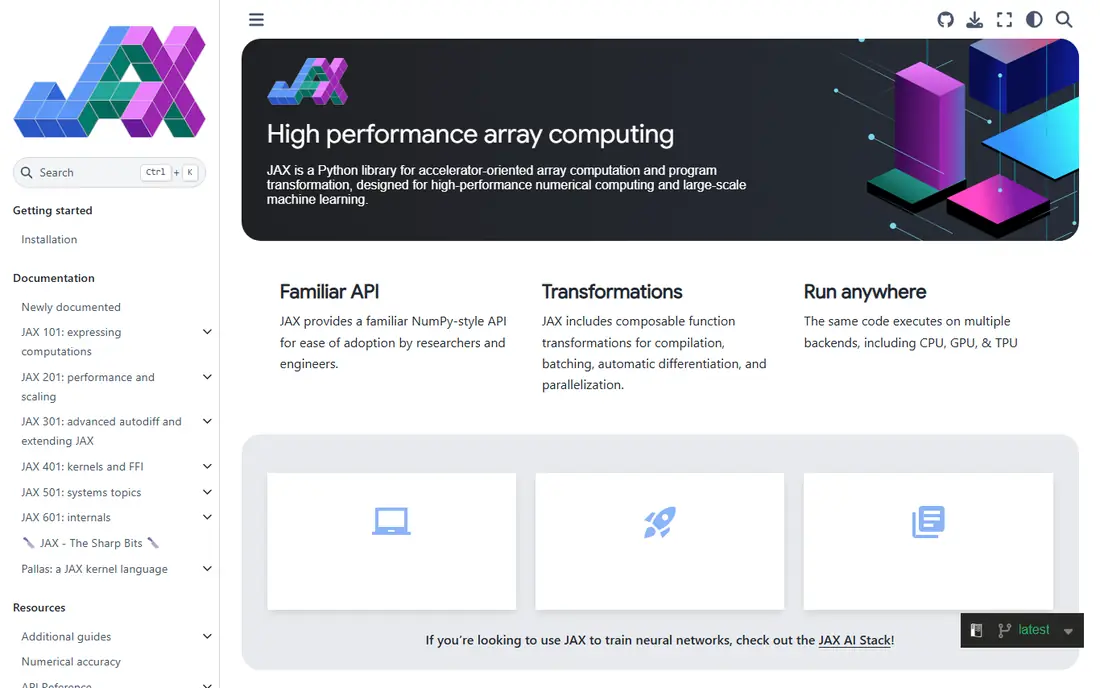
JAX combines NumPy-style code with automatic differentiation and compilation through XLA. You write array code that looks familiar, then transform it with grad, jit, vmap, and pmap to get gradients, compiled speed, vectorization, and parallelism. That design suits researchers who want control over performance without writing low-level kernels.
The learning curve is real. JAX favors a functional style, where functions avoid hidden state, and that style differs from the object-based style many PyTorch users know. Libraries built on JAX, such as Flax and Equinox, add model layers, but the ecosystem is still smaller than the PyTorch or TensorFlow worlds.
- Automatic differentiation with NumPy-like code
- Just-in-time compilation
- Strong GPU and TPU support
- Functional style takes time to learn
- Smaller high-level model library than TensorFlow
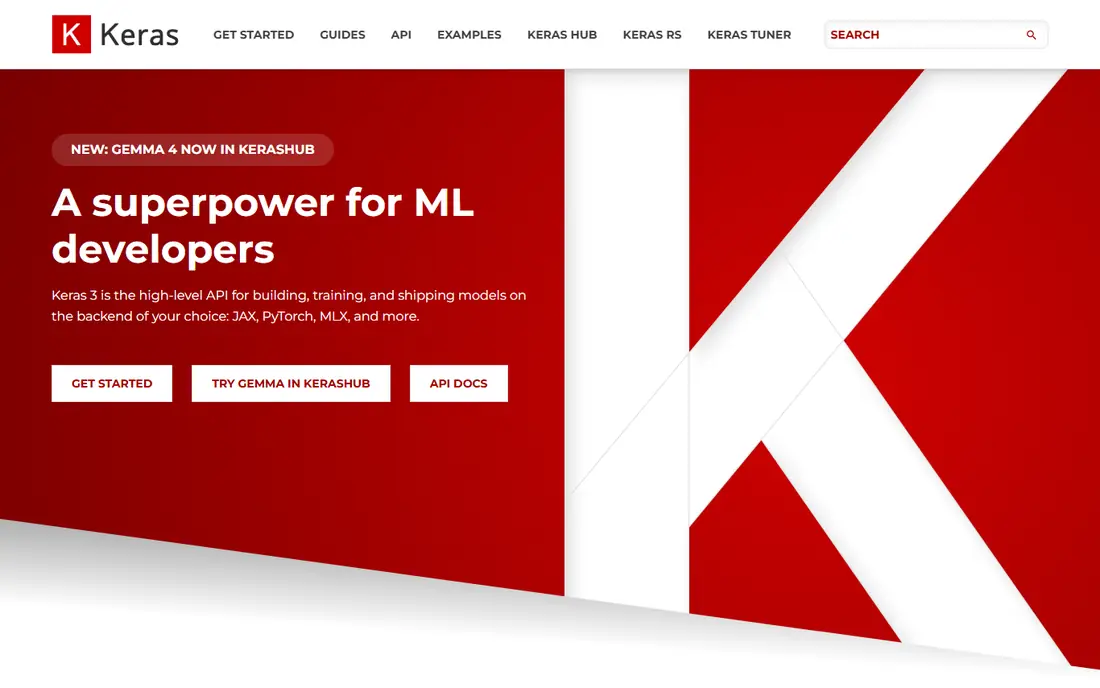
Keras is the fastest way to build a standard model and see it train. Layers, optimizers, and loss functions read clearly, and a working classifier or sequence model takes far less code than a low-level framework. Modern Keras can run on TensorFlow, JAX, or PyTorch as a backend, so it is less a rival to PyTorch and more a simpler front end you can place above it.
That simplicity has a limit. When you need a custom training step, a strange loss, or fine control over distributed training, you will drop into backend code. For teaching, prototypes, and standard models, Keras is still the best first alternative to try.
- Simple, readable API
- Fast model building
- Supports TensorFlow, JAX, and PyTorch backends
- Less control for custom training loops
- High-level defaults can hide details beginners need to learn
PaddlePaddle, from Baidu, is an industrial-grade framework with tools for training, inference, and deployment. It covers vision, language, and recommendation work, and it includes model libraries and serving tools aimed at production use. Teams that work with Baidu cloud services or Chinese language data may find its pretrained models and tools especially useful.
The main drawback for US and European teams is ecosystem size. The community, tutorials, and third-party libraries in English are thinner than those for TensorFlow or PyTorch. If you need a widely answered question at midnight, that gap matters.
- End-to-end applied tooling
- Strong vision and language models
- Deployment tools for industry
- Community outside China is smaller
- Docs in English vary in depth
MindSpore, from Huawei, is built for performance across varied hardware, including Huawei Ascend chips, GPUs, and CPUs. It supports dynamic and static graphs, distributed training, and tools for large models. For teams already using Huawei hardware or cloud services, the alignment can give real speed gains.
For most independent developers, the ecosystem is the limit. Fewer tutorials, fewer pretrained models, and fewer integrations mean more work to solve common problems. MindSpore fits best when hardware alignment or a specific deployment target drives the choice.
- Performance-focused design
- Support for varied hardware
- Tools for large model training
- Smaller community than major frameworks
- Best fit depends on hardware and cloud alignment
ONNX Runtime is a different kind of alternative. You do not train models in it. You export a trained model to the ONNX format, then run it fast on Windows, Mac, Linux, mobile, and edge hardware, with acceleration for many chips. That makes it a strong second step after training in PyTorch, TensorFlow, or another framework.
The catch is conversion. Not every operator converts cleanly, and you may need to adjust a model or fall back to a custom step. If your main problem is slow or costly inference in production, ONNX Runtime is worth testing before you rewrite your training code.
- Fast inference across platforms
- Broad hardware acceleration
- Standard ONNX model format
- Not a training framework
- Converting models can need extra work
MLX is Apple's array framework for machine learning on Apple silicon. Its API feels close to NumPy, with lazy computation and automatic differentiation, and it uses the unified memory of Mac chips so the CPU and GPU share data without extra copies. For researchers and app developers who work on Macs, that design makes local model work smooth and fast.
The limit is hardware. MLX runs on Apple silicon, so it does not help a team that trains on Linux servers or deploys to Windows machines. Treat it as a strong local alternative for Mac-based work, not as a general replacement for a cross-platform framework.
- Built for Apple silicon
- NumPy-like API
- Unified memory model suits Mac workflows
- Apple-only hardware
- Smaller ecosystem
- Not a fit for Linux or Windows servers
scikit-learn is the right alternative when your problem does not need deep learning at all. Classification, regression, clustering, and preprocessing are covered with a consistent API, clear docs, and stable behavior across versions. Many tabular problems are solved faster and more reliably with a gradient boosting model or a logistic regression than with a neural network.
It is not a deep learning framework, so do not force it into vision or large language work. If your data is tabular and your model is small, scikit-learn will save time, and you can still use it alongside a deep learning tool for preprocessing and evaluation.
- Simple, stable API for classical models
- Excellent docs
- Works well with NumPy and pandas
- Not built for deep neural networks
- No GPU training for most models
Deeplearning4j brings deep learning to the Java Virtual Machine. Teams that run Java or Scala services can train and serve models inside the same stack, without adding a Python service just for inference. It supports distributed training and integrates with big data tools that Java shops already use.
The ecosystem gap is the main drawback. Python frameworks have more models, more tutorials, and more community answers, so a Deeplearning4j team will solve more problems on its own. It fits best when the Java stack is a hard requirement, not just a preference.
- JVM support for Java, Scala, and Kotlin teams
- Distributed training
- Production deployment in Java stacks
- Smaller community than Python frameworks
- Fewer pretrained models and tutorials
How we picked these
We compared official documentation, feature pages, and public framework guides, and we kept only tools that are live and maintained in October 2026. We favored frameworks that cover training, inference, or a clear part of the PyTorch workflow, and we left out discontinued projects and narrow libraries that only handle one model type. All nine tools are free and open source, so price did not decide the ranking.
How to choose a PyTorch alternative
Start with where the model will run. If it ships to phones, browsers, or servers, TensorFlow or ONNX Runtime should lead your shortlist. If it stays in research, JAX or Keras will feel closer to PyTorch. If it runs on a Mac, test MLX before you commit to a cross-platform tool.
Then check the ecosystem for your exact task. Search for pretrained models, data loaders, and deployment guides for your domain, because a framework with a ready model for your problem will beat a faster framework with none. Finally, run the same small training job in two frameworks and compare code length, training time, and debugging effort. That short test tells you more than any feature table.
Frequently asked questions
What are the best alternatives to PyTorch?
TensorFlow is the strongest general alternative for production work, JAX is best for high-performance research, and Keras is best for fast prototyping. PaddlePaddle and MindSpore suit industrial or hardware-aligned work, while ONNX Runtime is best for fast inference after training.
Is TensorFlow better than PyTorch?
Neither is better in every case. TensorFlow has stronger production, serving, and mobile tooling, while PyTorch often feels simpler for research code. Choose TensorFlow when deployment and maintenance matter most, and stay with PyTorch or try JAX when experimental flexibility matters most.
What is the easiest PyTorch alternative for beginners?
Keras is the easiest start. Its high-level API builds standard models with readable code, and its docs cover common tasks well. scikit-learn is even simpler if your problem is classical machine learning rather than deep learning.
Can I use PyTorch models with ONNX Runtime?
Yes, in many cases. Export the trained model to ONNX format, then run it with ONNX Runtime for faster inference on supported hardware. Some custom operators may not convert cleanly, so test the exported model on real inputs before you deploy it.
Are these PyTorch alternatives free?
Yes. All nine tools on this list are free and open source. Costs appear only in the hardware and cloud services you use to train and serve models, not in the frameworks themselves.
Sources
- https://www.tensorflow.org
- https://jax.readthedocs.io
- https://keras.io
- https://www.paddlepaddle.org.cn
- https://www.mindspore.cn
- https://onnxruntime.ai
- https://ml-explore.github.io
- https://scikit-learn.org
- https://deeplearning4j.konduit.ai
- https://www.esparkinfo.com/machine-learning/deep-learning-frameworks
- https://phoenixnap.pt/blog/deep-learning-frameworks
See where you really rank - block by block
ProMapRanker scans Google Maps across a grid of your service area. Simple monthly plans from $19, white-label on every plan.
Start freeKeep reading
 wpforms alternatives
Best WPForms Alternatives in 2026
We compare 9 wpforms alternatives for WordPress forms, with free and paid options, current pricing notes, and honest limits for small business sites in 2026.
Read → windows task scheduler alternatives
Best Windows Task Scheduler Alternatives in 2026
Looking for Windows Task Scheduler alternatives? We compare 9 schedulers for Windows and cross-platform work, from free tools to enterprise automation.
Read → which ai video service is best
Which AI Video Service Is Best in 2026
which ai video service is best? We compare 10 legitimate AI video services on price, avatars, editing and output quality to help you pick the right tool.
Read →