 ProMapRanker
Which ERM Software Is Best for Financial Services in 2026


No-code risk workflows for mid-sized firms · Pricing starts at: See website
Key takeaways
- ERM here means enterprise risk management software for financial services, not environmental or employee resource tools.
- Most enterprise risk platforms are quote only, so budget for a sales process and a demo before you get a firm price.
- LogicGate and Resolver suit teams that want business users to shape workflows, while MetricStream and Archer suit large, complex programs.
- A risk tool records and tracks risk, but software alone does not make a bank, insurer, or lender compliant with any rule.
- Shortlist two or three platforms, load a real risk register into the demo, and test reporting before you sign.
Quick comparison
| Pick | Great for | Pricing starts at | Free tier | |
|---|---|---|---|---|
| LogicGate | No-code risk workflows for mid-sized firms | See website | No | Visit |
 MetricStream | Large, connected risk programs | See website | No | Visit |
 Resolver | Risk, audit, and incident work in one place | See website | No | Visit |
 AuditBoard | Audit-connected risk management | See website | No | Visit |
 ServiceNow Integrated Risk Management | Firms already running ServiceNow | See website | No | Visit |
 Archer | Complex regulated risk models | See website | No | Visit |
 Riskonnect | Insurance and claims-linked risk work | See website | No | Visit |
 IBM OpenPages | Large firms with deep control libraries | See website | No | Visit |
The best ERM software for financial services
ERM in this guide means enterprise risk management: one place to record risks, score them, assign owners, track controls, and report the result to senior managers and boards. The eight platforms below all serve that job for banks, insurers, lenders, and other regulated firms, with different trade-offs on size, setup effort, and price.
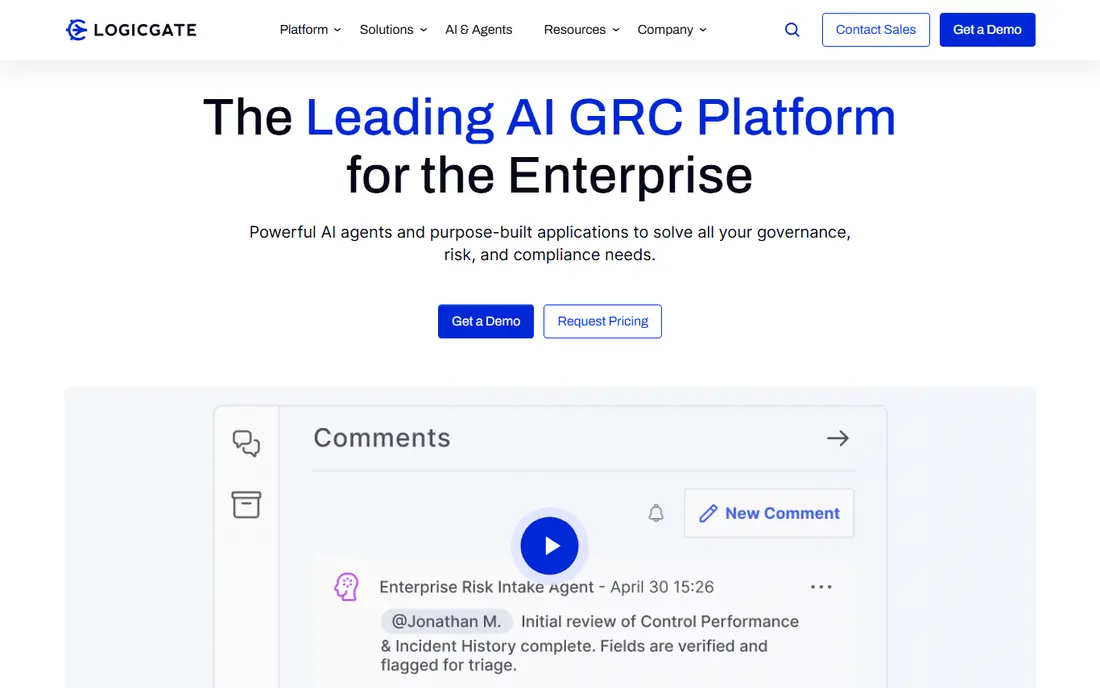
LogicGate Risk Cloud is built around a no-code builder, so risk teams can create applications, forms, workflows, and dashboards without waiting on developers for every change. That matters in financial services, where a new product, a new regulation, or a new third party can force a fast change to a risk assessment. Teams can also link risks to controls, issues, and third parties, which keeps the register from becoming a static spreadsheet.
The honest catch is scale and reporting depth. Public comparisons note that ad-hoc reporting outside the standard views can be awkward, and smaller teams may still need help shaping board-ready reports. LogicGate fits best when speed and business-user control matter more than the deepest enterprise analytics. Ask for a demo built around your own risk register, and check how a risk score change flows into a report.
- Drag-and-drop workflow builder
- Business users can shape forms and reports
- Standard and external users included without extra per-user fees in its model
- Standalone reporting can feel thin
- Deeper reporting needs careful testing
- Pricing is quote only

MetricStream is the heavyweight option in this list. Its platform connects enterprise risk, operational risk, compliance, audit, third-party risk, and cyber risk, so a risk that starts in one area can be traced through controls and issues elsewhere. For a large bank or insurer running many frameworks at once, that connected view is the main selling point, and its site cites analyst recognition across governance, risk, and compliance categories.
The trade-off is effort. Implementation and administration need dedicated staff, and contract scope needs care because modules are priced separately. Smaller firms will likely find it more platform than they need. If your firm already runs a mature risk function with several teams feeding one register, MetricStream belongs on the shortlist. If your team is small, start elsewhere and revisit it as the program grows.
- Broad connected governance, risk, and compliance coverage
- AI-assisted insight and analytics
- Strong fit for large regulated firms
- Enterprise scale and longer implementation
- Pricing is quote only
- Deeper changes may need specialist help

Resolver, part of Kroll, brings risk management together with incident management, internal audit, and compliance work. For a financial firm, that link matters: an incident or a failed control should update the risk picture, not sit in a separate inbox. Its risk tools cover registers, assessments, scoring, heat maps, and reporting, with workflows that route tasks to owners and track follow-up.
The catch is that breadth needs a clear rollout plan. Teams that buy every module at once can spend months configuring before they see value. Resolver fits best when risk, audit, and incident owners already work closely and want one system of record. Start with the risk register and one assessment cycle, prove the reporting works, then add modules in stages.
- Connected risk, incident, and audit workflows
- Configurable risk scoring and heat maps
- Usable by risk and compliance teams together
- Pricing is quote only
- Configuration still needs planning
- Smaller firms may not need the full suite
AuditBoard started in audit and controls work, and that heritage shows in its risk product. Risks link to controls, control tests, issues, and audit projects, so a control failure is visible in the risk register without manual rework. For a lender or insurer facing regular internal and external audit, that linkage saves real time during evidence collection and review.
The honest limit is emphasis. Teams that want a pure risk-quantification tool, with deep scenario modelling as the headline feature, may find AuditBoard more control and audit shaped than model shaped. It fits best when audit and risk share owners and evidence. Test how a risk assessment, a control test, and an issue move together in the demo, because that flow is the reason to pick it.
- Strong link between risk, controls, and audit work
- Clear task and evidence tracking
- Good fit for firms with active audit programs
- Pricing is quote only
- Audit focus may suit audit-led teams more than pure risk teams
- Rollout needs audit and risk owners aligned
ServiceNow Integrated Risk Management
Great for: Firms already running ServiceNow
ServiceNow Integrated Risk Management, often shortened to ServiceNow IRM, puts risk, compliance, audit, and third-party risk on the same platform as IT service and operations work. For a financial firm already running ServiceNow, that is a genuine advantage: risk issues can become tracked tasks with owners, deadlines, and audit trails, using workflows staff already know.
The catch is the entry cost. If your firm does not already run ServiceNow, buying the whole platform for risk alone is hard to justify, and enterprise pricing and implementation need a serious budget. It fits best for large firms with an existing ServiceNow estate and a central team to run it. Smaller firms should compare LogicGate or Resolver first, and only shortlist ServiceNow IRM when the wider platform case is already made.
- Sits inside the ServiceNow platform many firms already use
- Connects risk to IT, operations, and third parties
- Strong workflow automation
- Pricing is quote only
- Enterprise cost and implementation effort
- Weaker value for firms not already on ServiceNow
Archer, formerly RSA Archer, is a long-standing governance, risk, and compliance platform used by large banks, insurers, and other regulated firms. Its strength is modelling: complex risk hierarchies, control libraries, assessments, and reporting that can reflect how a large firm actually organises risk across business lines and legal entities. Teams with strict regulatory reporting needs often value that depth.
The trade-off is weight. Archer implementations can be long, and deeper configuration often needs specialist skills or outside help. That is fine for a large firm with a dedicated team, but it is a poor match for a small risk team that needs a working register in weeks. Pick Archer when your risk model is genuinely complex and you have the staff to run it. Otherwise, a lighter platform will deliver value sooner.
- Deep, configurable risk and control modelling
- Long track record in regulated industries
- Broad framework and control libraries
- Pricing is quote only
- Setup can need specialist skills
- Interface and rollout can feel heavy for small teams
Riskonnect serves integrated risk management with a strong base in insurance, claims, and safety. For an insurer, or a large firm with heavy claims and incident volumes, that link is useful: claims and incident data can feed risk analysis instead of living in a separate system. Its platform covers enterprise risk, third-party risk, business continuity, and related work, with dashboards and reporting for management review.
The catch is fit. A bank with no claims operation will care less about that heritage than an insurer will, and should weigh Riskonnect on its core risk features alone. It fits best when insurance, claims, or safety data already shapes your risk picture. In the demo, check how a claim or incident updates a risk score, and how cleanly the reporting separates insurance risk from other risk types.
- Strong insurance and claims heritage
- Integrated risk, claims, and safety data
- Good fit for insurers and large insured firms
- Pricing is quote only
- Insurance focus may matter less for pure banking teams
- Enterprise rollout needs planning
IBM OpenPages is an enterprise governance, risk, and compliance platform covering risk management, compliance, audit, operational risk, and third-party risk. Its strength is structure: detailed control libraries, issue tracking, loss event capture, and reporting that suit large firms with many entities, regulators, and frameworks to satisfy at once. IBM backing also appeals to firms that standardise on large vendors.
The trade-off, as with other enterprise suites here, is effort and cost. OpenPages needs a committed implementation team and a clear scope, or the project can drift. It fits best for large financial firms that already run formal control programs and need one system across them. Smaller firms should treat it as a later step, after a lighter register has proved what the firm actually needs.
- Deep governance, risk, and compliance coverage
- Strong control and issue management
- Suits large, multi-entity firms
- Pricing is quote only
- Enterprise implementation effort
- More platform than most small teams need
How we picked these
We compared official product pages, pricing pages, and public reviews for platforms that serve enterprise risk management in financial services, and we kept only products that exist and work today and truly fit that job. We favoured a mix of lighter no-code tools and deep enterprise suites, so both mid-sized firms and large banks and insurers have useful options. Where a vendor publishes no price, we wrote See website rather than guessing a figure. We did not claim hands-on testing, and we treated vendor claims about recognition and scale as vendor claims, not verified facts.
What to check before you buy ERM software
Start with your risk register, not the feature list. Bring your real risk types, scoring method, and reporting needs to every demo, and watch how a risk moves from identification to scoring, to control linkage, to board reporting. If that flow needs workarounds, the platform will frustrate your team every quarter.
Next, check ownership and workflow. A good register fails when nobody owns the follow-up, so test task assignment, reminders, and issue tracking with the people who will actually use them. Ask who can change a risk score, who approves that change, and what audit trail the system keeps. Those answers matter more in an exam or audit than a polished dashboard.
Then settle the total cost and the rollout. Quote-only pricing means implementation, training, and any extra modules can change the total sharply, so get a written quote that covers users, entities, modules, and support. Agree on a phased rollout, with the register and one assessment cycle live first, and add scoring models, third-party risk, or quantification only after the basics work. This is general information only, not financial or compliance advice, and software alone does not make an organisation compliant. Your compliance team and advisers should confirm that any tool fits your regulatory duties.
Frequently asked questions
Which erm software is best for financial services?
There is no single best choice, because the right platform depends on firm size and program maturity. LogicGate and Resolver suit mid-sized teams that want faster setup, while MetricStream, Archer, and IBM OpenPages suit large firms with complex, multi-entity programs. Shortlist by your register, scoring, and reporting needs, then test with real data.
What is the best erm software for financial services for a small team?
A lighter, no-code platform such as LogicGate or Resolver is usually a better start for a small team, because business users can shape workflows without a large IT project. Keep the scope tight at first, with one register and one assessment cycle, and add modules only after reporting works. Avoid buying a full enterprise suite before the team has a working routine.
How much does ERM software cost?
Most enterprise platforms in this guide are quote only, so public prices are rare and totals vary with users, entities, modules, and implementation help. Expect a sales process and a written quote, and budget separately for rollout, training, and support. Do not compare vendors on licence price alone, because implementation effort can differ sharply.
Does ERM software make a financial firm compliant?
No. Software records risks, controls, issues, and evidence, and it can make reporting and audit trails clearer, but compliance depends on your policies, controls, staff, and oversight. Use the tool to support your program, and confirm regulatory duties with your compliance team and advisers. A polished dashboard does not by itself satisfy a regulator.
What features matter most in ERM software for banks and insurers?
A clear risk register, flexible scoring, control linkage, task ownership, and board-ready reporting matter most, along with an audit trail for changes. Third-party risk and incident links matter when vendors or claims shape your risk picture. Test those flows in a demo with your own data before you judge any other feature.
Sources
See where you really rank - block by block
ProMapRanker scans Google Maps across a grid of your service area. Simple monthly plans from $19, white-label on every plan.
Start freeKeep reading
 who has best internet service
Who Has the Best Internet Service in 2026
Who has best internet service for US homes? We compare fiber, cable, fixed wireless and satellite providers on speed, price, availability and terms today.
Read → which survey tool has the best analytics
Which Survey Tool Has the Best Analytics in 2026
Find which survey tool has the best analytics in 2026, comparing Qualtrics, SurveyMonkey, Typeform, Alchemer, and more on reports, text, and stats today.
Read → which streaming service has the best movies
Which Streaming Service Has the Best Movies in 2026
Answering which streaming service has the best movies, with Netflix, Max, Criterion and more compared on libraries, prices and free options in this guide.
Read →