 ProMapRanker
Which Company Is Best for Domains in 2026

Key takeaways
- Namecheap is the best all-round pick for most buyers, with fair pricing, free privacy and a clear control panel.
- Cloudflare Registrar wins on long-term cost, since it charges registry cost with no markup, while Porkbun wins on flat, all-in pricing.
- Renewal price matters more than the first-year promo, since you will pay the renewal rate every year you keep the domain.
- Turn on two-factor authentication and auto-renew from day one, since a lapsed or hijacked domain can take a site and email offline.
Quick comparison
| Pick | Great for | Pricing starts at | Free tier | |
|---|---|---|---|---|
 Namecheap | Best overall registrar | $11.28 per year | No | Visit |
 Cloudflare Registrar | Lowest long-term cost | See website | No | Visit |
 Porkbun | Flat all-in pricing | $11.08 per year | No | Visit |
 Squarespace Domains | Clean simple management | $20 per year | No | Visit |
 Hover | No upsells | $18.99 per year | No | Visit |
 GoDaddy | Widest extension choice | See website | No | Visit |
 Dynadot | Low price and bulk tools | $10.88 per year | No | Visit |
 NameSilo | Large portfolios | $17.29 per year | No | Visit |
 IONOS | Lowest first-year price | $1 per year | No | Visit |
The best domain companies
A domain registrar sells and manages your domain name, including DNS settings, renewals, privacy and transfers. We compared published 2026 pricing for a standard .com, privacy inclusion, renewal behaviour, security options and control panel clarity.
Prices below are for a standard .com and were published in September 2026 comparisons. Exact prices vary by extension and can change, so check the current rate for your exact domain before checkout.
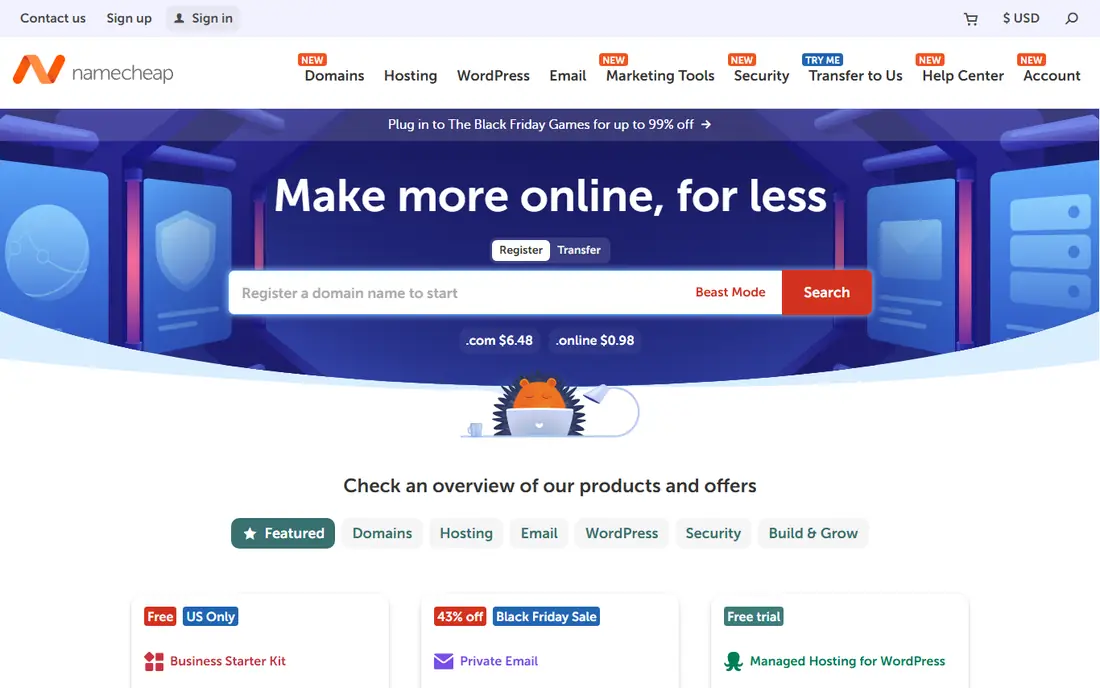
Namecheap is our pick for most buyers because it balances price, privacy and usability without a sales-heavy checkout. A .com starts near $11.28 for the first year in 2026 comparisons, WhoisGuard privacy is free for life, and the dashboard makes renewal dates and DNS settings easy to find. Email forwarding and DNS management are included, which covers the basics for a small business site.
The renewal jump is the point to note. Renewals run near $18.48 per year in the same comparisons, so the long-term cost is higher than the first-year figure suggests. That is still fair for the service, but buyers who plan to hold a domain for a decade should compare Namecheap's ten-year total with Cloudflare and Porkbun before choosing.
- Free WhoisGuard privacy for life
- Clear control panel
- Free DNS and email forwarding
- Renewal price is higher than the first-year price
- Support quality varies by channel
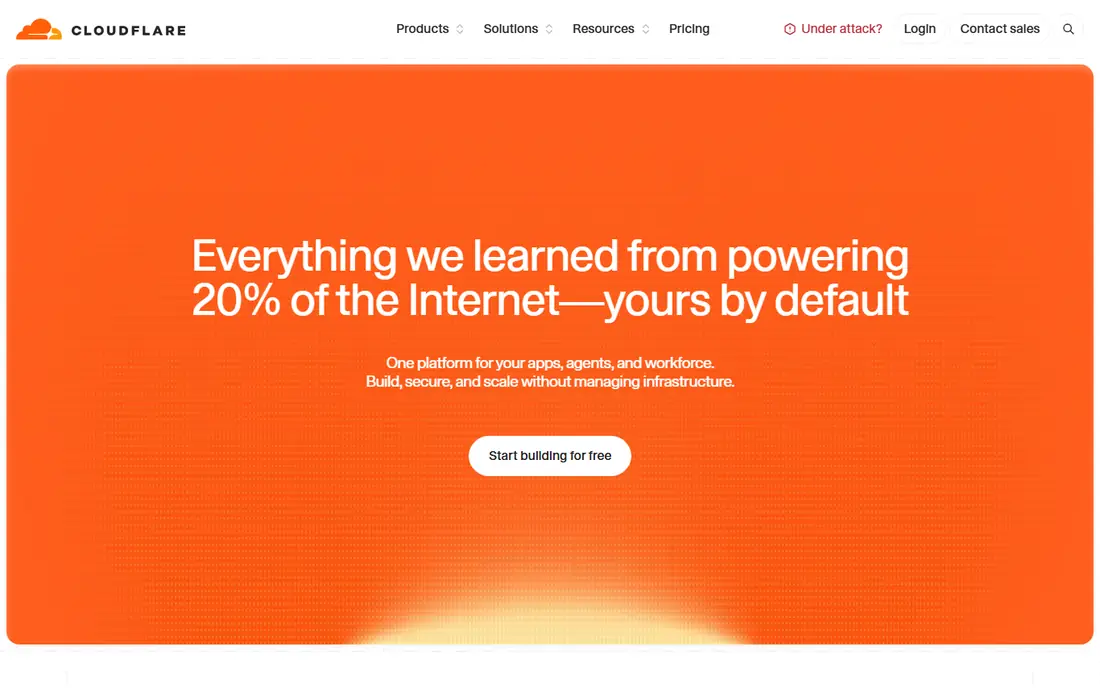
Cloudflare Registrar charges the registry wholesale cost with no markup, which makes it the cheapest long-term option in most comparisons, near $10 per year for a .com. Privacy redaction is free, and DNS management runs on the same infrastructure as its well-known DNS service, so changes apply quickly. For owners of several domains, the saving compounds every year.
The trade is ecosystem fit. Cloudflare Registrar is built for users who already use, or are happy to use, Cloudflare DNS, and it offers fewer bundled extras than a general registrar. It is the best choice for cost and security, less so for a buyer who wants a registrar to also sell hosting, email and site building in one checkout.
- At-cost registry pricing with no markup
- Free privacy redaction
- Fast DNS management
- You cannot buy a new domain without using Cloudflare for DNS in the usual flow
- Fewer hand-holding extras
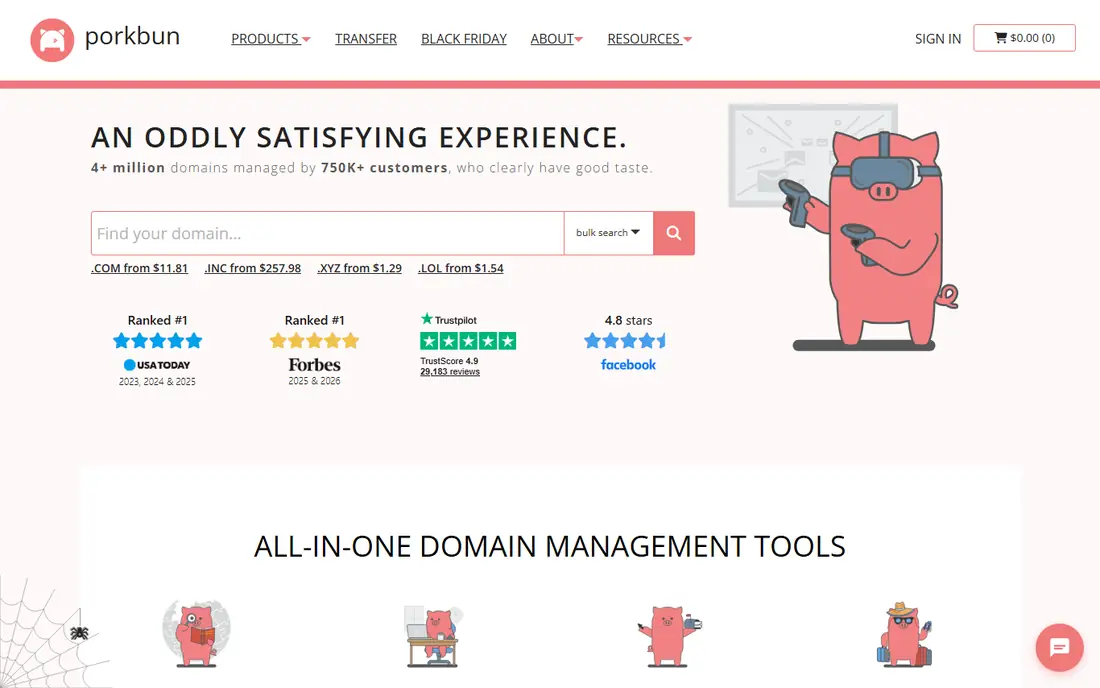
Porkbun wins on honesty of pricing. Its .com price of $11.08 covers both registration and renewal in September 2026 comparisons, with free WHOIS privacy and SSL included, so the price you see is close to the price you keep paying. Developers like its API and clean control panel, and its range of extensions is wide for a registrar of its size.
Brand familiarity is the only real drawback. Porkbun is less well known than Namecheap or GoDaddy, which can put off a first-time buyer, and its support team is smaller. For price-sensitive buyers who value flat renewals, those points are minor next to the long-term saving.
- Same $11.08 price to register and renew in 2026 comparisons
- Free WHOIS privacy and SSL
- Strong developer tools
- Smaller brand than Namecheap or GoDaddy
- Support hours are narrower than the largest rivals
Squarespace Domains took over Google Domains, and it kept the clean, no-surprise approach that made Google Domains popular. A .com costs $20 flat with fees included in 2026 comparisons, privacy is free, and management is simple for owners who mainly need a domain for a Squarespace site. There are no confusing promo tiers to decode at renewal.
The flat price is higher than the cheapest registrars, so portfolio owners will pay more over time. Squarespace Domains also fits best inside its own ecosystem. For a single business domain tied to a Squarespace site, the simplicity is worth the premium; for ten domains, Porkbun or Cloudflare will cost less.
- Flat $20 pricing with fees included
- Free privacy
- Pairs cleanly with Squarespace sites
- Higher flat price than Porkbun or Cloudflare
- Less suited to large domain portfolios
Hover is the registrar for buyers who hate checkout upsells. Its .com price of $18.99 applies to registration, renewal and transfer alike in 2026 comparisons, privacy is free on supported domains, and the checkout does not push hosting, email or security add-ons you did not ask for. That clarity suits non-technical owners who want to buy a domain and be done.
Price is the trade. Hover costs more per year than Porkbun, Dynadot or Cloudflare, and its bulk tools are lighter than those of portfolio-focused rivals. If you value a calm buying experience over the lowest price, Hover earns its premium; if you manage many domains, look elsewhere.
- Same price to register, renew and transfer in comparisons
- Free privacy on supported domains
- Clean checkout with no upsells
- Higher price than budget registrars
- Fewer advanced bulk tools
GoDaddy is the largest registrar, with the widest choice of extensions and round-the-clock phone support. For a buyer who needs an unusual extension, wants phone help at any hour, or wants hosting, email and marketing in one account, GoDaddy's scale is genuinely useful. Its brand recognition also reassures first-time buyers.
Renewal pricing is the well-known drawback. First-year promos can be very low, while standard renewals run near $21 to $23 per year in 2026 comparisons, and checkout adds products by default if you do not uncheck them. GoDaddy fits buyers who need its range or support, but check the renewal rate and strip unwanted add-ons before paying.
- Widest extension choice
- 24/7 phone support
- Huge range of add-on services
- Promotional first-year prices rise sharply at renewal
- Checkout pushes add-ons
Dynadot suits domain investors and technical buyers who want a low listed price plus bulk tools. Its .com price of $10.88 in 2026 comparisons, with free privacy, puts it among the cheapest options, and its control panel handles bulk registration, transfers and DNS well. For a portfolio, the combination of price and tools is strong.
The interface assumes more knowledge than a beginner registrar. A first-time buyer may find Dynadot's panel busier than Squarespace or Hover, and support is less geared to step-by-step guidance. For experienced owners, that is a fair trade for the price and bulk features.
- Low listed .com price of $10.88
- Free privacy
- Strong bulk management and control panel
- Interface is more technical than Namecheap or Squarespace
- Support is less hand-holding
NameSilo is built for holding many domains cheaply over time. Privacy is free forever, volume discounts lower the per-domain cost as a portfolio grows, and its management tools handle bulk renewals and DNS without fuss. Portfolio owners who value predictable costs and free privacy often keep NameSilo on their shortlist even when its headline price looks higher.
That headline price is the catch for a single domain. At $17.29 per year in 2026 comparisons, NameSilo costs more than Porkbun or Dynadot for one .com, and its design feels dated next to newer panels. For one domain, choose a cheaper registrar; for many domains, NameSilo's volume terms deserve a quote.
- Free privacy forever
- Volume discounts for large portfolios
- Straightforward management tools
- Higher headline price than Porkbun or Dynadot
- Design feels dated
IONOS wins on entry price, with a $1 first-year .com in 2026 comparisons, plus bundled email and hosting for buyers who want a package. As a large European host and registrar, it also suits buyers who want domain, email and hosting from one European provider with local support options.
The regular price after year one, near $20 per year, is the figure that matters for a long-term domain. Buyers who choose IONOS for the $1 first year should set a reminder to review the renewal, and check whether privacy and other features are included or charged separately on their plan.
- Very low $1 first-year price in comparisons
- Bundled email and hosting options
- Large European provider
- Regular price near $20 per year after year one
- Renewal terms need careful reading
How we picked these
We compared published September 2026 pricing for a standard .com, privacy inclusion, renewal behaviour, security features such as two-factor authentication, and control panel clarity. We favoured ICANN-accredited registrars with live domain sales, free or cheap privacy, and a clear renewal price. We left out registrars that only sell domains bundled with a website builder and do not allow easy transfer out.
How to choose a domain company
Start with the renewal price, then the first-year price. Add privacy cost, since a registrar that charges for privacy each year can cost more than a slightly dearer registrar with privacy included. Check transfer rules too, since you should be able to move your domain out without a fee or a long lock-in.
Next, turn on security before you point the domain at a site. Enable two-factor authentication on the registrar account, use a strong unique password, and consider registry lock for a critical business domain. A hijacked domain can redirect your site and email, so this step matters more than any design choice.
Finally, set auto-renew and keep payment details current. Domains expire on a fixed date, and a lapsed domain can be bought by someone else. A calendar reminder a month before renewal, plus auto-renew, is the cheapest insurance for a business domain.
Frequently asked questions
Which company is best for domains overall?
Namecheap is the best all-round pick for most buyers, balancing price, free privacy and usability. Cloudflare Registrar is cheapest long term, Porkbun is best for flat pricing, and Squarespace Domains is best for a simple experience. The right choice depends on how many domains you hold and how much hand-holding you want.
What is the cheapest domain registrar?
On long-term cost, Cloudflare Registrar charges registry cost with no markup, while Porkbun charges a flat $11.08 for a .com in 2026 comparisons. Dynadot is also cheap at $10.88. IONOS is cheapest in year one at $1, but its renewal price is higher, so compare the five-year total.
Is GoDaddy a good domain registrar?
GoDaddy offers the widest extension choice and 24/7 phone support, which suits some buyers. Its drawback is renewal pricing, with low first-year promos rising to a higher standard rate, plus a checkout that adds extras. If you choose GoDaddy, check the renewal rate and remove unwanted add-ons.
Should I buy a domain from my website builder?
Buying from your builder, such as Squarespace or WordPress.com, is simple and keeps billing in one place. Buying from a standalone registrar, such as Namecheap or Porkbun, usually costs less and makes it easier to move hosts later. Either works, provided you can transfer the domain out if you change platforms.
Do I need WHOIS privacy for my domain?
Yes, for most personal and small business domains. Privacy hides your name, address, phone and email from the public WHOIS record, which cuts spam and reduces the risk of targeted scams. Most registrars on this list include it free, so there is little reason to pay extra for it.
Can I transfer my domain to another registrar?
Yes, in most cases, after any initial registration lock period, usually 60 days. You release the domain lock, get an authorisation code from your current registrar, and start the transfer at the new registrar. Keep the domain lock released only during the transfer, and keep two-factor authentication on throughout.
Sources
See where you really rank - block by block
ProMapRanker scans Google Maps across a grid of your service area. Simple monthly plans from $19, white-label on every plan.
Start freeKeep reading
 who has best internet service
Who Has the Best Internet Service in 2026
Who has best internet service for US homes? We compare fiber, cable, fixed wireless and satellite providers on speed, price, availability and terms today.
Read → which survey tool has the best analytics
Which Survey Tool Has the Best Analytics in 2026
Find which survey tool has the best analytics in 2026, comparing Qualtrics, SurveyMonkey, Typeform, Alchemer, and more on reports, text, and stats today.
Read → which streaming service has the best movies
Which Streaming Service Has the Best Movies in 2026
Answering which streaming service has the best movies, with Netflix, Max, Criterion and more compared on libraries, prices and free options in this guide.
Read →